Diablo 2 Resurrected Class Tier List by Budget and Activity
Sorceress is an excellent first farmer when fast travel matters, Trapsin offers accessible damage and control, and Paladin covers several strong specialist roles. Summon Necromancer rewards a cautious budget start. Amazon shines in dense packs and against suitable bosses, while Barbarian's Find Item gives him a farming niche that raw clear speed misses. Druid remains a useful choice for elemental or summon-supported progression.
Checked October 22, 2026: Diablo II: Resurrected patch 3.3 and Ladder Season 15. The main comparison covers the seven original expansion classes in five-act play, not four-act Classic. Reign of the Warlock adds an eighth class; its separate ownership and balance context is addressed below. LoD and RotW do not have identical current item access.
There is no single class ranking that simultaneously describes an untwinked starter, a geared MF specialist and an Uber farmer. The first table ranks low-budget Ladder access. Later sections explain where gear, route and Hardcore priorities change the answer. A class can have several strong builds without one setup doing all their jobs at once.
How the tiers are assigned
The starting comparison assumes solo-capable Softcore progression, no inherited equipment and affordable early runewords. It weighs useful damage while leveling, ability to begin a productive Hell route, immunity handling, resources, survival tools and movement before expensive Teleport access. It is not a speedrun ranking, a statistical loot-per-hour study or a promise of equal performance on every player setting.
S means a particularly convenient first-character shortlist under those assumptions. A means a strong practical choice with a more visible route, travel or setup tradeoff. B means a more demanding first start whose strengths can become much more valuable later. No C tier is necessary here: none of these classes is generally unplayable. Classes within a tier are not ordered.
Expensive equipment does not improve the beginner tier retroactively. A class's fastest finished build is judged separately from the version a new player can assemble. Hardcore also changes the weighting: safe damage, control, resistances, Life and recovery become more important than shaving travel time.
First Ladder character tier list
Class | Starter tier | Practical starting direction | Main limitation |
Sorceress | S | Early spells into Blizzard or a planned dual-element setup | Fragility and single-element immunities |
Assassin | S | Early traps into Lightning Sentry, Death Sentry and Fire Blast | Trap setup and corpse access; not a free Mosaic build |
Paladin | S | Early aura/melee progression into Hammer or route-specific FoH | Respec timing, positioning and slower travel before Enigma |
Necromancer | A | Summons, curses and Corpse Explosion | First corpse, early bosses and army travel |
Amazon | A | Javelin progression into Lightning Fury / Charged Strike | Lightning immunities, sustain and limited travel speed |
Druid | A | Fire progression, then suitable Fire, Wind or summon plan | Aiming, route coverage and slower movement |
Barbarian | B | Planned melee or War Cry progression | Weapon dependence or mana pressure; slower solo boss progress |
For a player who values caution over speed, Summon Necromancer can be the preferred first character despite the A label. For someone committed to Cow Level, Javazon can be a better investment than a general S-tier starter. The tier is a starting convenience judgment, not a command to abandon a preferred playstyle.
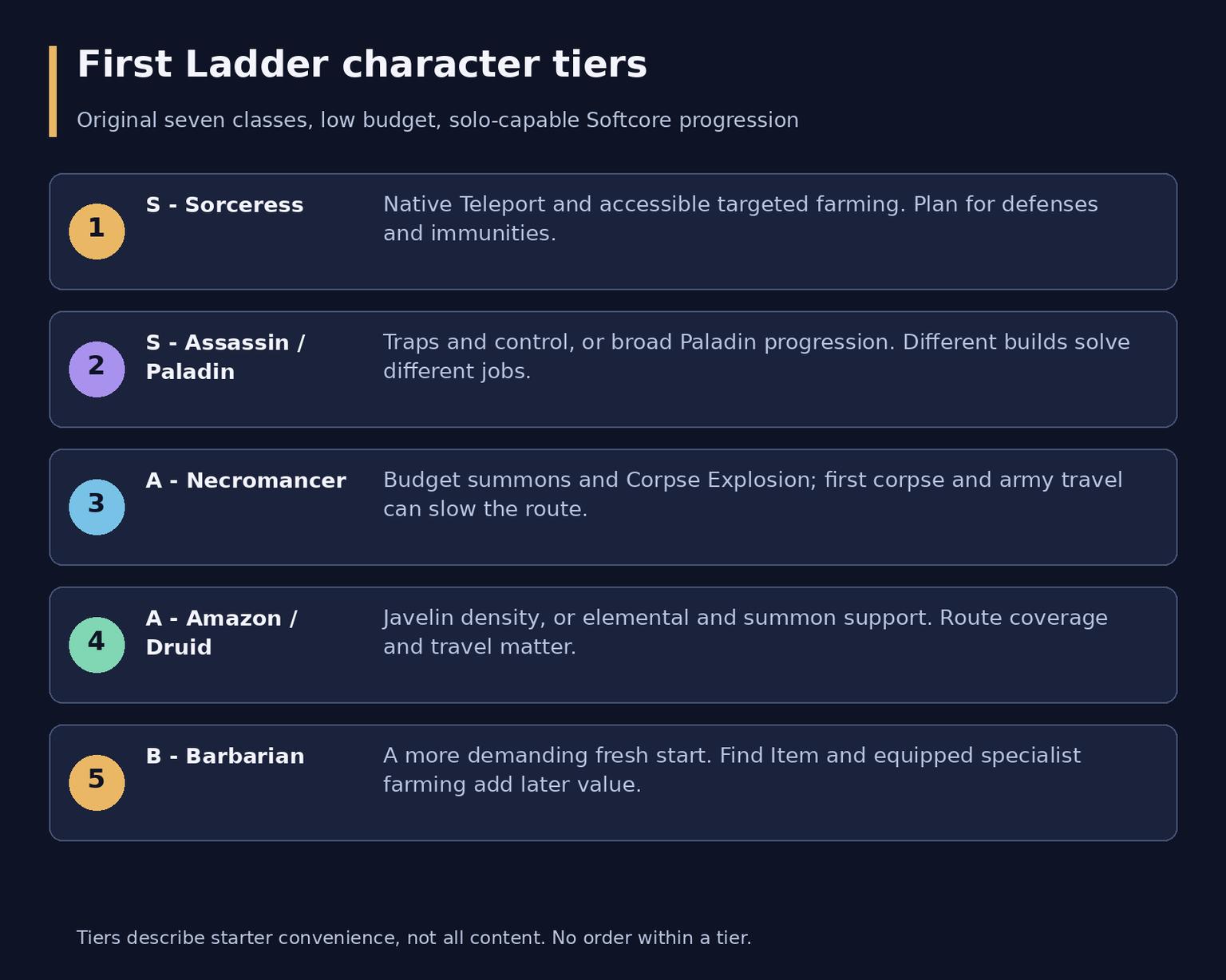
This is a low-budget first-character comparison of the original seven classes, not an absolute endgame ranking.
Sorceress for travel and targeted farming
Native Teleport is the defining early advantage: she can reach suitable targets without waiting for Enigma. Blizzard is effective for budget boss MF, while Frozen Orb paired with Fire Ball, Meteor or Hydra can provide broader progression coverage. Start with skills available at the current level and transition when the main skill and its support are ready; a finished Blizzard allocation is not a level-one plan.
Fire builds offer useful leveling and targeted farming, while Lightning and Nova can become strong high-end area farmers. Their equipment requirements are different. A self-wield Infinity Nova setup needs a coordinated mana, Energy Shield, Telekinesis and casting-speed plan; its close-range play is not automatically safer than a cheap Blizzard farmer. Infinity is not mandatory for every early Sorceress route.
The weakness is turning mobility into unsafe positioning or forcing a single element through unsuitable enemies. Sunder improves coverage but has a defensive cost, and current Cold Mastery rules are weaker against a broken immunity than early Sunder guides imply. In Hardcore, choose controlled movement, hit recovery and reliable resources before copying a high-speed showcase. Sorceress is strong for early MF and keys, not the default low-budget Uber recommendation.
Paladin offers several different specialists
Blessed Hammer with Concentration provides Magic damage and broad Hell usefulness. Affordable caster equipment, including suitable Spirit items, can establish the build. Enigma later improves travel and hammer positioning, but is not required to begin useful farming. Narrow rooms and the few Magic-immune enemies still need a plan.
Fist of the Heavens is especially attractive in Chaos Sanctuary because its Holy Bolts damage Demons and Undead. That advantage does not apply equally to animal-heavy routes. Smite is the Uber specialist, while Zeal offers a more conventional melee style with stronger weapon, attack-speed and hit-chance dependence. A Hammerdin's area-farming result and a Smiter's boss result belong to different setups.
Holy Shield, suitable shields and auras offer defensive tools, but block and resistances still need deliberate gear and attribute choices. Conviction reduces fire, cold and lightning resistance for an appropriate elemental plan; it does not amplify Blessed Hammer's Magic damage. A prepared Smiter earns the Uber recommendation through reliable hits, Crushing Blow, Life Tap, regeneration control and encounter-ready resistances. Owning Grief alone does not supply all of that.
Assassin stays strong without a Ladder Mosaic assumption
Trapsin combines ranged damage with Mind Blast and Cloak of Shadows control. Lightning Sentry, Death Sentry and Fire Blast provide several tools for progressing through immunities. Corpse-based clearing becomes better after the first kill, so pack farming and lone-boss damage should not be treated as identical strengths. Burst of Speed improves travel and trap placement, while defensive choices must suit the encounter.
A practical trap build can work before Enigma or Infinity. Extra skills, suitable attack-speed breakpoints for laying traps and adequate defenses come first. Faster Cast Rate helps actions such as Teleport but is not the universal trap-placement stat. For Hardcore, control and ranged setup are valuable only if you actively use them rather than rush blind into packs.
Mosaic Martial Arts is a different gear-defined project. Two claws supply the combined 100% chance not to consume charges with finishers, but charges must be built and maintained. Current online Ladder crafting is disabled in both LoD and RotW; non-Ladder and Offline crafting are available. Therefore a current Ladder Assassin rating must stand on a legal setup such as traps, not borrow Mosaic's performance. A dedicated Dragon Talon Uber build is another separate option, not evidence that ordinary farming gear is Uber-ready.
Amazon rewards density and suitable targets
Lightning Fury turns dense groups into an advantage, while Charged Strike supplies powerful single-target damage against suitable bosses. This makes Javazon an attractive Cow Level farmer and later a useful Chaos or Baal candidate. Budget versions can farm compatible areas before Infinity; javelin skills, Pierce, attack speed, recovery and mana sustain are meaningful early improvements.
Lightning immunities and travel are the main constraints. Sunder and Infinity can broaden coverage, but do not remove the need to restore resistances and keep the mercenary alive. Enigma adds Teleport access at high cost; it does not make Amazon's casting behavior identical to Sorceress. A route with dense monsters may suit her better than repeated long trips to scattered targets.
Physical Bowazon generally depends more on weapon quality and attack-speed planning; Faith is a high-budget direction rather than a first-character requirement. Elemental bow alternatives have their own routes and scaling. For Hardcore, use distance, control and defensive support rather than treating large damage as protection. Killing an ordinary boss quickly does not automatically qualify a general Javazon for Uber Tristram.
Barbarian has an economic farming role
Barbarian is the most demanding default solo starter in this comparison. Melee builds need a weapon that keeps up, and War Cry avoids that particular bottleneck but introduces mana and boss-damage concerns. Battle Orders and other warcries offer survival and party utility. They do not make early damage or hit chance irrelevant.
At higher investment, Berserk with Find Item specializes in elite hunting. A Pitzerker can be excellent for suitable unique-monster routes, while Whirlwind or Frenzy variants can support Travincal farming. Find Item provides another chance at loot from an eligible corpse, not a guaranteed duplicate. Destroying or shattering corpses can undermine the route. His value cannot be captured by comparing only time to the first kill.
Grief can improve an appropriate melee setup, and Enigma changes travel for a finished elite hunter. Neither makes every Barbarian the same build. Frenzy can be adapted for Ubers with dedicated preparation, but a Travincal farmer is not automatically ready. Hardcore benefits from Life, shouts and control, while melee exposure and Berserk's defensive tradeoff still require attention. A strong equipped Barbarian and an untwinked one deserve different accessibility judgments.
Necromancer is accessible without being effortless
Summon Necromancer brings skeletons, a mercenary, curses and Corpse Explosion. The army creates space, and useful skill bonuses can establish a budget character without an expensive damage weapon. The first corpse, narrow passages and early boss fights can slow progress; once a corpse chain begins, pack clearing changes substantially. Curses and mercenary survival are part of the playstyle, not optional background effects.
Enigma improves travel and lets you gather the army at the destination. It accelerates an existing build rather than making a cheap summoner invalid. Bone offers directed Magic damage and control, while Poison Nova is a more equipment-sensitive area-farming direction. Death's Web and suitable resistance reduction can significantly change a poison character's performance; its finished result should not determine the budget tier of all Necromancers.
For Hardcore, summons, ranged actions and curses make Summon Necromancer a useful cautious shortlist. The player can still be killed through poor positioning or dangerous effects, so army size does not replace resistances and Life. General boss damage is less convenient than pack clearing, and specialized summon strategies for Ubers are not the same thing as a beginner's ordinary army.
Druid has useful defensive and mixed-damage paths
Fire is convenient for early progression, with later Fire or Wind choices depending on preferred gameplay and equipment. Wind combines Physical Tornado damage with Cold Hurricane and defensive support such as Cyclone Armor, Oak Sage and a bear. It can operate with ordinary caster gear; aiming Tornado and traveling efficiently remain real limitations before luxury mobility.
D2R improved Fire and shapeshifting options and allows spirit wolves, dire wolves and a bear together. Summon Druid is therefore a real army-oriented alternative, generally trading speed for that playstyle. Fire's mixed damage components help, but fire-heavy routes still depend on enemy resistance and equipment. Flickering Flame can improve a suitable fire build without being required for Normal progression.
Fury is a weapon-dependent melee direction; Metamorphosis is a specialist shapeshifting upgrade, not a general prerequisite for the class. A dedicated Fury Uber setup exists, but ordinary Fury gear should not be assumed sufficient. For Hardcore, summon support, Life and elemental protection are useful; maintaining those tools and surviving Physical hits still matter. Druid's slower travel does not justify calling every Druid build weak or obsolete.
Match the farming class to the route
Activity | Practical shortlist | Why the answer changes |
Early Andariel or Mephisto MF | Blizzard or suitable Fire/Hydra Sorceress | Teleport and target resistances favor planned routes |
Cow Level | Javazon, traps or Corpse Explosion | Density, mana and first-corpse access matter |
Chaos Sanctuary | FoH, Hammerdin or geared Javazon | Enemy types, positioning and immunity coverage |
Baal runs | Javazon, Hammerdin or geared elemental casters | Waves and final-boss damage are different checks |
Travincal or elite hunting | Equipped Barbarian with Find Item | Corpse preservation, weapon quality and route safety |
Keys | Sorceress or a geared mobile farmer | Countess immunities and Nihlathak hazards differ |
Terror Zones | A finished build suited to the current zone | Layout, immunities and danger vary rather than staying fixed |
Uber Tristram | Prepared Smiter; dedicated melee alternatives | Survival, recovery and boss mechanics over broad AoE |
MF affects item quality, not rune drop chance. Rune farming can reward dense kills or eligible Find Item searches, so Barbarian has a different economic niche from a boss-MF Sorceress. There is no verified universal loot-per-hour winner independent of player settings, route, economy and equipment. Do not copy an offline player-setting route as an identical online result.
Terror Zones expand useful farming destinations, but a character that clears one favorable area does not automatically handle all zones at the same speed. Unlock access by defeating Baal at the relevant difficulty with the character. RotW adds its own Herald-related threats and Sunder acquisition path. The current zone and the build you own matter more than a fixed class label.
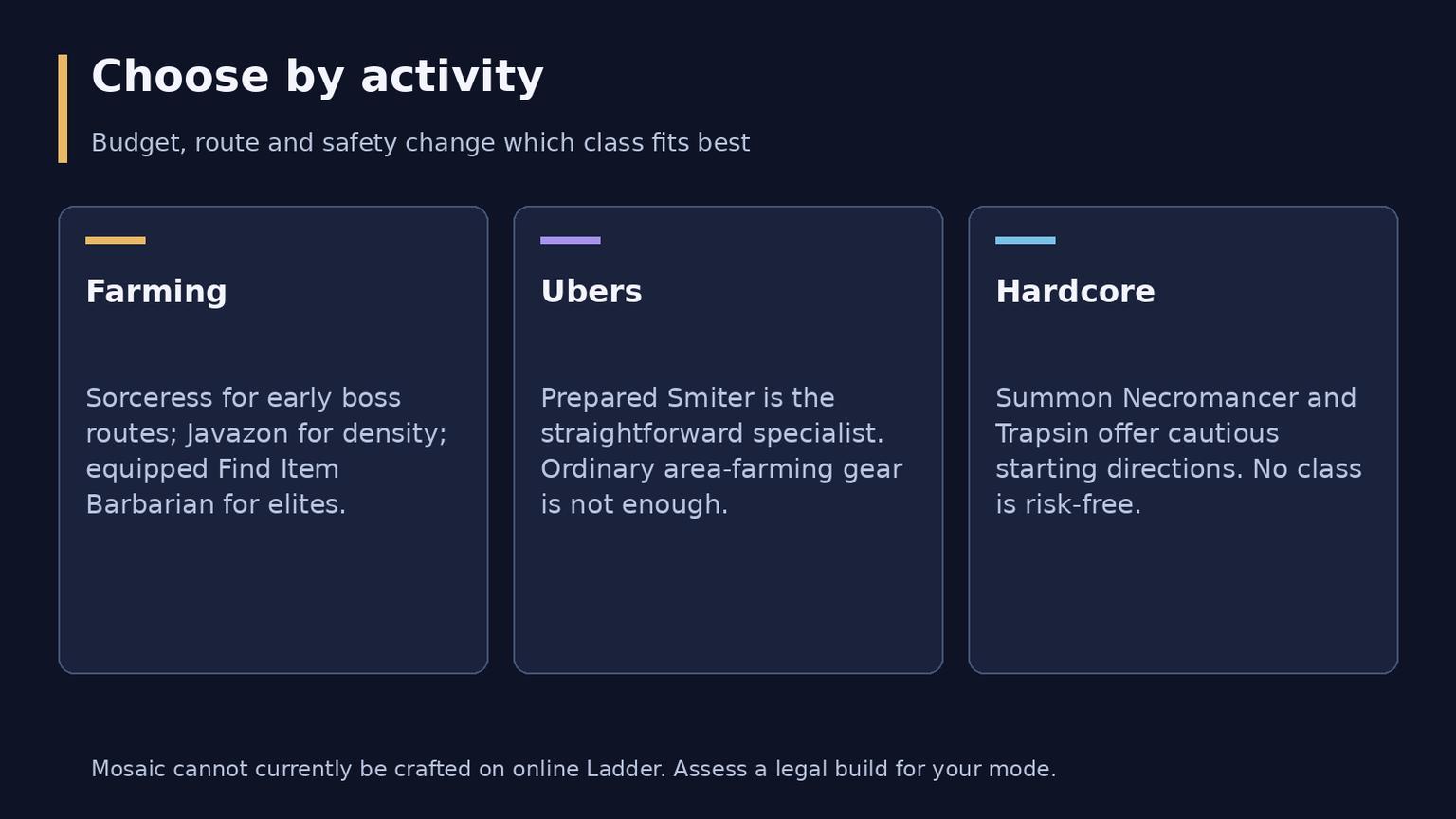
Separate area farming, specialist boss preparation and cautious progression when choosing the next character.
Sunder and resistance reduction change coverage
A matching Sunder changes a monster's corresponding immune resistance to 95%, not zero. It works from the active inventory and carries a player-side penalty. Elemental characters must compensate their resistance loss before treating it as a free upgrade. A charm that breaks immunity does not guarantee a fast kill by itself.
Conviction and Lower Resist work at one-fifth effectiveness against the immunity broken by Sunder. Cold Mastery follows that one-fifth rule too, following its patch 2.6 change; it does not itself break immunity. The earlier full-strength Cold Mastery assumption is obsolete. Eligible item-based minus-resistance modifiers are distinct, and should not all be reduced indiscriminately by the same rule.
Infinity's Conviction affects fire, cold and lightning, not poison, Magic or Physical resistance. Its separate minus-enemy-lightning-resistance modifier belongs to the wielder, so placing it on a mercenary does not directly add that modifier to the player's spells. LoD and RotW Sunder acquisition differ; the expansion adds Latent/Renewed versions. In 3.3, the minimum Latent drop level is 75 and the ordinary MF-based source is Hell-only. These are later rules than the original Terrorized-elite-only introduction.
Gear changes the ranking but not the starting budget
Spirit and Insight help establish affordable caster and mana-support plans. Enigma improves travel for classes lacking native Teleport; Infinity improves suitable elemental coverage; Grief changes appropriate melee damage; Faith supports physical bows. These are different investments, not a mandatory list for every class. Poison Nova and physical Bowazon showcase setups also need more than an inexpensive starter inventory.
D2R additions have their own access history. Flickering Flame is available in current expansion modes. Cure and the current Hustle successors, Mania for weapons and Hysteria for armor, have online non-Ladder restrictions that differ between LoD and RotW; 3.3 opens the listed newer words there with RotW. Offline is supported. Mosaic's current Ladder exclusion is separate. This affects which high-end comparison is relevant before a player spends runes.
Reign of the Warlock adds the released Warlock class and therefore an eighth option for owners. Magic, Fire, Echoing Strike and summon-oriented builds should be compared within that expansion context. Patch 3.2 changed Echoing Strike scaling and other mechanics; 3.3 fixes Bind Demon and Sigil: Death interactions. Launch-era bug damage is not evidence of a class with no weaknesses. The seven-class starter table deliberately does not pretend to rank this additional purchase against the same ownership assumptions.
Hardcore changes what counts as best
For cautious first progression, shortlist Summon Necromancer and Trapsin, then consider Paladin or a supported Wind Druid if their gameplay suits you. This is a recommendation about controllable damage and defensive tools, not a guarantee that those classes cannot die. Summons, curses, crowd control and a reliable mercenary buy space only when maintained.
Prioritize Life, resistances, recovery and safe movement. Block needs the intended shield, Holy Shield where relevant and an attribute plan; it is not a universal requirement for every caster. Energy Shield needs coordinated mana and Telekinesis investment. A risky close-range Nova or melee setup should not inherit the safety assessment of a ranged or summon-based build from the same class.
Choose your first productive route before choosing the most expensive final setup. Keep a functioning farmer while assembling an Uber specialist or a high-end alternate. Respec when the relevant main skill, supporting points and equipment are ready rather than following a universal level requirement. A familiar A-tier character can be more useful than an unfamiliar S-tier plan built around items you cannot obtain in your mode.
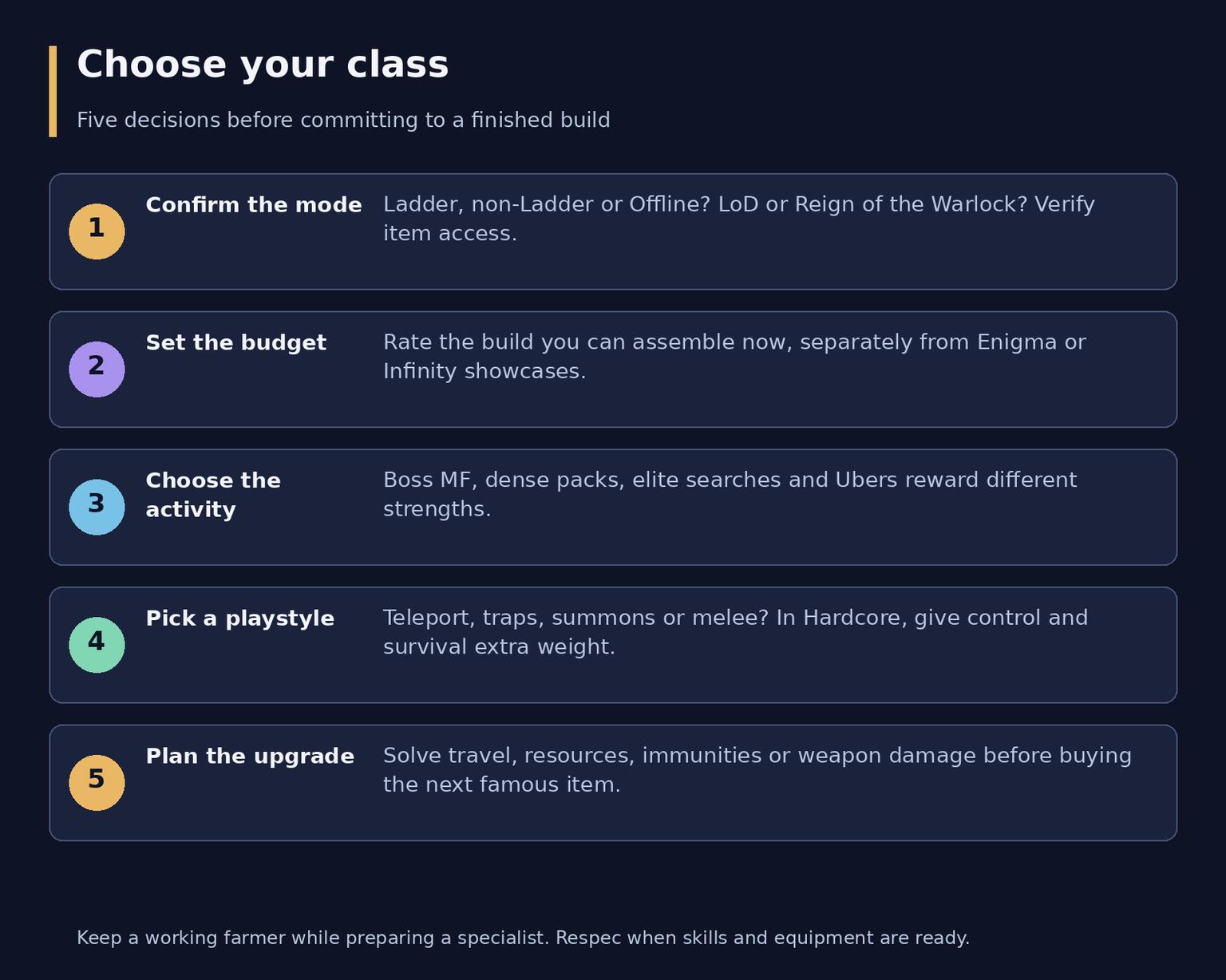
Confirm mode and budget, choose an activity, select a playstyle and plan the first useful upgrade.
Frequently asked questions
Which class is best for a first Ladder character
Sorceress is attractive for early boss farming and Teleport. Trapsin offers control and flexible damage, while Paladin offers broad progression. Summon Necromancer is a useful alternative when a cautious army-based start matters more than travel speed.
Which class is best for Magic Find
A budget Sorceress is convenient for compatible boss routes. An equipped Berserk/Find Item Barbarian excels at a different task, elite hunting. Match the farmer to the target and maintain clear speed rather than maximizing MF alone.
Which class should I choose for Ubers
A properly prepared Smiter is the straightforward specialist. Build Crushing Blow, Life Tap, regeneration control and encounter-ready defenses. Hammerdin farming strength does not automatically make the same equipment Uber-ready.
Which class is easiest for Hardcore
Summon Necromancer and Trapsin are useful cautious shortlists because they offer summons or control and damage from safer positions. Paladin and Wind Druid also offer defensive tools. Familiarity, resistances and positioning matter more than treating any class as risk-free.