Diablo 4 Apocalypse Warlock Endgame Build
Checked October 21, 2026 for Diablo IV Season 15, live patch 3.2.3. Warlock is a permanent Lord of Hatred class and requires access to that expansion and Diablo IV. Apocalypse is an official Ultimate skill; Apocalypse Warlock is a community build name. This guide selects a level-70 endgame Sigil setup, with a practical transition before its automation is complete.
The appeal is a repeating burst cycle: persistent Hellfire hits charge Annihilation, then Apocalypse spends those stacks on a large explosion. It rewards preparation and positioning. It is less forgiving when you enter an empty arena without charges, drain your Life through Scorching, or abandon the Sigil that supports your damage.
Understand the three separate counters
Annihilation changes Apocalypse from its ordinary delayed ritual into a stack-driven blast. Hellfire skill hits generate stacks up to 100; at least 20 are needed to fire. More stacks increase damage and explosion size. Do not build around shortening the base skill's listed 67-second cooldown: the ordinary ritual explicitly excludes Cooldown Reduction, and this variant instead depends on hits.
Annihilation stacks, Overpower stacks and stored Sigil kills are different systems. The first charges your blast, the second supports Ritualist scaling, and the third feeds ritual effects and Hands of the Worldbreaker. Having one counter full does not fill the others.
Double Blast makes the final hit repeat with certainty when Apocalypse is empowered by Volatility. Survivor Damage increases your damage against enemies left alive for two seconds, longer against Hexed targets. Use that window to resume pressure rather than pause to admire the first explosion. This is direct burst supported by persistent effects, not a poison or Bleeding build.
Class mechanic, resources and sustain
Complete Disciple of the Forbidden from level 15 in Ked Bardu and choose Ritualist; the Fragment selection opens at 30. Ritualist binds Vollach, also spelled Valloch in some databases. Scorching empowers Occult Hellfire skills at a Life cost and allows Volatility to stack. Commanding Vollach helps pay that cost and provides Fortify. This class mechanic is permanent, unlike Season 15's Soul Splinters.
Wrath pays for Umbral Chains and Bombardment; Dominance is the separate demonic resource, not another name for Wrath. Use Wrath Refund on Chains, regeneration, Life on Hit and Undying to keep the cycle stable. Vollach belongs on the action bar: forgetting the command can turn a damage upgrade into a self-inflicted sustain problem.
Overpower supports Ritualist's Occult damage and area. It does not make Critical Strike Chance or a working Vulnerable source irrelevant. Hex, Weaken and Vulnerable are separate debuffs. Subversion supplies Hex, Dark Prison supplies Weaken; the selected Hellfire Aura does not also grant Sigil of Smoke's Vulnerable effect.
Skills and the 83-point target
The six manual actions are Apocalypse, Umbral Chains, Bombardment, Sigil of Subversion, Dark Prison and Summon/Command Vollach. This target uses the completed five-piece Rite of the Nameless bonus. Chaos and Summons are allocated for automatic creation, not added as seventh and eighth buttons.
Skill | Purchased ranks | Selected upgrades |
Apocalypse | 15 | Double Blast, Survivor Damage, Annihilation |
Umbral Chains | 15 | Wrath Refund, Long Range Slow, Chain Whips |
Bombardment | 1 | Additional Demon, Focused Target, Endless Barrage |
Sigil of Subversion | 1 | Movement Speed, Cast Range, Sigil of Lava |
Sigil of Chaos | 15 | Volatility Casts, Volatility Duration, Hellfire Aura |
Dark Prison | 13 | Fortify, Weaken, Chain Aura |
Sigil of Summons | 1 | Summon Hellwyrm |
Nether Step | 1 | Extra Charge, Movement Speed |
That is 62 base ranks plus 21 upgrade choices, totaling 83 points including earned reward points. Item-granted ranks are additional. Vollach's class command is not another purchased 15-rank skill. Nether Step is a future mobility allocation; it is not manually usable on the listed six-slot bar. Until you acquire an item that casts it, use ordinary Evade or explicitly replace a support skill.
This is a finished respec target, not a leveling order. Obey category and level gates, keep temporary prerequisites until the tree permits their refund, and add damage ranks after the required variants work. Current skill customization uses branches; do not append an obsolete separate passive/Key Passive shopping list to this 83-point budget.
Build the burst window
Start safely, cast Dark Prison, and command Vollach before your Life begins falling. Aim Chain Whips through the useful combat area. Add Endless Barrage as you move: its repeated Hellfire impacts keep charging Apocalypse without requiring you to stand still. Refresh the effects when enemies relocate; casting them into an empty corridor produces no useful hits.
Place Subversion where the pack will fight. With Hands and five-piece Rite, Apocalypse is a Sigil skill and its cast creates the other base Sigils. Fleshwrit keeps ritual progress moving. Fire when the enemy group is inside the useful area and the blast is large enough. Around 50 stacks can be a practical farming compromise; approach 100 for a durable target when waiting remains safe. These are play recommendations, not additional unlock requirements.
Against elites, build hits while sidestepping hazards, then commit the burst before their movement carries them away. Against bosses, prioritize consistent contact and ritual uptime. Hold a charged blast briefly for a vulnerability or stagger opportunity, but do not waste an entire damage window waiting for a perfect counter. Ordinary enemies provide kills; bosses demand reliable stored-kill generation from the equipment engine.
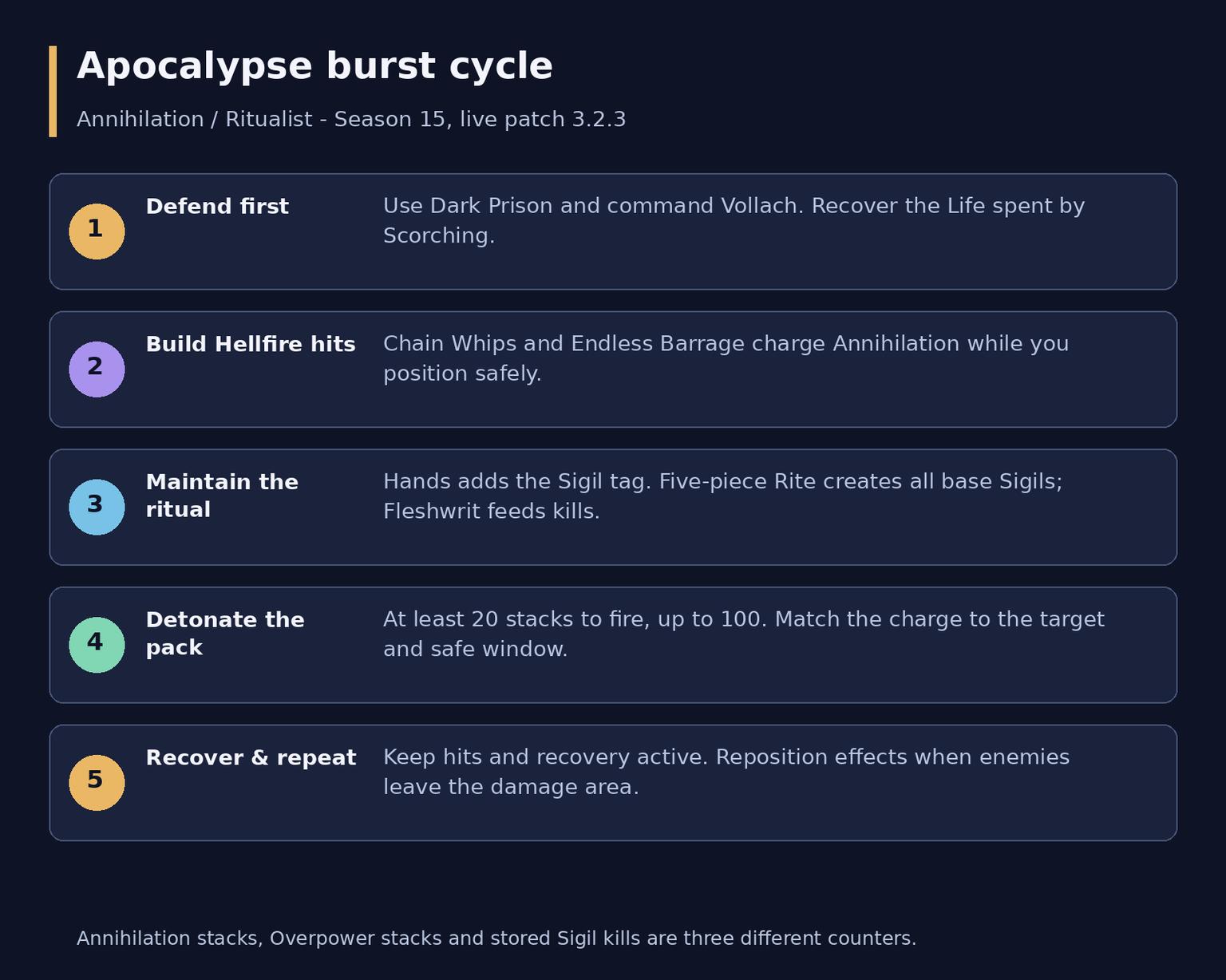
Apocalypse cycle: defend, establish hits, maintain Sigils, detonate and recover.
Equipment: assemble the engine first
Slot | Main choice | Why it matters |
Gloves | Hands of the Worldbreaker | Adds the Sigil tag to Apocalypse and a stored-kill bonus inside Chaos |
Chest | Fleshwrit Carapace | Sigil damage and automatic stored-kill progress |
Two-handed weapon | Scepter of the Three | Ultimate ranks and damage charged by non-Ultimate hits |
Amulet | Moloch's Beating Flame | Scaling from Volatility-empowered skills |
Ring | Wendigo Brand, optional | Kill-based damage and speed; replace for low-kill encounters if needed |
Other ring | Crushing Aspect | Damage while Fortified |
Helm | Aspect of Heavenly Strength | Defense tied to wielding a two-handed weapon |
Pants | Misanthropic Aspect | Conditional defense; check your surviving demon count |
Boots | Undying Aspect | Healing on skill casts to support Life spending |
Hands is essential to this Sigil-based version; a generic offensive glove does not reproduce its tag conversion. Its current damage bonus reaches 290-350%, depending on stored kills and the roll. Fleshwrit adds 70-90% Sigil damage, gives active Sigils one kill each second and preserves unused kills. Neither item guarantees an instant fully charged first blast.
Scepter is a two-handed bludgeoning weapon. Current Blizzard notes give it 15 Ultimate ranks and a non-Ultimate-hit damage charge of 1.7-2.5% per hit, capped at 170-250%, resetting after all activated Ultimates end. Some database cards still display different values; use the final patch notes and current tooltip. Without it, a strong two-hander is a transition, with fewer ranks and no identical charging effect.
Moloch rewards using different empowered skills rather than pressing only Apocalypse. A defensive Legendary amulet is a temporary fallback, with a real damage loss. Do not treat The Hemat Stone as a second equipped amulet: in this setup it occupies a charm slot, enhancing Ritualist/Vollach/Fragment effects. No Mythic Unique is required to begin assembling the engine.
Rite of the Nameless is a Talisman set. Five pieces create all base Sigils when you cast a Sigil skill. Before five pieces, replace Subversion with a manually cast Chaos so that Hands can function; you give up manual Hex application and must assess that weaker variant separately. Before Hands and Fleshwrit, continue with a functioning earlier build instead of assuming the finished damage package is active.
Stats, crafting and sockets
Fix survival and sustain before polishing damage. Prioritize Maximum Life, Armor and missing Resistances on defensive slots; Movement Speed on boots; and sufficient recovery for Scorching. On offensive slots, seek applicable Critical Strike Chance, Critical Strike Damage multiplier, Hellfire ranks, Fire damage and Willpower. Vulnerable damage needs an actual Vulnerable source, such as a selected seasonal power; never count an unselected modifier.
Prefer Greater Affixes on useful stats rather than collecting stars on irrelevant ones. On eligible non-Unique slots, choose a learned Tempering affix such as Damage per Overpower Stack, Maximum Life or Movement Speed where the current slot permits it. Inspect the actual manual and menu before spending; a table showing a temper on a converted late-game item is not permission to Temper an ordinary Unique.
At the Blacksmith, current Masterworking raises Quality to 25, followed by a random +50% Capstone affix upgrade. It is not the old twelve-rank, 4/8/12 system. Favor valuable offensive affixes on lasting gloves/jewelry and survival on defensive pieces. Avoid expensive repeated Capstone attempts on equipment you expect to replace. Tempering is not a prerequisite for Masterworking.
Use sockets to close current defensive gaps or reinforce the chosen damage package. Seasonal Soul Splinters in jewelry have costs as well as benefits: increased Wrath costs or reduced movement can make an otherwise attractive option uncomfortable. In Eternal, replace seasonal gems with ordinary legal gems instead of assuming those powers carry over.
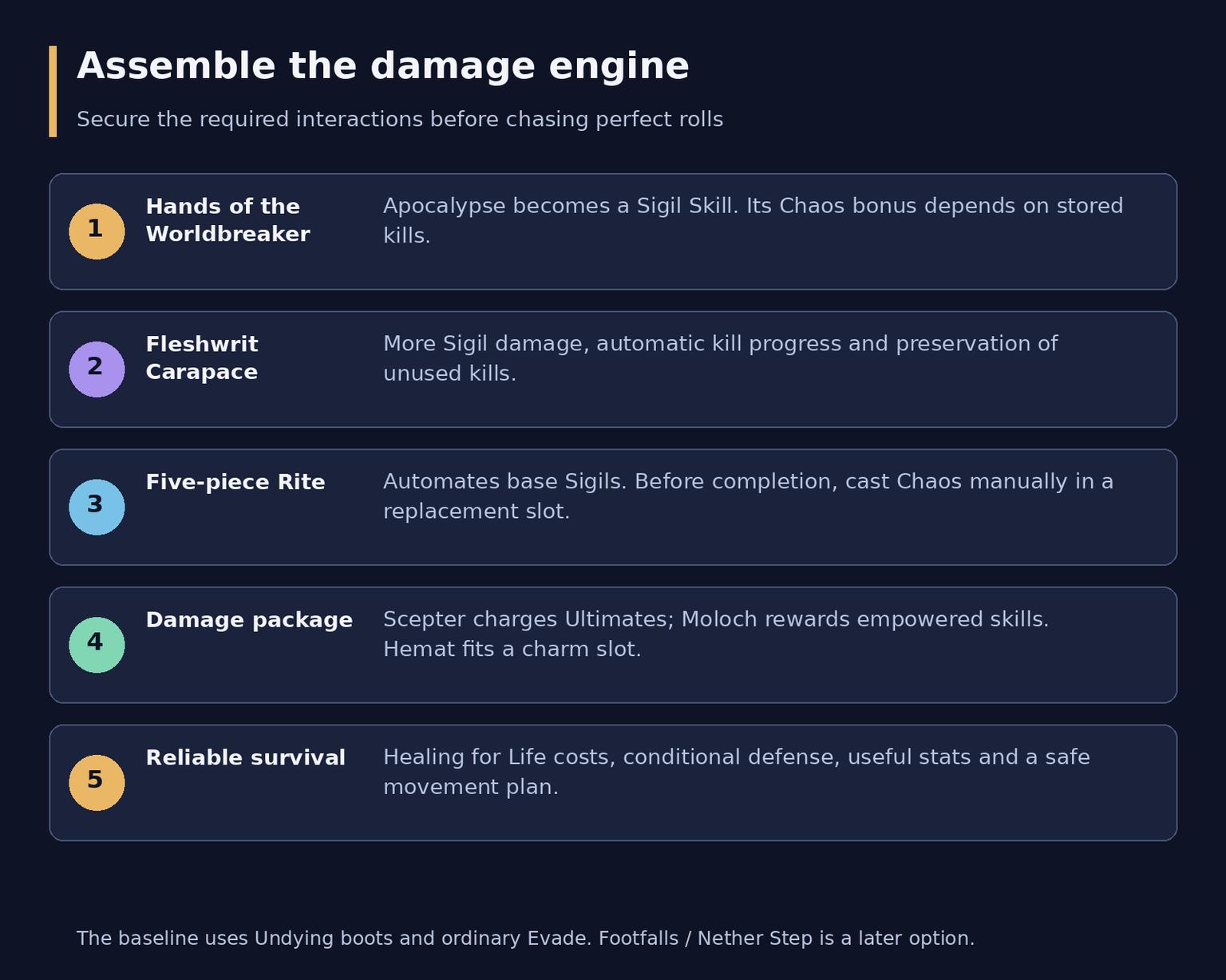
Equipment sequence: skill conversion, ritual consistency, then damage and defense.
Paragon and optional expansion systems
Use five boards including Starter, in this order: Starter with Entropy; Pyrosis with Empowered; Ritualism with Wrath; Greater Hex with Hellforge; Chaos with Occultist. Prioritize the sockets and relevant Legendary nodes before long detours for small bonuses. Ritualism rewards Sigil casts, Greater Hex supports your debuff package, and Chaos connects Occult damage with Overpower.
Activate each Glyph's attribute requirement inside its actual radius. Recheck the threshold after rotating boards or moving nodes; total character attributes do not substitute for radius requirements. Level Glyphs through The Pit, selecting tiers you finish reliably. This is the board/socket route; individual connecting nodes should fit your available points and current Glyph radius rather than imitate a fully unlocked planner prematurely.
Runewords and Mercenaries require their expansion entitlement and unlocks. Optional Zan/Mot and Cir/Que support defensive effects; Raheir with an Aldkin reinforcement is a reasonable survival package. They are not native Warlock barriers or immunity. Without those systems, retain defensive Aspects and ordinary socket bonuses and lower difficulty until the loss is covered.
Footfalls of the Waning World enables a later Evade/Nether Step route. Do not copy its mobility into the baseline Undying-boots setup. Likewise, high-end Cube transfiguration and Mythic conversions are later optimizations, not prerequisites silently folded into the equipment table.
Chain Aura reduces damage arriving from outside its area by 45%; it is not blanket reduction against everything inside. Fortify and Weaken supplement it. Misanthropic requires no more than one demon alive for longer than two seconds. The listed baseline has no guaranteed permanent Barrier, Immunity or Unstoppable; evade lethal attacks and keep a potion available.
Choose content and diagnose weak attempts
The Pit tests both pack clearing and boss sustain. Nightmare Dungeons and Infernal Hordes reward maintaining hits through dense enemies and provide crafting progress. Kurast Undercity favors bursts prepared before priority targets. Lair bosses expose setups that depend too heavily on fresh kills. Raise difficulty only when you can reproduce the complete cycle without resource collapse or repeated deaths.
In Season 15, Waking Nightmares and Prime Evil powers are seasonal layers. Their buffs can improve the setup but do not replace its permanent class engine; do not promise the same performance in Eternal. Neither a universal top-tier ranking nor a guaranteed maximum Pit tier follows from owning the listed items.
If damage stalls, check Hellfire variants and hit contact first, then the Chaos area, stored kills and Hands conversion, then Life/Wrath recovery. If survival fails, inspect conditional defense uptime before adding more damage. A long counter-building phase is often a broken engine or excessive difficulty, not evidence that another expensive item alone will solve the run.
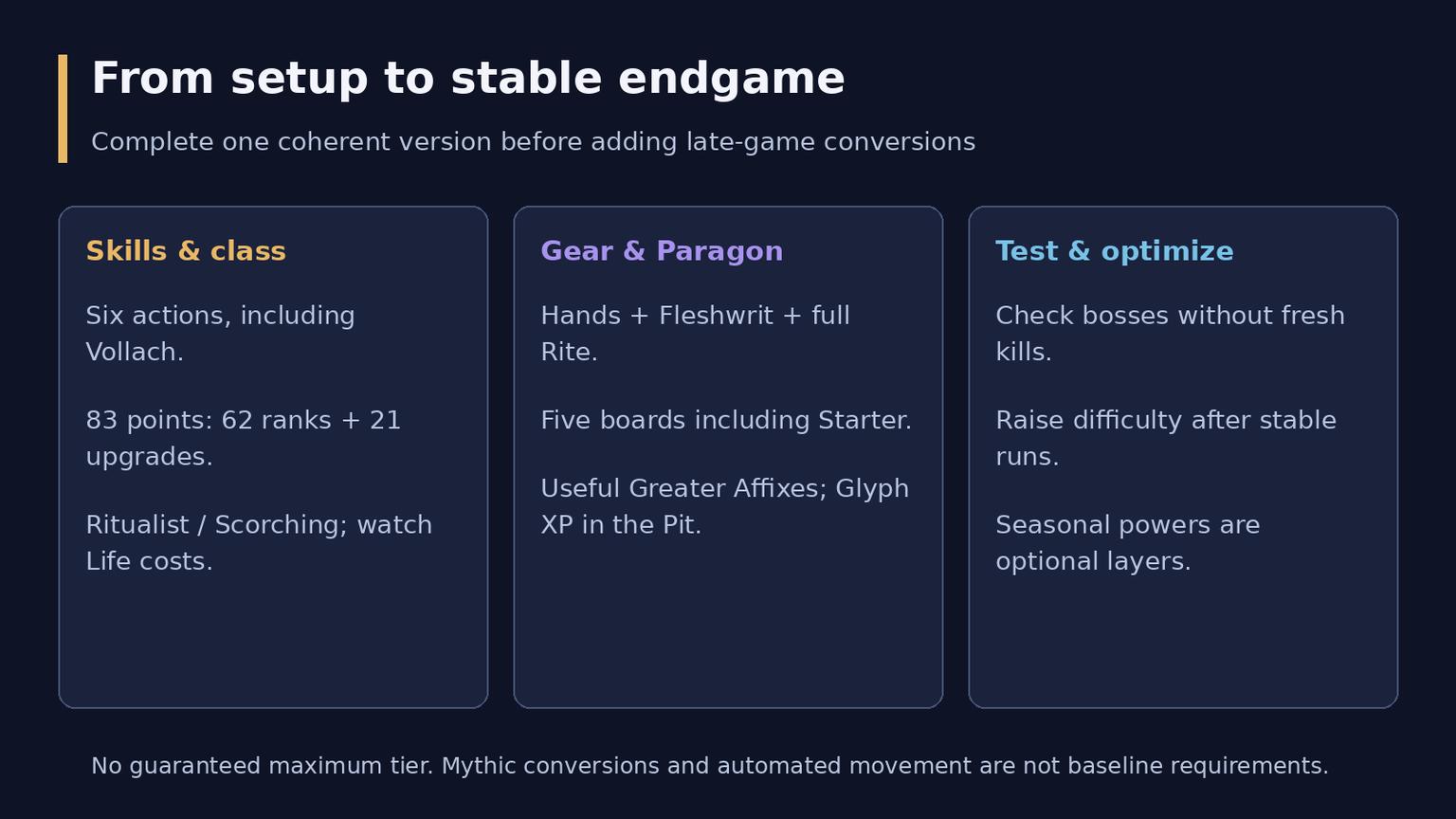
Progression priorities: legal skills, complete engine and dependable endgame repetition.
FAQ
What is Apocalypse Warlock?
A community-named endgame build around the official Apocalypse skill with Annihilation, using persistent Hellfire hits to charge repeated bursts.
Which Unique should I secure first?
Hands of the Worldbreaker enables the Sigil conversion. Fleshwrit Carapace supplies ritual consistency; without that engine, stay with a working transition build.
Does it work against bosses?
Yes, when hits, Life recovery and stored-kill generation remain reliable without fresh packs. Test that loop before increasing difficulty.
Do I need cooldown reduction or seasonal powers?
Annihilation primarily needs Hellfire hits. Support cooldowns still matter; seasonal powers are optional additions and are not assumed available in Eternal.