Best Diablo 4 Warlock Builds for Leveling and Endgame
For demanding endgame, start with Apocalypse and Blazing Scream, both highly rated in an October 21 comparison. Abyss Rampage and Infinistep Blazing Abyss remain specialist alternatives supported by a September push list. For a fresh character, Demon Summoner or a leveling version of Abyss Rampage is a more sensible starting point. Dread Claws remains a mobile option for ordinary endgame, but calling it the universal best push build would overstate the current evidence.
Checked October 22, 2026: Diablo IV Season 15, Season of Hell's Legacy, live patch 3.2.3. Warlock is a released Lord of Hatred class, available on Seasonal and Eternal Realms with the expansion. These are live build recommendations, not PTR rankings. Seasonal powers discussed below do not carry over as permanent class mechanics.
Choose by activity and equipment
Build names are community labels, usually taken from an official skill. Hell Fracture, Dread Claws and Apocalypse are skills; Minion Warlock describes a family of summon builds rather than one fixed loadout. The comparisons below are qualitative editorial guidance, not numerical benchmarks or guaranteed Pit clears.
Build | Best use | Bosses and farming | Main tradeoff |
Abyss Rampage | Broad endgame and push shortlist | Strong bossing and area damage | Manage summon placement and resources; medium complexity |
Infinistep Blazing Abyss | Fast farming and advanced endgame | Excellent mobility; strong boss shortlist | More setup dependent than a leveling build; high execution demands |
Hellfire Blazing Scream | High-tier push shortlist | Strong area coverage | Finished gear and correct variant matter; not a starter template |
Dread Claws | Mobile everyday endgame | Fast packs; positioning matters on bosses | Moderate survivability; the variant below needs specific gear |
Hell Fracture | Ranged alternative | Line up repeated casts and enemy groups | Variant-dependent resource and Unique reliance; moderate complexity |
Hellfire Apocalypse | Planned burst windows | Large area burst after setup | More preparation and less forgiving defenses |
Abaddon Summoner | Accessible summon play | Army handles packs and sustained fights | Slower setup; less immediate movement and burst control |
Abyss Rampage and the two Blazing Scream variants sit above Dread Claws in the reviewed Season 15 push list. That list was last updated September 14; it is supporting evidence, not an October leaderboard measurement. The October 21 comparison places its own Apocalypse and Blazing Scream versions at the top and the selected Dread Claws version below them. This disagreement is a reason to compare exact variants, not to merge rankings. Abaddon Summoner remains an accessible alternative. Do not treat all Hell Fracture versions as identical: an Abyss conversion and an Abodian rider setup have different equipment and gameplay.
For Nightmare Dungeons, Helltides and routine Infernal Hordes, favor a setup that clears without resource stalls. Dread Claws is useful here once its engine works. For timed Kurast Undercity runs, movement and reliable pack kills matter more than a theoretical maximum hit. For the boss ladder, compare sustained single-target output and recovery between damage windows; Abyss Rampage is a stronger starting shortlist than a blanket Dread Claws recommendation. For high Pit push, use a dedicated push variant rather than your speed setup.
In the seasonal Waking Nightmares, learn encounter mechanics before raising difficulty. Prime Evil activity modifiers change the context: Terror supports Helltide and Infernal Hordes, Destruction supports Undercity and Lair Bosses, and Hatred supports the Pit and Nightmare Dungeons. None proves that one class setup wins every activity.
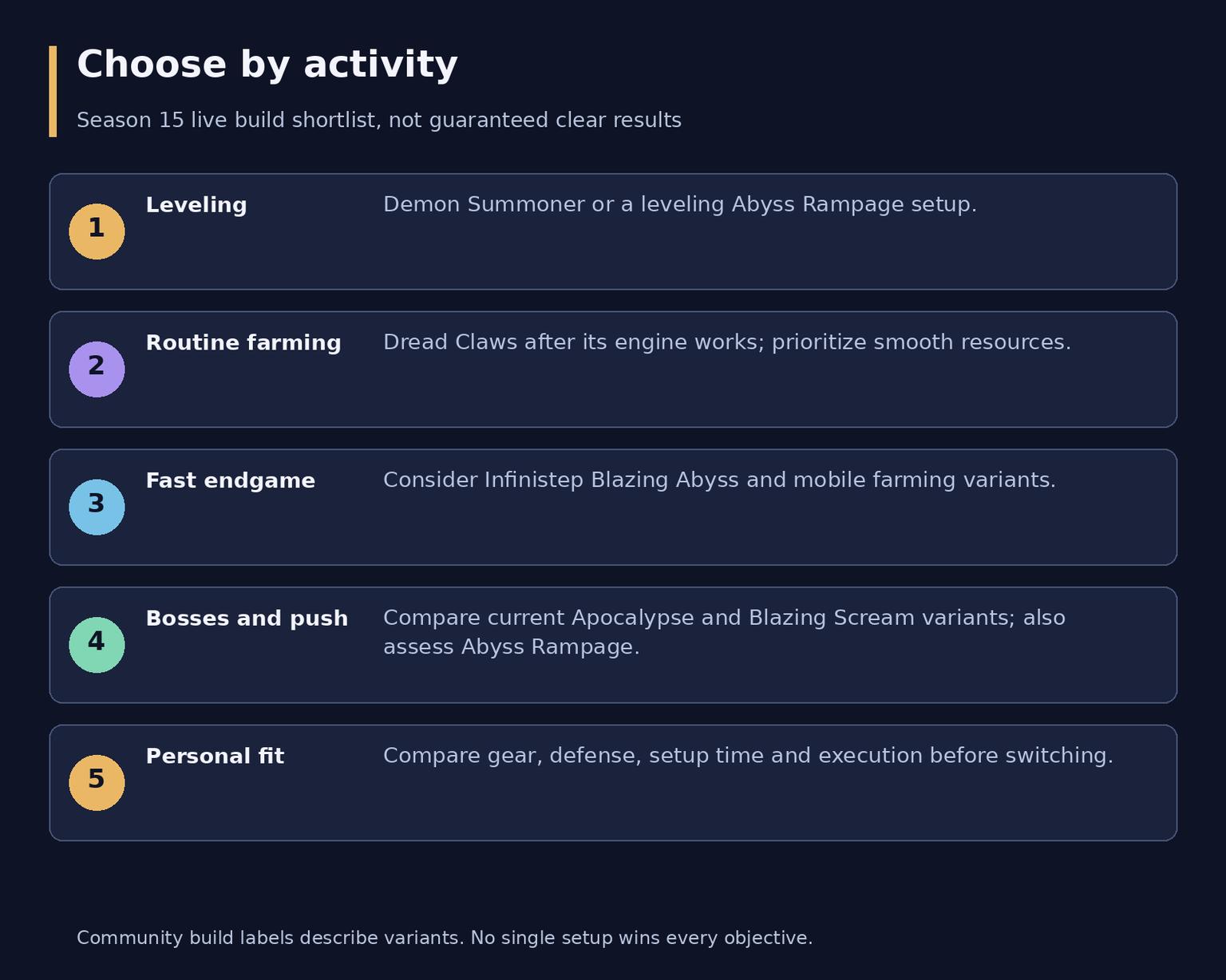
Choose a build by goal; the named options are recommendations, not guaranteed results.
Level first and switch when the engine is ready
Blazing Scream is also highly rated for leveling in the October comparison. Demon Summoner is a comfortable beginner route because it lets you learn positioning while summons contribute damage. A leveling Abyss Rampage route is another established choice. Use its early skill allocation and available Legendary powers rather than forcing an endgame tree onto a low-level character.
Start the class quest Disciple of the Forbidden from level 15 and follow the current priority-quest marker. Current walkthroughs place Soul Shard selection after that quest and Fragments at level 30. Blizzard's original reveal also mentions level 30 for the class mechanic, so distinguish the early quest from having the complete Shard-and-Fragment setup. In Russian, the confirmed quest name is Адепт запретных знаний.
Wrath fuels repeated Core casts; Basic skills can generate it. Dominance refills more slowly and pays for Archfiend skills and relevant summons. If a leveling character repeatedly runs dry, keep a generator and reduce spending before adding more offensive modifiers. Do not sacrifice a working resource loop for a higher damage tooltip.
The Dread Claws variant below is a transition plan after acquiring Litany of Sable and, ideally, Footfalls of the Waning World. It is not the easiest zero-Unique starter. Until then, remain on a functioning leveling build, use available Codex powers where unlocked, and avoid spending your rarest materials on gear you will immediately replace.
Dread Claws loadout and class mechanic
This version uses Mastermind Shard with Blasphemous Fragment. The Shard binds Laalish; its interaction with Shadowform supports Abyss damage, while the Fragment adds Hex through Recast skills. Legion serves summon-army alternatives, Vanguard supports Demonform-oriented approaches and Ritualist supports ritual-based setups. A Shard choice is part of the build, not an interchangeable bonus.
The following is one coherent midgame variant, not a mixture of different published Dread Claws bars. Summon Laalish occupies a slot through the class mechanic. Nether Step is used through Evade with the required boots.
Panel skill | Allocated base ranks | Defining choice |
Profane Sentinel | 8 | Sentry; apply Vulnerable |
Dread Claws | 15 | Enveloping Terror, Ambush, Damage |
Summon Laalish | Class mechanic | Mastermind Shard and Blasphemous Fragment |
Rampage | 8 | Abyssal Titan |
Sigil of Summons | 1 | Cooldown; support summon uptime |
Metamorphosis | 15 | Terror Demon and Damage Scaling |
Additional base allocations are Nether Step 15 and Dark Prison 1. The published completed tree spends 83 points: 63 base ranks and 20 upgrade points. Its other selected upgrade labels include Killstreak Damage, Elite Hit Chance, Single Target Damage, Wide Beam, Fortify, Weaken, Damage Reduction, Movement Speed, Summon Hellwyrm, Shadow Recall, Chain Aura and Dominance. Each selected upgrade costs one point; the completed tree contains one selected Damage upgrade. These are final allocations, not a leveling order. Missing progression points mean you cannot reproduce the full tree yet.
There is no old-style passive or Key Passive allocation to copy: the redesigned skill tree removed those nodes and moved many effects to equipment. Skill variants, the Shard, Legendary powers and Paragon now carry those interactions. Keep Terror Demon selected so Metamorphosis supports this bar rather than substituting a different transformation loadout.
Fight around your demon and preserve the loop
Before engaging, summon Laalish and establish the set-bonus window. Put Rampage's Abyssal Titan near the priority target, then use Profane Sentinel for Vulnerable. Metamorphosis supplies the Shadowform engine; Dread Claws spends stacks to attack around both you and the relevant Greater Demon. Position so those areas can overlap on an elite or boss, rather than chasing unrelated targets across the room.
Use Nether Step through Evade to reposition and recall summons. Mobility helps sustain the engine, but a lethal telegraph still takes priority over another cast. Sigil of Summons supports the demon group during a sustained fight. Refresh the Laalish-related window around its 20-second cycle instead of repeatedly interrupting damage with unnecessary setup.
Wrath regeneration, resource-return affixes and Dominion's spending interaction keep repeated casts sustainable. If Wrath empties, stop treating the rotation as a fixed button sequence: move out, restore your setup and resume after resources recover. Spending Dominance also affects the protection supplied by Seed of Horazon, so avoid emptying it without a purpose.
On bosses, keep the Titan aligned with the target and save movement for dangerous patterns. If survivability is the limiting factor, Dark Prison with Chain Aura can replace Sigil of Summons as a deliberate defensive variant. After a death or broken setup, rebuild summons, Shadowform and Vulnerable before committing to another damage window. This is safer than attempting to recover through uninterrupted spam.
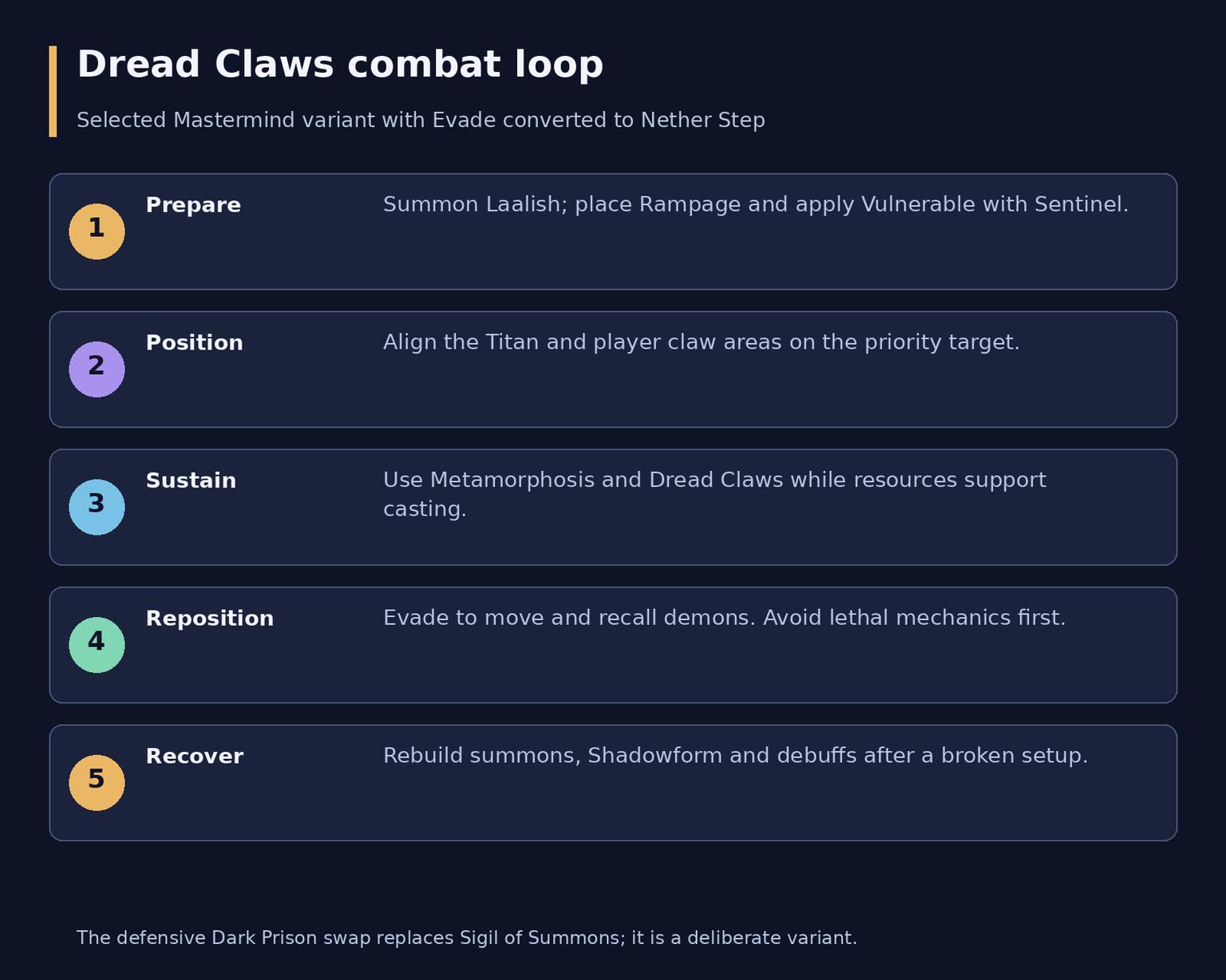
Setup, position, sustain, reposition and recover; defensive needs can interrupt the sequence.
Equipment for this particular variant
Use a one-handed Litany of Sable with an off-hand, not a two-handed weapon plus a focus. The Unique increases Dread Claws damage and produces extra claws when Shadowform stacks are gained. It is essential to this selected engine; without it, return to the leveling plan rather than claiming an ordinary weapon reproduces the same interaction.
Footfalls of the Waning World converts Evade into Nether Step and reduces its cooldown as Shadowform stacks are lost or consumed. Without the boots, put Nether Step on the bar and give up another utility slot. Seed of Horazon increases Demonology damage according to current Wrath and reduces incoming damage according to current Dominance. It is an upgrade, not permission to ignore either resource.
Leoric's Crown counts as jewelry and amplifies socketed gems. It is optional while assembling the build; a useful Legendary helm is a reasonable interim choice. This progression does not require a collection of Mythic Uniques. Prioritize a suitable Litany before optional upgrades, and do not import a six-Mythic finished variant into the midgame shopping list.
Slot | Selected item or power |
Helm | Leoric's Crown; interim Legendary with Aspect of the Fortress |
Chest | Aspect of Might |
Gloves | Aggressive Aspect |
Pants | Juggernaut's Aspect |
Boots | Footfalls of the Waning World |
Amulet | Seed of Horazon |
Ring 1 | Aspect of Fathomless Dark |
Ring 2 | Aspect of Calamity |
Main hand | Litany of Sable |
Off-hand | Duelist's Aspect |
Before Seed of Horazon, move Calamity to the amulet and use Edgemaster's Aspect on the vacated ring. Calamity supports critical chance through Hex; Fathomless Dark rewards Shadow Resistance. Might needs its Basic-skill trigger: do not assume permanent uptime from a bar containing no Basic skill. The published setup relies on a mercenary interaction, so verify the buff in actual play, especially when grouped.
Target weapon damage, reliable critical chance, relevant damage multipliers and Dread Claws or Demonology ranks where eligible. Seek Wrath regeneration and resource return when spending is unstable; pursue cooldown reduction for transformation uptime. Greater Affixes on a useful stat beat a larger count of irrelevant Greater Affixes. Maximum Life, Armor and resistances are real priorities, with Life also supporting the selected Metamorphosis scaling.
Tempering Masterworking sockets and the Talisman
Tempering and Masterworking remain separate Blacksmith services; the Cube is not a synonym for either. Use current manuals and the live affix list. Natural Motion provides Movement Speed; Worldly Stability includes resource-cost support, while Worldly Finesse offers a critical-damage option and Natural Resistance supplies defensive choices. Match the manual to the eligible slot rather than importing an old recipe name or pretending every stat can roll everywhere.
For this variant, practical temper targets include Abyss damage on gloves, Life on defensive pieces, Movement Speed on boots and resource return on rings. The boot interaction specifically favors its supported Evade behavior; do not assume a generic Evade-cooldown temper improves the converted Nether Step. The cited guides disagree on some optimization choices, so no unverified complete affix pool or fixed percentage cap is presented as universal.
Masterwork a lasting item after confirming the base and temper. Useful targets are cooldown reduction on the helm, relevant critical stats on offense, Life on defensive gear and the boots' supported cooldown affix. Resetting for a perfect outcome is a late optimization, not a prerequisite for routine farming. Upgrade for the bottleneck you actually observe: deaths, resource gaps or damage.
The selected defensive Runewords are Igni-Lac and Cir-Que, for Challenging Shout support and an Earthen Bulwark barrier respectively. These are Diablo IV Ritual/Invocation combinations. Rune access and mercenary unlocks belong to expansion systems; check the included Vessel of Hatred access and its unlock quests on your account. If those helpers are not unlocked, use ordinary gems for relevant damage, Willpower or missing resistances and play a lower difficulty while rebuilding defenses.
Hire Raheir for protection; Aldkin with Field of Languish is a coherent reinforcement option for this variant. A hired mercenary does not accompany you in an ordinary player party, so reassess any buff that depended on him. Do not select the same mercenary in both roles.
For the Talisman, use a six-slot Ancestral Horadric Seal with five Chains of Horazon Charms and Rustbitten Dirk. This supports the Laalish-based damage window and isolated-target damage. Prioritize useful skill ranks and resistance coverage. Other Dread Claws versions use Shadow of Harash; that is a different setup, not an extra set to add to these six slots.
Soul Splinters are Season 15 socket choices with penalties, not permanent class powers. Anguish's resource-cost penalty can break a marginal Wrath loop; Pain trades movement for protection, and Black Soulstone adds risk alongside damage. Do not copy a socket list that exceeds the seasonal limit of three equipped Soul Splinters. Ordinary gems are a valid starting point while testing those tradeoffs.
Paragon progression and final optimization
At the current level cap of 70, build toward the five-board limit including the starter. The chosen order and Glyph pairing are below. These are not old level-100 character boards.
Order | Board | Glyph |
1 | Starter | Abyssal |
2 | Greater Hex | Unbound |
3 | Overmind | Demonologist |
4 | Demonic Spicules | Destruction |
5 | Dominion | Mastermind |
The named Legendary nodes support the Hex, summon and resource interactions of this version. Connect useful sockets and nodes without sacrificing required defenses for distant damage. For each Glyph, count the required attribute inside its actual radius and read the live additional-bonus threshold. A stat elsewhere on the board does not automatically satisfy it. No single threshold number applies to every Glyph and board order.
Prioritize Glyph experience for Abyssal, Demonologist, Unbound, Destruction and Mastermind. Work toward the level-50 radius milestone and level-51 Legendary bonus; some specialist text incorrectly merges those two steps. The Pit is the Glyph-upgrade activity. Finish functional bonuses before spending heavily to perfect optional gear.
Then test the same activity and difficulty after each substantial change. Fix survival and resource uptime first, complete the essential items and set, improve Glyphs, and only then chase exceptional Greater Affixes and repeated Masterworking resets. For a high-push objective, compare the actual cost of changing to Abyss Rampage or a Blazing Scream variant against polishing Dread Claws indefinitely.
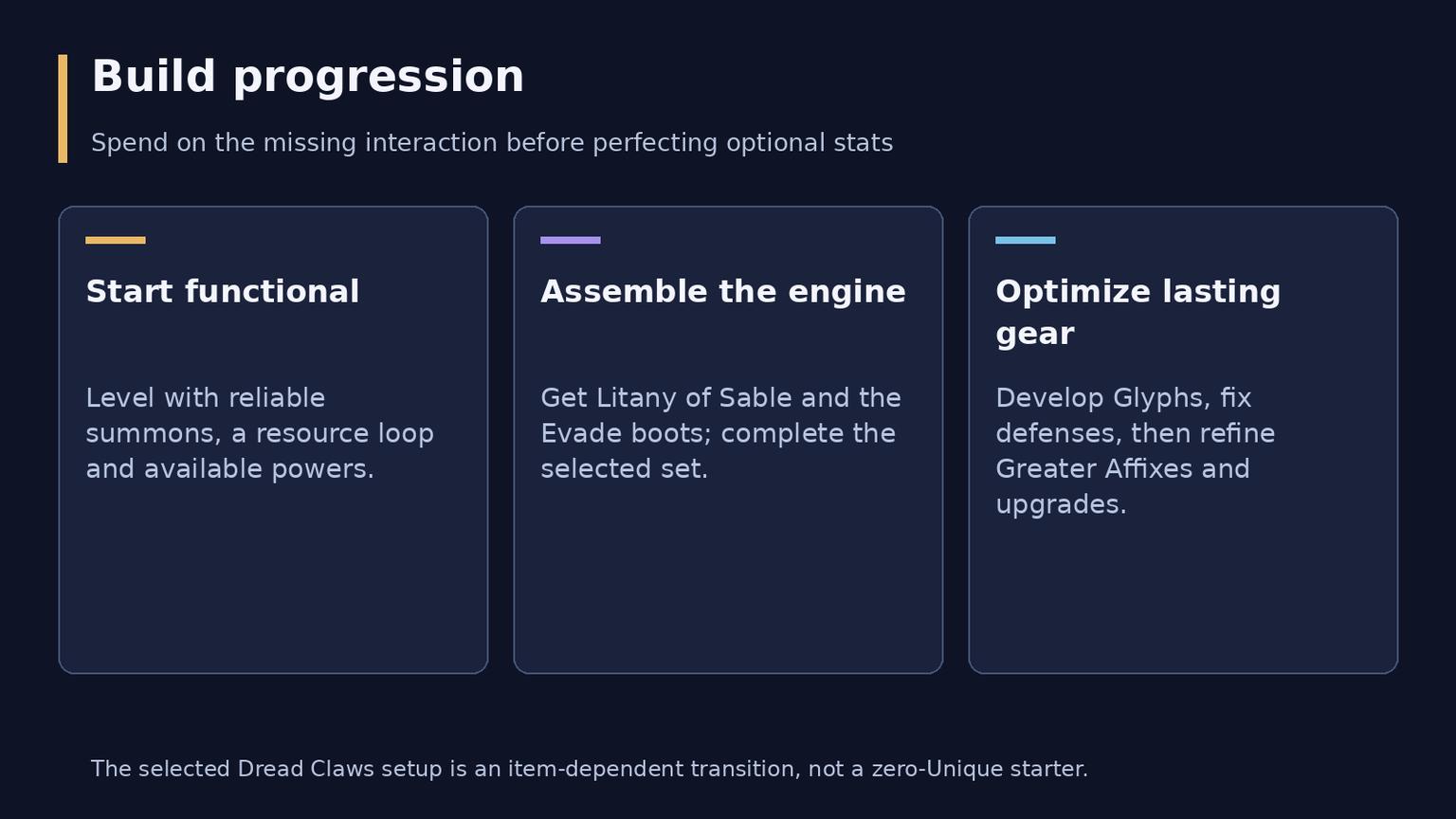
Start with a functioning leveling build, assemble the required engine, then optimize lasting equipment.
Frequently asked questions
What is the best Warlock build in Season 15
The October comparison favors its Apocalypse and Blazing Scream variants. Abyss Rampage and Infinistep Blazing Abyss are additional candidates from the earlier specialist push list. Dread Claws is a useful mobile alternative, but the available comparisons do not establish it as the universal winner.
Which Warlock build is best for leveling
Demon Summoner is a beginner-friendly option; a leveling Abyss Rampage setup is another established route. Keep a working resource loop and switch to an item-dependent endgame build only when its required pieces are available.
Does Dread Claws require a Mythic Unique
This particular version needs Litany of Sable and prioritizes improving it toward Mythic quality. Other useful pieces are upgrades, not a mandatory full Mythic set. Without the weapon, use a different starter setup.
Should I use the same setup for bosses and Pit push
Not automatically. Bosses reward sustained single-target damage and recovery, while push also demands defense and difficult pack control. Use activity-specific variants, and never treat a tier list or claimed maximum clear as a guaranteed result.