Diablo 4 Dread Claws Warlock Endgame Build
Dread Claws Warlock fights close to its targets, placing its own claw attacks and a Greater Demon's attacks over the same enemies. The practical challenge is keeping Shadowform, summons and resources working while moving safely. This guide covers an Enveloping Terror endgame setup with Nether Step on the bar, so it does not depend on Unique boots to provide its movement skill.
Checked October 21, 2026 for Diablo IV Season 15, Season of Hell's Legacy, live patch 3.2.3. Warlock is a permanent Lord of Hatred class, released in April 2026; Diablo IV and expansion access are required. The class engine also works in Eternal. Seasonal powers are optional additions, not the source of the class's Soul Shards.
What Dread Claws actually does
Dread Claws is an official Core skill, not a Unique item or a transformation. Dread Claws Warlock is the community's descriptive name for builds using it. The skill costs 30 Wrath before modifiers and deals direct Shadow damage with Abyss and Demonology interactions. Season 15 added the Greater Demon tag to the base skill and increased its base damage from 50% to 70%. Those numbers describe the base attack, not a finished character's damage or every variant's coefficient.
Choose Enveloping Terror. Claws strike around you, and spending one Shadowform stack also creates claws around your most recent Greater Demon Summon. Position that demon beside the same pack or boss you are attacking. A second circle somewhere behind you contributes little against your actual target. This is a repeated cast, not a permanent damage aura with a fixed uptime timer.
Cascading Dread and Ravenous Jaws are alternative variants. The latter's Season 15 Eviscerate increase does not turn Enveloping Terror into a bleed build. Critical strikes, applicable damage multipliers and reliable Vulnerable/Hex application matter here; Overpower and damage over time are not the engine of this setup.
Soul Shards and the resource loop
Complete Disciple of the Forbidden in Ked Bardu from level 15 for the class mechanic; Fragments follow at level 30. Select Mastermind Shard and Blasphemous Fragment. Mastermind supports Abyss damage while Shadowform is present and lets Recast skills preserve its Stealth at an additional stack cost. Blasphemous adds Hex through Recast hits and improves the damage enemies take from Abyss Demonology skills. This is why merely having a purple-looking attack is not enough: its selected variant and tags must match the interaction.
The class skill Summon Laalish, also presented as Command Laalish in guides, takes an action slot. Use it for its Greater Demon and Vulnerable utility. Rampage with Abyssal Titan supplies another Greater Demon and a controllable position for the overlapping claws. Remember that Enveloping Terror refers to the most recent eligible summon; after changing your summon order, check where the second circle actually appears.
Wrath pays for Dread Claws. Command Fallen with Fallen Rush maintains up to three Grunts for 20 seconds, generating Wrath when they hit. Keep them attacking, then refresh or redirect them when needed. Dominance supports your larger summons; it is not interchangeable with Wrath. Do not exhaust it by repeatedly replacing a demon that is already in a useful position.
Nether Step gives four Shadowform stacks in its base effect. Terror Demon Metamorphosis lasts 15 seconds, grants four stacks each second and lets Abyss skills preserve Stealth during that window without replacing your bar. Movement and casts can consume stacks through different interactions. A larger maximum is useful, but does not create stacks by itself.
Six skills and an exact point target
Use Command Fallen, Dread Claws, Nether Step, Rampage, Metamorphosis and the class's Laalish command. Dark Prison and Sigil of Subversion are not seventh and eighth manual buttons in this version. A rune-triggered Dark Prison is an optional extra, explained separately below.
The following is a complete 83-point editorial allocation for that bar. It uses five purchased active skills, three branch choices for each, and the innate class command. Take only one option in each branch and respect its character-level unlock. Base ranks exclude equipment bonuses.
Skill and base ranks | Selected branch choices | Job in the build |
Command Fallen 8/15 | Dominance; Wrath; Fallen Rush | Maintain the Grunts and sustain resources |
Dread Claws 15/15 | Damage; Ambush; Enveloping Terror | Main direct Shadow attack and overlapping circles |
Nether Step 15/15 | Damage Reduction; Movement Speed; Shadow Recall | Reposition Abyss summons, extend duration and escape |
Rampage 15/15 | Elite Hit Chance; Lesser Demon Wrath; Abyssal Titan | Greater Demon, Recast positioning and resource support |
Metamorphosis 15/15 | Maximum Life; Stagger Bar; Terror Demon | Shadowform window, extra Life and conditional Unstoppable |
Laalish command | Mastermind Shard; Blasphemous Fragment | Class slot, no purchased skill ranks in this allocation |
The arithmetic is 68 base ranks plus 15 branch choices. If reward points are still missing, leave Command Fallen at one rank first and retain the functional modifiers. Establish all five actives and the class command, finish Dread Claws, then invest in Nether Step, Metamorphosis and Rampage before filling spare Basic ranks. This is an endgame target, not a level-by-level leveling tree.
Current skill trees no longer have the old separate Passive and Key Passive network. Names such as Damage, Wrath and Ambush in this table are modifiers attached to a specific skill. They are not generic passives to buy again elsewhere.
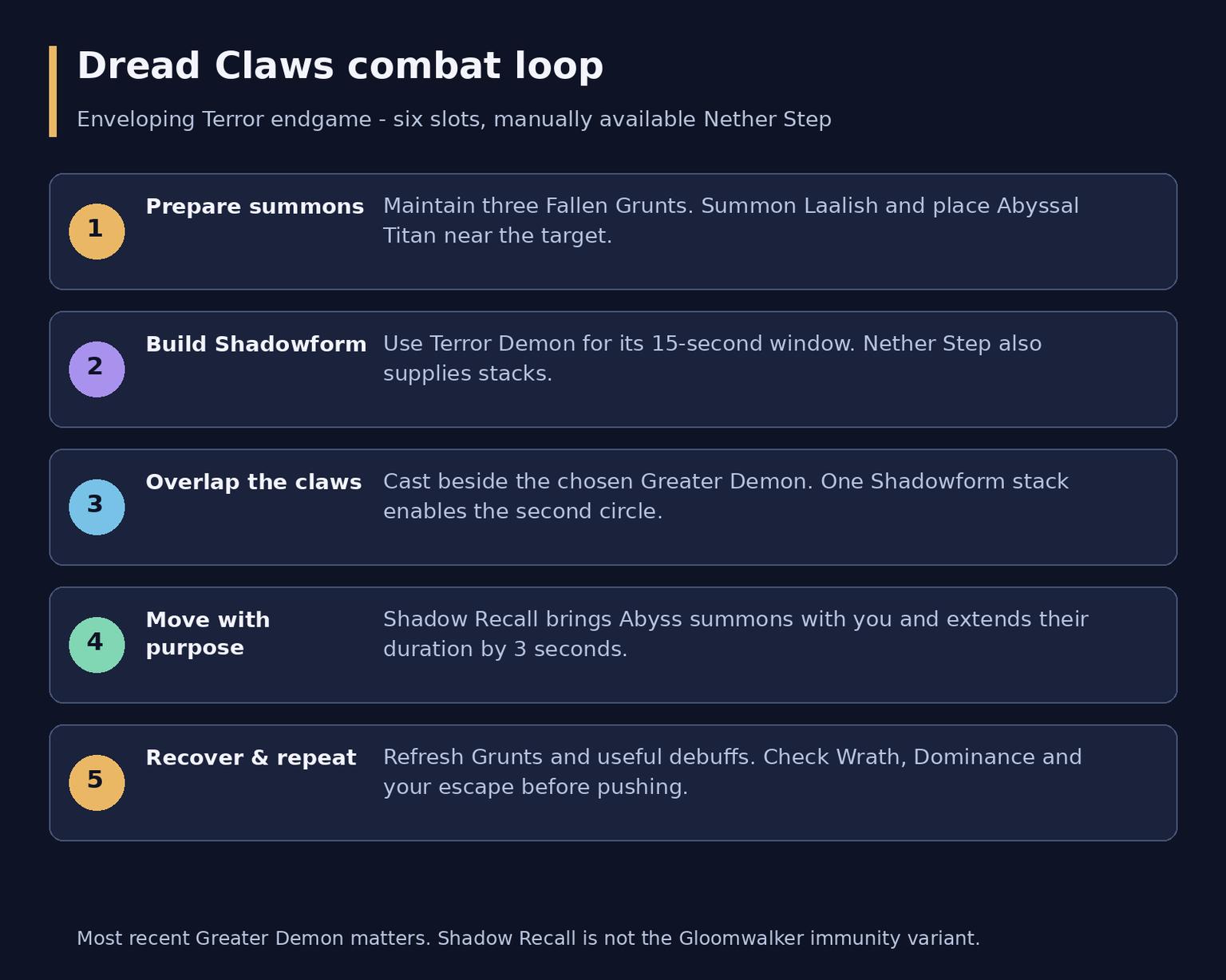
Keep the two claw areas on your target while rebuilding resources and Shadowform.
How to play packs and bosses
Before a dangerous pull, establish the three Grunts and summon Laalish. Place or command Abyssal Titan onto the enemies you want to kill. Activate Terror Demon when there is enough fighting ahead to use its window, then cast Dread Claws from a position where the two areas overlap. Ambush rewards attacks from Stealth; maintaining that state is part of the damage setup rather than a cosmetic effect.
Use Nether Step with Shadow Recall to bring your Abyss summons into the next useful position. Shadow Recall extends their durations by three seconds. Aim across a pack's edge or into a clear space, not blindly into its center. The selected Damage Reduction decays with the movement bonus, so it is a short protective window rather than permanent mitigation.
The selected Stagger Bar modifier makes Metamorphosis Unstoppable, but it is not immunity. Incapacitating effects add 10 Stagger, one point decays each second, and reaching 100 causes a five-second stun. Watch that buildup instead of treating Terror Demon as a license to ignore every control effect.
Against elites, keep Hex applied through Recast hits and use Laalish for Vulnerable. Claws do not automatically apply Vulnerable through the unselected Vulnerable branch. Abyssal Titan can knock enemies down; that control buys room against ordinary packs but does not replace boss positioning.
Against a boss, put the summon near its current position, stay close enough for overlap and save a movement opportunity for the next lethal attack. If the boss moves, reposition the demon before spending the entire Wrath pool on empty ground. Refresh the Grunts before sustain collapses. During downtime between Terror Demon windows, rebuild stacks and avoid trading your Life for an extra cast.
The usual causes of a broken rotation are an expired Grunt group, no Shadowform for the second circle, a Greater Demon out of range, or repeated teleports that leave no escape available. Check those before replacing several gear pieces. Faster attacks only help when you can afford them.
Equipment that makes the setup work
Use a one-handed weapon and Focus, with Litany of Sable as the intended dagger. Its Unique power increases Dread Claws damage and fires extra claws when you gain Shadowform. This is the first defining damage item to pursue. A suitable Legendary weapon lets you practise the manual overlap loop beforehand, but it does not reproduce Litany's triggered claws or the finished setup's output.
Footfalls of the Waning World changes Evade into Nether Step and reduces its cooldown as Shadowform stacks are lost or consumed. It is a valuable mobility upgrade, not required for the six-button version above. Until it drops, use ordinary defensive boots and your manually slotted Nether Step. If you later remove that button for another skill, review the entire bar and allocation rather than treating the freed slot as a free extra skill. Season 15 disables the boots' Nether Step Evade while channeling another skill.
Lurid Pact is an optional ring for a stronger Rampage contribution. It boosts Rampage and enlarges the brute and its smashes through kills. It is not a replacement for Litany's Dread Claws interaction. No Mythic Unique is required to learn this version; any later Mythic-quality conversion or expensive item is optimization after the engine works.
Slot | Suggested item or Aspect | Priority |
Main hand and Focus | Litany of Sable; Demonic Aspect on Focus | Weapon damage and Demonology scaling |
Chest and pants | Deeper Shadows on chest; Might on pants | Shadowform capacity, Shadow Resistance and Basic-triggered defense |
Gloves | Aspect of Calamity | Critical Strike Chance against Hexed enemies |
Amulet and one ring | Hellbent Commander; Lurid Pact or a defensive Legendary | Summon support without sacrificing sustain |
Second ring | Aspect of Peril | Scaling through Vulnerable application |
Helm and boots | Defensive Legendary helm; Footfalls optional | Life, resistances and dependable movement |
This is a suggested legal slot map, not a universal BiS list. Deeper Shadows increases maximum Shadowform stacks and now also gives 50% Shadow Resistance in Season 15. Calamity rewards Hex; it does not supply the Hex itself. Might requires Basic attacks, so keep using Command Fallen rather than assuming its defense is always on. Salvage useful Aspect rolls into the Codex, then imprint suitable Legendary pieces.
For affixes, start with weapon damage, Dread Claws or applicable Abyss/Demonology ranks, Willpower and enough resource sustain. Add attack speed, Critical Strike Chance/Damage and damage against Vulnerable enemies once their conditions are reliable. Jewelry can carry resource support; a higher damage roll that repeatedly empties Wrath can make a run slower. Life on Hit helps sustained close combat, but cannot rescue a character killed by one attack.
Build Life, Armor and resistances for your chosen difficulty before chasing perfect offensive Greater Affixes. Prefer a Greater Affix on a property the build actually uses, such as weapon damage or an important offensive/resource stat. Fill weapon sockets with Amethysts for damage, use Sapphires in armor for Willpower when defenses allow, and choose jewelry gems to repair resistance gaps. Use the best tier you can reasonably craft; optional rune pairs replace some ordinary gem sockets.
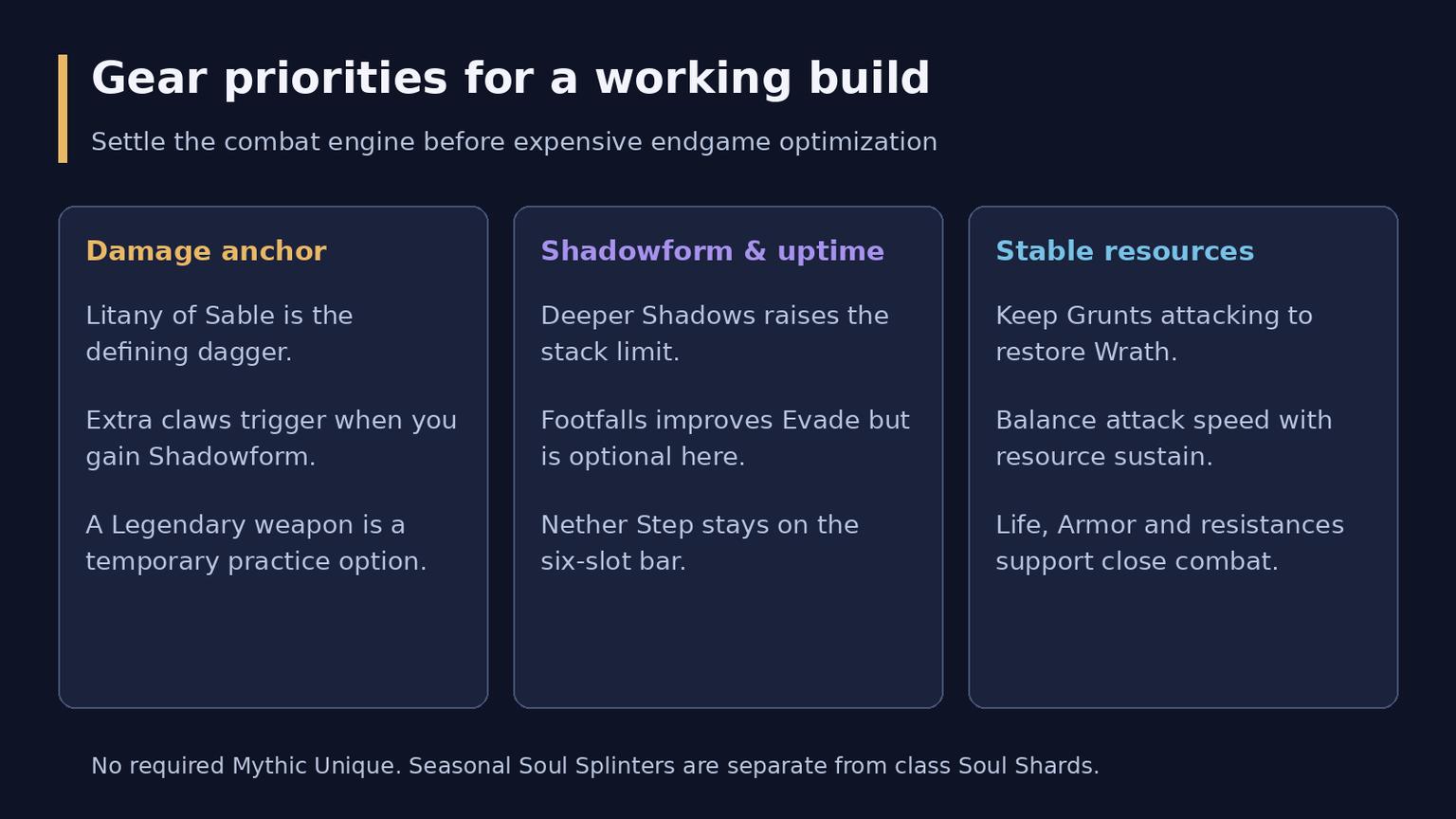
Get the defining dagger, stabilize Shadowform and sustain, then optimize the remaining slots.
Tempering and Masterworking priorities
On non-Unique pieces, current Tempering selects one affix from a learned manual at the Blacksmith. Useful examples are Worldly Finesse for Critical Strike Damage on gloves, Worldly Stability for Resource Cost Reduction on jewelry or Attack Speed on a compatible weapon/Focus, Natural Motion for boot Movement Speed, and Natural Resistance for a missing resistance. Choose a property supported by that slot's current menu. Unique items cannot receive that added Temper affix.
Masterworking improves Ancestral gear through Quality, up to 25, followed by a random +50% Capstone affix bonus. It is not the former twelve-rank system with repeated milestones at 4/8/12. Tempering is not a prerequisite in the current system. Prioritize the lasting dagger's weapon damage, then the affixes limiting your actual damage or survival. A resource problem can justify resource improvement before more critical damage.
Obducite comes from activities including Nightmare Dungeons, Infernal Hordes and Kurast Undercity. Farm a difficulty you clear consistently rather than paying for repeated failed attempts. Do not spend heavily perfecting an item you are about to replace, and do not expect Masterworking to strengthen a Unique power's printed effect as though it were an ordinary affix.
Paragon after level 70
Plan around five boards including Starter. A practical route is Starter with Abyssal, Greater Hex with Unbound, Overmind with Demonologist, Demonic Spicules with Destruction, then Dominion with Mastermind. These are Warlock Glyph choices; similarly named Glyphs for other classes are not interchangeable. At lower budgets, connect useful Legendary nodes and active Glyph sockets before buying long branches for small bonuses.
Greater Hex rewards applying Hex or Vulnerable and reduces affected enemies' damage to you. Overmind supports Abyss damage against controlled enemies and elites. Demonic Spicules builds damage through repeated Demonology hits. Dominion rewards spending Dominance to summon, improving damage and reducing Demonology Wrath costs; keep that trigger in the loop rather than assuming a permanent discount.
Allocate attributes inside the actual Glyph radius: Unbound requires 25 Intelligence, Demonologist and Mastermind require 40 Willpower each for their additional bonuses. Character-sheet totals outside the socket's radius do not satisfy those conditions. Upgrade Glyphs through The Pit, aim for their useful radius and Legendary upgrades, and then raise the ones you actually use. Do not copy an older board path whose radius or attribute requirements no longer match your Glyph.
Optional expansion and seasonal additions
Lord of Hatred is required for Warlock and its Talisman progression. Shadow of Harash is a relevant Talisman direction; work toward its set bonuses and useful Demonology ranks while maintaining the manual combat loop. You do not need a complete expensive mixed set before attempting early endgame.
Runewords and Mercenaries are expansion systems originally introduced with Vessel of Hatred; check your account entitlement and unlock their quests before using them. The core bar above does not require either. An optional Neo + Prid pair can automate Dark Prison, while Nagu + Que can add Earthen Bulwark's barrier. Without those runes, use ordinary gems and keep your own defensive timing; the native bar has no automatic barrier from Que.
For solo support, Raheir is a sensible defensive hire, with Varyana's Bloodlust as an optional reinforcement for attack speed. Unlock these companions first; they are not part of the Warlock skill-point total. In a group, do not base survival on the assumption that a hired solo companion is always present.
Season 15 Soul Splinters and Prime Evil powers are temporary seasonal additions. They are separate from permanent Mastermind/Blasphemous choices. Establish the class engine before choosing a seasonal effect with a drawback, especially one increasing resource costs or damage taken. Eternal characters should follow the same mechanical core without assuming access to those seasonal powers.
Choosing content and increasing difficulty
The build's overlapping area attacks suit dense Nightmare Dungeons, Infernal Hordes and Helltides. For Kurast Undercity, movement helps only if kills remain quick enough for the activity's objectives. Lair bosses test summon positioning and sustained single-target resources; they expose weaknesses that easy packs can hide.
In The Pit, judge progress by repeatable clears, boss time and deaths. This is a mobile endgame farming setup with boss capability, not a promise of a particular maximum tier. Seasonal Waking Nightmares are another option when unlocked on a Seasonal character. Increase difficulty only when the rotation still works through an elite pack and a boss without exhausting movement, potions and resources.
Before every substantial jump, test the same problems: do both claw areas hit, do Grunts survive and attack, does Shadowform stay available, and can you survive between defensive windows? Fix the first failed condition. A functioning lower-difficulty run is more useful than an impressive damage tooltip attached to an unstable character.
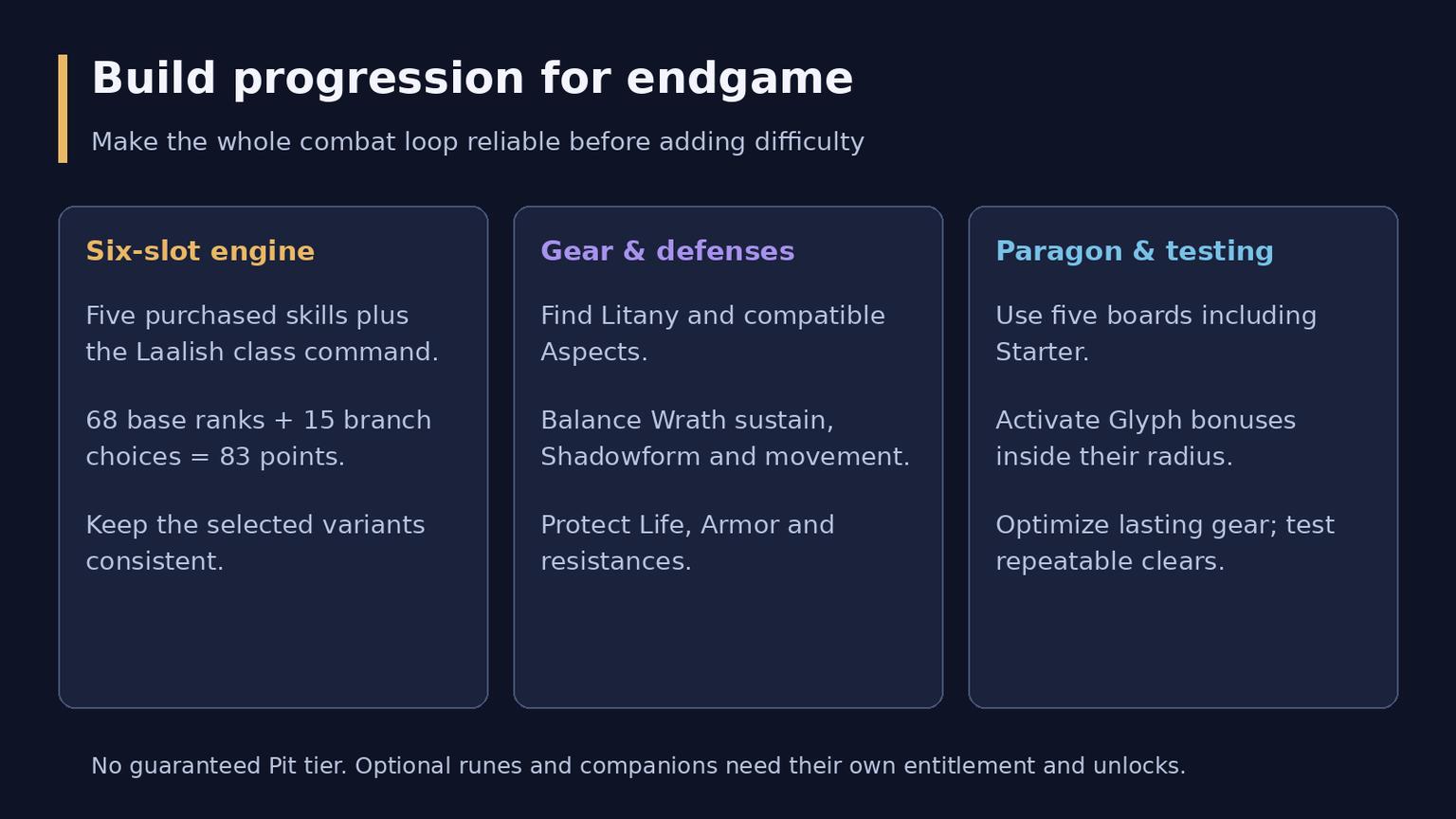
Raise difficulty after the whole combat loop is reliable, not merely after one strong hit.
FAQ
Is Dread Claws an official build name?
Dread Claws is an official Warlock skill. The build name describes a player-created setup. This guide uses Enveloping Terror with Mastermind and a six-slot endgame bar, rather than mixing every Dread Claws variant.
Do I need Litany of Sable and Footfalls?
Litany is the defining damage item for the intended setup; a Legendary weapon is a temporary practice option. Footfalls is optional here because Nether Step already has a manual action slot. Removing that slot later requires a revised setup.
Can this build fight bosses?
Yes, provided your Greater Demon and player claw areas overlap and resources last through the fight. Keep Vulnerable and Hex active, refresh Grunts and move the summon when the boss changes position. No specific Pit tier or kill time is guaranteed.
Which expansion and seasonal systems are required?
Warlock requires Diablo IV and Lord of Hatred. Optional runes and Mercenaries need their own entitlement and unlocks. Season 15 powers are not mandatory, and the permanent class engine can be used in Eternal without them.