Diablo 4 Hell Fracture Warlock Leveling Build
Hell Fracture gives a leveling Warlock a repeatable area attack, with Molten Bomb keeping the resource loop moving. This guide follows the Fire-based Eruption variant: create fractures, enter them to release Brimstones, then reposition while explosions finish the pack. It works without a particular Unique or a completed endgame equipment set.
Checked October 21, 2026 for Diablo IV Season 15, Season of Hell's Legacy, and live patch 3.2.3. Warlock is a permanent Lord of Hatred expansion class, playable since April 2026, not a seasonal transformation. You need Diablo IV and access to Lord of Hatred. The class and its normal skills work in Seasonal and Eternal realms; Season 15 Soul Splinters are a separate temporary system.
Which Hell Fracture build is this?
Hell Fracture is an official Core skill with Occult and Hellfire tags. The build name describes a player-created setup around that skill; it is not a separate specialization selected at character creation. Here the goal is levels 1-70, campaign or campaign-skip progression, followed by a sensible first endgame setup.
The unmodified skill costs 35 Wrath and deals Fire damage. Its fractures remain for 15 seconds and can explode up to twice more when you cast Hell Fracture again. That is the early version to use before the chosen variant unlocks.
Eruption changes that behavior: a cast creates three smaller fractures in front of you, and entering a fracture releases five Brimstones. It no longer uses the base skill's explode-again-on-cast loop. Three is the number created by this variant's cast, not a claimed global limit on every fracture you can have active. Do not apply the base repeated-explosion instructions or invent a permanent-field strategy for Eruption.
Ruptured Abyss is another variant with different tags and interactions. Its Shadow/Abyss, Hex and Overpower setup is not the Fire leveling tree below. You do not automatically switch to Metamorphosis or an Abyss build at level 40.
The six-slot bar and resources
Use Molten Bomb, Hell Fracture, Nether Step, Profane Sentinel, Apocalypse and Command Abodian once their respective unlocks are available. The Soul Shard demon uses one of the same six action slots. Before acquiring it, an empty slot or a temporary utility skill is acceptable; refund temporary investments when assembling this bar.
Wrath fuels Hell Fracture. Molten Bomb generates 10 Wrath before its upgrade and also deals Fire damage. With Brimstone Mortar it creates a Brimstone at the impact point, so rebuilding resource still contributes to the fight. Do not spend the whole pool on enemies that are already about to die.
Dominance is the other resource, used for demon abilities. Profane Sentinel costs 10 Dominance in its base form and supplies a beam that makes enemies Vulnerable. It is support and additional damage, not a reason to replace Fire scaling with a full summon-only gear plan. Avoid recasting expensive support when an existing summon is already doing the job.
Nether Step is your movement and escape tool. Its selected Gloomwalker variant provides up to three seconds of Immunity; this is a short window, not permanent invulnerability. Keep a charge for a dangerous elite affix or a boss attack rather than spending every charge simply to reach the next pack.
Skill order without a false level-by-level promise
Begin with one rank in Molten Bomb. While Core skills remain locked, put required temporary points into the available Basic skill, then refund excess ranks once Hell Fracture is accessible. Add one rank in Hell Fracture, Nether Step, Profane Sentinel and Apocalypse as each category opens. Take useful branch choices when the character-level gate allows them; a point budget does not bypass that gate.
Prioritize Hell Fracture's ranks while establishing resource recovery and movement. Before Eruption unlocks, play the base repeated-cast version. Once available, select Eruption and change your movement pattern to enter fractures safely. Do not choose Ruptured Abyss alongside it: variants in the same branch are alternatives.
The table is an allocation order by available points, not a claim that every character owns every modifier at a particular level. Seasonal reward points, campaign progress and temporary prerequisites can shift when you complete a stage.
Point budget | Target allocation | Practical purpose |
First points | Molten Bomb 1, then Hell Fracture 1 when unlocked | Generator plus the main spender |
Early progression | Add Nether Step, Profane Sentinel and Apocalypse at rank 1 | Movement, Vulnerable support and a finisher |
34 points | Hell Fracture 15; the other four skills 1 each; three branch choices on each skill | Functional core once branch gates are open |
48, then 62 points | Raise Profane Sentinel to 15, then Nether Step to 15 | Improve support, then movement availability |
76, then 83 points | Raise Apocalypse to 15, then Molten Bomb to 8 | Finish the leveling allocation as points arrive |
At the full target, base ranks total 68 and the fifteen branch choices cost another 15, for 83 points. Command Abodian comes from the class mechanic rather than this allocation. Missing reward points do not break the build: leave the final Molten Bomb ranks for later.
Final skill choices
Skill and base ranks | First two branch choices | Variant |
Molten Bomb 8/15 | Area Bonus; Wrath | Brimstone Mortar |
Hell Fracture 15/15 | Additional Fracture; Volatility | Eruption |
Nether Step 15/15 | Extra Charge; Movement Speed | Gloomwalker |
Profane Sentinel 15/15 | Single Target Damage; Wide Beam | Focused Glare |
Apocalypse 15/15 | Double Blast; Survivor Damage | Annihilation |
There is no extra old-style passive tree or Key Passive to add to these totals. The redesigned skill system concentrates points into actives and their branches; former passive functions may instead appear on items and Aspects. Gear-granted skill ranks are extra and are not counted as spent points here.
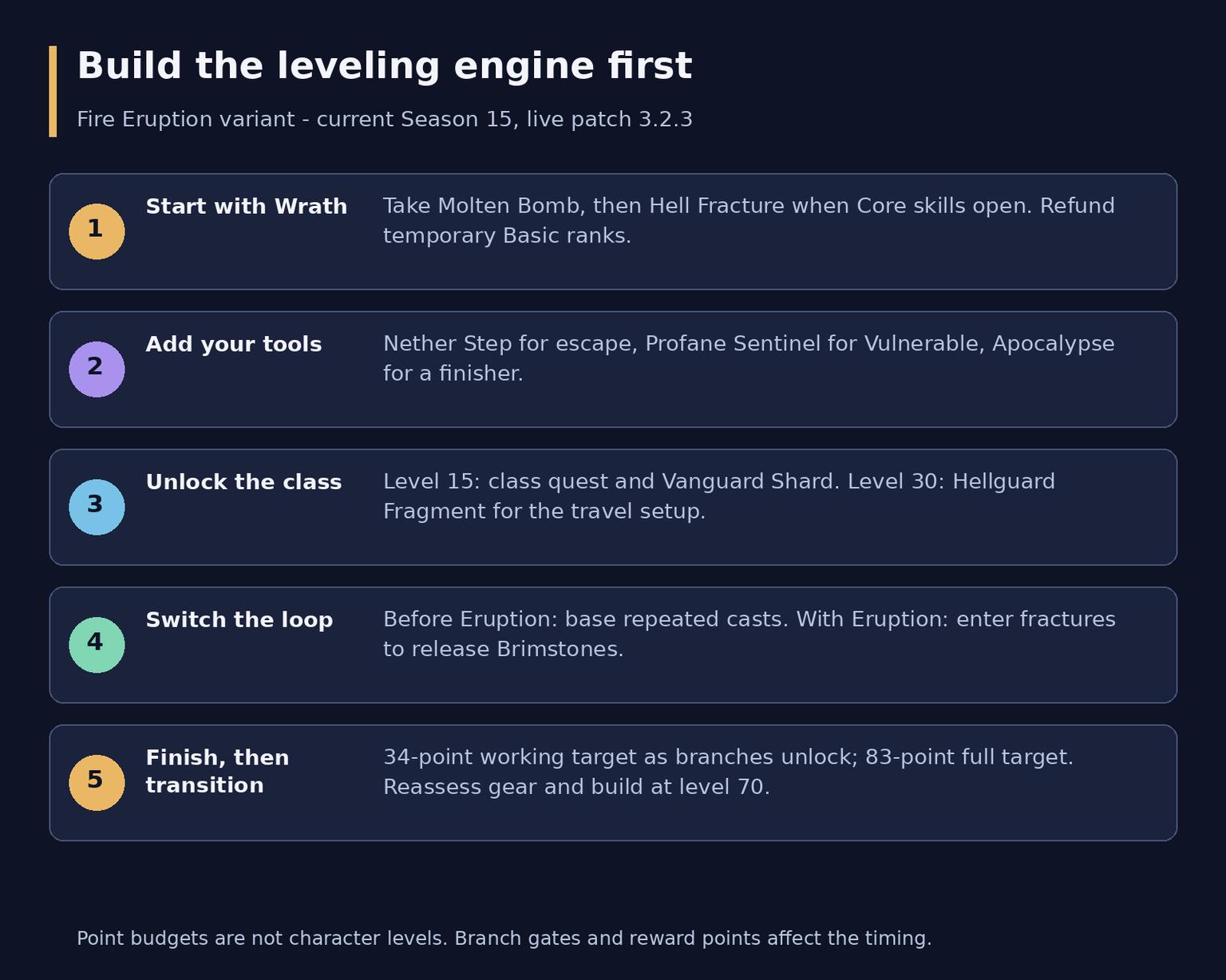
Unlock the working skill loop before completing the full 83-point target.
Soul Shards and important milestones
At level 15, follow Disciple of the Forbidden in Ked Bardu. Choose Vanguard Shard for Abodian's travel and grouping utility in this version. Commanding him lets you mount the demon and drag ordinary enemies behind you; dismount before committing to the next damage window. Bosses are not guaranteed to be dragged like regular monsters.
At level 30, Hellguard Fragment is the practical continuation for this travel-oriented choice, adding Brimstone activity to Abodian's command. Other fragments support different engines. In particular, do not import Inferno or Warden's Demonform requirements and then claim they are always active in this bar.
Vanguard's additional Archfiend-summon effect has a Demonform condition. This build does not take Metamorphosis, so its basic functionality must not depend on permanent Demonform. Soul Shards are the class mechanic; the Season 15 Soul Splinters socketed in jewelry are unrelated despite their similar names.
Fighting packs, elites and bosses
Against a normal pack, approach from an angle that gives you a safe exit. Cast Hell Fracture ahead of the enemies and enter the generated fractures only when the ground is safe. Brimstones spread the damage. Use Molten Bomb while Wrath recovers and avoid wasting a full setup on a single nearly dead straggler.
For an elite, place Profane Sentinel first so its beam supplies Vulnerable, then keep the target near your fracture and Brimstone damage. Focused Glare rewards leaving its gaze on the same durable target. Hell Fracture is primarily direct Fire damage here; it does not become a dedicated damage-over-time build merely because its effects look fiery.
Apocalypse is the finisher for a dangerous group or a meaningful boss window. The chosen Annihilation variant builds stacks from Hellfire hits, requires at least 20 and stores up to 100, so evaluate its current stack state rather than importing the unmodified ritual's cooldown routine. Its base version explicitly does not benefit from ordinary Cooldown Reduction. That stat remains useful for appropriate movement and support skills, not a universal solution for every button.
On a boss, stabilize resource generation, maintain the useful summon and cast where the boss will actually remain. When the boss moves away, rebuild the setup instead of paying for explosions behind it. Save Nether Step for the next lethal pattern. Vulnerable support is useful, but crowd-control and dragging effects do not make a boss behave like a normal pack.
Do not chase Overpower stacks or Shadow-specific multipliers for this Fire variant. Critical Strike and applicable Fire, Core or Occult bonuses can help, but a higher-damage weapon and a working resource loop usually matter earlier than perfect secondary rolls. No guaranteed leveling time or endgame tier is implied.
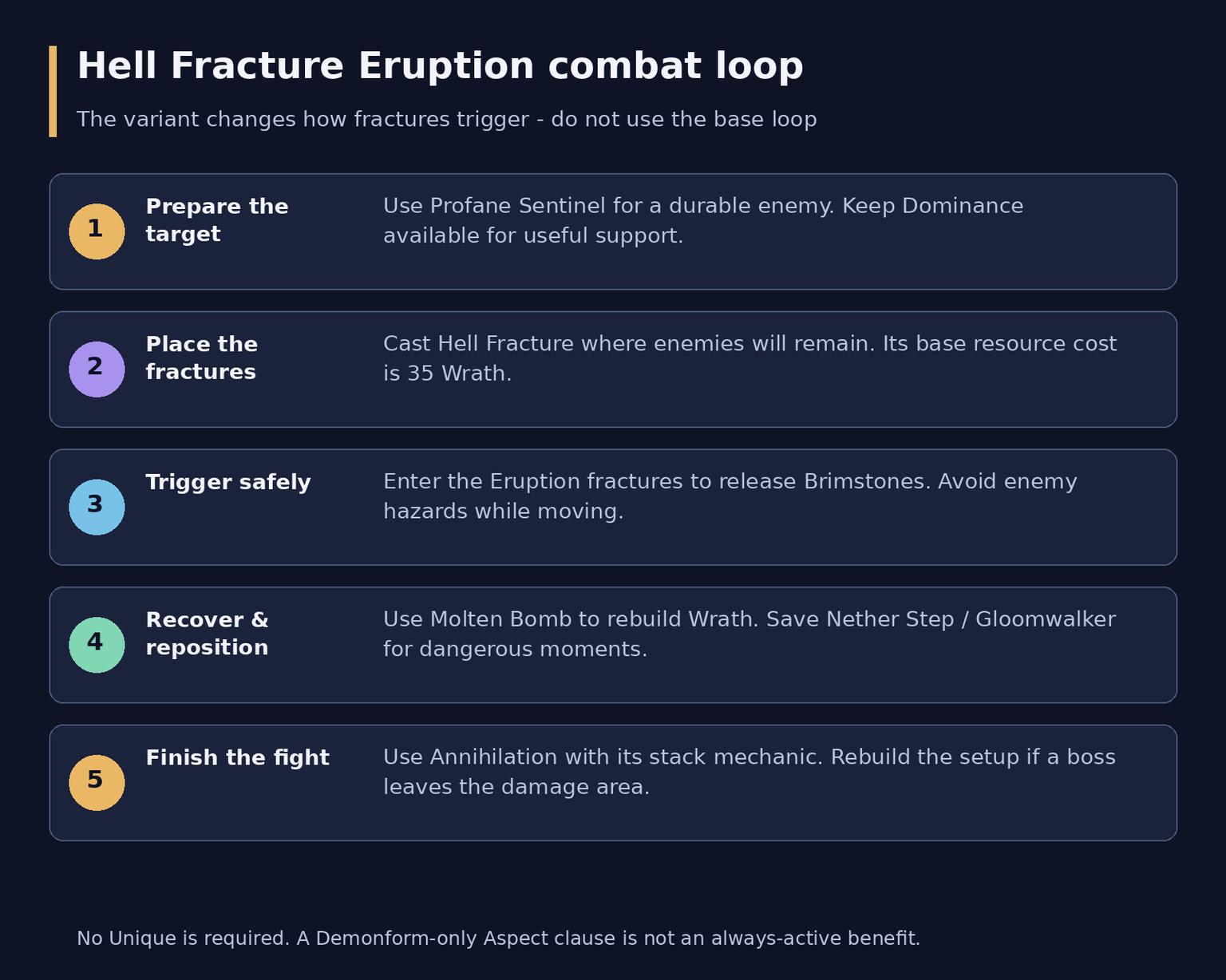
Eruption requires entering fractures; it is not the base skill's repeat-cast loop.
Gear and Aspects during leveling
Equip a legal Warlock weapon with a meaningful damage improvement rather than keeping an obsolete weapon solely for a minor affix. A one-handed weapon plus Focus or an appropriate two-handed weapon can work. Compare the whole setup, including any lost Aspect, rather than comparing two item-power numbers in isolation.
Useful priorities are weapon damage, applicable Hell Fracture or Core ranks, Willpower, resource support and movement speed. Keep Maximum Life, armor and resistance adequate for the difficulty you are playing. Cooldown support can improve movement uptime. A leveling drop does not need a perfect Greater Affix to be an upgrade.
No Unique or Mythic Unique is mandatory. If a Unique drops, keep it only when its actual effect helps the current skills without destroying resource stability or defenses. Do not farm an endgame boss simply to obtain an item that an advanced guide assumes.
Three optional Aspect goals are enough for this stage. Aspect of Might is a practical Codex unlock from Dark Ravine and grants defense after Basic skill use, fitting your regular Molten Bomb casts. Pyroclastic Aspect improves Brimstone coverage and damage; its instant-detonation clause requires Demonform and is not a promise for this build's normal state. Aspect of Lava adds damaging lava pools and a Volatility interaction, making damage over time relevant only when that effect is equipped.
Treat Pyroclastic and Lava as useful finds, not guaranteed early dungeon rewards. Salvage spare Legendary powers to learn or improve Codex entries, then imprint only when the gain justifies the materials. A compatible non-weapon slot can keep a useful power through several weapon replacements. Do not buy repeated expensive rerolls for a piece you expect to replace shortly.
A cheap Temper on equipment you will actually use can help. Choose an available, compatible learned affix supporting damage, resource comfort or life, rather than hunting an endgame manual before continuing. Masterworking and repeated Capstone rerolls are later optimization; they are not required to make this leveling build function.
Choosing activities and reaching level 70
For a first playthrough, continue the campaign and complete the class quest promptly. Campaign skipping is an account option when available, not an instruction to abandon an unfinished story. With the relevant activities unlocked, combine Helltides with nearby Whispers, useful dungeons and first-time Stronghold completions. These offer overlapping experience, equipment and materials without forcing one universal fastest route.
Use the difficulty where packs die consistently and you can enter fractures without repeated deaths. Lower it when the generator phase becomes a long struggle or elite hazards force you away from every cast. In a group, let teammates hold durable enemies near your damage and do not drag the pack out of their attacks. Solo players should take smaller pulls while movement tools are unavailable.
Season 15 quests and rewards are optional additions to the normal leveling engine. Earn available skill-point rewards, but assess the drawbacks on a Soul Splinter before equipping it. Neither a seasonal gem, a Rune combination nor a Mercenary is mandatory for the bar above. Expansion systems have their own unlocks; owning the class does not mean a fresh character has completed all of them.
At level 70, move into a current endgame plan when your equipment supports its resource costs and required interactions. Start Paragon with useful stats, survivability and a Glyph that matches the chosen damage tags, then satisfy its nearby attribute requirement. Do not copy an old level-50 or level-60 board route, or apply a Shadow/Abyss endgame layout to Fire Eruption unchanged.
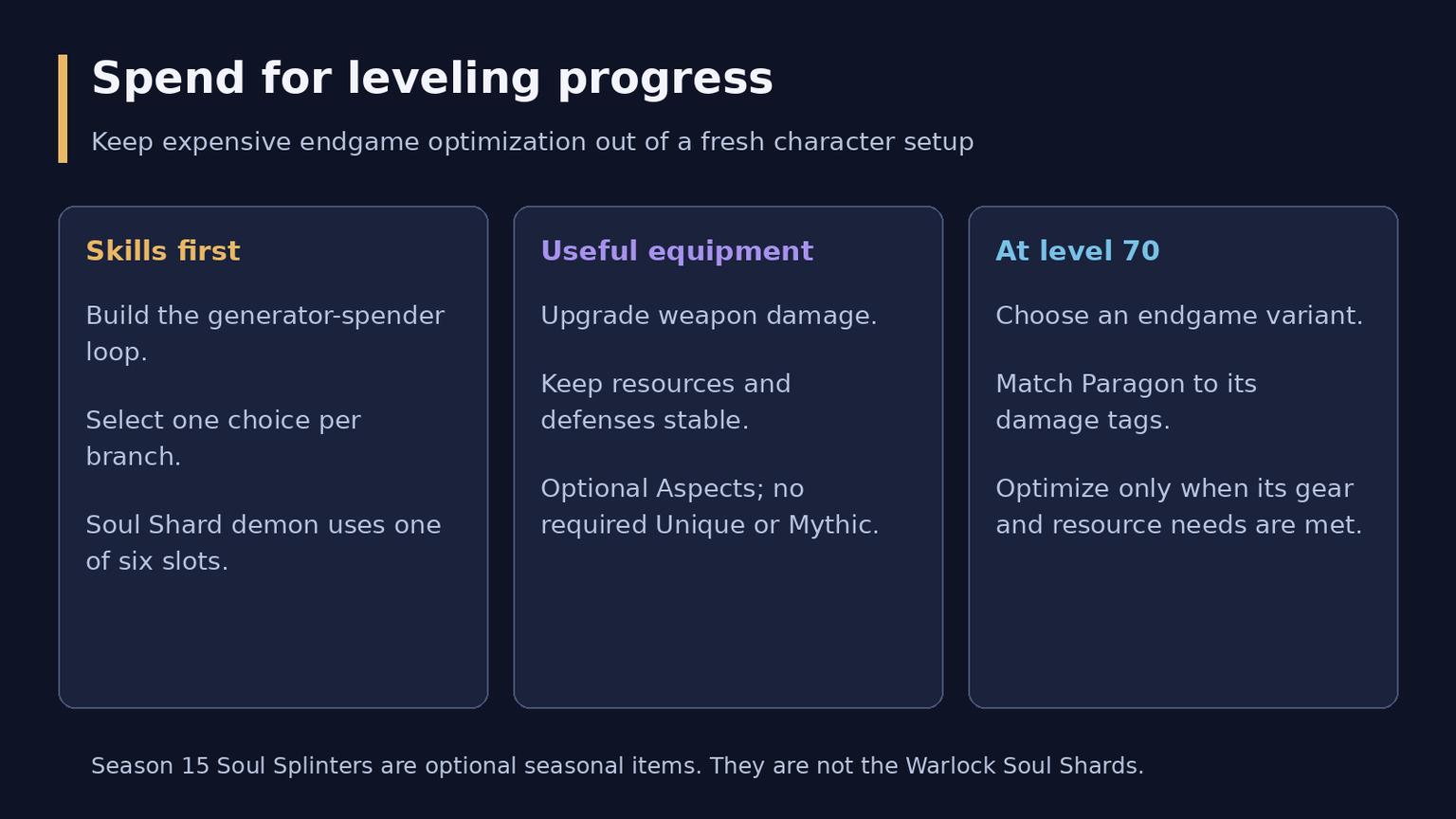
Complete a reliable leveling loop before paying for endgame optimization.
FAQ
Does Warlock require an expansion?
Yes. Warlock is a permanent Lord of Hatred class and requires the relevant expansion access. It is not a Season 15-only archetype.
When does the Hell Fracture build start working?
The generator-and-spender loop starts once Molten Bomb and Hell Fracture are available. Play base fractures first, then adopt the enter-fracture loop when Eruption unlocks. The full 83-point allocation is a later target.
Do I need a Unique, permanent Demonform or a seasonal power?
No. The Fire Eruption setup works with ordinary suitable gear. Demonform-dependent effects are conditional bonuses, and Soul Splinters are optional seasonal items rather than the class Soul Shard mechanic.
Is it suitable for solo leveling, and when should I switch builds?
Yes, provided difficulty and pull size let you use fractures safely. Reassess at level 70 and switch when the new endgame setup has its required equipment and resource support, rather than changing automatically at level 40.