Diablo 4 Horadric Cube: Unlock, Recipes and Crafting
The Horadric Cube is a crafting station introduced with Lord of Hatred. You use its recipe interface in Temis to modify equipment, transmute ingredients and create eligible items. It is not an inventory-storage shortcut or a copy of Diablo II's recipe rules.
Checked October 21, 2026, for Season 15, Season of Hell's Legacy, and live patch 3.2.3. The core system is permanent expansion content on Seasonal and Eternal Realms. Seasonal ingredients can have their own recipes without making the Cube itself seasonal. Owning the base game alone does not grant this expansion station.
Unlocking and using the station
Follow the Lord of Hatred campaign to discover the Cube, then complete its crafting introduction when offered and use the station in Temis. Blizzard places access during the campaign. Some walkthroughs describe the station in a post-campaign sequence; that is not sufficient evidence to make full campaign completion a universal prerequisite. If access is missing, check your current story and introduction objectives.
The completed introduction is described as an account unlock. For an alt, use the available story-complete or campaign-skip route and check the station before replaying the whole campaign. Do not confuse shared access with transferring a seasonal character's equipment or material balance to another realm or mode.
Interact with the station, select an available recipe and insert the required item or items. The recipe identifies valid inputs, quantities and materials; stored crafting materials are drawn from the materials interface. Inspect the result preview and confirm Transmute only when the intended recipe is selected. Input counts vary by recipe: three duplicate items and one upgrade base are different operations, not interchangeable uses of a fixed Diablo II grid.
There is no verified Cube-level ladder, maximum station rank or mandatory weekly upgrade sequence in the documented system. Later patches add recipes, while individual operations impose their own item eligibility. A disabled recipe is a reason to inspect its requirements, not proof that the whole Cube needs another rank.
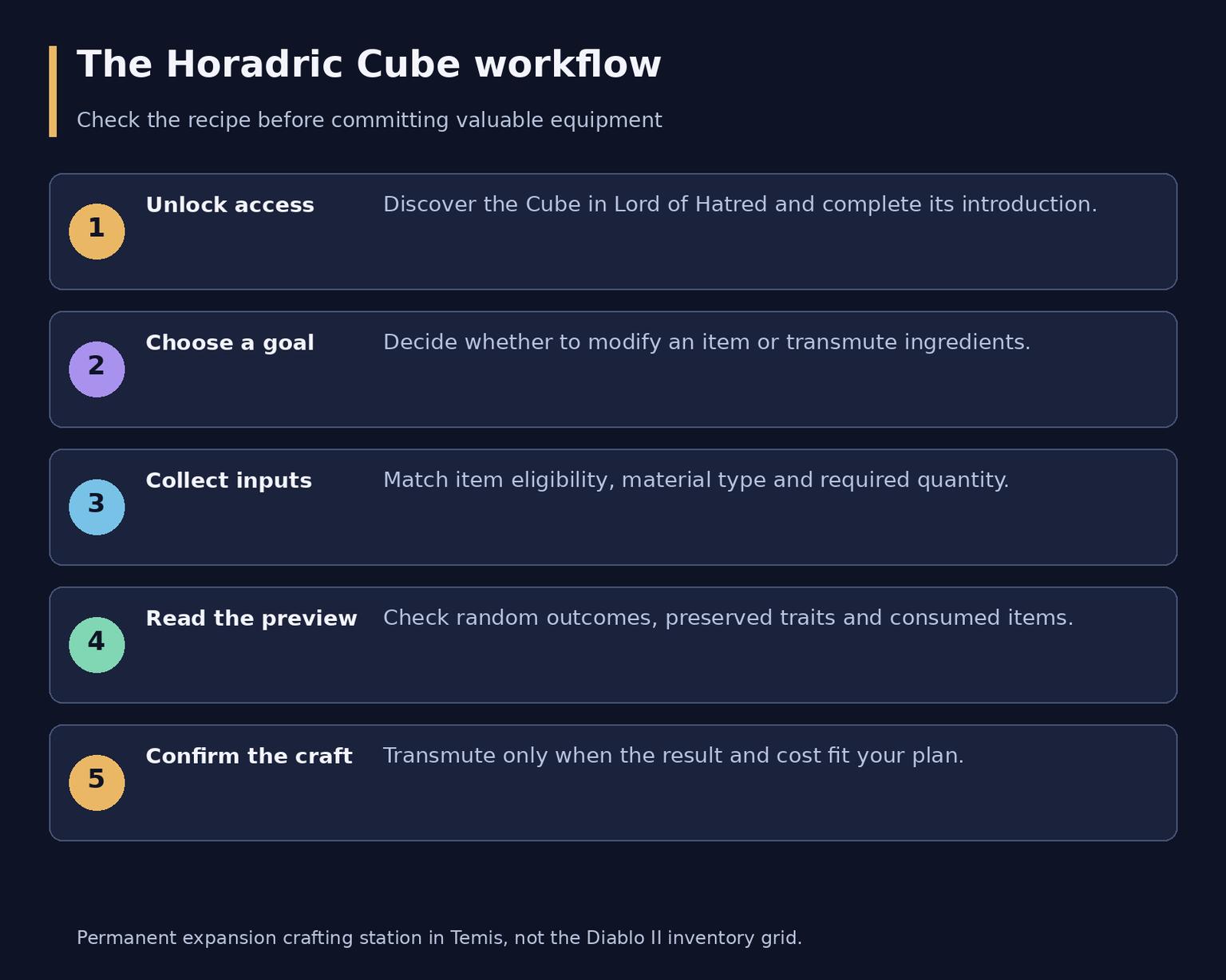
Finish access requirements, choose a goal, collect ingredients, inspect the preview and confirm the operation.
Main recipe categories
Item modification covers adding, removing and rerolling eligible affixes. Adding an affix needs room under that item's limit; it does not mean adding unlimited stats. Tuning Prisms narrow supported outcomes by category. An offensive category is not a guarantee of your favorite damage affix or its maximum roll.
Item transmutation can combine compatible items, recycle duplicates or change rarity. The selected recipe determines whether the original becomes a new item. Treat random Unique creation as an attempt within an eligible item pool, not a purchase of a chosen Unique. Class and item-type restrictions still apply.
Talisman recipes include Set Charm rerolls and conversion of eligible Ancestral Uniques into Unique Charms. Rune transformations and Amalgamation support specified combinations rather than every conceivable input. The Cube also creates Horadric and Flawless Horadric gems beyond the Jeweler's normal gem tiers. Use the Diablo IV recipe, not an old rune or gem formula from another game.
The ordinary recipe list supplies instructions for supported operations; hidden combinations can also exist. You do not need to find a separate recipe scroll for every visible entry. Conversely, an online secret formula is useful only when verified in the current Diablo IV context. A hidden seasonal recipe is not evidence that its ingredients or result remain available forever.
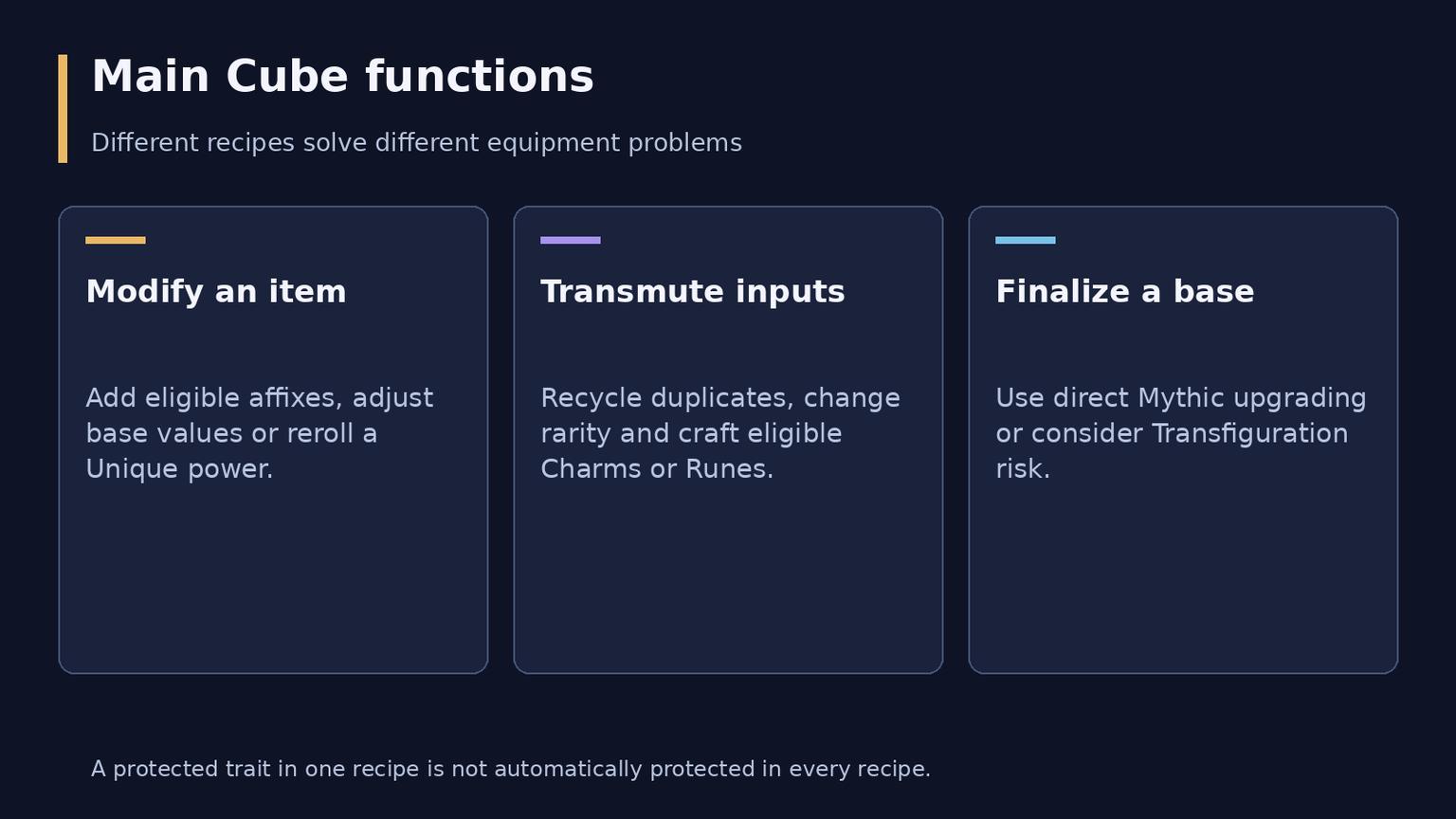
Distinguish modifying a retained item from transmuting inputs and preparing a final upgrade.
Materials and a sustainable supply
Primordial Dust is a family of recipe materials, not one interchangeable currency. Relevant names include Raw, Coarse, Refined, Volatile, Pure, Enhanced and Attuned Primordial Dust. Use the exact type shown by the recipe. Saving plenty of Raw Dust does not replace a missing specialized ingredient.
Blizzard lists elites, Cube Spoils from War Plans, Undercity Tributes and Whisper Caches as sources of Cube materials. Choose repeatable content that also develops your character. An Undercity setup with suitable material rewards can focus a session, but neither every elite nor every cache guarantees the specific dust or prism you need.
Higher difficulties change the material mix. The final Season 15 notes make Coarse Dust less common as difficulty rises and Refined, Volatile, Pure, Enhanced and Attuned more common. That is not a published fixed drop percentage. If you need a particular material, compare the reward focus and your clear speed rather than assuming the highest Torment is always best.
Infused Horadric Resin comes from salvaging Talisman Charms and Seals. Tuning Prisms have separate purposes, including affix categories and Transfiguration. Check materials in their own interface; do not substitute Obducite, Tempering supplies or boss keys unless the selected recipe explicitly requests them. No universal material cap, unrestricted trading rule or guaranteed crafting refund is established here. Seasonal materials belong to the season that supplies them.
Useful recipes and ingredient examples
These examples cover different decisions rather than an exhaustive catalogue. Read the live recipe for the full eligibility and any confirmation cost.
Operation | Required inputs | What to expect |
Add Affix | Eligible item, 1 Coarse Primordial Dust, 5 Raw Primordial Dust | A random eligible affix; item needs available affix capacity |
Affix Value Reroll | Rare-or-better equipment or Talisman item, 1 Attuned Primordial Dust, 100 Raw Primordial Dust; Talisman items also need 100 Infused Horadric Resin | Random base values with protected properties retained |
Reroll Set Charm | 1 Set Charm, 25 Raw Primordial Dust, 50 Infused Horadric Resin | Another Charm from the same set, not a selected missing piece |
Direct Mythic upgrade | Eligible Ancestral Unique, 5 Resplendent Sparks | Same item upgraded to Mythic; Crafted restriction applies |
Costs belong to the named operation; they are not a universal Gold ladder. Repeatable rerolls consume another batch of ingredients. No system-wide cooldown or daily allowance is documented here, but a recipe can still require particular item power, difficulty or a modifiable base. Check those conditions rather than applying one old level requirement to all recipes.
Protecting your equipment
In Season 15, Affix Value Reroll changes base values while preserving Greater Affixes, Enchanted and Tempered affixes and eligible Transfigurations. Horadric Reroll is different: on Legendary-or-higher Charms and Seals it randomizes base affixes while preserving the set bonus and Unique/Mythic Charm power. Read which properties the selected operation protects; a safety rule from one recipe does not automatically cover another.
Unique Power Reroll adjusts the numerical power roll rather than replacing the Unique with any power you choose. Live 3.1 expanded its use to Unique Charms and non-Ancestral Uniques. Some early guides retain the old Ancestral-only wording. Patch 3.2.3 also fixed Cube rerolls for several affixes, so an old failed attempt is not proof that the affix is permanently excluded.
The direct Mythic upgrade now keeps the original item's identity, affixes, Tempering and Masterworking. It cannot accept an Unmodifiable item. The result receives Crafted, and you may equip only one item carrying that tag. Mythics from the Jeweler or Blacksmith do not acquire this particular tag just because they were crafted. Preserve an excellent upgrade candidate instead of feeding it into an unrelated random transmutation.
Transfiguration is a separate late decision that can make gear Unmodifiable. Finish the changes you still need before taking that risk. Items marked Legacy are not valid Cube inputs. Never assume a consumed duplicate, old affix or invested material can be restored by salvaging the result.
Cube versus other crafting services
The Blacksmith still handles its own forging and equipment-improvement services. The Occultist remains the place for Enchanting and supported Aspect imprinting. Extracting a power into the Codex of Power is not the same as creating a Unique Charm or rerolling its numerical effect. The Cube complements these systems; it does not combine all their menus into one recipe.
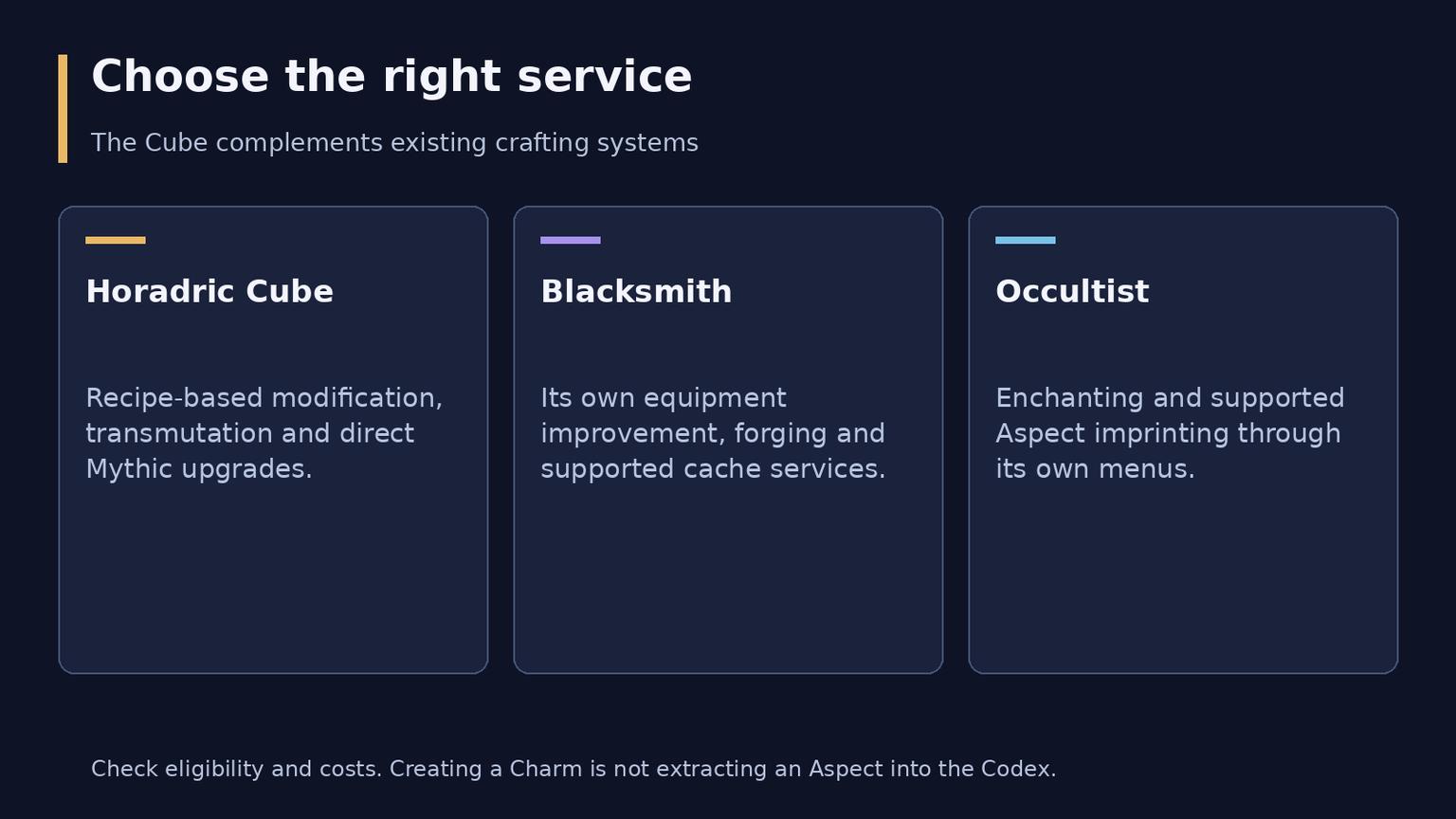
Choose the service for the operation you need, then check how it interacts with the item's existing modifications.
For your first useful craft, solve one real problem: a viable base lacking an affix, a duplicate Set Charm or a strong item with weak base values. Test unfamiliar recipes on expendable inputs. During leveling, avoid spending rare materials chasing perfection on soon-replaced equipment. At endgame, compare the expected gain with the value of the consumed items and keep a budget for repeated random attempts.
Frequently asked questions
How do I unlock the Horadric Cube?
Discover it through the Lord of Hatred campaign and complete its crafting introduction. Use the station in Temis; check access on alts before repeating the story.
What should I use it for first?
Fix a specific build problem with a supported recipe. Preview whether it modifies your item or consumes it to create another one before committing valuable gear.
Where do recipes and materials come from?
Visible recipes explain their inputs in the Cube. Materials come from eligible rewards such as War Plans, Whispers, elites and Undercity; Resin comes from salvaging Charms and Seals. Hidden combinations need separate verification.
Does the Cube disappear after the season?
No. The core station is permanent Lord of Hatred content on Seasonal and Eternal. Seasonal materials and their recipes can have separate availability rules.