Diablo 4 Legacy Uniques: New Items and Old Gear Explained
Diablo 4 uses Legacy in two different equipment contexts. In Season 15, Legacy Uniques is Blizzard's name for new items inspired by earlier Diablo games. These are permanent additions, not obsolete drops. A Legacy label on an old item in your stash means something else: that particular copy belongs to an earlier itemization system and has crafting restrictions.
This guide separates the two meanings and explains how to inspect an old Unique before keeping, replacing or salvaging it. Information is checked for October 21, 2026, Season 15 and live patch 3.2.3.
What Legacy Uniques means now
The Season 15 collection brings familiar equipment identities into Diablo 4. A new Leoric's Crown is current equipment even though its name celebrates the series' past. It is not locked out of crafting merely because an article calls it a Legacy Unique.
The older Legacy equipment label applies to an individual item affected by a systems transition. An item's age, name and realm do not independently establish that status. Read the actual tooltip and check whether the relevant crafting interface accepts it.
For practical purposes, ask two separate questions: which Unique is this, and what status does this particular copy have? That distinction prevents both needless salvage of new gear and wasted effort trying to rebuild an obsolete copy.
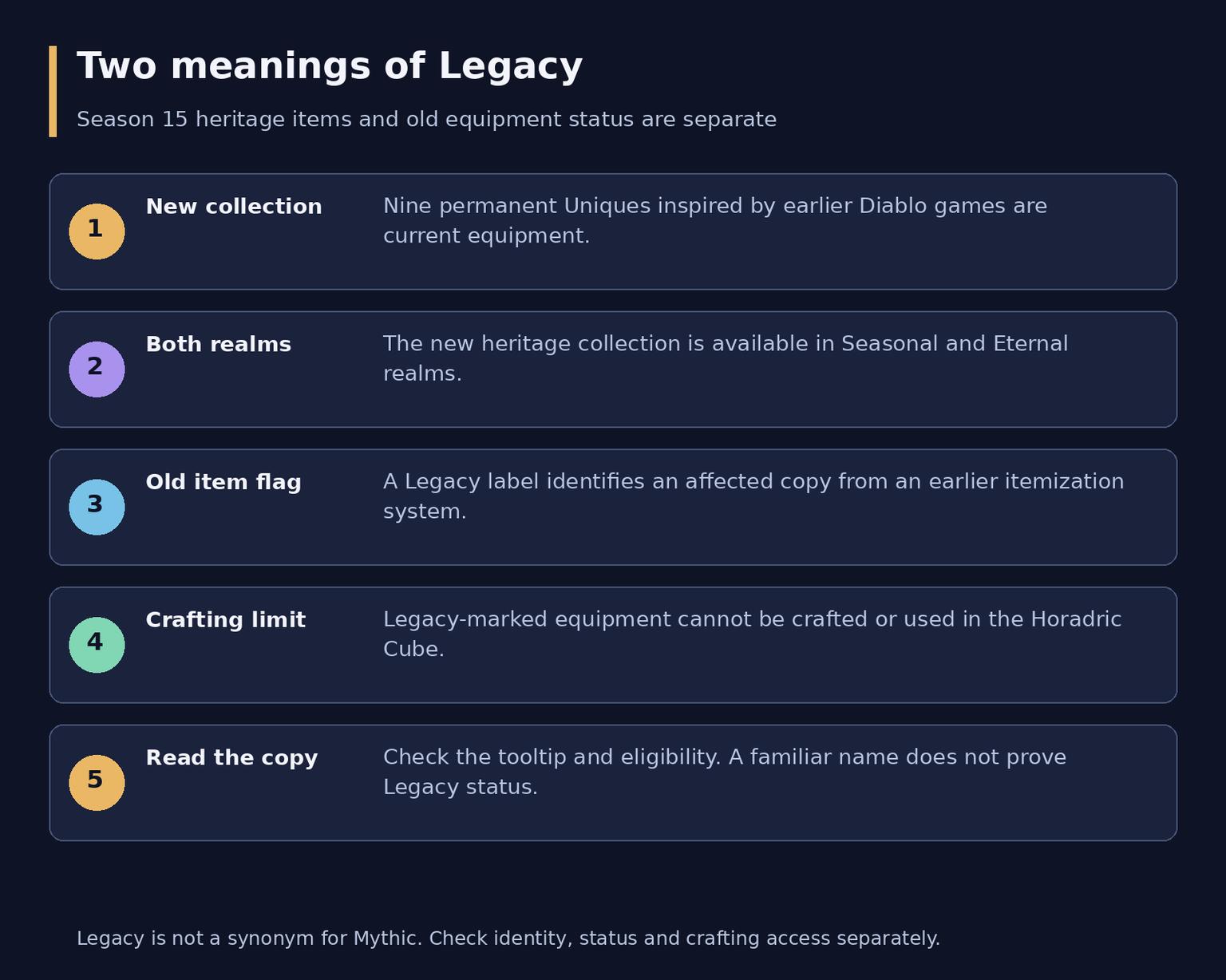
Legacy Uniques from the series' past and Legacy-marked equipment are different concepts.
The nine permanent Season 15 additions
Blizzard's live announcement lists the following nine items. An asterisk identifies an item also available as a Unique Charm. The listed weapon classes matter: a familiar name does not make a weapon usable by every class.
Item | Equipment slot | Classes |
Leoric's Crown | Helm | All classes |
Nemesis Bracers* | Gloves | All classes |
Stone of Jordan* | Ring | All classes |
Sirloin of the Bovine | Legs | All classes |
Arioc's Needle* | Two-handed polearm | Barbarian, Druid, Spiritborn |
Henri's Perquisition* | Offhand focus | Sorcerer, Necromancer, Warlock |
In-Geom* | One-handed sword | Barbarian, Druid, Rogue, Necromancer, Paladin, Sorcerer, Warlock |
The Furnace* | Two-handed mace | Barbarian, Druid, Necromancer, Paladin, Warlock |
Messerschmidt's Reaver | Two-handed axe | Barbarian, Druid, Necromancer, Paladin, Warlock |
These additions are available in both Seasonal and Eternal realms. They are not a promise that every character can obtain every item from any monster. Class eligibility and the relevant loot pool still matter. Current rules allow Unique items to drop from level 1 on any difficulty; the old blanket instruction to reach Torment IV before finding a Unique is outdated.
Do not turn this collection into a mandatory shopping list. Start with the effect your build needs. An item that accelerates a farming loop may offer less against a boss with no supporting enemies. An extra utility effect also costs an equipment slot that could otherwise provide damage, defense or resource support.
Read the current effect, not an old screenshot
Leoric's Crown is a useful example of why version checks matter. The current item card gives a 35-50% increase to socketed gem effects and treats the helm as Jewelry. Earlier preview descriptions showed 75-100%. Those numbers are not interchangeable. Its unusual Jewelry property is an item-specific exception, not permission to put jewelry-only effects in every helm.
In-Geom also received a live correction: its cooldown reduction was fixed from 12 seconds to 15. Nemesis Bracers had an issue preventing shrine interactions from spawning elite packs, and Leoric's Crown had an enchanting problem. These were bugs addressed in live notes, not evidence that every heritage item is permanently unmodifiable.
When a guide and your item disagree, check the guide's patch, the exact copy shown and the triggering condition. Compare performance in the activity you actually play. A short dungeon test and a sustained boss test can reveal different weaknesses even when the same item looks impressive on paper.
How old gear becomes Legacy
Diablo 4 has undergone several equipment transitions. Season 4: Loot Reborn introduced a broad affix and crafting overhaul, including Greater Affixes, Tempering and Masterworking. Later changes to progression and item power created more opportunities for old equipment to differ from newly generated drops. These historical changes explain why an Eternal stash may contain several generations of the same item.
The current 3.0 transition has a particularly important rule. Blizzard explains that obsolete base or tempered affixes supporting removed functions were replaced with +100 All Stats and marked Legacy. Affected examples include passive skill ranks and double-cast weapon tempers. Legacy items cannot be crafted or used in the Horadric Cube.
That rule is about affected equipment, not Unique rarity alone. An old Rare or Legendary can have a migration problem too. Conversely, a newly dropped Unique with a familiar name is not automatically old-system gear. Greater Affixes describe stronger affixes; they do not by themselves certify that an old copy is eligible for every current upgrade.
Do not assume an old Unique preserved its original power untouched. Blizzard explicitly warns that pre-expansion powers may change when skill variants replace older effects. A high roll on a function the build no longer uses is less valuable than a modest roll on the correct current effect.
Inspect a returning character's stash
Begin with equipped items and the spare copies that support your main skill. Enable detailed item information, read the full power text and look for the Legacy status. Inspect base stats, affixes and existing modifications separately. Do not rely only on the item's icon, color or an old inventory screenshot.
Then compare a current copy of the same Unique. Check the power's condition, not just its percentage: does it require an elite kill, a shrine, a particular damage type or a resource interaction? Check whether the supporting skill or variant still exists in your chosen setup.
Finally, compare the whole build. Replacing a ring can change resource sustain, resistances and cooldown availability at the same time. Equip one change at a time and keep the original until you have tested the replacement. This is a comparison method, not a claim that any particular old item is universally stronger or weaker.
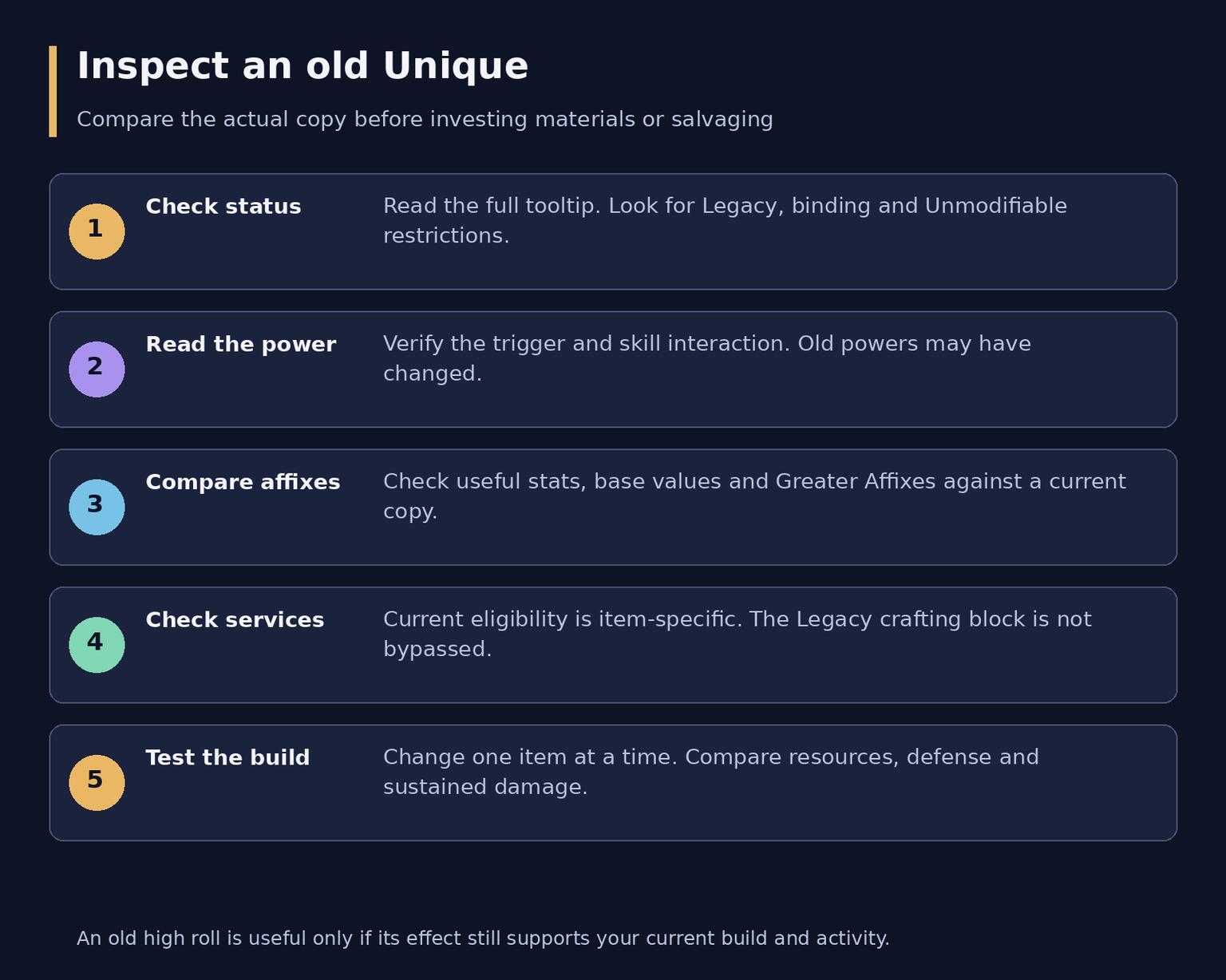
Inspect the copy's status, power, affixes and crafting eligibility before spending materials.
What can you do with each kind of item?
The table distinguishes a current, modifiable Unique from equipment actually marked Legacy. Current eligibility also depends on the item, its quality, the recipe and any Unmodifiable status. The word current is not a guarantee that every service accepts every copy.
Action | Current modifiable Unique | Legacy-marked old copy |
Equip and use | Subject to class, slot and level rules | Can remain functional; inspect changed effects |
Temper | Use the current eligible recipe and interface | Excluded by the current no-crafting rule |
Masterwork | Eligible Ancestral Uniques can be improved | Excluded by the current no-crafting rule |
Enchant | One affix can be rerolled under current rules | Excluded by the current no-crafting rule |
Horadric Cube | Only eligible items and recipes | Explicitly excluded |
Salvage | Possible; review the result first | A disposal choice, not a conversion into new gear |
Trade | Check binding and trade eligibility | Legacy does not override binding restrictions |
The crafting restriction is broader than a missing upgrade button. There is no published universal recipe that turns every Legacy-marked copy into a newly rolled, current version. Farming a replacement is the reliable plan when the old copy cannot support the systems your build needs.
Masterworking rules have also changed since the early game. Current eligible Ancestral Uniques can use the system, and old instructions that require every item to be tempered first are no longer a safe general rule. Likewise, advice saying Uniques can never be enchanted is outdated: the current system permits rerolling one affix on eligible Uniques.
For trading, inspect the binding text before negotiating. A Unique name does not guarantee that a particular copy is transferable, and an old item's scarcity does not remove account binding. Do not treat a claimed collector price as proof that the trade window will accept it.
Mythic is a separate distinction
Uber Unique is older terminology associated with the rarest iconic items. It is not a synonym for a Legacy-marked copy. Mythic systems have since been reworked: the current game allows eligible Uniques to become Mythic variants. A heritage item, its Mythic version and an obsolete old copy are therefore separate questions.
Season 15's direct Horadric Cube upgrade preserves the input item's affixes and modifications in a one-to-one transfer. This does not bypass Legacy or Unmodifiable restrictions. The Cube's Crafted-tagged Mythics also have a one-equipped limit; do not apply that limit indiscriminately to every Mythic made through other services.
The Cube requires Lord of Hatred and its unlock. The fact that an item exists in the general game does not grant access to every expansion crafting feature. Check the recipe and its displayed inputs before committing a valuable current copy.
Keep, replace or salvage
Keep an old item when it still enables a working setup, fills a temporary gap or has personal collection value. Mark important comparison copies as favorites and separate them from disposable duplicates. Keeping one useful reference is easier to manage than keeping a full page of indistinguishable rolls.
Replace it when the current build expects an effect, affix combination or crafting path the old copy cannot provide. Prioritize the slot that fixes a real failure: unreliable resources, repeated deaths or missing damage against your target. A complete set of fresh items is not necessary before you can start playing again.
Salvage redundant copies after the replacement passes a practical test. Read the Blacksmith's preview rather than expecting a fixed return from every Unique. Salvage is irreversible; it does not preserve the old power for another item or turn an ordinary Unique into its current equivalent.
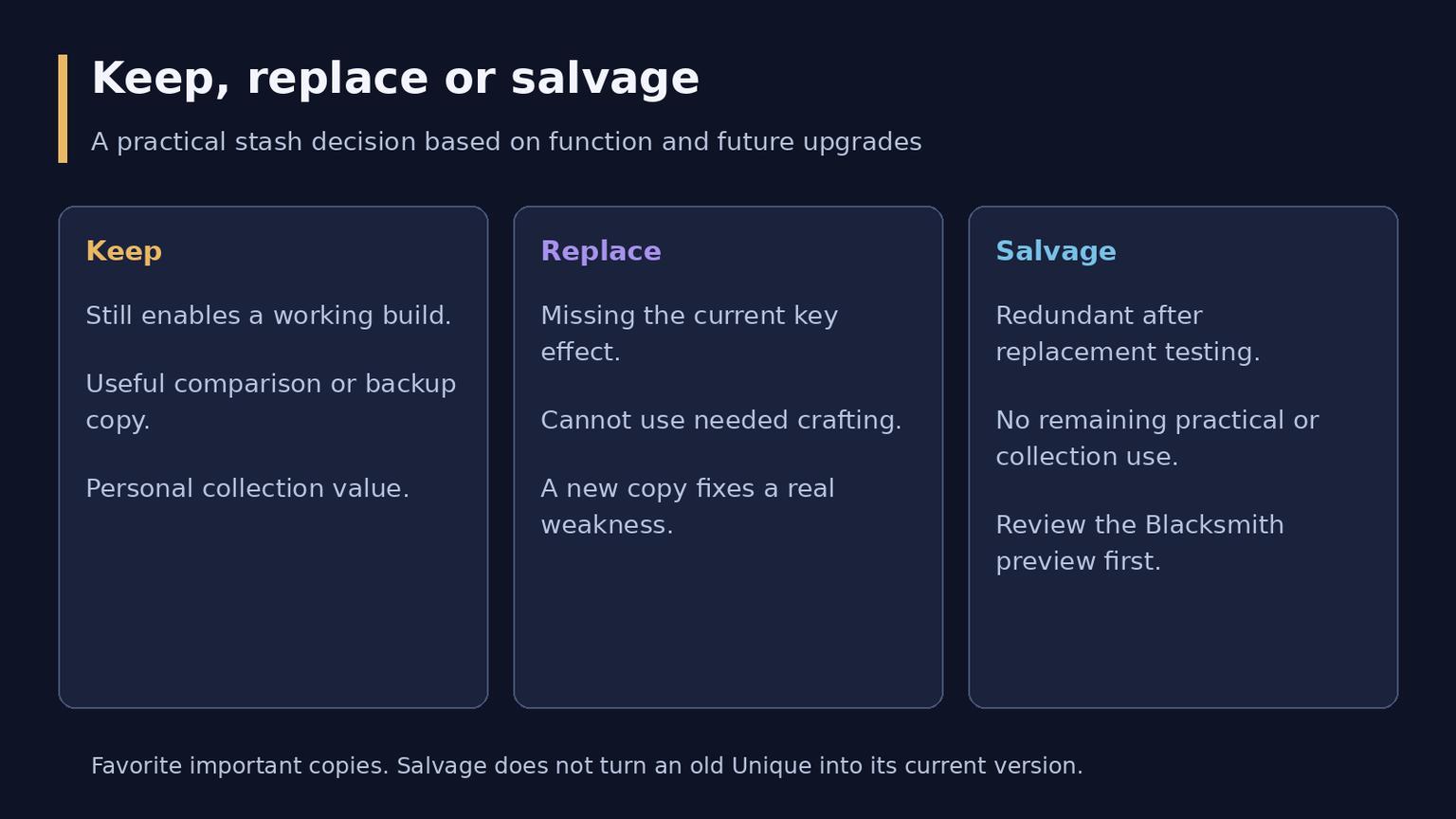
Choose by function, upgrade potential and collection value rather than age alone.
Seasonal and Eternal equipment
Legacy-marked items are often encountered on returning Eternal characters because old equipment accumulates there. Realm location alone does not make an item Legacy. The permanent Season 15 heritage collection is explicitly available in both realms.
Seasonal characters move to Eternal when the season ends, but that transfer is not an automatic conversion of every item into Legacy equipment. Separate character and equipment migration from the rules for a season-specific power or consumable. A seasonal mechanic's removal can change a build without changing the status of every item it used.
For a returning character, first rebuild the skill setup, test on a manageable difficulty and replace the weakest slots. For a new seasonal character, use current drops and current build information. Old stash archaeology is useful for an Eternal collection; it should not become a prerequisite for understanding the new heritage items.
FAQ
What is a Legacy Unique in Diablo 4?
In the Season 15 announcement, it is a new permanent Unique inspired by earlier Diablo games. A Legacy label on an old equipment copy is a separate itemization status with crafting restrictions.
Can Legacy Uniques still drop?
The new Season 15 heritage items are current additions available in Seasonal and Eternal realms. An obsolete version from an earlier item system is not a separate target-farm category; new drops follow current generation rules.
Can you upgrade old Legacy-marked equipment?
The current 3.0 rule excludes Legacy items from crafting and the Horadric Cube. Do not plan to restore one through Tempering, Masterworking or Enchanting. Look for an eligible current replacement instead.
Should you keep old Uniques?
Keep copies that still work, help compare a replacement or matter to your collection. Replace gear that blocks the build's current mechanics, then salvage redundant copies after testing and checking the salvage preview.