Diablo 4 Minion Warlock Leveling Build
Minion Warlock levels by creating demons, spending them through attacks and rituals, and rebuilding the group before the next fight. This guide uses Bombardment with a dependable Basic generator, Legion Shard and a manually slotted movement skill. You can play it without a specific Unique, completed Talisman set or automated endgame rotation.
Checked October 21, 2026 for Diablo IV Season 15, Season of Hell's Legacy, live patch 3.2.3. Warlock is a permanent Lord of Hatred class, available since April 2026, and requires Diablo IV plus expansion access. Minion Warlock is a community description of a summoning setup, not an official specialization selected at character creation. The scope here is levels 1-70, followed by the first endgame decisions.
The build you are assembling
Keep Command Fallen, Bombardment, Nether Step, Rampage, Sigil of Summons and the Legion class command for Ae'grom. That is six action slots. This version deliberately retains its generator throughout leveling, rather than assuming gear and demon-hit resource effects already cover every cost.
Fiend of Abaddon is an optional later boss variant that replaces Sigil of Summons. It is not a seventh button. Do not remove Nether Step simply to copy every summon named in a planner. If you want to drop Command Fallen instead, first test resource recovery on a boss without trash; that is a separate transition, not a requirement for this guide.
Bombardment is the main repeatable attack. It costs 30 Wrath before modifiers and slams down four demons in its base form, dealing Physical damage. Season 15 made the base skill a Summon skill, increased base damage from 40% to 55% and enlarged its impact radius. These base values are not a finished character's damage calculation.
The Brutality variant rewards consecutive casts within three seconds by calling down more demons, up to four additional. It is not the Demon Mangler variant that leaves attackers behind, nor the Hellfire rain of Endless Barrage. Rebuild Wrath before the next burst rather than trying to preserve Brutality through every empty corridor.
Which demons do what
Command Fallen starts as a Basic attack that summons an exploding Lunatic and generates Wrath. Once Fallen Rush opens, it instead maintains up to three Grunts for 20 seconds. Their hits generate 10 Wrath each, and recasting with all active redirects them. Keep them attacking your actual target; three idle Grunts do not solve a resource problem.
Rampage is an Archfiend summon with a base cost of 15 Dominance and a base duration of 10 seconds. Abyssal Titan makes it an Abyss Recast skill with a larger demon that can be commanded to leap. The selected Lesser Demon Wrath modifier temporarily makes your Lesser Demon skills generate Wrath on hits. This helps the loop, but is not a promise of unlimited resource.
Sigil of Summons creates a ten-second ritual. Killing eight enemies or demons inside fuels a 20-second attacking demon; the base active limit is three, and Feeding Frenzy adds up to two more. With the selected Cooldown branch, keep the base kill requirement rather than importing Stronger Summons' increased requirement. Ritual placement and demon deaths matter even when the next pack has few enemies left.
Ae'grom is the Greater Demon bound through Legion Shard. Its command summons Vile Children in the normal Legion setup. It is not Fiend of Abaddon, which is a separate Ultimate skill. Season 15 made Ae'grom Unhindered by enemies and improved its priority for nearby elites and other important targets. You still need to place your own attacks sensibly.
These are different kinds of summons, not one permanent army with a single universal cap. Expiring Grunts, ritual demons, Rampage and the class demon have separate rules. Restore them through their skills and available resources when they disappear. The selected summons do not require corpses; they are not raised from a corpse stockpile. Do not budget around an unverified claim that every demon inherits a fixed percentage of every player stat.
Legion Shard and defensive milestones
At level 15, start Disciple of the Forbidden in Ked Bardu to open the class mechanic. Choose Legion Shard and put its Ae'grom command on the bar. Fragments follow at level 30. Sacrificial is the defensive choice here: while Lesser Demons are active, it grants Unstoppable, sacrificing one when needed to prevent crowd control. Its protection depends on having Lesser Demons available.
Spawn is a different Fragment that passively produces Vile Children and changes Ae'grom's command to explode Lesser Demons. Do not combine Spawn's command behavior with Sacrificial's protection as though both were selected. Likewise, the alternative Evisceration Fragment is not part of this setup.
For escape, take Nether Step and later Gloomwalker. That variant lets you move while Immune for up to three seconds; recast to leave early. Choose Extra Charge and Movement Speed in its other branches. Shadow Recall is an alternative, not an additional upgrade that transports every demon in this build. Save an escape opportunity when facing an elite rather than spending all charges for travel.
Skill order from first points to late leveling
Start with Command Fallen at rank one. Spend temporary prerequisite points in the available Basic skill until Core access opens, take Bombardment at rank one, then refund excess temporary ranks when the tree permits. Add Nether Step as soon as its category becomes available. Early on, a generator, spender and escape matter more than maximizing the number of summons on screen.
Before level 20, do not assume you already have the later Archfiend branch choices. Add Rampage and Sigil of Summons when their categories and modifiers open. At level 15 fit the class command; at level 30 choose the Fragment. Other modifiers have their own level gates. A large point budget cannot bypass them, and there is no universal level-34 switch that every character must follow.
Stage | Points and skills to prioritize | What changes in play |
First points | Command Fallen 1, then Bombardment 1 when unlocked | Alternate generation and targeted casts |
Early leveling | Nether Step 1; required temporary prerequisites | Keep a safe route out of dangerous attacks |
Class unlock | Legion and the Ae'grom command from the level-15 quest | Add the class demon to the six-slot plan |
Middle levels | Rampage 1, Sigil 1; Fallen Rush, Brutality and other branches when allowed | Set up rituals and demon-hit resource support |
Late leveling | Bombardment ranks first, then Rampage, Sigil and Nether Step | Improve the functioning loop before optional Basic ranks |
Use the following full target as reward points become available. It is an allocation target, not a claim that a fresh level-70 character automatically owns every point.
Skill and base ranks | One selection in each branch | Role |
Command Fallen 8/15 | Dominance; Wrath; Fallen Rush | Grunts and resource recovery |
Bombardment 15/15 | Focused Target; Additional Demon; Brutality | Main Physical attack and ritual fuel |
Nether Step 15/15 | Extra Charge; Movement Speed; Gloomwalker | Mobility and a short Immunity window |
Rampage 15/15 | Elite Hit Chance; Lesser Demon Wrath; Abyssal Titan | Greater Demon, commands and resource synergy |
Sigil of Summons 15/15 | Damage; Cooldown; Feeding Frenzy | More Lesser Demons and stronger attacks inside the ritual |
Ae'grom command | Legion Shard; Sacrificial Fragment | Class slot, no purchased ranks in this allocation |
The total is 68 base ranks plus 15 branch choices, or 83 points. A useful intermediate target is Bombardment 15 with the other four actives at one rank and all fifteen modifiers, costing 34 points once their gates are open. Then complete Rampage, Sigil and Nether Step, and fill Command Fallen last. If rewards are missing, keep the working skills and modifiers and postpone those extra ranks.
There is no old separate Passive or Key Passive network in the current tree. Damage, Wrath and similar names in the table are branches of specific active skills. They are not generic passives that need another allocation.
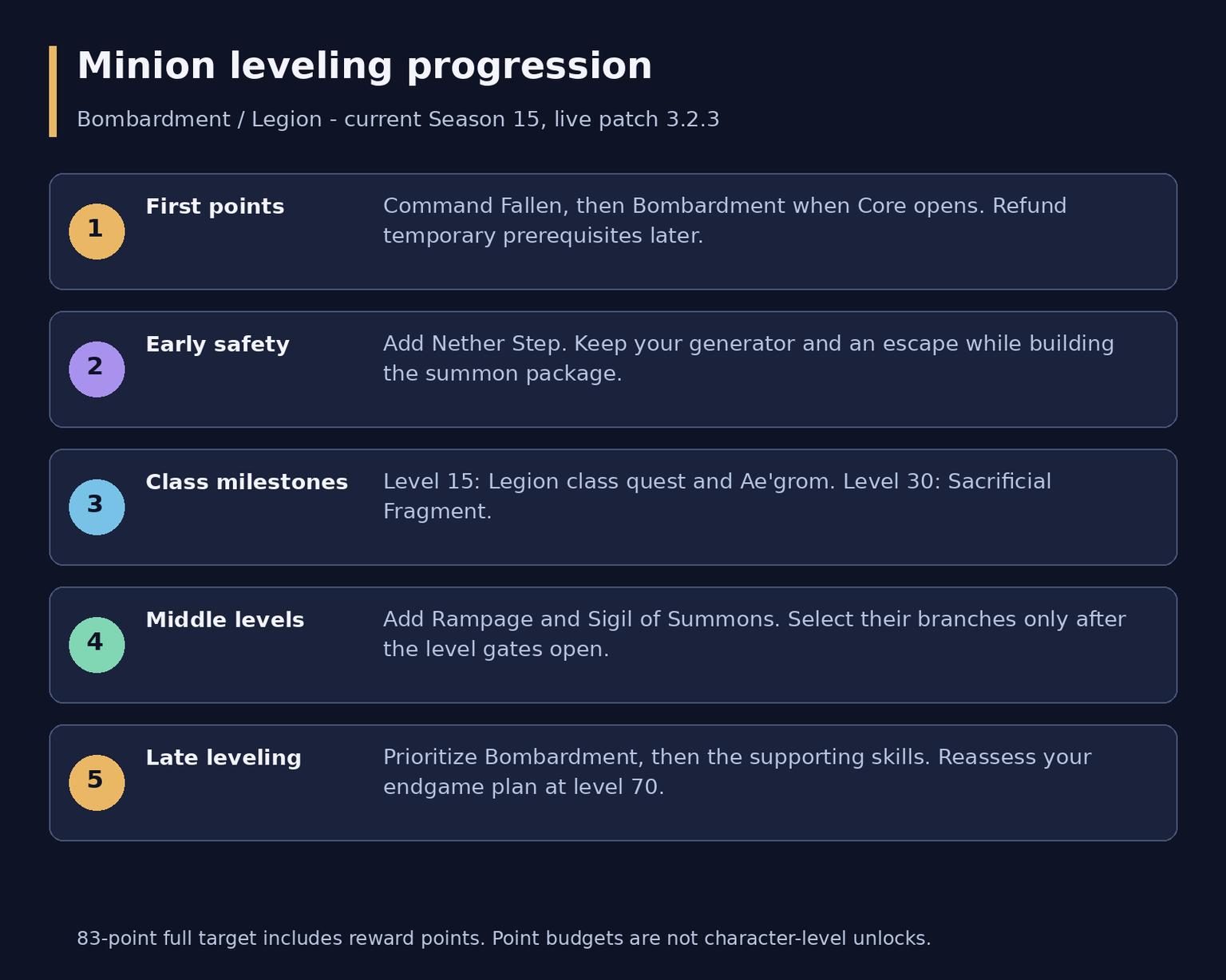
Build the resource loop and escape first, then complete the summon package as its branches unlock.
How to play one fight
Open with your Grunts active and Ae'grom available. Place Sigil of Summons where the enemies will fight, add Rampage to that area, then cast Bombardment on the group. Demon deaths and enemy kills inside the ritual fuel more summons. Continue the short Brutality sequence while Wrath permits, then use Command Fallen or redirect the Grunts to restore the loop.
For ordinary packs, avoid setting up a full ritual and every summon after the last enemy is already dying. Move toward the next useful fight. Against elites, spend the setup time, command the Titan onto the priority target and aim Bombardment where its impacts will land. Knockdown from the selected Titan helps against susceptible enemies; the bar does not include a dedicated Hex curse or guaranteed Vulnerable button. Do not prioritize conditional Vulnerable damage as though it were always active.
Bosses remove the easy supply of trash kills. Preserve Grunts, keep your Greater Demon in range and use Bombardment inside a useful ritual instead of chasing an expired setup. If the Sigil fills slowly, rely on the direct attack and already-active demons while rebuilding it. Fiend of Abaddon can replace that slot for a boss-focused variant: keep Command Fallen, Bombardment, Nether Step, Rampage, Fiend and Ae'grom.
For that optional swap, move Sigil's rank investment to Fiend and select Elite Damage, Lesser Demon Bonus and Spiteful Enrage. The base Fiend has a 60-second cooldown and a 15-second duration. Spiteful Enrage increases its effectiveness against a target surviving repeated hits and extends its lifetime, up to 60 seconds. The Dominance modifier that removes the cooldown is not selected here. Do not treat the Fiend as an endlessly spammable summon.
If summons expire or are lost, stop spending as though the army were intact. Restore the generator group, summon what you can afford and move away from lethal ground effects. Sacrificial does not guarantee protection after you run out of Lesser Demons. Gloomwalker gives a short recovery window, not permanent immunity or a barrier.
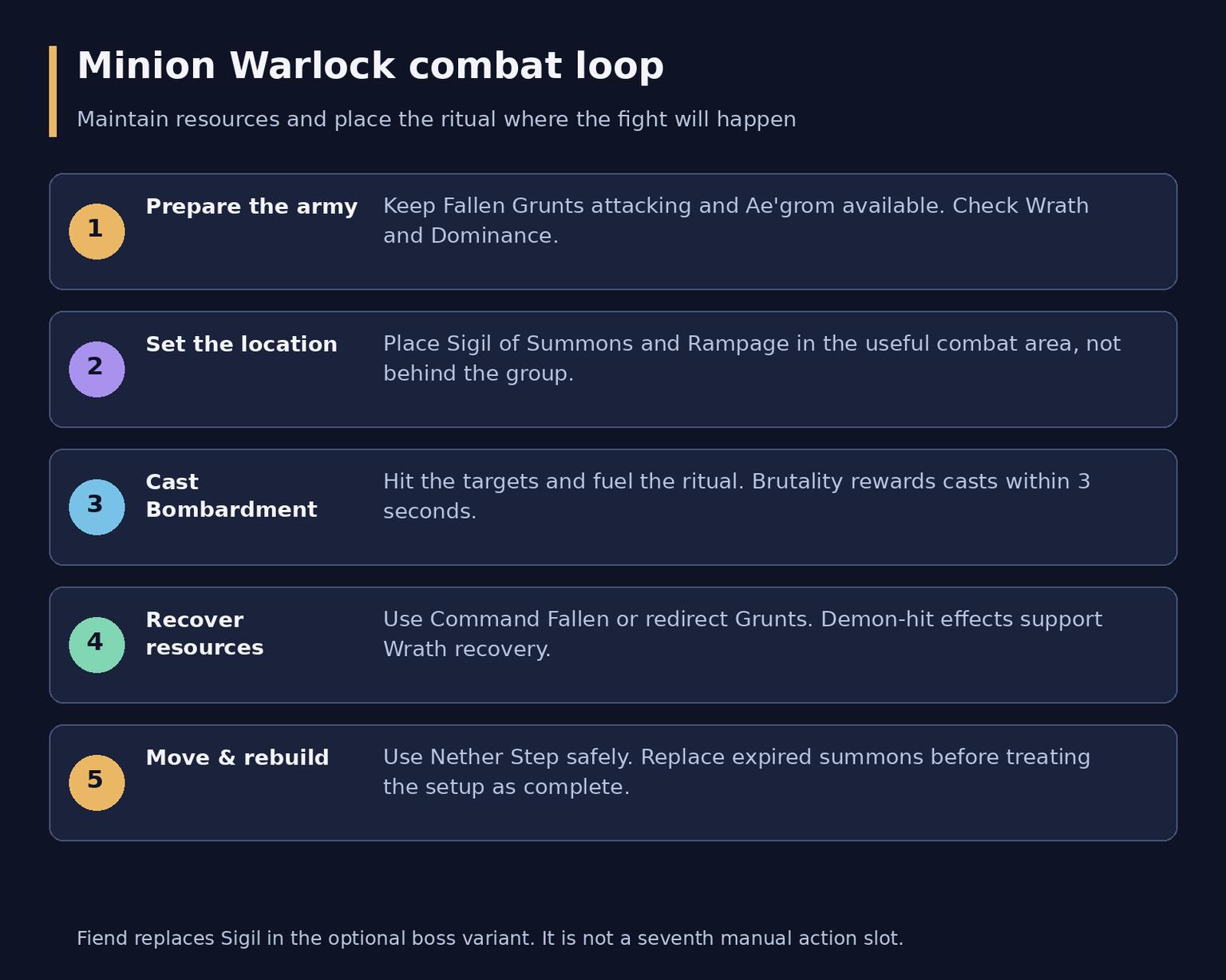
Spend and replace demons deliberately, and check the generator before blaming low damage on gear.
Equipment without an endgame shopping list
Upgrade weapon damage regularly. Use a legal Warlock one-handed weapon with Focus or a suitable two-handed weapon; compare the whole setup when changing between them. The skills' damage uses weapon-based coefficients, so a major weapon upgrade helps the attacks rather than only the character's basic swing. Willpower and applicable Summon or Demonology bonuses support the shared engine. Do not buy a Shadow-only package for a primarily Physical Bombardment setup just because another Warlock guide uses it.
Attack speed improves casting pace and resource spending. Individual summon attack/cast rates and variant effects have their own rules; do not assume every creature speeds up identically. Critical strike properties are useful for applicable direct hits, but leveling does not require an expensive critical-strike cap. Bonuses to Vulnerable targets need an actual source of Vulnerable. Keep resource generation or cost support when losing it would interrupt Bombardment.
On armor, take Life, Armor and resistances appropriate to the difficulty. Movement speed helps travel and positioning. Your selected native bar has no automatic barrier, Fortify loop or guaranteed minion taunt protecting every pull. Use potions and distance when needed; summons fighting in front do not make your own defenses optional.
Hellbent Commander is a useful optional Aspect for Summon damage. Put an important offensive Aspect on a lasting amulet when appropriate, rather than repeatedly paying to imprint every temporary weapon. Aspect of Might provides defense after Basic skills and can be unlocked through Dark Ravine for the Codex. Keep using the Basic skill to activate it. These improvements help, but no particular Aspect is required to begin leveling.
Do not use Aspect of Reanimation as a Warlock leveling recommendation. Season 15 explicitly fixed its availability for Warlock because it did not affect their demons. Salvage useful compatible Legendary rolls into the Codex, then imprint when the item is worth keeping. A source listing a familiar minion Aspect is not enough to establish compatibility.
Ae'grom's Schism is an optional Unique that adds Ae'grom's other half and a second command charge. If a suitable version happens to drop, it can help the Legion setup. Do not stop normal leveling to farm it: a defensive Legendary chest and the ordinary class demon are adequate substitutes. No Mythic Unique, completed set or expensive unique-charm arrangement is required.
Modest crafting and the level-70 transition
Tempering can add one selected affix from a learned manual to eligible non-Unique gear at the Blacksmith. For a weapon you will keep for several levels, a compatible attack-speed or useful damage affix can help. Life on armor and movement speed on boots are practical alternatives when available in the slot's current menu. Avoid copying an old manual name or spending heavily on a piece you will replace immediately.
Masterworking is an endgame investment for lasting eligible gear, not a leveling requirement. Keep the material budget for later upgrades. Use affordable socketed gems you already have when helpful, but do not spend heavily adding sockets to constantly replaced items.
At level 70, review your intended endgame variant, its resource needs and whether it retains the same skills. Begin Paragon with efficient paths to useful damage, Life and an active Glyph socket. Later Demonology choices should match the actual summons and tags you keep. Upgrade Glyphs through The Pit and satisfy their purchased-attribute requirements inside the radius. This leveling article does not prescribe a complete old-season board route.
Activities for solo and group leveling
Follow the campaign if this is your chosen progression or the required story remains unfinished. With campaign skip available, combine accessible Whispers, Helltides, first Stronghold clears and dungeons with objectives you can complete comfortably. Expansion zones and seasonal activities depend on their own access and quest progress. Do the class quest promptly rather than delaying the mechanic for a preferred farming route.
Choose difficulty by reliable kill speed and survival. Increase it when elites and a boss remain manageable without repeatedly losing the resource loop or using every potion. A harder setting that makes each pack a long setup can be worse for leveling. No fixed hours-to-70 route is guaranteed.
Solo play gives you control over pack positioning. In a group, place the ritual where the party actually holds enemies and direct summons toward the same priority target. Move with the group instead of defending an empty ritual. Neither mode removes the need to generate resources and refresh temporary creatures.
Runewords and Mercenaries are optional expansion systems with their own entitlement and quest unlocks. This version keeps its own mobility and needs neither to function. Season 15 Soul Splinters and Prime Evil powers are temporary additions, separate from Legion Soul Shards. Establish the build before adding seasonal effects that increase resource costs or damage taken. Eternal uses the permanent class mechanics without those seasonal powers.
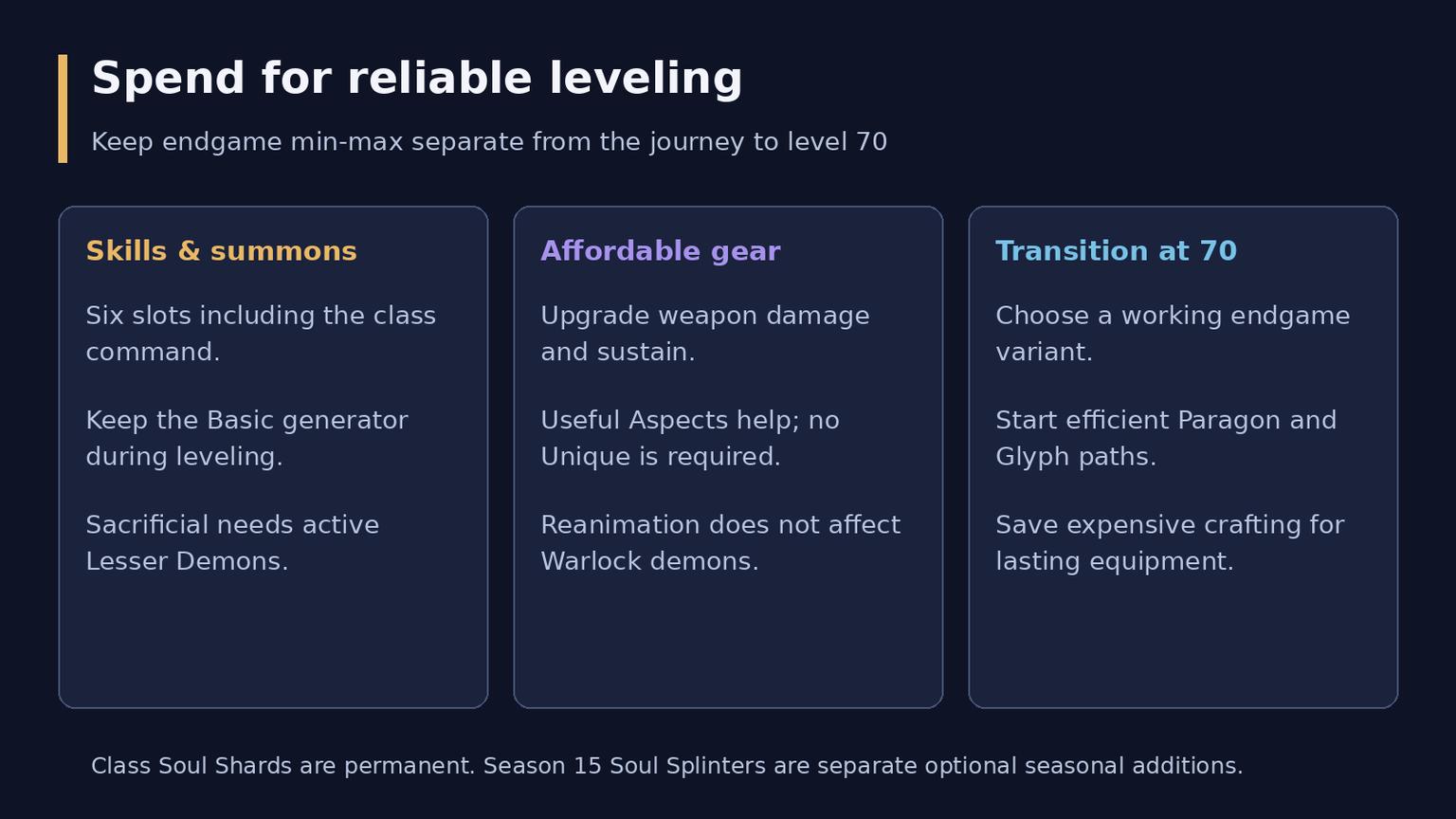
Spend for a reliable leveling character before pursuing a fully optimized endgame setup.
FAQ
Does Minion Warlock work for solo leveling?
Yes. Maintain Grunts, place rituals where enemies will remain and keep Nether Step ready. Summons contribute damage, but their presence does not replace your Life, resistances or positioning.
Which summons should I unlock first?
Start with Command Fallen and Bombardment, add movement, then Legion's Ae'grom from the level-15 class quest. Add Rampage and Sigil as their categories and modifiers open. Do not assume every later variant works from the first levels.
Is a Unique or Talisman set required?
No. Ae'grom's Schism and useful Aspects are optional upgrades. The manual Bombardment setup works without an automated set or Mythic Unique, and keeps its Basic generator for dependable resources.
When should I switch to an endgame build?
Reassess at level 70 and switch when the chosen version's skills, resource recovery and equipment are ready. Fiend can replace Sigil for a boss variant earlier when unlocked, but it does not become a seventh action slot.