Diablo 4 Occultist Guide: Aspects, Enchanting and Keys
The Occultist turns a usable drop into equipment that supports your build. Visit for a learned Legendary Aspect, one unwanted affix or a new activity key. The important decision comes before the transaction: is this the item you want to keep, or are you spending scarce materials on a temporary replacement?
This guide reflects Diablo IV Season 15, Season of Hell's Legacy, and live patch 3.2.3, checked October 21, 2026. The reusable Codex and normal crafting services are permanent systems, not temporary seasonal powers. Recent changes matter: eligible Unique, Mythic Unique and Iconic Mythic items can now be enchanted, and the latest published Ancestral enchanting cost is lower than in the previous season.
Finding and unlocking the Occultist
Look for the Occultist's three-loop symbol on a town map. Base-game locations include Kyovashad, Ked Bardu, Cerrigar, Zarbinzet and Gea Kul. Expansion settlements such as the Kurast Bazaar offer additional convenience once you have access to them. You do not need an expansion merely to use the base-game Occultist.
The established basic unlock is level 25, or earlier when you acquire your first Codex Aspect through a dungeon. Follow the Occultist's priority introduction if it appears. On a fresh character, an accessible dungeon that awards a useful Aspect can therefore be a more productive first visit than waiting solely for a level notification.
The NPC unlock is not a promise that every activity recipe is immediately usable. Key crafting depends on the corresponding activity and your progression. Check a locked tab's requirement and current priority quests. Old instructions to clear a tier-3 Nightmare Dungeon refer to the retired numbered-sigil progression; do not treat that launch-era step as a verified current requirement.
Choose the service that solves your problem
Your goal | Occultist service | Important limit |
Add a build-defining Legendary power | Imprint from the Codex of Power | Compatible Rare or Legendary equipment only |
Repair one bad equipment affix | Enchant Item | One chosen affix line per item, not every line |
Prepare another dungeon activity | Craft keys in the available menu | Recipe, materials and activity access still apply |
Recycle unwanted activity keys | Salvage eligible keys | Destroys the key in exchange for Sigil Powder |
Do not confuse learning a power with applying it. The Blacksmith learns Codex upgrades when you salvage suitable Legendary drops; the Occultist applies learned Aspects. Selling an item does not teach its Aspect.
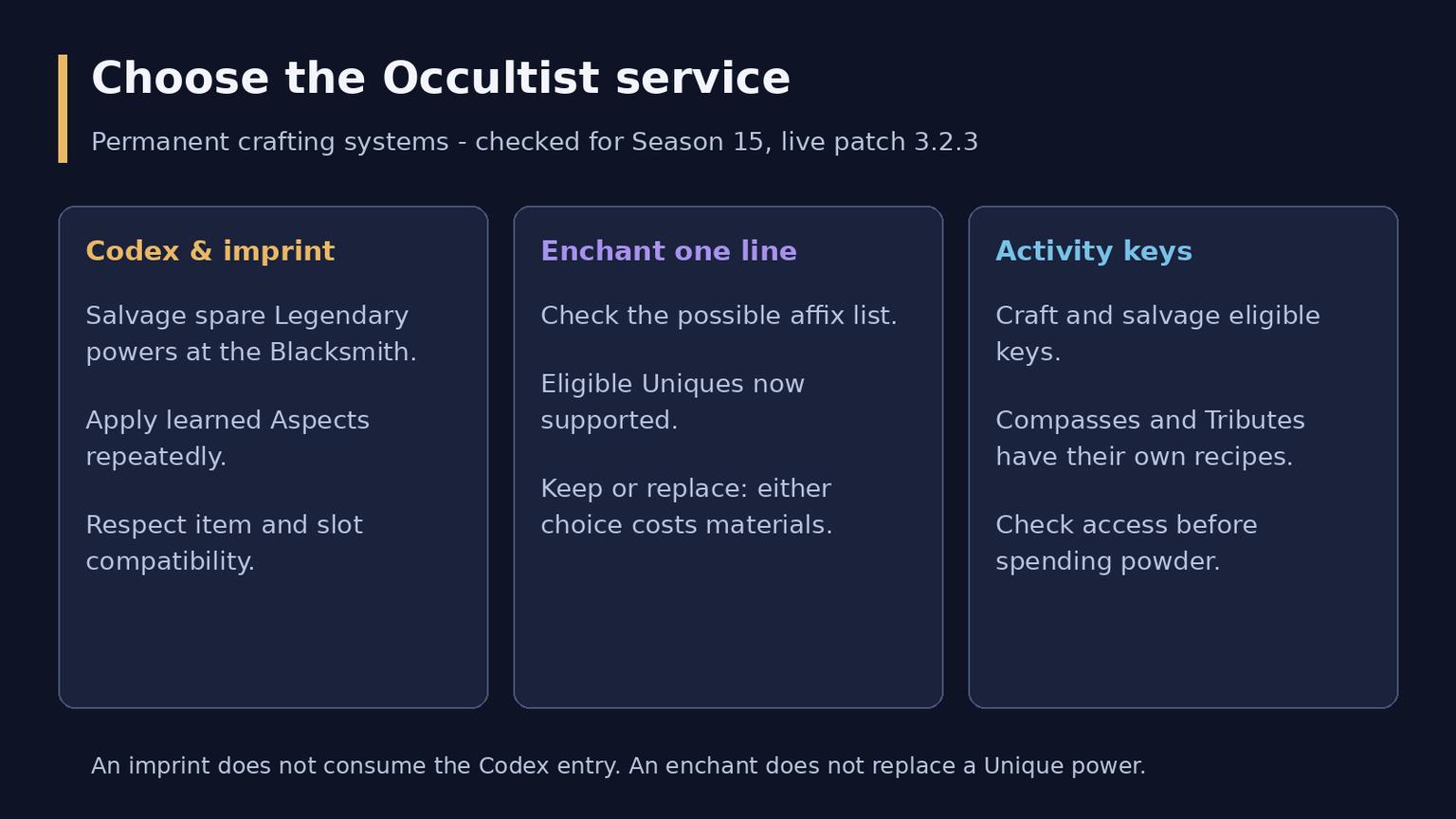
Choose between a reusable power, one affix replacement and activity-key crafting.
Codex of Power: learn once, imprint repeatedly
The Codex is your reusable library of Legendary Aspects. Some dungeons unlock an entry at its initial strength. Salvaging a Legendary item at the Blacksmith can learn its Aspect or improve the stored value when the salvaged power is stronger. Inspect the Codex-upgrade marker before deciding what to sell or dismantle.
There is no need to extract a power into a separate one-use Aspect item and carry it in your inventory. Applying a learned Aspect does not consume the Codex entry. You can pay to apply it again, or replace an existing Legendary Aspect with another compatible entry. A weaker new drop does not overwrite a better learned value.
Be careful with your currently equipped item. Salvage destroys it. If its Aspect is the only thing keeping your build functional, obtain a replacement before sacrificing it for the library. Conversely, an excellent Aspect on an otherwise poor drop may be more valuable in the Codex than in your stash.
Codex progress is shared within the relevant realm and account partition, rather than being a new extraction collection for every character. Seasonal progress is separate from Eternal progress. At season end, transferred Codex entries retain the stronger learned value when merged with Eternal; starting a new season does not mean bringing the previous Eternal library into it. Hardcore and other separated partitions should not be assumed to share everything.
Imprinting without wasting a good base
Place eligible Rare or Legendary equipment in the imprinting panel, choose a learned Aspect and inspect the result before paying. Imprinting a Rare makes it Legendary, but that does not guarantee a modern endgame-quality base. Compare the actual affixes and item quality, not the new color alone.
Aspect categories restrict the legal equipment slots. A resource or mobility power cannot simply be placed wherever you have room. Use the compatible choices shown in the interface and check the displayed power value for that slot. Unique, Mythic Unique and Iconic Mythic powers are not replaced through ordinary Legendary imprinting.
Gold and the materials displayed for that particular transaction are the price of application. There is no universal flat price that makes every weapon, ring and amulet equally cheap. A cheap defensive or resource Aspect can be worth applying while leveling; repeatedly rebuilding every temporary weapon is usually a poorer investment.
Enchanting: change one line, protect the rest
Enchanting replaces an eligible equipment affix. Choose the line carefully: after the first enchant, that is the line you can reroll again. You cannot fix a second unrelated affix by paying more at the same service.
Open the possible-affix list before rolling. The desired stat must be legal for that item, and some combinations are excluded. A small roll of a useful stat may already solve the problem; insisting on a perfect result can cost more than finding a better base.
After an attempt, select a proposed replacement or keep the current affix. Keeping it still spends the Gold and materials and commits that line to the enchanting system. It is not a free preview. Later attempts do not provide an archive of every previously discarded affix.
Repeated attempts increase the Gold charge toward the applicable limit; they do not guarantee the desired stat. There is no finite roll allowance comparable to an old Tempering durability counter. Check the next quote and set a personal budget before beginning. An enchanting-cost cap is not a guarantee that chasing perfection becomes economical.
Uniques and Greater Affixes
The old blanket statement that Uniques cannot be enchanted is obsolete. Released patch 3.1 opened one undesirable affix on eligible Unique, Mythic Unique and Iconic Mythic items to Enchanting. This changes an eligible affix, not the item's signature Unique power. Reworking that power through a separate system is a different operation.
Enchanting does not create a Greater Affix. Rerolling a Greater Affix sacrifices its greater status: do not select a valuable starred line when the problem is an ordinary line beside it. Think of the item as a combination of affixes, Aspect or Unique power, and crafting potential. A star on the wrong stat is not automatically better than an ordinary stat your build needs.
Tempered affixes are not normal Occultist reroll targets. Masterworking is also a separate process; an enchanted item is not automatically Masterworked, and enchanting is not a way to choose a Masterworking result. Legacy or Unmodifiable restrictions must be checked on the actual item before investing.
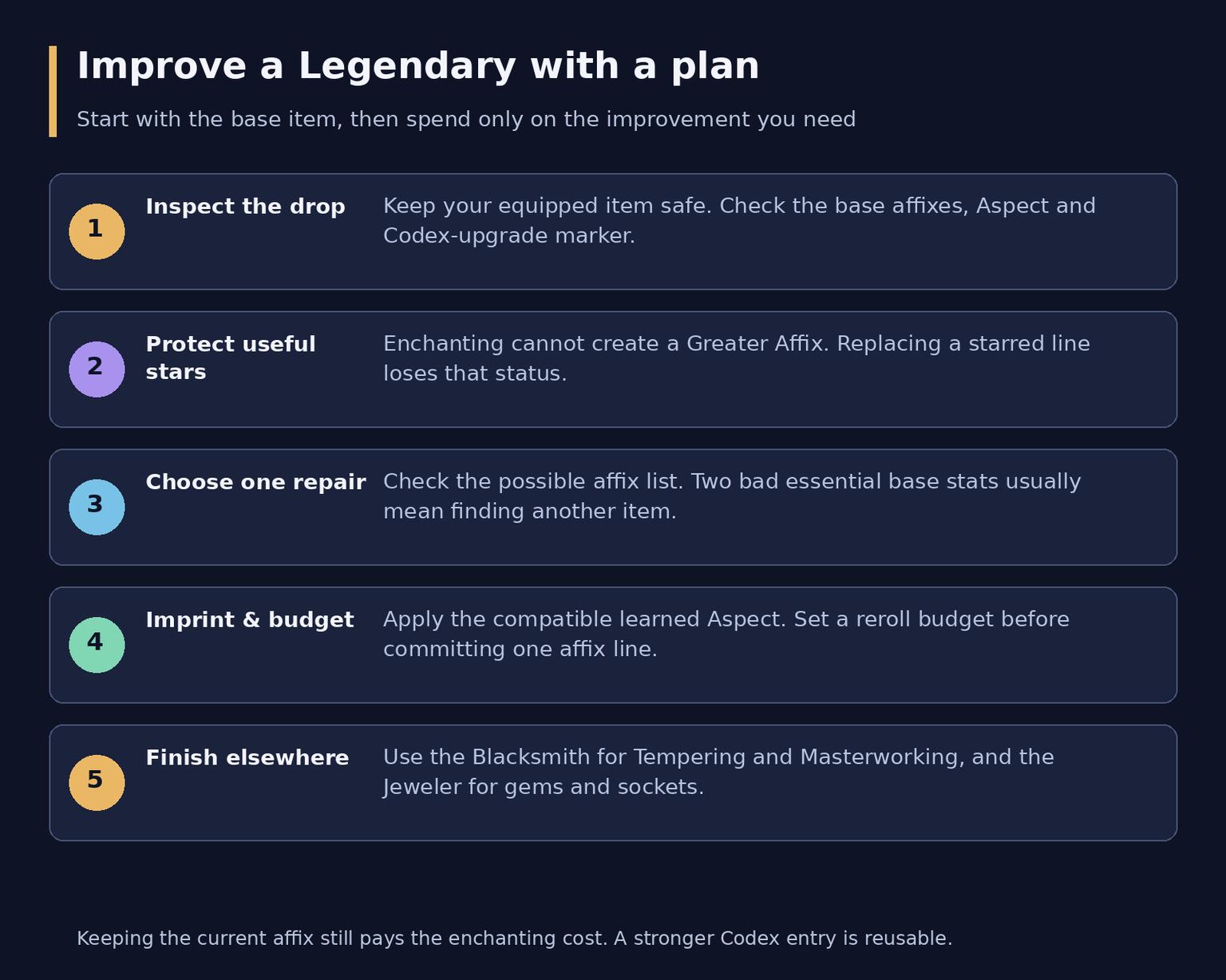
Decide whether to keep the base before committing an affix or paying for repeated upgrades.
Current costs: use the correct material and recipe
The released Season 15 notes give several precise changes. These numbers are not a complete invoice for every service: the Ancestral line below is the Forgotten Soul component, with the rest shown in the transaction preview.
Operation | Published current amount | What you should know |
Enchant an Ancestral item | 10 Forgotten Souls | Reduced from 25; Gold and any other listed materials remain separate |
Craft a random Magic Tribute | 100 Sigil Powder | Random Magic Tribute, not your choice of a high-rarity reward |
Craft an Infernal Horde Compass | 500 Sigil Powder | A recipe for that activity, not a Nightmare Dungeon sigil |
Salvage a Nightmare Dungeon Sigil | 20 Sigil Powder returned | Do not apply the old universal 15- or 25-powder estimate |
Salvage an Escalation Sigil or Infernal Horde Compass | 100 Sigil Powder returned | A return for destroying the key, not its purchase price |
Gold supports all of your crafting plans, while salvaging unwanted equipment supplies materials such as Veiled Crystals. Forgotten Souls come from appropriate reward sources, including Helltide and other endgame rewards; do not dismantle a valuable piece merely because you are short for one more attempt. Sigil Powder belongs to the activity-key economy and is recovered by salvaging eligible unwanted keys.
A sensible budget starts with a goal: enough resource generation to maintain your combat loop, a needed defensive stat, or the Aspect that enables your main skill. Pay for that improvement first. Leave maximum rolls and repeated marginal upgrades until you have a base worth keeping.
Sigils, Compasses and Tributes
The Occultist still crafts and salvages Nightmare Dungeon Sigils. A standard Nightmare Sigil is listed at 60 Sigil Powder in the specialist reference; use the live recipe quote before confirming, especially for a different key type. Modern Nightmare Dungeon difficulty follows your selected world difficulty rather than the original 1-100 sigil ladder. Do not spend time farming a historical tier number to satisfy an old guide.
The current service also includes Infernal Horde Compasses and random Magic Tributes, as the released cost changes confirm. These are separate entry systems. A Tribute is associated with Kurast Undercity, which requires the relevant expansion access; crafting an entry item does not grant that access. A Compass does not open a Nightmare Dungeon, and Sigil Powder is not a universal boss-summoning material.
Salvage only keys you genuinely will not use. Higher-rarity Tributes have different powder returns, so the same dismantle-all habit can destroy a desirable targeted run. Check the key's activity, modifiers, party conditions and reward before deciding that powder is more useful. Do not assume that every seasonal key or quest object belongs in this menu.
Which crafts belong elsewhere?
NPC or station | Main job relevant here | Do not confuse it with |
Occultist | Imprinting, one affix enchant, eligible key crafting and salvage | Adding Tempered affixes or sockets |
Blacksmith | Equipment salvage, Tempering and Masterworking | Applying a learned Codex Aspect |
Jeweler | Gem crafting and equipment socket services | Rerolling a normal equipment affix |
Alchemist | Potions, elixirs and incense | Equipment affix replacement |
Purveyor of Curiosities | Obol purchases with random item results | A guaranteed specific Aspect or affix |
Horadric Cube | Its own unlocked conversion and reroll recipes | The Occultist's one-line Enchant Item service |
The Cube received further recipe changes in Season 15, and patch 3.2.3 fixed several Cube affix rerolls. Those fixes do not turn the Cube into an Occultist tab or remove the NPC's one-line limitation. Likewise, older Masterworking rank tables and Tempering rules should not be inferred from a guide about this vendor.
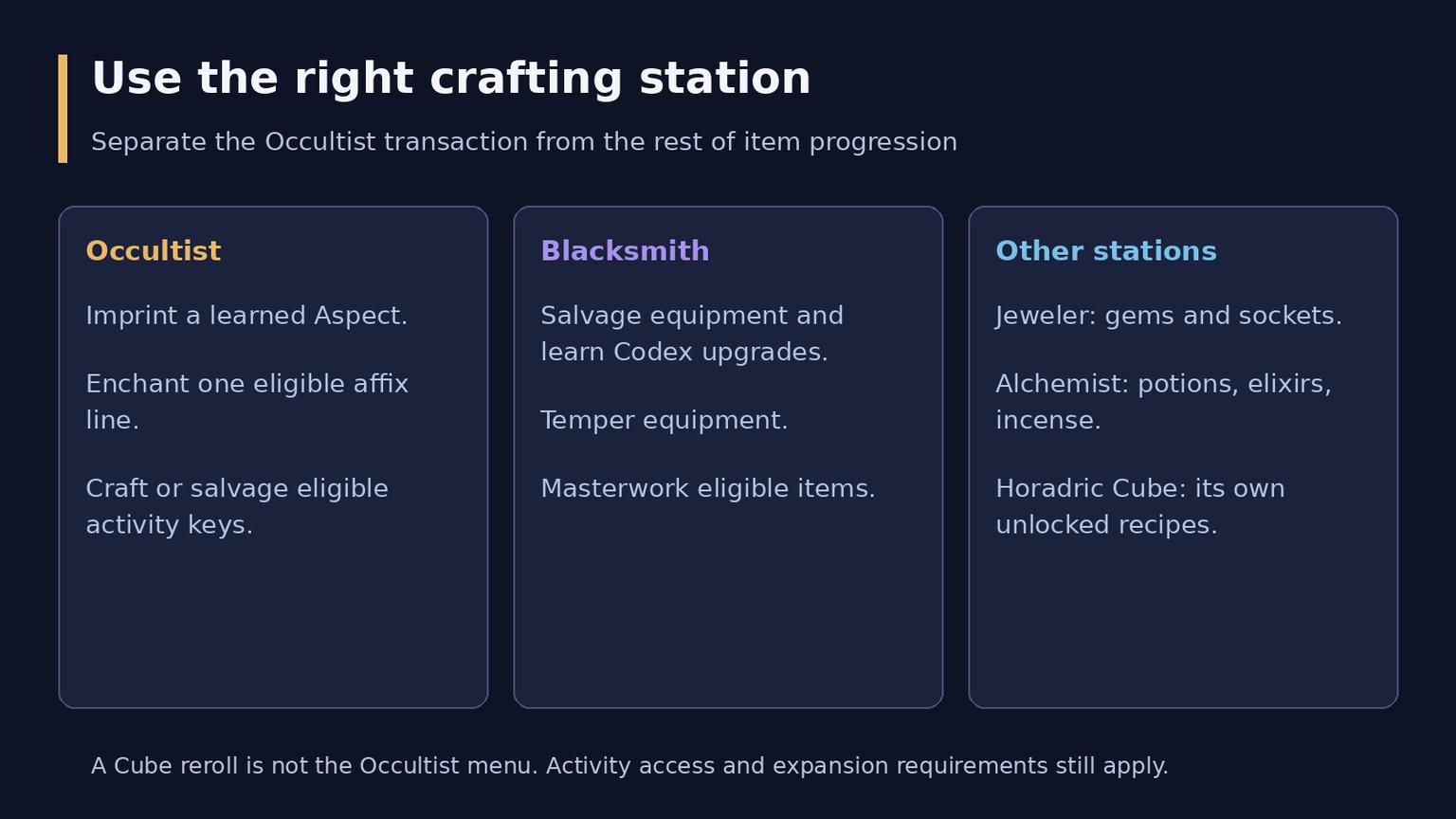
The Occultist applies powers and enchants; the Blacksmith and other stations handle separate improvements.
A practical town-visit routine
First, protect anything you are wearing and inspect new drops for Codex upgrades and a genuinely better base. Salvage a useful spare power at the Blacksmith, then return to the Occultist with the equipment you intend to use. Check the correct Aspect slot and identify the one affix that would make the biggest difference.
During leveling, prioritize a working build over perfect rolls. In early endgame, fix the obvious missing stat on a strong base and stop when it is useful. For an established character, coordinate the Aspect, the chosen enchant and the item's other crafting steps before paying for optimization. If two essential base affixes are wrong, keep looking rather than expecting enchanting to repair both.
Finally, refill activity keys only for content you intend to run. A town trip is successful when the next activity becomes safer or more productive, not when every crafting menu has consumed materials.
FAQ
How do I unlock the Occultist?
The basic unlock is level 25 or earlier through your first dungeon Codex Aspect. Follow the priority introduction when offered. Individual key recipes can have additional progression requirements.
Do I need to extract and store Aspect items?
No. Salvage suitable Legendary drops at the Blacksmith to learn or improve their Codex entries. The Occultist can imprint a learned power repeatedly for the displayed cost without consuming the entry.
How many affixes can I reroll, and can I enchant a Unique?
One eligible affix line per item, with repeat attempts on that same line. Eligible Unique, Mythic Unique and Iconic Mythic items now support enchanting too; their signature power is not the normal affix being replaced.
Does the Occultist perform Tempering and Masterworking?
No. Those are Blacksmith services. Use the Occultist for imprinting and enchanting, and the Jeweler for gems and sockets. Separate Cube recipes have their own rules.