Diablo 4 Paladin Overview: Oaths, Skills and Playstyles
Paladin is a live, permanent Diablo IV class included with Lord of Hatred, not a seasonal transformation or a pending PTR class. Early access began with the expansion announcement on December 11, 2025 in North America, December 12 in UTC. Lord of Hatred itself launched on April 28, 2026. You need Diablo IV and the relevant expansion entitlement to create a Paladin.
This overview is checked for October 21, 2026, Season 15 and live patch 3.2.3. The class is playable on Seasonal and Eternal realms. Its Faith resource, Oaths and skills are permanent; the current season's powers are separate. Start here to choose a playstyle before committing to a detailed build.
What makes the class different
Paladin combines weapon combat with conjured holy attacks, shields and Auras. Its Wardens of Light identity supports a heavily armored protector, but the kit also offers ranged hammers, ricocheting shields and angelic movement. The familiar names from earlier Diablo games do not guarantee the same mechanics or equipment rules here.
The practical attraction is flexibility: you can deal damage while sharing defensive or offensive benefits with nearby allies. You still need a working damage engine when playing solo. A shield, several Auras or a healing skill will not by themselves supply the boss damage required by harder content.
Strength is the primary damage attribute. Faith fuels many attacks and returns through regeneration, Basic skills and options such as Rally. Resolve is a defensive stack mechanic, not your main casting resource. Fervor and Judgement are also distinct from Faith; their value depends on your chosen Oath and skill tags.
Four Oaths, four different priorities
Oaths unlock at level 15. Choose one in the class mechanic interface and change it outside combat when testing another approach. You are not permanently locked to the first choice. Path of the Paladin exists as a story quest available to other classes too; do not confuse that quest with a required Oath-unlock chain.
Oath | Main interaction | What you manage |
Zealot | Fervor and echoed critical attacks from Zealot-tagged skills | Reliable critical hits and keeping Fervor active |
Juggernaut | Converts Resolve stacks into stronger, larger Juggernaut attacks | Building and spending Resolve without losing defensive coverage |
Judicator | Basic skills apply Judgement; compatible Core attacks detonate it early | Marking targets and triggering the follow-up |
Disciple | Cooldown-based Disciple casts grant Arbiter form | Timing eligible skills to maintain useful transformation windows |
Arbiter is the form used by Disciple and Arbiter of Justice, not a fifth Oath. Nor does selecting an Oath automatically convert every skill on your bar to its category. Read the tags after choosing variants: a visually similar attack can belong to a different scaling package.
Season 15 improved several Oaths and Core skills. Judgement now scales with the rank of the skill applying it, and Judicator gains extra damage when its explosion hits only one enemy. That makes the applying skill and boss setup meaningful, rather than treating every mark as a fixed launch-era damage packet.
Skills that shape your playstyle
The six skill groups are Basic, Core, Aura, Valor, Justice and Ultimate. Basic skills such as Advance or Holy Bolt help recover Faith. Core choices establish the main attack: Zeal emphasizes rapid close combat, Blessed Hammer creates spiraling projectiles, Divine Lance offers thrusting or modified ranged attacks, and Blessed Shield supports ricochets or alternative shield patterns.
Valor supplies movement and protection through skills such as Rally, Falling Star and Aegis. Justice contributes battlefield control, healing and area damage: Condemn pulls enemies together, while Consecration creates a healing and damaging area. These tools are useful only when you place them where the fight actually happens.
Ultimate choices have different purposes. Zenith offers a powerful sword attack; Fortress creates a defensive window; Arbiter of Justice grants an angelic form with Wing Strikes and modified movement; Heaven's Fury supplies sustained holy pressure. The class can support both burst and sustained damage, so choose around the intended loop rather than assuming every Paladin must slowly outlast enemies.
Current skill customization uses variant branches. There is no reason to import an old standalone passive or Key Passive allocation into an overview of the current tree. A detailed build should specify its current branches and prerequisites; this article does not prescribe a single universal skill bar.
Holy is a real damage type, not a label that makes every attack scale identically. Physical attacks and Fire conversions also exist in relevant setups. Check the chosen variant before prioritizing damage affixes. Conjured weapons and Wing Strikes are not proof of a permanent controllable minion army.
Auras and party utility
An equipped Aura has a passive effect and an active use. Fanaticism Aura supports attack speed and critical chance through Faith spending, with a base active that Weakens nearby enemies. Defiance Aura improves Armor and Resistances and offers a short Unstoppable activation. Holy Light Aura damages nearby targets; its returning active bolts can heal you.
Variants can change those jobs. For example, Fanaticism's Rite of Humility replaces the active's Weaken with Vulnerable. Defiance's Rite of Prayer adds healing and Resolve generation. Do not describe every alternative as simultaneously active, or assume that learning an Aura without the required equipped setup grants its full benefits.
Consecration can heal allies in its area, while control and movement help the group keep enemies in useful positions. This utility supplements damage; a dedicated support-only character is not required to enjoy the class. Plan around proximity and timing instead of expecting distant allies to benefit from every local effect.
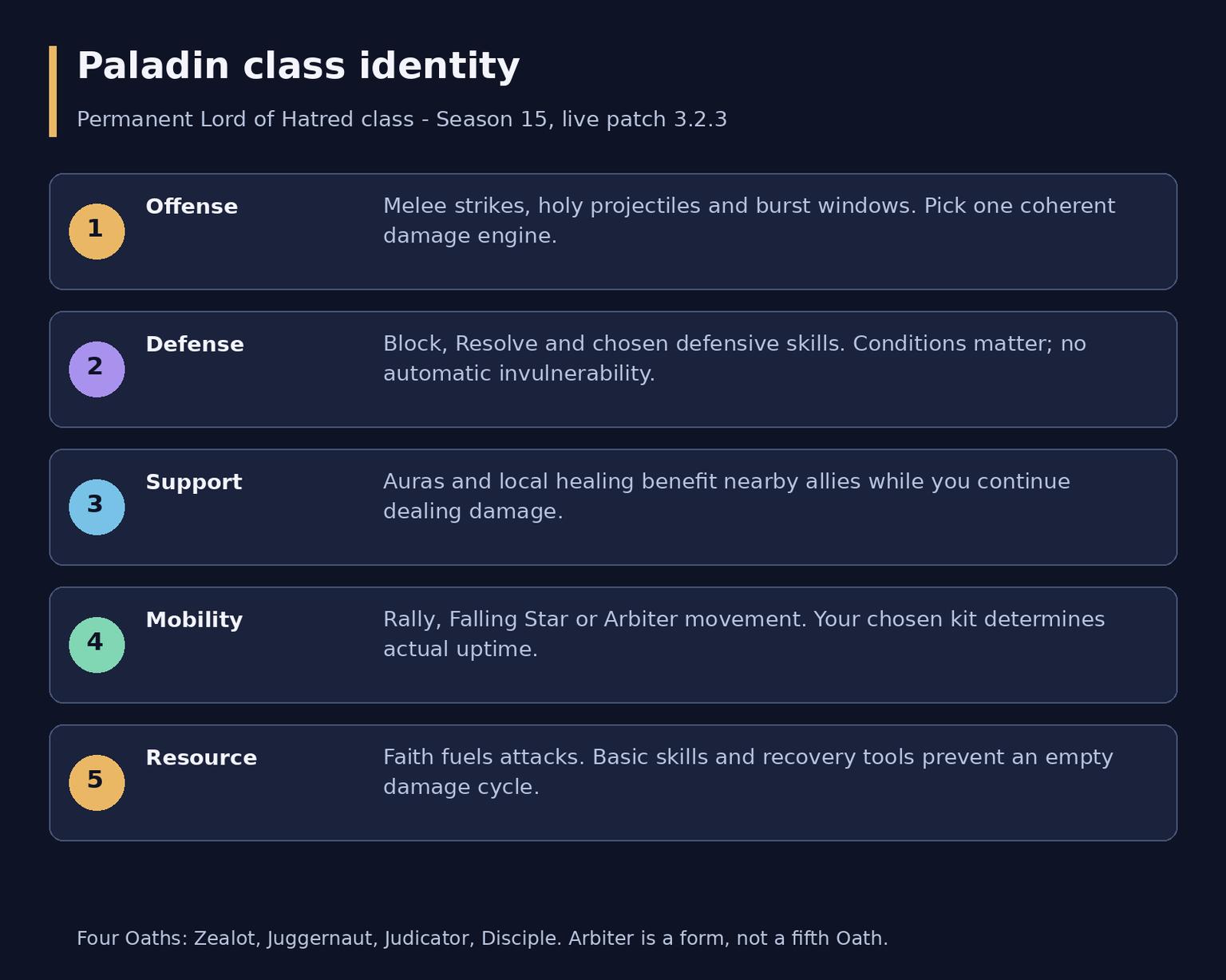
Paladin identity: damage, defense, utility, movement and Faith management.
Defense and movement in practice
Block, Armor, Resistances, Resolve and selected Fortify effects provide several defensive layers. They have conditions and cover different problems. Base Resolve supplies damage reduction while active and normally loses a stack to direct hits; Juggernaut modifies its minimum and spending behavior. It is not a percentage reduction multiplied by every stack.
Aegis offers a block window and nearby Taunt. Defiance's Unstoppable helps against crowd control, while Fortress has a limited Immunity window. Neither implies permanent invulnerability. Keep health recovery available and move out of lethal ground effects rather than treating block as an answer to every damage source.
Paladin is not inevitably slow. Falling Star can reposition you, Rally supports movement and Faith, and Arbiter form changes Evade to Angelic Leap. Those benefits depend on the chosen skills, form uptime and equipment. Spending every movement cooldown just to reach the next pack can leave you without an escape when an elite starts its dangerous attack.
A simple combat loop before picking a build
Enter with Faith available and identify the skill that does most of your damage. Gather or position enemies if your attacks need a shared area, establish the relevant Oath mechanic, then spend during the useful window. Use a Basic attack or your chosen recovery tool before the resource bar becomes empty.
For Zealot, that means maintaining Fervor and landing suitable critical attacks. For Judicator, it means applying marks before the detonation. Disciple needs eligible cooldowns rather than random button presses; Juggernaut needs a sustainable Resolve cycle. Preserve a defensive response for the threatening part of the encounter.
Bosses reveal gaps that packs can hide: fewer fresh kills, fewer targets for recovery, and more movement out of your damage area. Test single-target sustain early. If a boss encounter stalls, examine resource recovery, actual skill contact and the Oath's activation conditions before adding another offensive item.
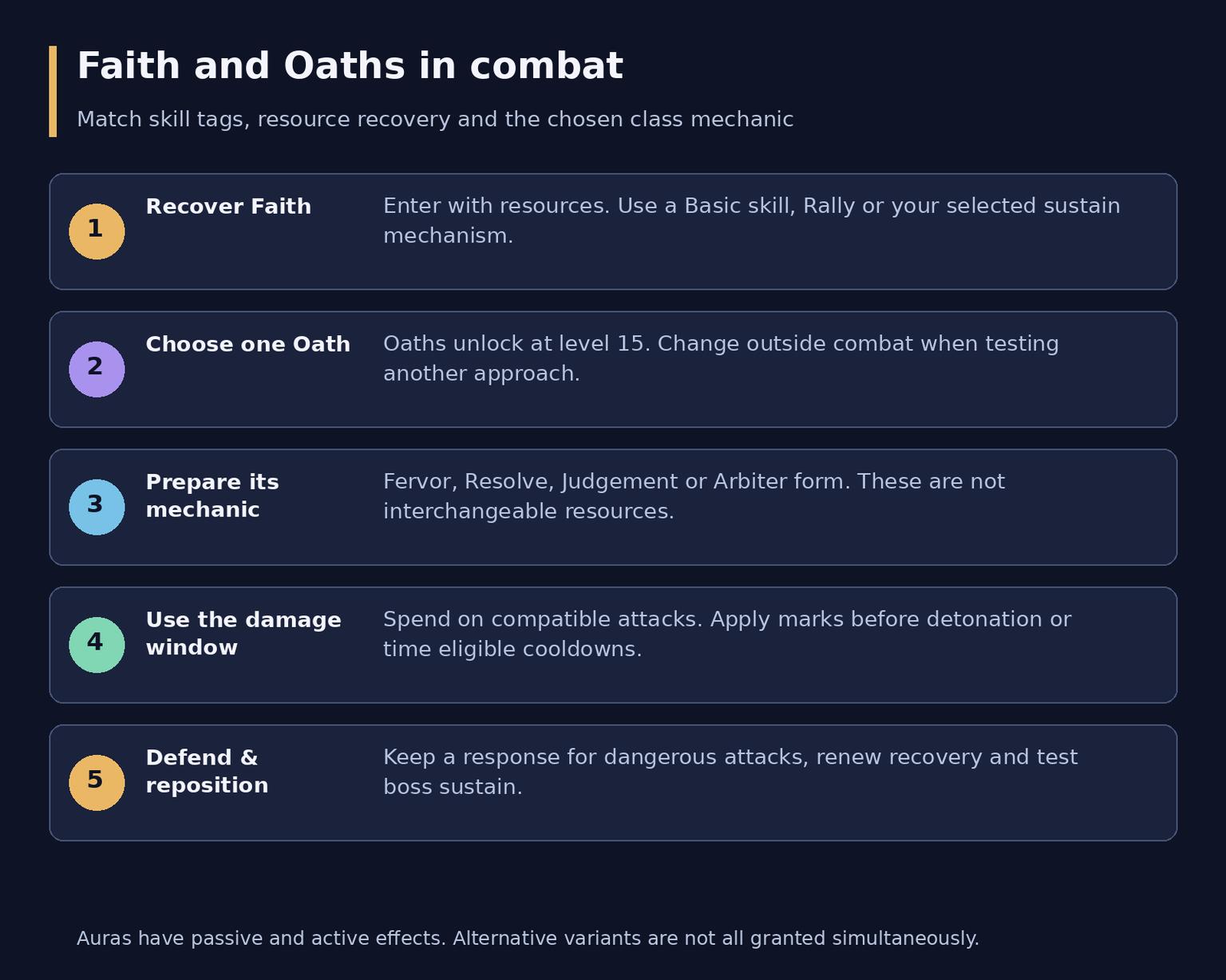
A practical loop: recover Faith, select an Oath, activate its mechanic, deal damage and reposition.
Weapons, shields and meaningful equipment
Paladin can use one-handed swords, maces, axes and its signature flails, alongside shields. Two-handed swords, axes and maces are also options. The normal equipment choice is a one-handed weapon plus shield or a two-handed weapon; do not import another game's ability to freely combine a two-hander with a shield.
Shield-centered skills and bonuses need their relevant equipment interactions. Inspect the selected skill and item requirements before changing weapon style. A two-handed damage upgrade can remove block, shield affixes or an important Unique interaction. Conversely, a weak shield is not automatically superior merely because it looks appropriate for the class.
Uniques are build-specific tools. Herald's Morningstar improves Blessed Hammer and can produce an additional base hammer through Lucky Hit. Ward of the White Dove boosts Blessed Shield and rewards weaving another skill before subsequent throws. Red Sermon is a two-handed Zeal option. None is a class-wide prerequisite for ordinary leveling.
Legendary Aspects likewise reinforce a particular mechanic. Aspect of Glynn's Anvil supports Resolve-based defense; Aspect of Watkin's Law belongs to Judicator gameplay and was changed in Season 15 to consume and reapply Judgement under its stated conditions. Cathedral Song also changed from its old Lucky Hit trigger to a Judgement-consumption trigger. An older item guide may therefore describe a different rotation even when the item's name is unchanged.
Look first for useful skill ranks, compatible damage multipliers, resource recovery and defenses. Favor Greater Affixes on stats the build actually uses. Mythic Uniques can be later upgrades in specific setups, but are not required to understand the class or begin playing it.
Leveling, crafting and the endgame transition
For a first character, choose one main attack and keep a reliable Faith generator, a defensive tool and practical movement. Zeal and Blessed Hammer have established leveling paths; choose by preferred range and feel, not an unsupported universal ranking. Auras can make the journey comfortable, but filling all slots with support does not fix a weak main attack.
Replace weapons as their useful damage improves and add affordable Aspects when they solve an actual problem. Expensive optimization belongs on lasting gear. Tempering adds a chosen affix from a learned manual to eligible non-Unique equipment at the Blacksmith. Masterworking improves eligible Ancestral Legendary or Unique gear through current Quality progression and a Capstone upgrade; it is not the old twelve-rank system.
At level 70, move to a coherent endgame build with matching Oath, Aspects, Paragon boards and Glyphs. Some aura-damage setups depend on gear such as Dawnfire to change how they clear enemies; their low-button gameplay is not the default behavior of every new Paladin. Read the requirements before copying only the visible skill bar.
The Pit tests scaling and boss damage; Nightmare Dungeons and Infernal Hordes reward repeatable clearing and support crafting progress. Kurast Undercity rewards efficient movement and priority-target damage. Lair bosses demand stable single-target output. These are practical build tests, not proof that every Oath performs equally at every difficulty.
Season 15 adds Waking Nightmares and seasonal powers as extra activities and modifiers. Oaths remain available in Eternal, but seasonal advantages should not be assumed there. War Plans, Talismans and the Horadric Cube are Lord of Hatred systems; optional Runewords and Mercenaries have their own expansion access and unlock requirements. The class does not require you to master all of them on the first evening.
Who should choose Paladin?
Choose it if you enjoy an armored character with visible defensive tools, a choice between close and ranged holy attacks, and useful effects for nearby allies. A simple generator-and-spender setup is approachable for a beginner. More advanced versions ask you to track Oath conditions, form uptime, resource recovery and gear conversions.
The main weaknesses are mismatched skill tags, empty Faith, conditional defenses and investments in equipment that does not support the selected engine. Shield survival, AoE, boss damage and speed each need deliberate choices. Judge the class through the build you want to play rather than a promise that Paladin is automatically the strongest or safest option.
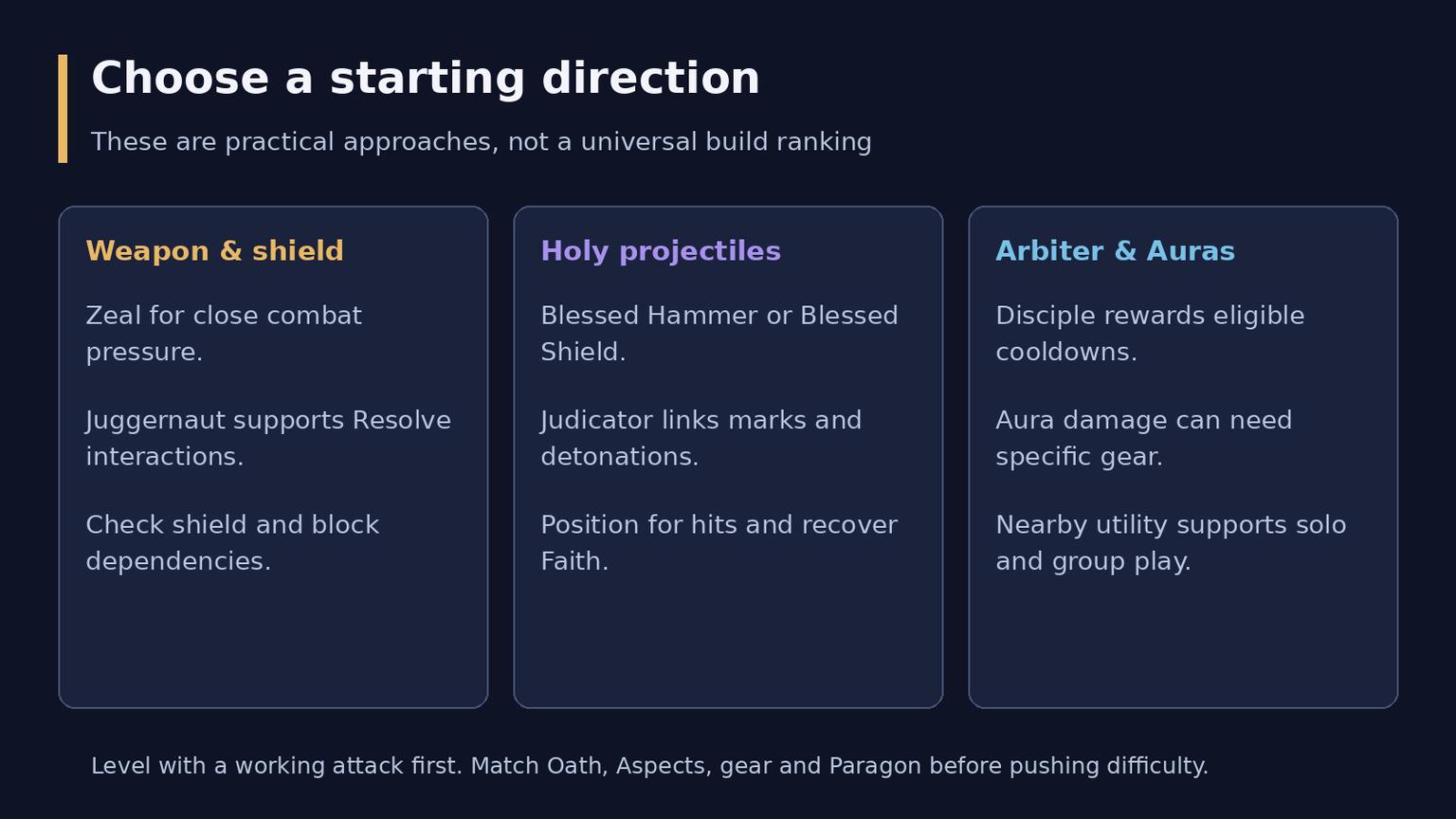
Starting directions: weapon and shield, holy projectiles, or Arbiter and Aura gameplay.
FAQ
Is Paladin already playable, and what do I need?
Yes. It is a permanent live class for Diablo IV players with Lord of Hatred access, playable on both Seasonal and Eternal realms.
When do Oaths unlock, and can I change one?
They unlock at level 15. Choose Zealot, Juggernaut, Judicator or Disciple in the class interface; you can change your choice outside combat.
Must every Paladin use a shield?
No. Two-handed setups exist, but shield skills, block bonuses and specific Unique shields require an equipment plan that supports their mechanics.
Is Paladin suitable for a beginner?
Yes, with one clear damage skill, reliable Faith recovery and a defensive response. Save complex Aura conversions and transformation optimization for a chosen endgame build.