Diablo 4 Soul Splinters Guide: Farming, Effects and Upgrades
Soul Splinters are Season 15 socketable gems, not a currency to spend at a reputation vendor. Put one into an eligible jewelry socket to gain a benefit and accept its drawback. A useful Splinter can improve a build considerably; the wrong one can interrupt its resource engine, remove critical strikes or make routine farming unsafe.
This guide covers Season of Hell's Legacy, checked on October 21, 2026, against live patch 3.2.3. The system is currently seasonal. Do not confuse these eight jewelry gems with the three Splinters of Evil that select a Prime Evil power and reputation track. Completing the seasonal story awards those separate alignment items, not a guaranteed collection of all eight socketable Soul Splinters.
For a straightforward start, continue your seasonal progression, keep useful Splinter drops and pick one type that suits your build. Once you want a specific one, look for a matching Gem Reserve on a Nightmare Dungeon Sigil. Build a stock of matching duplicates rather than waiting exclusively for a direct Unique drop.
Access and equipment rules
Use a Season 15 character on the Seasonal Realm. Soul Splinters are not presented as a permanent Eternal Realm gem system. The season's gems are distinct from Lord of Hatred features: obtaining seasonal items does not automatically grant access to the Horadric Cube or War Plans. Those systems require Lord of Hatred. The Cube is unlocked through its campaign and becomes available in Temis; Vessel of Hatred alone does not supply it.
The normal jewelry setup has three sockets across an amulet and two rings. Each Splinter type can be used only once at a time, so collecting duplicates is primarily useful for upgrades and alternative characters, not equipping three copies of one effect. Respect any level requirement shown on the individual item rather than treating every rarity as an immediate leveling upgrade.
Leoric's Crown is a specific exception because the helm counts as jewelry and accepts the relevant gems. Its current item entry lists a 35-50% increase to the effect of socketed gems. Do not repeat the old 75-100% figure or treat the Crown as permission to socket Soul Splinters into every helmet. Compare its full equipment trade-off before replacing an important helm power.
Finding your first copies and choosing a farm
Seasonal play provides opportunities to collect Splinters before you have a specialized farming setup. Community reports include Helltides, seasonal reputation rewards and the Undercity merchant. Check a cache's actual contents rather than assuming every completed activity awards a fixed number. Ordinary monsters, elites or a boss with a matching name should not be treated as a guaranteed named-Splinter dispenser.
For a specific type, the most actionable community-tested route is a Nightmare Dungeon carrying the matching Gem Reserve affix. Open the Horadric Reserve chests inside the dungeon; running straight to the boss can bypass the reason you selected that Sigil. These pairings narrow the source, but do not guarantee the desired gem from every chest or run.
Target Splinter | Matching resistance | Reserve affix to look for |
Anguish | Fire | Ruby Reserve |
Sin | Lightning | Topaz Reserve |
Lies | Cold | Sapphire Reserve |
Pain | Poison | Emerald Reserve |
Mother | Physical | Skull Reserve |
Hellfire | All elements | Diamond Reserve |
Damnation | Shadow | Amethyst Reserve |
The Black Soulstone Splinter grants All Stats instead of a matching resistance. A Diamond Reserve pairing has been suggested, but is not reliably confirmed. Farm Diamond for Hellfire if useful, while treating any Black Soulstone result as a bonus rather than a promised target.
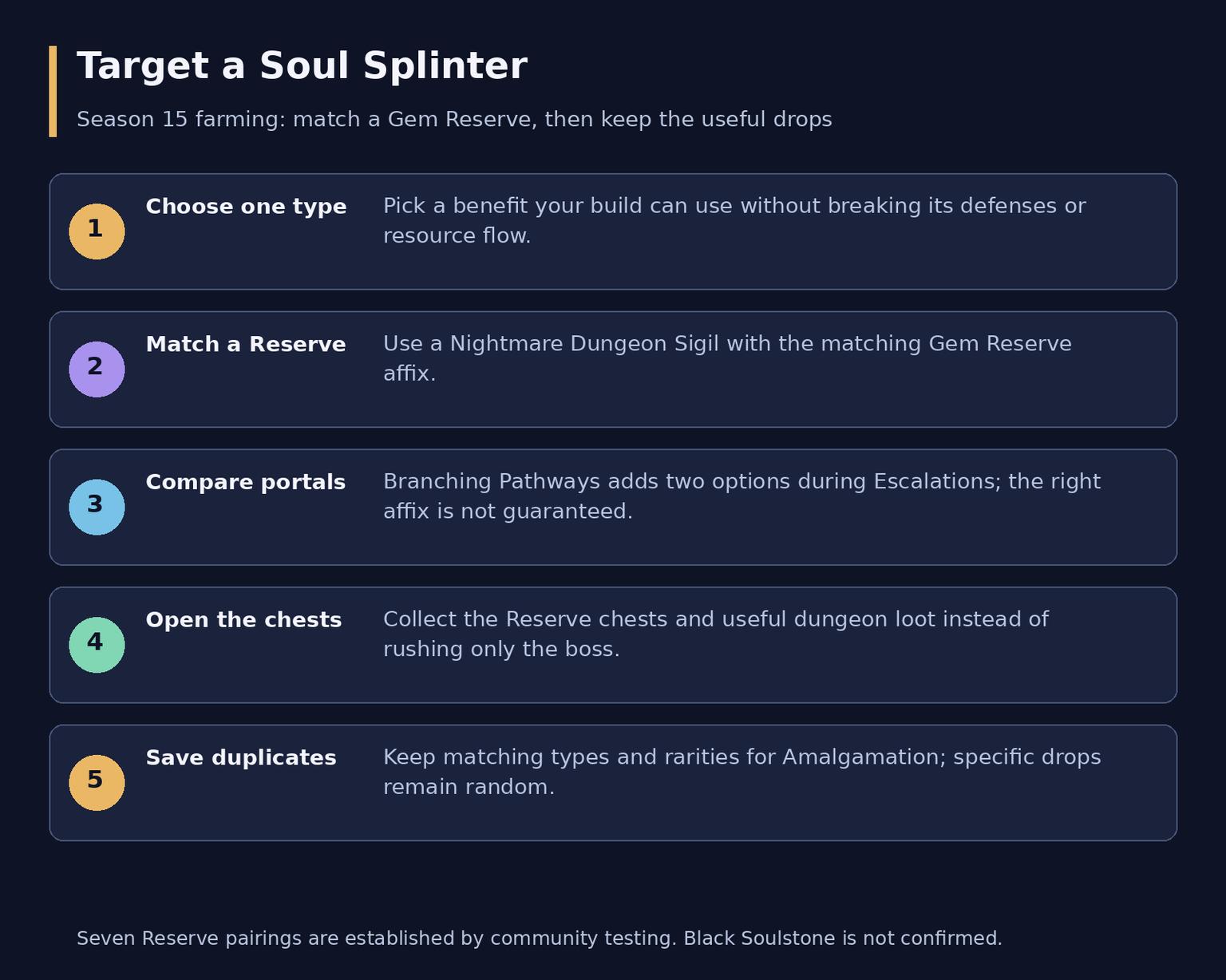
Match the Reserve, collect its chests and keep duplicates; a matching affix is not a guaranteed drop
When Escalations help
A regular Nightmare Dungeon with the right Reserve is already a useful starting point. With the appropriate expansion systems unlocked, Escalation Sigils give you a longer loop with choices between floors. Allocate Branching Pathways in the Nightmare Dungeon War Plan to gain two additional portal choices, then inspect their affixes before advancing. The node expands the offered options; it does not reroll a Sigil in your inventory or guarantee your preferred Reserve.
The connected preparation path used by the farming guide is Dread Revival, Recurring Nightmare and Branching Pathways. These are War Plan nodes, not class skills. You can combine five regular Nightmare Dungeon Sigils into an Escalation Sigil in the Cube, but keep an already suitable regular Sigil out of that recipe. A key that directly matches your target can be more useful than another random starting option.
Solo farming is practical when your build clears the selected dungeon reliably. A coordinated party can reduce time spent clearing and help sustain a longer session, but there is no verified special party multiplier guaranteeing more Soul Splinters per player. Agree on the Reserve and collect the relevant chests together. In Solo Self-Found, plan around the mode's restrictions instead of a group route.
Raise difficulty when several complete runs remain comfortable. If the boss takes much longer or frequent deaths interrupt the route, test a lower setting. The checked sources do not provide a dependable per-Torment drop multiplier, a minimum tier guaranteeing an Abyssal gem, or a daily or weekly Soul Splinter farming cap. Judge the farm by useful duplicates collected over multiple runs, not one lucky drop.
The eight effects and their trade-offs
The following comparison uses the top, Abyssal/Unique tier without Leoric's Crown. Lower rarities generally have smaller benefits, while many penalties remain unchanged.
Soul Splinter | Abyssal benefit | Liability |
Anguish | +20% Attack Speed and Critical Strike Chance | +30% Primary Resource costs |
Sin | +50% Maximum Life | -30% Maximum Primary Resource |
Lies | +100% Gold/material drop rate; +25% experience | Always Weakened and Vulnerable |
Black Soulstone | +2.5% damage per soul; up to 200 souls | +1% damage taken per soul |
Pain | 25% Damage Reduction | -30% Movement Speed |
Mother | Unhindered; touching enemies applies Vulnerable | A 4-second Stun after 250 touches |
Hellfire | 50% multiplicative damage increase | -100% Critical Strike Chance |
Damnation | +25% experience after an elite-pack kill | +1 Monster Power for the 25-second effect |
The Black Soulstone's souls last 10 seconds and do not refresh collectively when you earn another kill. Its value changes between dense packs and an isolated boss. Do not judge it from a maximum-stack screenshot while ignoring the simultaneous increase in incoming damage.
Anguish and Sin both interact with resources, but in different ways: one makes spending more expensive, the other reduces your maximum pool. Check effects that depend on remaining or maximum resource before accepting either penalty. Hellfire needs even more care if your skills or item triggers rely on critical strikes. More listed damage does not compensate automatically for disabling an essential interaction.
Pain can help a fragile character survive, yet slower movement may make avoiding attacks harder. Mother supplies movement through enemies and Vulnerable application, but its eventual Stun still needs planning. Lies and Damnation are farming choices when their risks remain manageable. None is a universal recommendation for every class or every difficulty.
Upgrading through Amalgamation
There are four live rarities: Magic/Lesser, Rare, Legendary/Greater and Unique/Abyssal. Use Amalgamation in the Horadric Cube with five copies of the same type and rarity. The result is one of that same type at the next rarity, not a random different Splinter. Mixed names or mixed rarities do not substitute for matching ingredients.
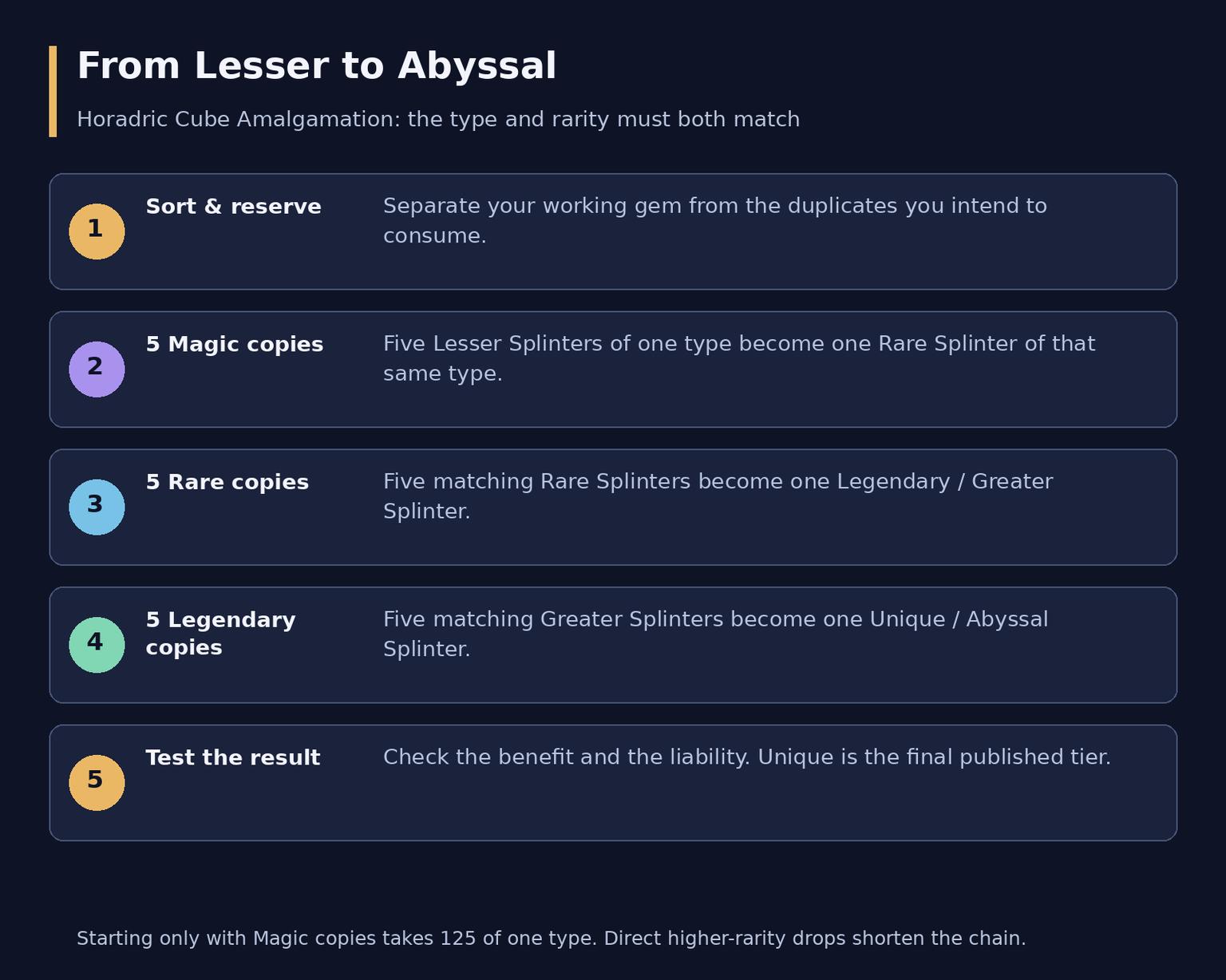
Five matching copies produce one at the next rarity; keep your working gem out of the ingredient pile
The upgrade inputs are five Magic for one Rare, five Rare for one Legendary, then five Legendary for one Unique. Starting entirely with Magic copies therefore takes 125 matching Splinters to make one Unique: 25 Rare, then five Legendary, then one Unique. Direct higher-rarity drops shorten that path. This is ingredient arithmetic, not a prediction of dungeon runs or hours.
The documented recipe lists the matching Splinters as its ingredients; the checked current recipe does not list an additional gold or dust charge. Confirm the Cube's displayed preview before committing rather than applying a cost from another Cube operation. Unique is the final published Soul Splinter tier. Ordinary gem fragments are not a substitute for matching Splinters in this upgrade chain.
Single-resistance Splinters rise from 250 to 1,750, 2,625 and 4,375 resistance across the four tiers. Hellfire instead grants 35/250/375/625 All Resistance, while Black Soulstone gives 7/20/30/50 All Stats. Those are rating values, not that many percentage points of resistance. Higher rarity also improves the main effect, but does not erase the bargain: upgrading Anguish still leaves the resource-cost penalty.
What to keep and what to upgrade first
Test a candidate in familiar content before committing enough duplicates to finish its upgrade chain. Watch the entire fight: resource recovery, movement, critical triggers and incoming damage all matter. Change one Splinter at a time so that a failed test has an understandable cause. Compare the result with the ordinary gem you displaced as well as with other seasonal options.
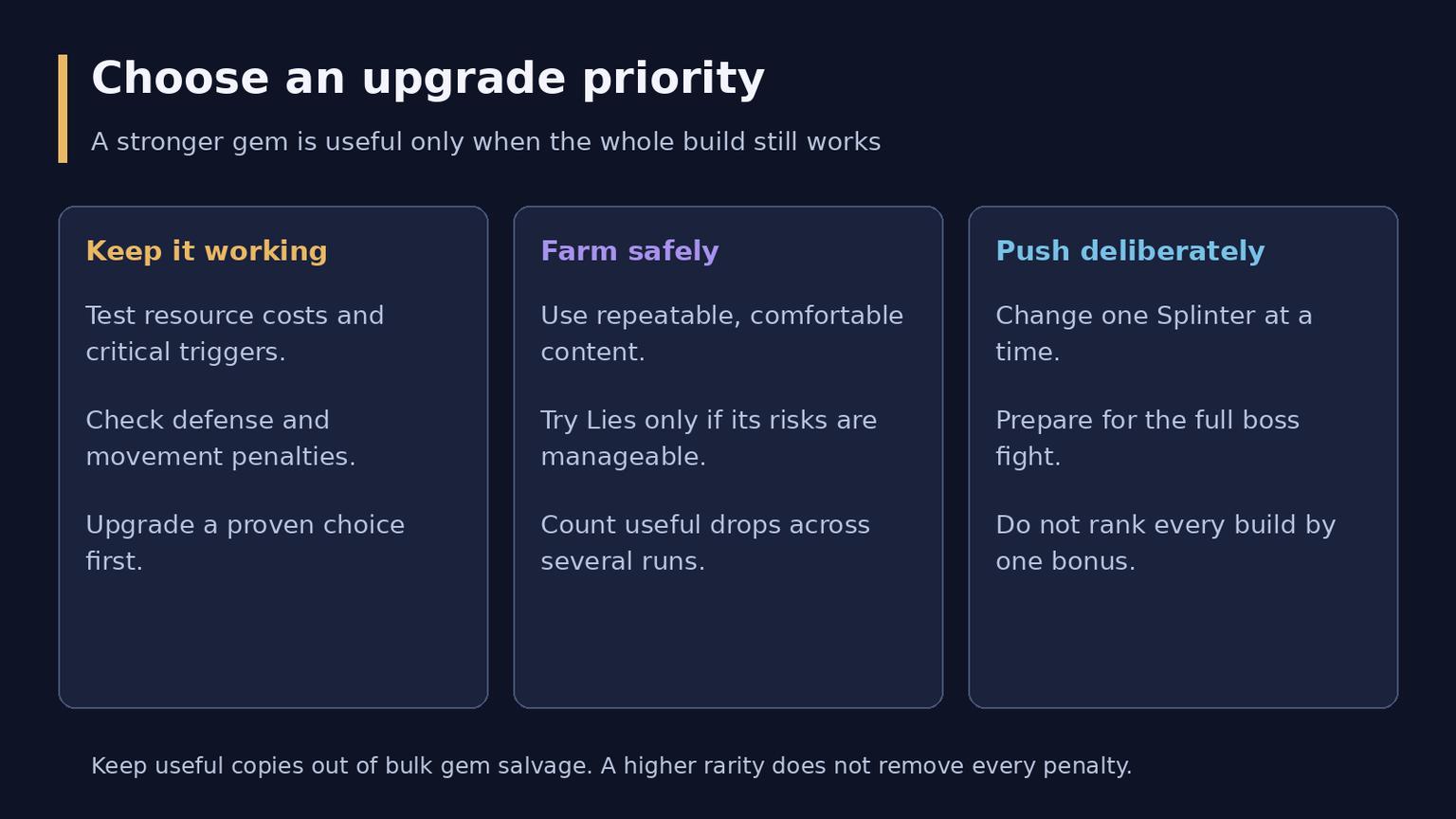
Fix a working build first, improve a safe farm next and save specialized combinations for deliberate tests
Prioritize a gem you are already using successfully, then one needed for a second repeatable activity. Keep at least one working copy separate if consuming all five ingredients would leave your current setup incomplete. Saving duplicates has a clear purpose when they advance a chosen upgrade; hoarding every type indefinitely makes storage harder without improving the build you actually play.
The Cabochon Merchant in the Undercity is an optional alternative when its War Plan conditions are met. A published community test showed Lesser Splinters at 400,000 Gold each, but stock is random and this is an observed offer, not a guaranteed price for every Splinter. Refreshing stock can consume other resources, so inspect the current offer and set a spending limit. A fresh character should not empty its crafting budget chasing one favorable shop roll.
Storage and the end of the season
Soul Splinters are account-bound seasonal items. They are physical gem items rather than a balance in the materials wallet, and can be kept in the stash. Compatible ordinary seasonal characters can use shared storage; do not assume transfers between Seasonal and Eternal, Normal and Hardcore, or separate modes. Account-bound does not mean you can hand duplicates to another player.
Keep useful copies away from bulk gem salvage. Players have reported losing Soul Splinters through the Jeweler's salvage-all-gems option. Check the selection, store reserved copies first and use removal rather than salvage when changing a socketed setup. Socketing is equipment customization, not a consumable charge spent on every fight; Amalgamation, by contrast, consumes its ingredients.
As of this check, Blizzard has not confirmed that Soul Splinters will become permanent Eternal Realm equipment after Season 15. Do not save a collection on the assumption that the effects will survive the seasonal transition. Permanent Legacy Uniques and shared War Plan progress have their own announcements; neither proves that seasonal socketable powers transfer unchanged. Recheck the next season's official transition notes before planning an Eternal build around them.
FAQ
Where should I farm a particular Soul Splinter?
Use a Nightmare Dungeon with its matching Gem Reserve and open the Reserve chests. Escalations with Branching Pathways offer more floor choices. Seven pairings are established by community testing; Black Soulstone has no reliably confirmed Reserve target.
What are Soul Splinters used for?
They are seasonal socketable gems with benefits and drawbacks. They are not a vendor currency, summoning material or the separate Splinters of Evil reputation system. Duplicates of the same type and rarity feed Cube upgrades.
How many copies do I need for an Abyssal Splinter?
Five Legendary copies make one Unique/Abyssal copy. Starting only with Magic copies takes 125 of the same type. Higher-rarity drops reduce the number you need to collect.
Will they remain usable after Season 15?
Their permanent use on Eternal has not been confirmed in the checked official materials. Treat them as seasonal and consult the transition announcement when it is published rather than assuming your collection carries over with its powers intact.