Diablo 4 Spiritborn Overview: Guardians and Spirit Hall
Spiritborn suits players who enjoy staying active: closing gaps, grouping enemies, maintaining short defensive windows and turning repeated attacks into stronger follow-up effects. The Nahantu warrior channels animal spirits through martial techniques. You control the fighter directly; choosing a Guardian does not give you a permanent pet army or turn the class into a shapeshifter.
The appeal is flexibility with consequences. An attack associated with one Guardian can work with another Guardian's Spirit Hall bonus, but the combination still needs a coherent damage engine. Four animal themes do not mean that investing equally in four damage types produces a good character. Start with one reliable way to kill enemies, then add the resource supply, protection and movement that let it work.
This overview reflects Season 15, Season of Hell's Legacy, and live patch 3.2.3 as checked on October 20, 2026. It explains the class rather than prescribing one endgame build.
Access and the important changes since release
Spiritborn arrived with Vessel of Hatred in October 2024, advertised for October 8, with the scheduled global rollout beginning October 7 in Pacific time. You need Diablo IV and access to Vessel of Hatred to create the class. Standard expansion access is sufficient; Deluxe or Ultimate cosmetics are not class requirements. Lord of Hatred includes Vessel of Hatred, so owning that newer expansion also supplies the required access.
Expansion ownership now affects more than the character selection screen. The redesigned skill tree has three modifier branches per active skill. The first two offer general modifiers; the final branch offers major skill variants. Without Lord of Hatred, two of its three variants are accessible; owning it opens all three. The tree redesign itself is a permanent game update. Old instructions to allocate points into the former passive and key-passive tree nodes are therefore not a current leveling plan.
Season 15 also changed Spiritborn interactions. Variants that previously replaced a skill's original Spirit now add the new Spirit tag instead. Blizzard corrected excessive damage from the Tzic rune, reduced Aspect of Supremacy's maximum stacks and strengthened other parts of the class. A launch-era damage demonstration, or a recently fixed interaction, is a poor basis for choosing a build today.
Four Guardians and the styles they support
The following damage types describe the native skill families. Variants can change a skill's damage type, and additional Spirit tags do not automatically convert its damage.
Guardian | Native emphasis | Practical attraction |
Jaguar | Fire, repeated direct hits, Ferocity | Aggressive attack sequences and keeping momentum |
Eagle | Lightning, movement, precision | Mobile attacks, projectiles and Vulnerable support |
Gorilla | Physical damage, protection, Thorns | Close combat supported by barriers, blocking and Resolve |
Centipede | Poison, damage over time, control | Poison pressure, area effects and sustain |
Jaguar
Jaguar rewards continuous offense. Ferocity is an attack-speed buff, not the Vigor resource bar. More attack speed can make a generator feel better, but it can also empty a spender's resource supply faster. Rake exemplifies the aggressive attack style, while Rushing Claw helps maintain contact or reposition through enemies.
In the primary Spirit Hall slot, Jaguar builds toward an additional strike through repeated direct-damage events and rewards sustained attacking. Its secondary bonus supports Ferocity. This is attractive if you enjoy maintaining pressure; consider how your setup behaves when a boss becomes untargetable or movement interrupts your sequence.
Eagle
Eagle combines mobility with accurate attacks. Quill Volley is a projectile example, while Soar offers repositioning. A ranged-looking animation does not guarantee that maximum distance is optimal: projectile overlap and the selected variant can change where you should stand.
The current primary Eagle bonus launches Storm Feathers from Eagle skill casts or Evade, supports movement and applies Vulnerable. The secondary bonus supports guaranteed critical casts and damage against Vulnerable enemies. These are separate benefits; selecting Eagle is not a promise that every button becomes a long-range attack or that movement alone replaces your main damage skill.
Gorilla
Gorilla supplies tools for holding your ground without making positioning irrelevant. Crushing Hand is an area-damage example. Armored Hide's base form supplies passive Resolve generation and an active window of Unstoppable and blocking; chosen upgrades or variants can change that package.
Primary Gorilla adds Thorns damage on qualifying attacks and generates a short barrier. Secondary Gorilla raises maximum Resolve and provides Unstoppable while its stack condition is met. Resolve currently supports Armor, and taking direct damage consumes a stack. Track its uptime rather than assuming a permanent defensive bonus. A barrier absorbs damage; blocking, Armor and Unstoppable solve different problems.
Centipede
Centipede favors Poisoning, pressure over time and control. Withering Fist introduces poison during leveling; Stinger and Touch of Death illustrate different ways to build around the theme. Poison damage and Poisoning damage over time are related concepts, but a skill's direct hit and its continuing damage do not necessarily scale identically.
Primary Centipede layers Poisoning, slowing and reduced enemy damage through hits. Its secondary bonus supplies healing associated with nearby enemies you have poisoned. This supports dense encounters, but a build must still function against one boss. Do not assume that ordinary critical-strike investment improves poison ticks in the same way it improves a direct hit.
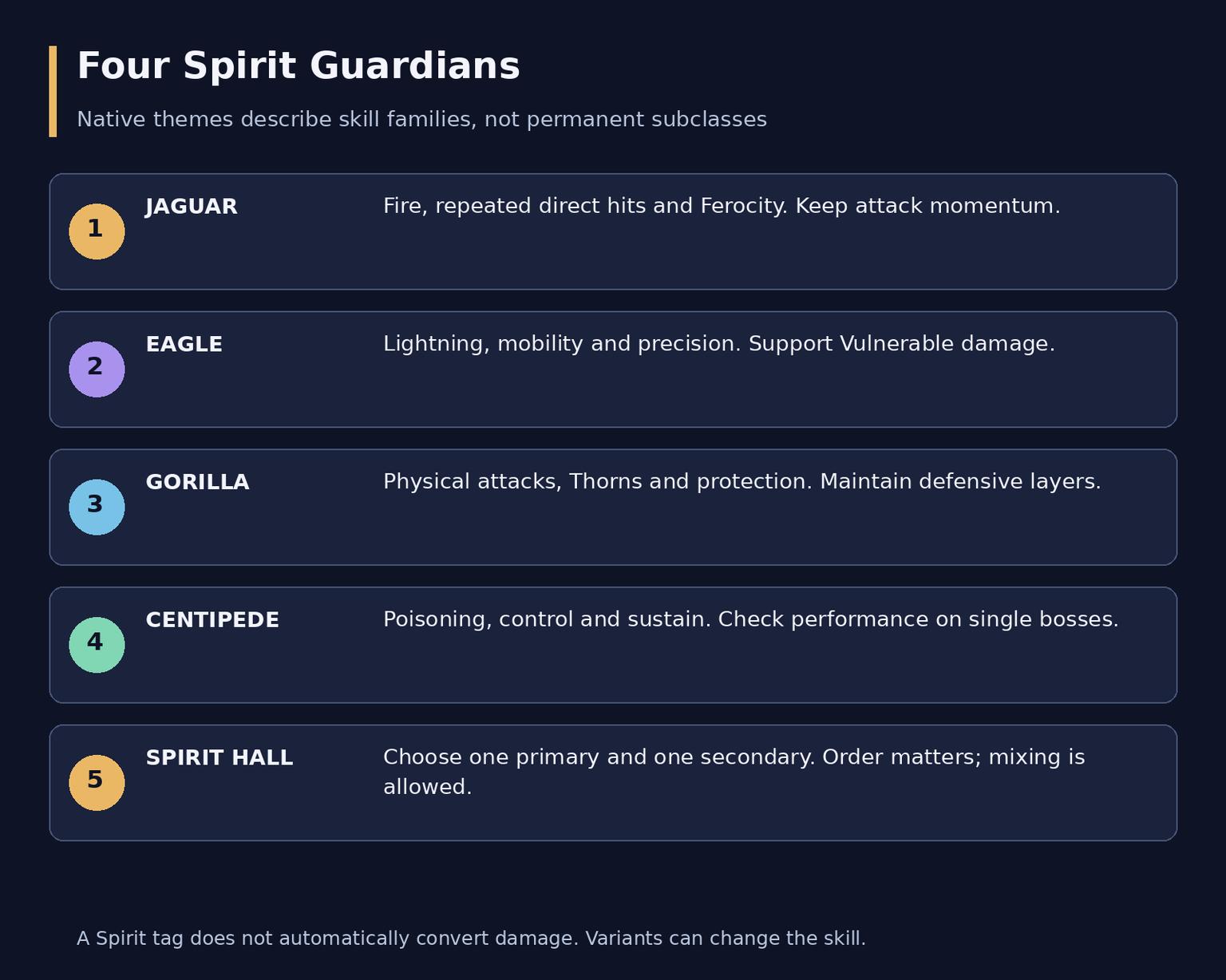
Four native Guardian themes, with Spirit Hall choices layered on top of the skill selection.
Spirit Hall is a build decision, not a permanent subclass
On your first Spiritborn, reach level 15 and complete Sacred Hunt, started through Tarka in Gea Kul, to unlock the primary Spirit Hall selection. The class quest only needs completing once per class on the account; later characters benefit from the existing unlock. The secondary slot unlocks at level 30. Check the class window before repeating a quest solely to obtain an already unlocked mechanic.
You choose one primary and one secondary Guardian. They can be the same animal or different ones. Their effects depend on the slot, so swapping their order changes the result. Primary Gorilla plus secondary Jaguar is not interchangeable with primary Jaguar plus secondary Gorilla.
The primary choice also adds its Spirit tag to your skills. For example, an Eagle attack can additionally count as Gorilla with primary Gorilla, enabling relevant interactions. It does not become Physical damage merely because it gained that tag. The secondary choice normally grants its listed bonus; equipment such as Harmony of Ebewaka can add further tag interactions. Always read the modified skill and item together.
Change one part at a time when experimenting. First ask which main skill deals your damage. Then ask what primary bonus it can reliably trigger and what the secondary choice fixes: speed, critical support, healing or control protection. Choosing a Guardian because its animal looks powerful is less useful than checking whether you can maintain its conditions.
Vigor and a usable combat loop
Vigor is the main resource. It does not inherently refill just because you wait. Basic attacks generate it; Core attacks normally spend it. Upgrades, equipment and other effects can add generation, refunds or different spending rules. You should be able to identify your actual source of recovery before removing a Basic attack from the bar.
The beginner loop is straightforward: enter from a safe angle, establish protection or control, generate enough Vigor, spend it through the main attack, then rebuild while repositioning. This is a framework rather than a fixed rotation. An item-based endgame engine may sustain the spender continuously, while a Basic-focused setup may make the generator itself the damage source.
When the loop stalls, inspect the cause before adding more damage bonuses. Are you missing enemies with the generator? Is your refund conditional on critical hits? Did a selected upgrade raise the resource cost? Does the effect require a kill, making it unreliable on bosses? More attack speed will not repair a refund that never triggers.
Skills should cover jobs, not fill a checklist
Spiritborn's six skill categories are Basic, Core, Focus, Defensive, Potency and Ultimate. Their purpose is easier to understand through the jobs on your bar. Basic usually supplies a repeatable generator; Core often supplies the main spender. Focus and Potency include offensive and utility tools, Defensive helps you survive, and Ultimate supplies a larger spirit-powered effect. There is no requirement to take exactly one skill from every category.
Incarnate is an additional tag, not a seventh category. Skills such as Ravager, Toxic Skin and Armored Hide combine a passive benefit while equipped with an active effect. A variant can substantially change what that button does. Read the selected version instead of applying the base skill's description to every build.
Keep an escape or control answer available when learning. Soar and Rushing Claw can help reposition, Vortex can group enemies, and Scourge can disrupt them. Spending every movement charge to reach a pack may leave you with no answer to its dangerous attack. Choose a manageable bar before pursuing a faster but more demanding setup.
Survival and the limits of crowd control
Spiritborn can combine barriers, Armor, resistances, blocking, dodging, healing and damage reduction. These layers need active maintenance. A short barrier expiring between packs, depleted Resolve or a defensive skill still on cooldown can explain deaths on a character that felt durable moments earlier. Do not treat Fortify as an automatic class-wide defensive system.
Unstoppable answers control impairment; it is not blanket immunity to incoming damage. A high block chance is also not permission to stand in every ground effect. Build enough life and appropriate defenses for the difficulty, then use movement to avoid attacks that your temporary protections cannot safely absorb.
Against ordinary enemies, pulls, slows, fears and knockdowns can create safe damage windows. Bosses generally use a Stagger system rather than being repeatedly displaced like a normal pack. Test whether your damage and recovery work without frequent kills and constant crowd control before raising the difficulty for boss farming.
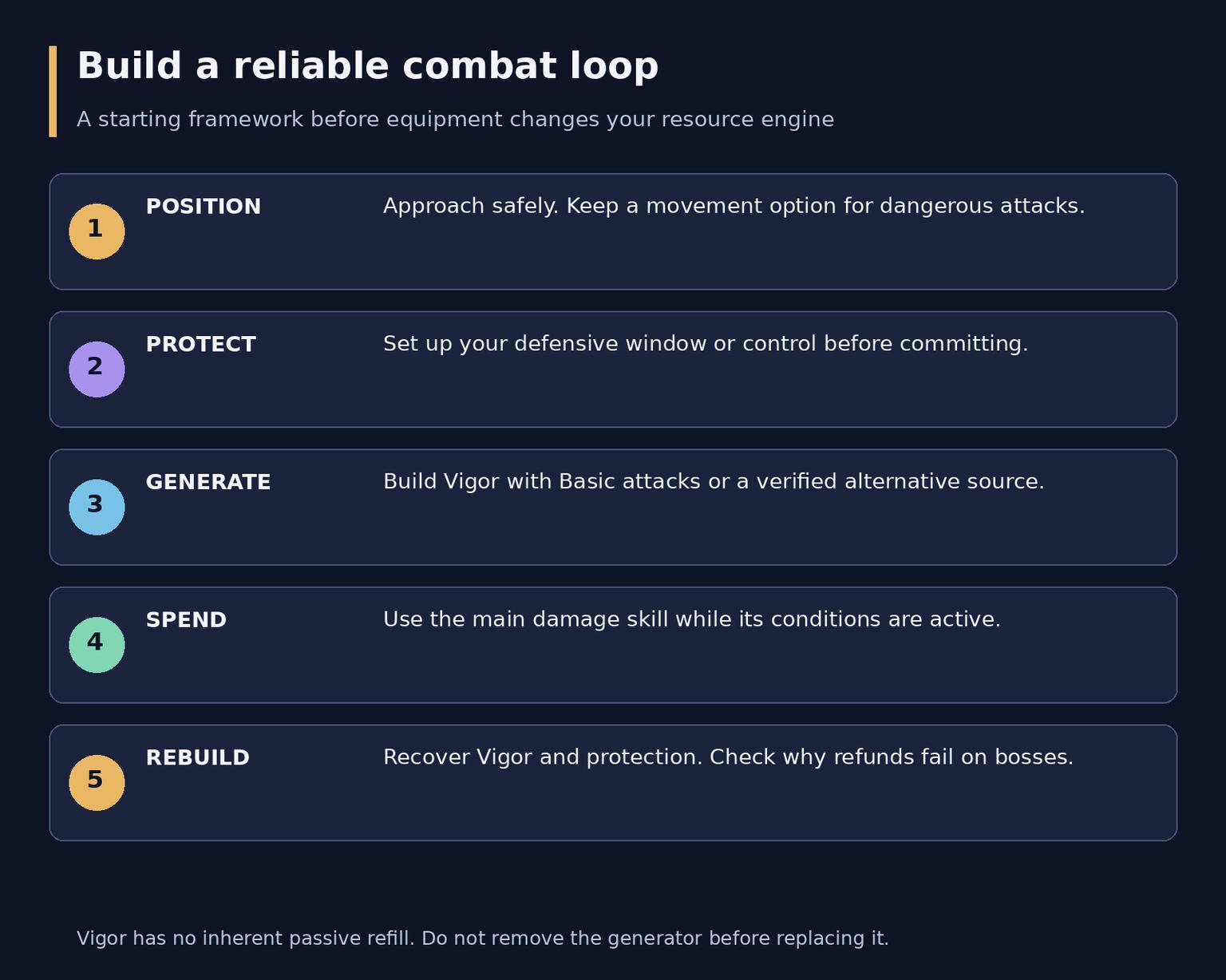
A beginner framework: position, protect, generate, spend and rebuild. Equipment can change the resource engine.
Weapons, Uniques and equipment priorities
Spiritborn uses two-handed quarterstaves, glaives and polearms. It does not have a dual-wield or shield-based class arsenal. While leveling, compare usable weapon damage alongside the effect supporting your main attack; at endgame, a build-defining Unique can matter more than a superficially attractive replacement.
Item or system | What it can change | What to check first |
Rod of Kepeleke | Adds Basic status to Core skills and changes casting and full-Vigor behavior | Maximum Vigor and dependable recovery |
Ring of the Midnight Sun | Returns recently spent Vigor on critical hits | Whether critical hits and the refund actually sustain the loop |
Harmony of Ebewaka | Adds secondary-Guardian tag interactions | The resulting tags and bonuses used by the build |
Sepazontec | Supports a Basic-attack damage approach | Whether the main damage skill is actually Basic |
These are examples of different engines, not a universal shopping list. A refund ring does not fix a character that cannot trigger it consistently. Equipping several famous Uniques without their supporting interactions can be weaker than a coherent Legendary setup.
Use Legendary Aspects to support the chosen engine, defense and resource supply. Read their trigger conditions and eligible categories. In the current tree, some former passives have moved into equipment effects and some former Aspects have moved into skills. An old screenshot may show a bonus in the wrong place even when its name is familiar.
Tempering supplies a chosen extra affix to eligible gear; Masterworking develops item Quality and a final affix bonus on eligible Ancestral items. The current Quality system replaces the old twelve-rank Masterworking model. Modern Unique and Mythic customization also differs from launch, so do not apply a blanket old rule that all Unique affixes are untouchable. Improve a usable base with the right effects before spending heavily on final optimization.
Progression and choosing content
Leveling now leads to level 70, followed by Paragon progression. Build the Paragon route around the effects you actually use, including relevant Legendary nodes, Glyphs and their requirements. The Season 15 Swarm of Storms board supports Pestilent Swarms, Spirit Storms and Storm Feathers; it is not an automatic choice for every Spiritborn.
Lord of Hatred owners can also develop the Talisman system through Seals and Charms. Guardian-related set bonuses add another layer of conditions, rather than replacing Spirit Hall. Seasonal powers are a separate layer again: Season 15's Soul Splinters offer benefits with drawbacks. Neither system should be mistaken for a permanent fifth Guardian or an inherent property of the class.
For Helltides and repeated dungeon clears, look for easy movement, dependable area damage and little recovery downtime. For bosses, check sustained single-target damage, survival between cooldowns and resource generation without kills. For harder Pit progression, precise defensive timing and a complete scaling engine matter more than fast movement alone. These are selection criteria, not a claim that one Guardian wins every activity.
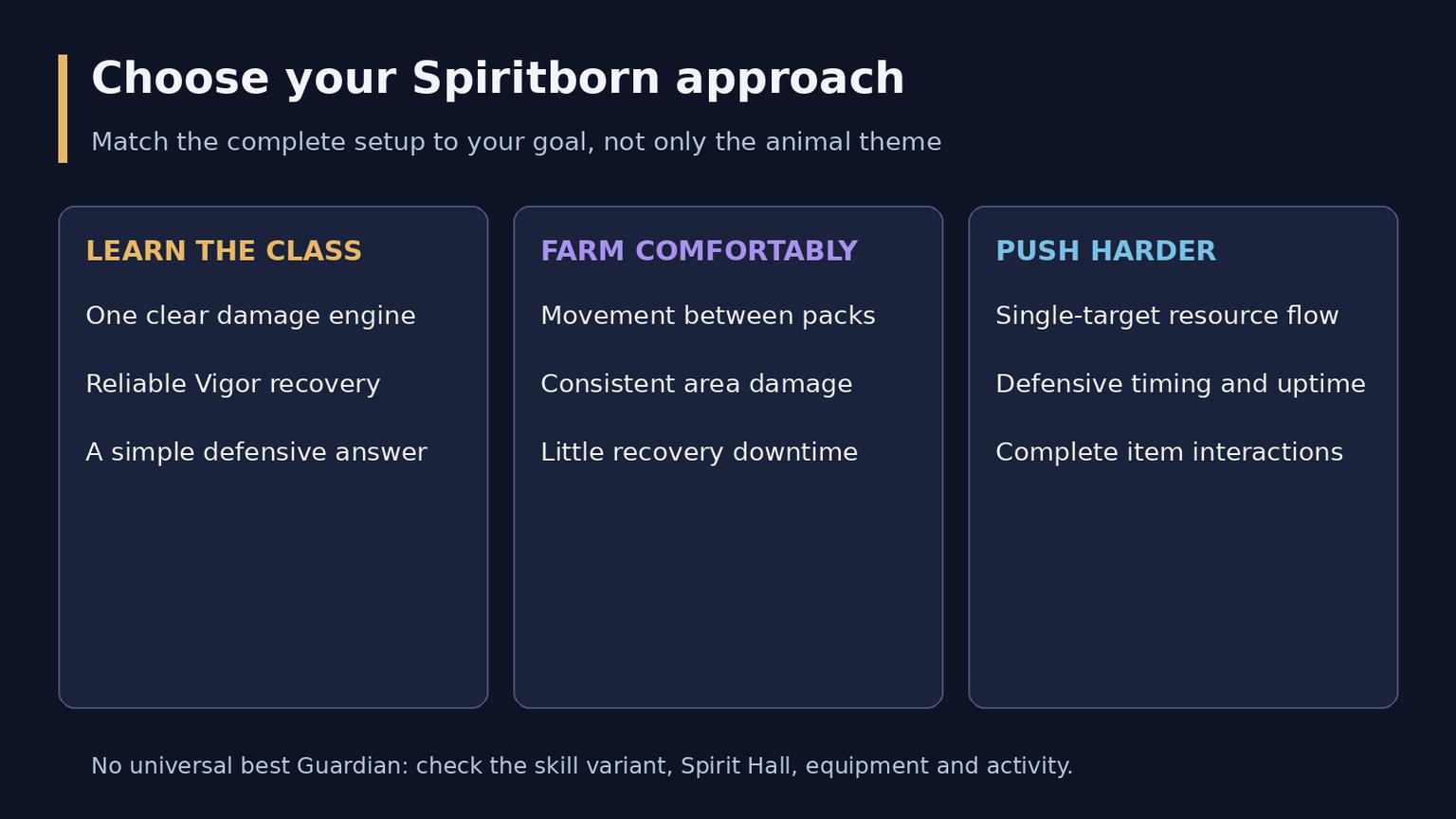
Choose for learning comfort, farming speed or progression demands, then match the complete setup to that goal.
Spiritborn is approachable if you start with one damage button, an understandable Vigor source and a reliable defensive answer. Its complexity appears when several item effects, Spirit tags and short buffs must work together. Before copying an endgame setup, confirm that you own the required expansion features and have the items that make its combat loop possible. A simpler functioning character is a better starting point than an incomplete imitation.
Frequently asked questions
Do I need Vessel of Hatred to play Spiritborn?
You need Diablo IV plus access to Vessel of Hatred. Lord of Hatred includes it, so that expansion also unlocks Spiritborn. A premium cosmetic edition is not required.
Which Spirit Guardian should I choose first?
Choose around the main skill and the problem you need to solve. Jaguar supports attack momentum, Eagle movement and precision, Gorilla protection, and Centipede poison pressure and sustain. Primary and secondary bonuses differ; there is no universal best pair.
Is Spiritborn suitable for a beginner?
Yes, with a straightforward setup. Keep a reliable generator until your equipment genuinely replaces it, learn one defensive window and add complexity gradually. A resource-dependent endgame configuration can feel worse when copied without its required items.
Can I combine different Spirit Guardians?
Yes. Spirit Hall allows one primary and one secondary selection, including different Guardians or the same one twice. The primary adds its Spirit tag to skills; selected variants and items can introduce further interactions without automatically changing every skill's damage type.