Diablo 4 Talisman System: Seals, Charms and Upgrades
The Talisman is a permanent Lord of Hatred item system with its own character-screen tab. One equipped Seal determines the available Charm slots and can alter their rules. Charms supply affixes, set bonuses and special powers alongside your existing armor, weapons and jewelry.
Checked October 21, 2026, for Season 15, Season of Hell's Legacy, and live patch 3.2.3. This is released expansion content for Seasonal and Eternal characters, not an unfinished PTR feature or a base-game unlock. Seasonal Soul Splinters are a separate mechanic; their season restrictions do not define the Talisman's availability.
Unlock the tab and equip your first components
Progress through the opening Lord of Hatred campaign and complete Last of the Horadrim with Lorath. This unlocks the Talisman tab and provides the starter Seal and Charm. You do not need to finish the entire expansion campaign or reach Torment before using the system.
Open the character screen, select the Talisman tab, equip the Seal in its central position and place Charms in the unlocked surrounding slots. The tab manages one configuration, not several independent Talismans equipped like extra amulets. A new Seal can increase capacity, so compare its slot count before replacing the old one.
If the tab is missing, check quest completion and the current character's access first. Blizzard fixed the launch bug that failed to credit all party members in this quest. The old workaround of repeating it solo on an alt is historical troubleshooting, not a current mandatory unlock step.
Seals and Charm limits
Early Seals commonly open three slots; Rare and Legendary progression provides more, and suitable affixes can bring the total to six. A Legendary Seal with an extra-slot affix is a practical route to six slots. Rarity alone does not prove that every Seal opens six: read the complete tooltip, including any rule-changing power.
Seals include Magic, Rare, Legendary and Mythic options, in addition to the starter Normal Seal. Charms have their own rarity, item power, level requirements and eligibility. The overall Talisman has no single universal rank that you raise through a fixed upgrade ladder. Check the actual component rather than borrowing requirements from ordinary jewelry.
The ordinary Unique Charm limit is one unless your Seal changes it. For example, the live 3.1 redesign of Seal of the Golden Epiphany allows up to three Unique Charms and removed its old two-slot penalty. That does not mean every Seal lets you equip three. General and class-specific powers coexist; a class restriction or unused skill can make a rare component worthless to your build.
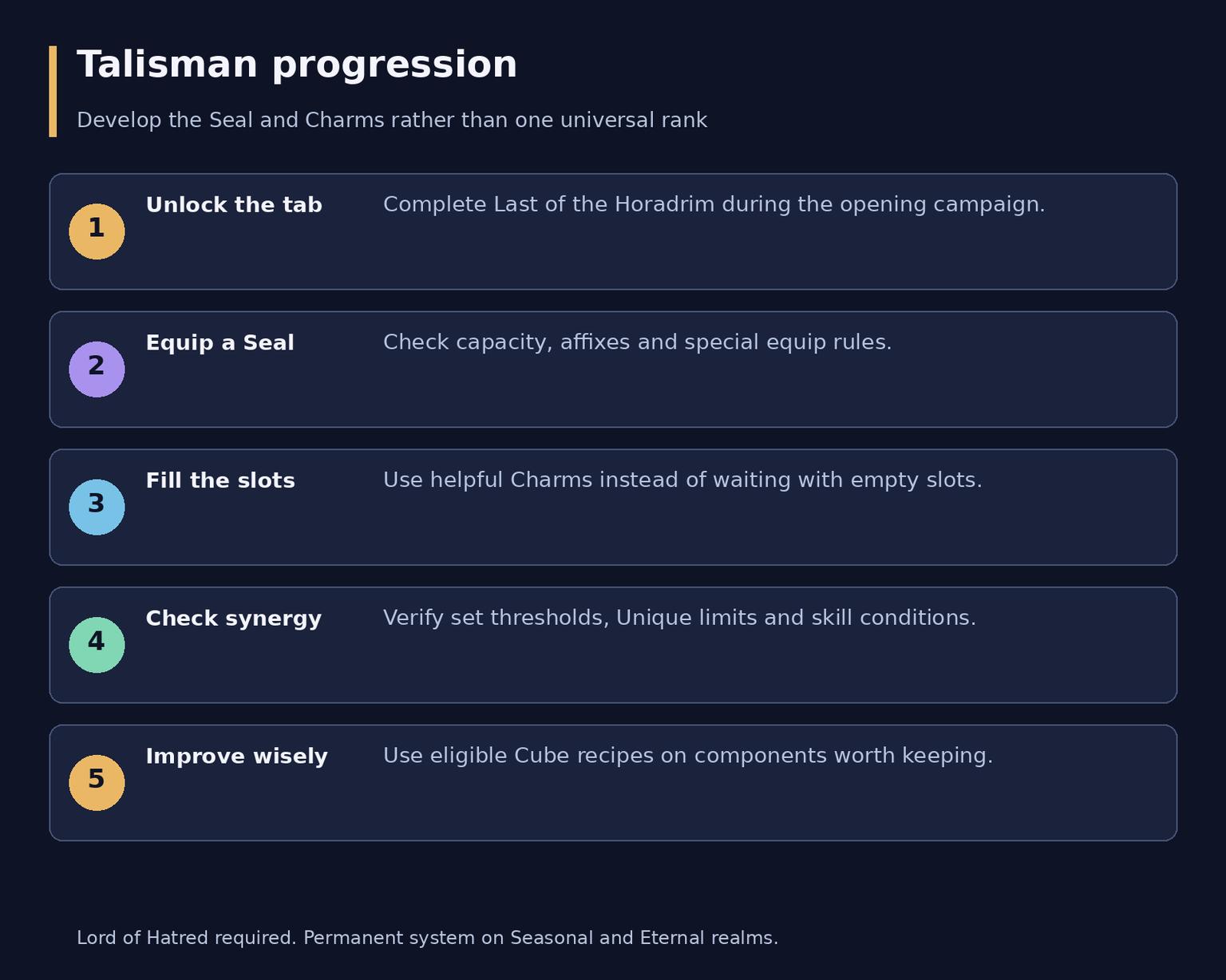
Unlock the tab, equip a Seal, fill its slots, check synergies and improve suitable components.
Choose the right kind of Charm
Regular Charms provide useful affixes. Set Charms combine individual stats with bonuses activated by matching pieces. Unique Charms provide a special Unique power with their own affixes, allowing an eligible effect to move into this system while freeing a normal gear slot. Not every Unique equipment item is eligible for conversion.
Set thresholds belong to the actual set. Read which bonuses become active at your equipped count instead of assuming all sets share a universal two-piece, four-piece and full-set schedule. Replacing one apparently weak piece can remove a much stronger combined bonus. Count the entire configuration before judging the individual affix gain.
Goal | Useful properties to compare | Common mismatch |
Damage | Relevant skill ranks, damage conditions, set synergy | A bonus for a skill you never use |
Survival | Life, Armor, resistances, defensive powers | Extra damage while frequent deaths stop the run |
Resource sustain | Resource capacity and powers supporting your rotation | Capacity that does not solve actual recovery |
Speed farming | Movement and effects that work during normal clears | A setup dependent on a long boss encounter |
Bossing | Reliable single-target triggers and sustained uptime | Bonuses that need repeated trash kills |
The Talisman is not a new active skill bar. Its affixes and powers contribute stats or effects with their own triggers. Offense, defense and utility are practical ways to compare them, not three official item rarities. Check activation conditions in combat as carefully as the headline number.
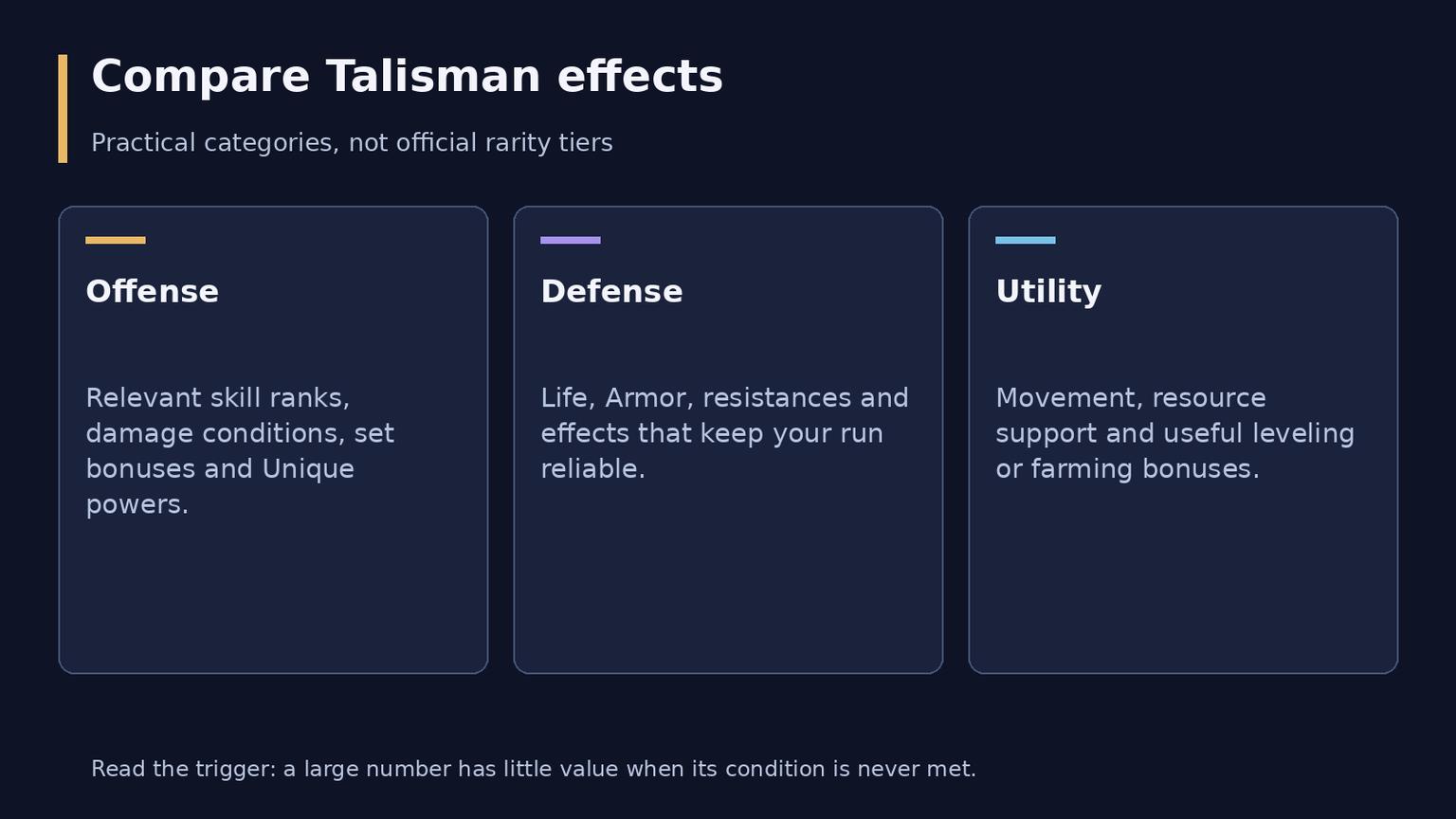
Compare offensive value, defensive coverage and utility in the context of your current build.
Where Seals and Charms come from
The starter components are provided during the unlock. Subsequent items are random loot from ordinary eligible content: enemies, chests, dungeon runs and activity rewards. You can begin using early components during the campaign; Torment matters for more specialized endgame pieces. It is not sensible to leave every slot empty until a perfect endgame drop appears.
Nightmare Dungeons, Helltides and useful cache rewards can fit a sustainable farming routine. Infernal Hordes also has a dedicated Chest of Talismans: live 3.1 notes establish its displayed cost as 200 Aether, fixing an unintended 100-Aether opening. Completing the activity and meeting its chest requirement is separate from guaranteeing a particular set piece or Unique.
Prioritize content that also gives your character useful experience or equipment. No verified universal fastest route, precise drop percentage or Talisman-wide daily/weekly cap is established here. A world boss or event reward is not a guaranteed source of the exact component you want. Party play can help clear content, but no special Charm drop multiplier is claimed for group size.
Crafting and rerolls
Use the Horadric Cube interface for the applicable Talisman recipes. In Season 15, Affix Value Reroll and Horadric Reroll are distinct: the former rerolls base values while protecting the listed desirable modifications; the latter randomizes base affixes on Legendary-or-higher Talisman components while preserving set bonuses and Unique/Mythic Charm powers. It also preserves the Seal's set-bonus properties. Read the recipe preview before spending.
Three useful published ingredient lists are:
Cube operation | Components and materials | Outcome |
Reroll Set Charm | 1 Set Charm, 25 Raw Primordial Dust, 50 Infused Horadric Resin | Another Charm in the same set; not a chosen missing piece |
Horadric Reroll | 1 eligible Talisman item, 1 Pure Primordial Dust, 100 Raw Primordial Dust, 100 Infused Horadric Resin | Same component with randomized base affixes |
Craft Unique Charm | 1 eligible Ancestral Unique, 3 Unique Charms, 1 Enhanced Primordial Dust, 50 Raw Primordial Dust, 100 Infused Horadric Resin | The corresponding Unique Charm |
These are recipe ingredients, not a universal Gold price or an upgrade-to-maximum-rank cost. Check the live interface for eligibility and the full confirmation cost. The official Season 15 notes expanded conversion eligibility, so old lists of excluded Uniques can be out of date. Creating a Unique Charm is not a promise to create its Mythic-quality version.
Salvaging unwanted Charms and Seals supplies Infused Horadric Resin. Keep useful set duplicates and conversion ingredients before salvaging everything. Do not assume dismantling returns the exact dust, Gold or Charms previously consumed by crafting. There is no verified full-refund loop here.
Do not treat Tempering, Masterworking, Enchanting or Codex imprinting as interchangeable names for these Cube recipes. Transfiguration is another operation and can make an item Unmodifiable; an old amulet-transfiguration trick does not establish a freely rerollable Legendary-power slot on the Talisman itself.
When to invest materials
While leveling, fill available slots with useful stats and replace weak components through normal drops. Save costly attempts for pieces likely to survive your next few upgrades. A larger Seal can be more valuable than a marginal affix increase because it enables another working Charm, but check whether the change breaks your current set or Unique limit.
At endgame, establish the needed set threshold and key power first, then improve the remaining affixes. Test one change at a time on the activity you actually play. An on-kill effect can excel in dense AoE farming and contribute little in a boss fight without adds. Conversely, sustained single-target bonuses can be unnecessary in a run where ordinary enemies already die immediately.
Store spare components in the stash appropriate to your realm and mode. Non-Mythic Charms and Seals can be traded when their individual binding state allows it; do not promise that crafted, modified or Mythic pieces are transferable. Inspect level and class requirements before buying. Seasonal equipment belongs to seasonal progression and moves with the normal rollover to Eternal; it does not become starting gear for a fresh season.
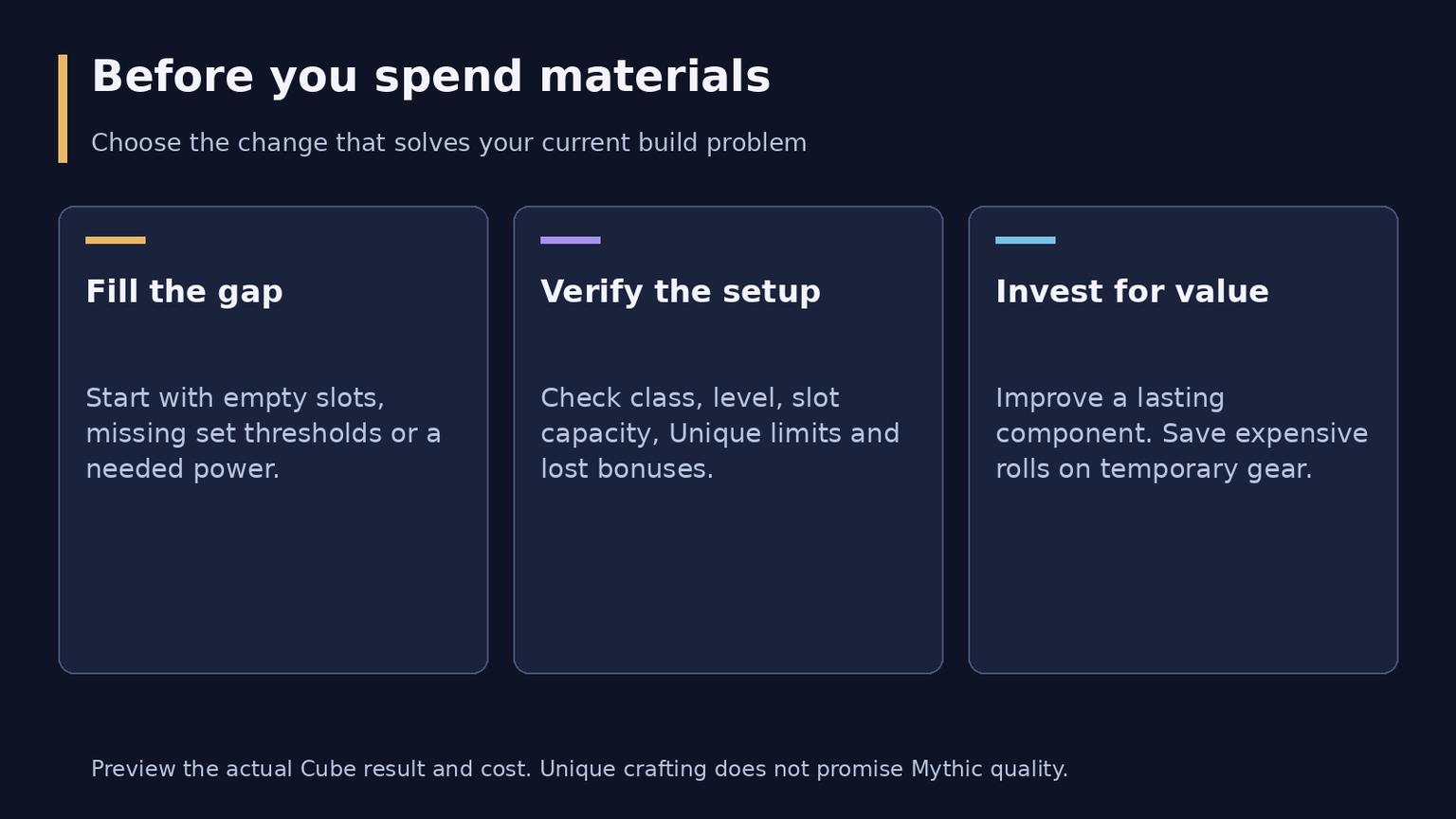
Fix an empty slot or build requirement first, verify the full configuration, then improve a lasting component.
Frequently asked questions
How do I unlock the Talisman?
Own Lord of Hatred and complete Last of the Horadrim near the beginning of its campaign. Lorath introduces the system and its starter components.
Where do I get more Seals and Charms?
From eligible loot and activity rewards after unlocking the system, plus supported Cube recipes. The Infernal Hordes Talisman chest is another option; exact pieces remain random.
Can I upgrade my Talisman?
Improve the Seal and Charms, complete useful sets and use the appropriate Cube operations. There is no single Talisman rank that replaces component progression.
Is the system seasonal?
No. It is permanent Lord of Hatred content for Seasonal and Eternal characters. Keep separate seasonal powers and their expiration rules distinct.