Diablo 4 Waking Nightmares Guide: Challenge Dungeons Explained
If you are looking for Diablo IV Challenge Dungeons, the live activity to look for is Waking Nightmares. Challenge Dungeons described prototype encounters on the 3.2.0 Public Test Realm. Blizzard explicitly warned that those tests were not the final seasonal content. Their adjustable arena encounters should not be treated as a complete rulebook for the released system.
This guide covers Season 15, Season of Hell's Legacy, checked on October 21, 2026, against live patch 3.2.3. Waking Nightmares recreate places and encounters from earlier Diablo games inside Diablo IV. They range from brief interruptions while exploring Sanctuary to substantial journeys ending with a Prime Evil. Choose the format and reward you need before committing to a long run.
Three formats with different purposes
These are not interchangeable with Nightmare Dungeons, the Pit, Kurast Undercity or Infernal Hordes. A Chronicle resembles a Nightmare Sigil in how you activate it, but opens a seasonal Waking Nightmare. The Tower's competitive scoring and leaderboards are a separate system; do not interpret a Waking Nightmare clear as a Tower ranking attempt. Strongholds are not an alternative entrance to this seasonal progression.
The distinction matters for planning. A quick popup can be worth doing on your way to another objective. A major Capstone needs uninterrupted time and a build that can sustain boss damage after the easy enemy packs are gone.
Format | How you encounter it | What to expect |
Major Waking Nightmare | Seasonal story, then harder Capstone versions | Multiple areas, objectives and a Prime Evil finale |
Standard Waking Nightmare | A fixed location; Chronicles can modify it | A dungeon-length visit to a legacy location |
Popup Waking Nightmare | An unexpected portal in the open world | A short encounter with a boss or enemy waves |
How to start your first run
Begin with a Seasonal Realm character and follow the Season 15 quest chain. Use the quest tracker to reach the story encounters rather than searching for an item literally called a Challenge Dungeon key. Completing the introductory journey explains the seasonal powers and leads you through the major locations.
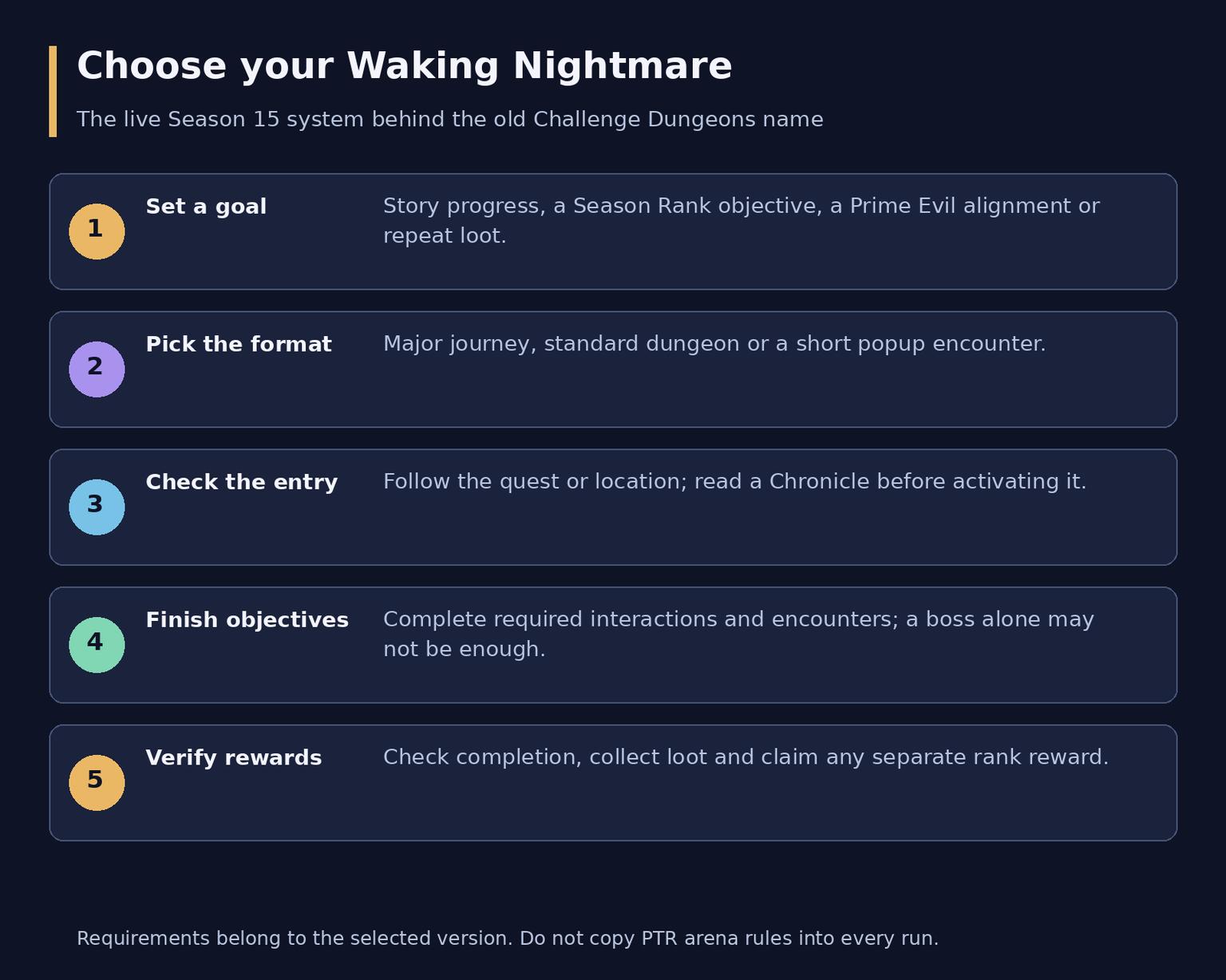
Choose the format first, then follow the objective and verify completion before leaving
The seasonal activity is not universally locked behind Vessel of Hatred or Lord of Hatred ownership. However, full seasonal completion is a different question: Blizzard states that roughly 15% of Season Rank objectives require Lord of Hatred, including finishing Rank VIII. Expansion-dependent objectives and War Plans rewards should not be advertised as benefits every base-game character automatically receives.
For standard dungeons, read the selected entrance and your current quest or rank objective. A normal visit and a Chronicle-modified visit can satisfy different requirements. If you are working toward a modified-run objective, simply clearing the unmodified location is not a substitute.
Using a Chronicle of Nightmares
A Chronicle of Nightmares is a consumable dungeon key tied to a named standard Waking Nightmare. Activate it from your inventory, travel to the marked location and complete that dungeon's objectives. Check the destination before using the item: it does not open an arbitrary major Capstone or every portal encounter.
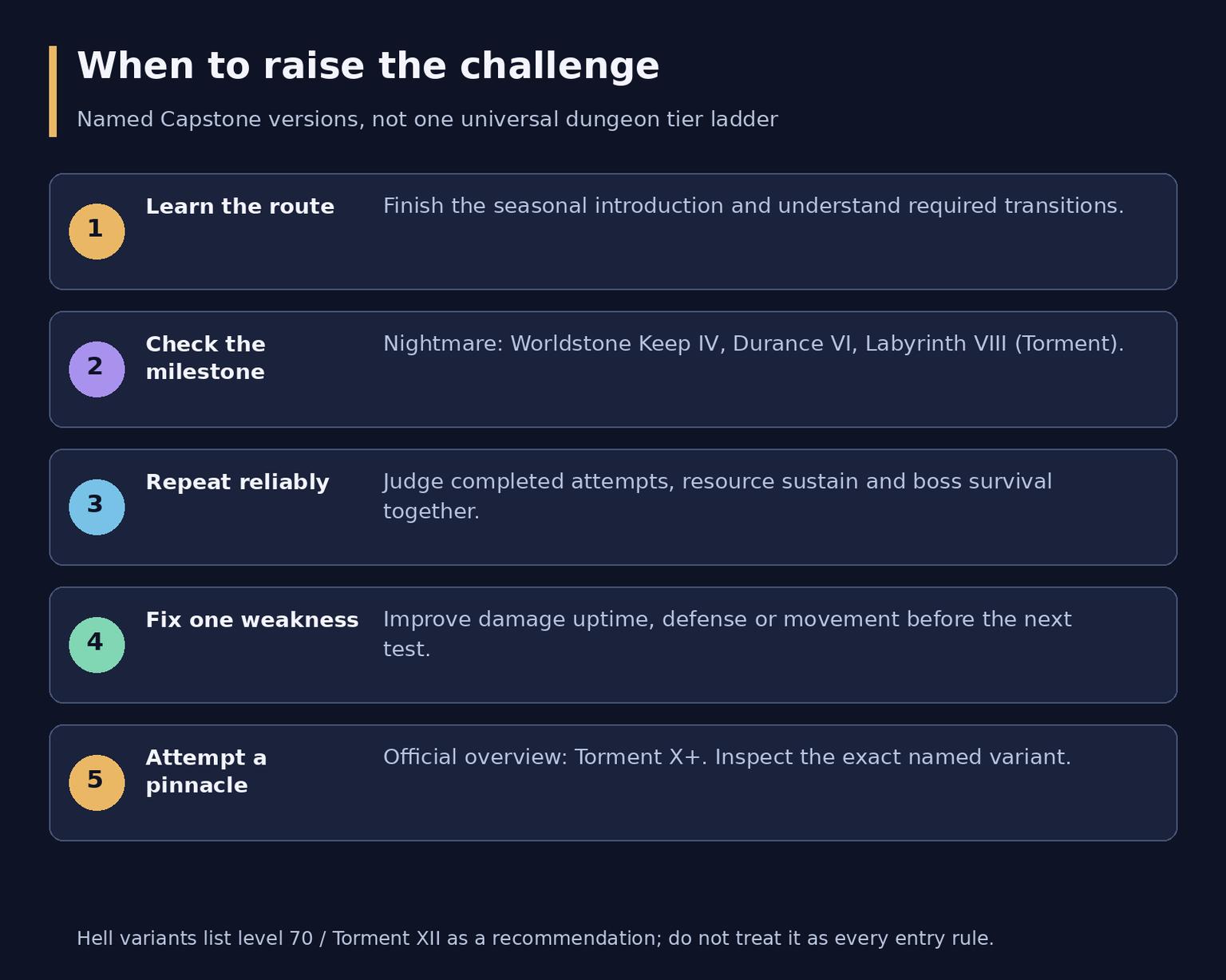
Progress through the named versions and your current objective rather than an invented universal tier ladder
Chronicles roll two random affixes. Read both before entry, especially if your character already struggles against elites or needs a long setup before dealing damage. A convenient layout with awkward modifiers can be less efficient than a slightly longer route your build handles comfortably. Keep a useful Chronicle for seasonal objectives instead of activating every key immediately.
Random popup Waking Nightmares are a reported source of Chronicles, but a key is not guaranteed from each encounter. There is no reason to budget a precise number of portal clears for your next key. When you have several, compare destinations and affixes, then choose the run that advances an unfinished objective or provides a reliable repeatable clear.
Major runs and difficulty progression
The major journeys culminate in the Echoes of Baal, Mephisto and Diablo. Their story appearances and later Capstone variants serve different stages of progression. Do not assume a requirement attached to a Nightmare or Hell variant applies to the first quest visit.
Nightmare Capstone | Listed difficulty | Season Rank milestone |
Worldstone Keep | Torment IV | Clear to advance into Rank VI |
Durance of Hate | Torment VI | Clear to advance into Rank VII |
Labyrinth | Torment VIII | Clear to advance into Rank VIII |
These milestones describe the named Nightmare variants, not a free-standing Challenge Dungeon tier ladder. Blizzard places the pinnacle Waking Nightmare challenge at Torment X and above. Current client-derived references list the Hell versions with a recommendation of level 70 and Torment XII. A recommended setting is not proof that every version has an identical hard entry requirement; inspect the version named by your objective.
For Worldstone Keep, follow the route from the Ancients' Way to the Arreat Summit, defeat the three Ancients, then continue through the Keep. The Throne of Destruction encounter requires clearing summoned waves before pursuing Baal into the Worldstone Chamber. Running past a required encounter leaves progression blocked even if your movement speed is excellent.
Durance of Hate adds an objective sequence before its final descent. Collect the components for Khalim's Flail, complete the required interaction at the Compelling Orb and proceed through the Durance to Mephisto. Treat the tracker as your checklist: a missing component is an objective problem, not evidence that the boss portal is broken.
The Labyrinth retraces the cathedral, catacombs, caves and Hell before the confrontation with Diablo. For all three routes, learn the transitions before optimizing speed. Empty side corridors and unnecessary backtracking cost more than a few extra seconds spent reading a new objective.
Timers, deaths and repeat attempts
The current official overview does not establish one universal countdown, death allowance or checkpoint policy for every Waking Nightmare format. The Pit's run timer and death penalties should not be copied onto this activity. Similarly, the PTR option to add up to three Torment levels is not a universal live rule for every entrance.
Read the active objective and any rules shown by the selected version. A portal being temporary does not, by itself, establish a timed dungeon run. Do not assume that leaving, resetting the dungeon or disconnecting preserves every completed stage. For a long Capstone, finish and verify the completion notification before abandoning the instance or changing characters.
After a failed attempt, identify the actual bottleneck. If ordinary enemies are trivial but the boss exhausts your resources, more movement speed will not solve the problem. If unavoidable damage repeatedly kills you, a stronger weapon alone may not stabilize the run. Improve one weak link, then repeat the same version so you can tell whether the change helped.
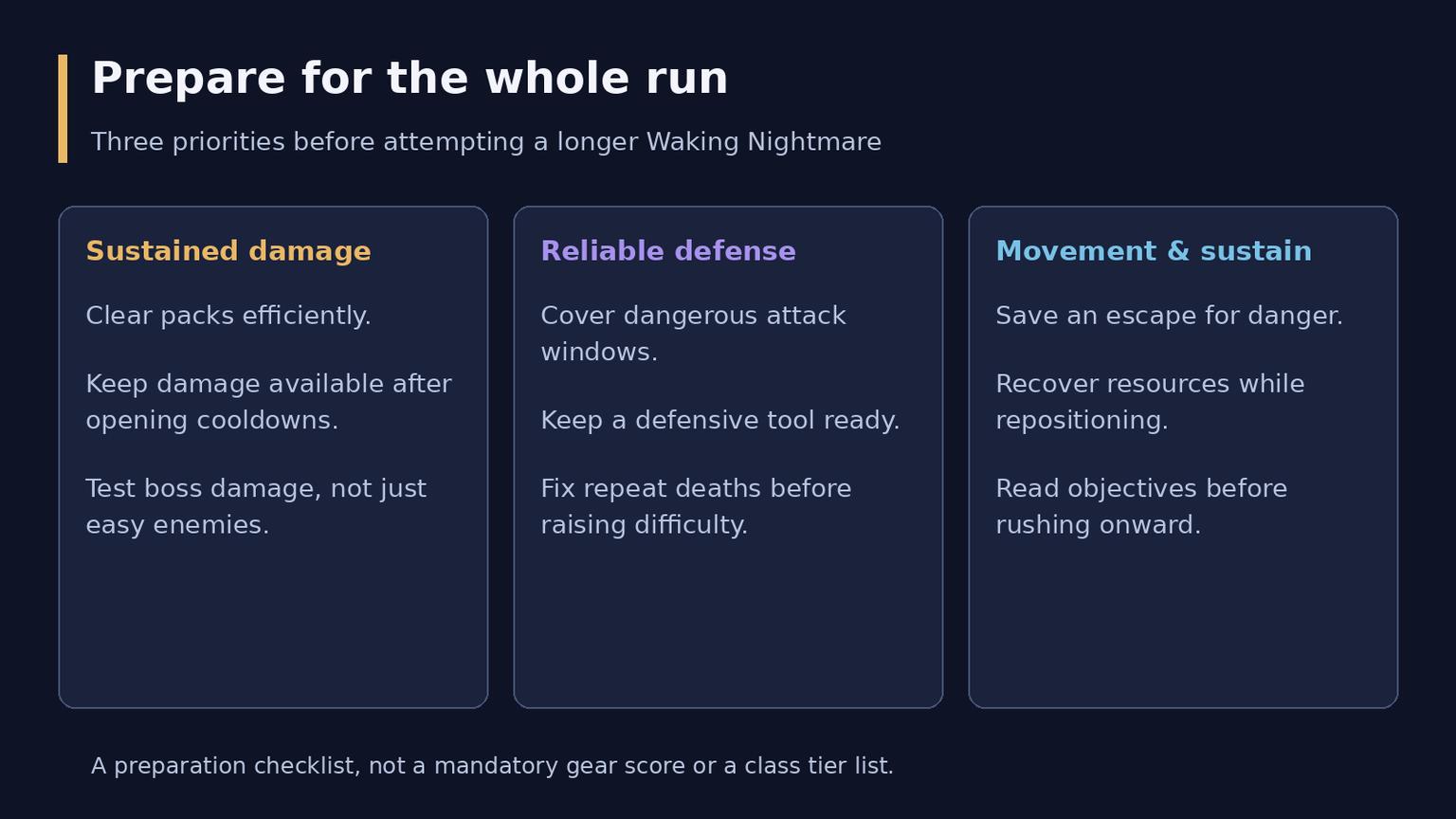
Build for sustained damage, reliable protection and movement that remains available when needed
Preparing a build that can finish
Use a build with both pack clearing and sustained single-target damage. Short popup encounters can hide weaknesses that become obvious over a multi-area Capstone. Test whether your damage remains available after your opening cooldowns, and whether you can rebuild your resource supply while moving out of danger.
Defenses should work during the dangerous part of the fight, not only while rapidly killing weak enemies. Bring an answer to crowd control if your build provides one, keep a defensive cooldown for threatening sequences and avoid spending every movement charge to cross an empty room. Crowd control helps manage packs; it does not justify assuming a boss can be permanently disabled.
Choose an elixir or incense that supports an actual weakness in your setup, where usable. Consumables complement functioning gear and skill interactions. They do not replace resistances, a sustainable resource engine or learning the boss's attack windows. There is no verified universal mandatory gear score or damage threshold for all formats.
Solo play is useful for learning routes at your own pace and testing whether your character can finish without assistance. With friends, agree on the destination, modifiers and objective before starting; stay together for required transitions. Check whether a particular seasonal objective specifies solo completion. The sources reviewed do not establish a special Waking Nightmare party-size rule or guarantee identical progression credit for every grouped character, so verify eligibility in the activity interface instead of promising a carry unlock.
Rewards and what is worth farming
Separate three reward layers. First, seasonal story progression introduces Splinters of Evil and lets you choose a Prime Evil alignment. Second, repeated dungeon completions provide loot and opportunities to obtain another relevant Splinter. Third, Season Rank objectives award their own claimed progression rewards. A rank reward is not a guaranteed boss drop.
Only one Prime Evil alignment is active at a time. This is distinct from Soul Splinters socketed into jewelry. Replaying the relevant major journey is useful when you want to change alignment, but do not assume every boss kill guarantees every seasonal item or a specific Unique.
For repeat farming, compare completed runs rather than the most impressive difficulty label. Include travel, failed attempts, backtracking and the time needed to sort rewards. A dependable standard dungeon can be more useful than repeatedly failing a pinnacle version. Higher pinnacle difficulty offers better loot opportunities, but Blizzard does not promise a Mythic Unique on every clear or a fixed drop percentage.
Additional Waking Spoils chests are conditional on the associated War Plans node. They should not be included in a universal base-game loot estimate or assumed to belong to everyone in a party. Patch 3.2.1 corrected cases where players without the node could loot them.
No dedicated Waking Nightmare weekly cache, competitive score or guaranteed bundle of Glyph XP and upgrade materials is established in the checked overview. Choose another activity when its stated reward better matches your immediate need. Waking Nightmares are especially useful when their seasonal objective, alignment progression and dungeon loot advance together.
If progression appears stuck
Check that you completed the correct version, interacted with required objects and claimed any separate Season Rank reward. Patch 3.2.3 fixed a problem where obtaining a Prime Evil Splinter too early could block seasonal quest completion, but it did not automatically repair every already affected character. Blizzard's workaround is to complete the seasonal chain on another character in the same partition, matching Normal or Hardcore and regular or Solo Self-Found, to unlock it for that partition. Do not delete your main character to try this.
If the problem survives the documented workaround, consult the current patch notes and support information before repeatedly resetting a long dungeon. Preserve the objective name and the point where progression stopped; those details are more useful than describing every failed attempt as a Challenge Dungeon bug.
FAQ
How do I unlock Challenge Dungeons in Diablo IV?
Look for Waking Nightmares, the live Season 15 activity. Begin the seasonal quest chain, then use the locations, Chronicles and Capstone variants required by your current objective. Challenge Dungeons was the earlier PTR terminology.
Can I play Waking Nightmares solo?
Plan solo runs around a self-sufficient build and the selected version's requirements. Check for solo wording on seasonal objectives before joining others; group completion should not be assumed to grant every character the same objective credit.
How do I raise the difficulty?
Progress through the named Capstone variants and the required Torment milestones. Standard Chronicles add modifiers. There is no verified universal Challenge Dungeon tier ladder covering all three formats.
What rewards make them worthwhile?
Dungeon loot, seasonal objectives and Prime Evil alignment progression are the main reasons to return. Separate claimed rank rewards and conditional War Plans chests from repeatable drops; no specific Mythic Unique is guaranteed per clear.