Diablo 4 Warlock Overview: Soul Shards and Playstyles
Warlock is a live, permanent Diablo IV class released with Lord of Hatred on April 28, 2026. You need the base game and access to that expansion to create one. The class is available on both Seasonal and Eternal realms; it is not a temporary seasonal transformation or an unreleased PTR feature.
This overview is checked for October 21, 2026, Season 15 and live patch 3.2.3. It explains the class before you choose a detailed build: how Wrath and Dominance interact, what Soul Shards change, and why a summoner, an Abyss caster and an Apocalypse setup need different equipment and habits.
Demons are part of the attack plan
Warlock combines direct spell damage, temporary summons, demon commands and transformations. Some builds maintain several attackers; others use demons mainly to fuel a ritual or support a personal damage window. You can emphasize sustained pressure or explosive attacks without turning every setup into a passive minion build.
Willpower is the primary damage attribute. Wrath supports regular casting, especially Core attacks, and is generated by Basic skills and selected recovery effects. Dominance pays for many larger summons and demon actions and regenerates more slowly. Read the actual cost of each chosen variant: not every skill involving a demon spends Dominance. Command Fallen, for example, is a Basic generator.
That distinction matters during a boss fight. Spending all Dominance on optional summons can delay the demon that supports your main engine. Removing a Basic skill before your Wrath recovery works can leave the rest of the bar unusable. A complicated-looking setup is only valuable when you can keep its essential actions running.
Soul Shards define the class mechanic
Complete Disciple of the Forbidden near Ked Bardu from level 15 to unlock Soul Shards. Choose one Primary Shard, binding its Greater Demon and receiving its playstyle passive. Fragments unlock at level 30; each Shard has three alternatives, and you select one to refine the setup.
Primary Shard | Bound Greater Demon | Practical direction |
Legion | Ae'grom | Lesser Demon activity, commands and recycling summons |
Vanguard | Abodian | Demonform and additional Archfiend attackers |
Mastermind | Laalish | Shadowform, Recast interactions and Abyss damage |
Ritualist | Vollach | Occult damage, Overpower and ritual interactions |
Vollach also appears as Valloch in some databases. These are spelling differences for the same class demon. Your Shard choice can be changed in the class interface; it does not permanently lock the character. Reconsider the Fragment, active bar and equipment together when switching, because a bonus for one engine does not automatically serve another.
The bound demon's summon/command belongs on the same six-slot action bar as your other skills when you want to use it manually. It is not a seventh free button. Soul Shards are permanent class customization, not loot to farm or a casting currency. Season 15's socketed Soul Splinters are a separate seasonal system.
Fragments can substantially change behavior. Legion's Spawn changes how Ae'grom creates and consumes Lesser Demons; Sacrificial prevents crowd control by sacrificing an active Lesser Demon. Ritualist's Scorching empowers eligible Occult Hellfire skills at a Life cost. Read that downside before adopting a late-game version with recovery tools you do not yet own.
Skills and the four names used in build guides
Warlock has Basic, Core, Defensive, Archfiend, Sigil and Ultimate categories. Basic skills generate resources; Core skills establish your repeated attack. Defensive choices provide movement, control or protection. Archfiend skills call larger demonic effects, while Sigils establish rituals that interact with kills and other conditions. Ultimates can create a major summon, transformation or damage window.
Hell Fracture is an official Core skill: its base Fire fractures remain and can explode again with subsequent casts. Variants can change their placement or convert the skill to Abyss. A Hell Fracture build is a community setup around that real skill, not an additional official specialization.
Dread Claws is also an official Core skill. Its base attack sends out shadowy claws; in Season 15 it also has the Greater Demon tag. Ravenous Jaws changes the interaction to consume Lesser Demons, while other variants change the attack pattern. A Dread Claws guide must identify its selected variant rather than combining every effect under the same name.
Apocalypse is an official Ultimate. Its ordinary delayed ritual and Annihilation variant play differently: Annihilation charges from Hellfire hits and releases a stack-driven blast. Minion Warlock, by contrast, is a descriptive community name covering summon-focused setups. It is neither a skill nor a fifth Soul Shard, and two guides using that label may feature different demons and attacks.
Understand tags, debuffs and damage
Hellfire and Abyss are skill tags, not permission to assume every attack deals the same damage type. Base Hell Fracture uses Fire, Dread Claws uses Shadow, and Bombardment starts as Physical before relevant conversions. Demonology and Occult tags define other interactions. Check the selected variant and the exact bonus before stacking an affix.
Hex increases the Abyss damage an affected enemy takes, with missing Life and stacking involved. It is not automatically a damage-over-time effect or a substitute for Vulnerable. Eviscerate interacts with Bleeding; Volatility empowers Hellfire casts. Shadowform supplies its own stack and Stealth behavior, while Demonform modifies your character and associated skills. They are separate states, not two names for the same transformation.
Persistent damage areas can produce repeated hits without being classified as DoT. Likewise, having a summon animation does not guarantee that every minion-related bonus applies. Season 15 explicitly added the Summon tag to base Bombardment and the Greater Demon tag to base Dread Claws. Current tags are more useful than assumptions drawn from the original release animation.
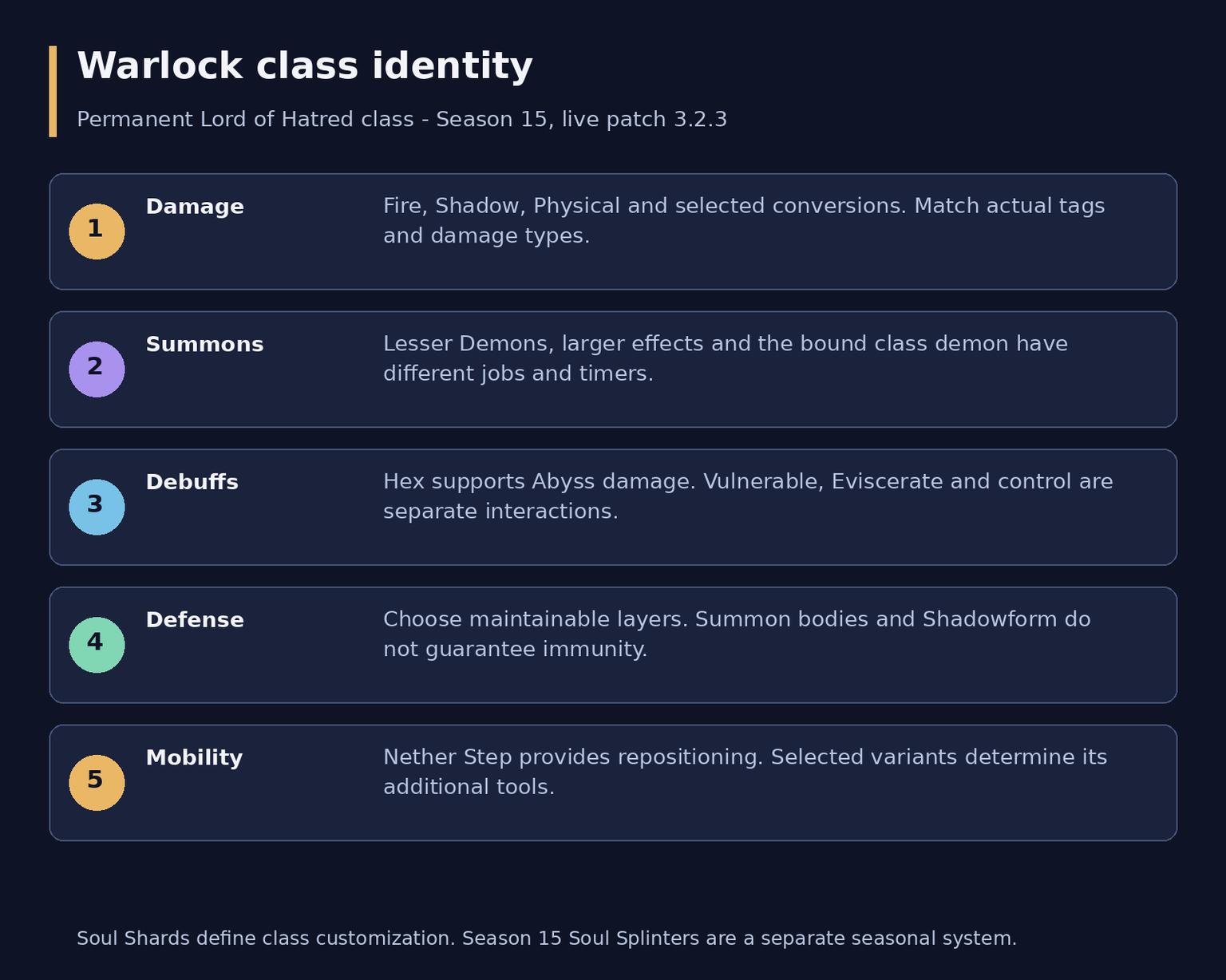
Warlock identity: damage, summons, debuffs, defense and mobility.
Mobility, control and survival
Nether Step gives targeted movement and Shadowform. Its variants can add different tools, including Gloomwalker's brief Immunity or Shadow Recall interactions with particular effects. Those alternatives are not simultaneously granted. Reserve an escape for dangerous attacks instead of spending every movement option simply to reach the next pack.
Dark Prison can contain enemies; selected modifiers add Fortify or Weaken. Its Chain Aura variant reduces damage arriving from outside its area, not every possible incoming hit. Tortured Wretch offers a deliberate Taunt, and other demon skills provide pulls or additional control. Do not assume that every summoned body automatically tanks the boss for you.
Armor, Resistances, Maximum Life, healing and the chosen skill-based layers remain important. Shadowform is not universal permanent immunity. Sacrificial depends on available Lesser Demons, and Life-spending Scorching needs recovery or its command interaction. Build defense around the conditions you can maintain, especially when a boss offers no easy replacement targets.
A practical combat loop
Enter with enough Wrath for your main attack and Dominance for the required demon action. Place persistent effects where enemies will remain, apply the chosen debuff or summon setup, then spend during the useful window. Refresh temporary attackers and commands deliberately rather than repeatedly casting every summon as soon as it lights up.
Against packs, combine positioning and AoE so that your attacks keep making contact. Against elites, preserve movement and a defensive response for their dangerous sequence. Against bosses, test recovery without fresh kills and avoid placing the entire setup in a location the target has already left.
The most common failures are mismatched tags, empty resources, expired summons and damage windows activated before their support is ready. Fix those links before pursuing another expensive item. A group can help gather targets, but it can also kill them before your setup finishes; shorten preparation when the fight is already moving on.
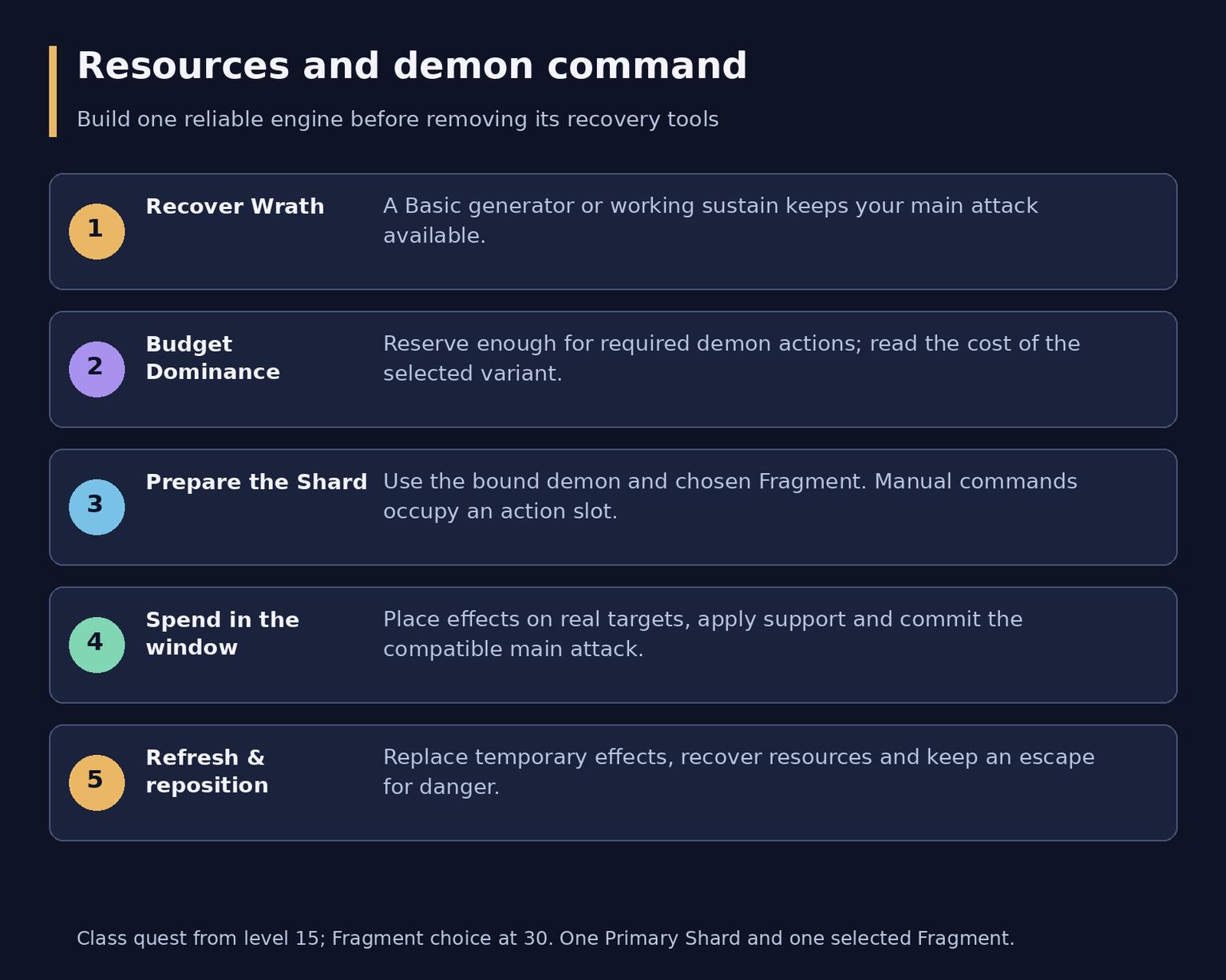
Resource flow: recover, prepare the Shard interaction, command, attack and rebuild.
Weapons and gear that change the engine
Warlock can use one-handed daggers, swords, axes, maces and flails, with a Focus off-hand. Two-handed swords, axes and maces offer another equipment route. The choice depends on weapon damage, available Aspects and required Uniques. A magical-looking tome is not evidence of a separate mandatory weapon system, and a shield is not the standard Warlock off-hand.
Three examples show why the build matters. Spine of Tathamet strengthens Hell Fracture and creates a triple fracture on every third cast. Hands of the Worldbreaker adds the Sigil tag to Apocalypse and a damage interaction inside Sigil of Chaos. Ae'grom's Schism strengthens Ae'grom and its summons, adds the other half and an additional command charge. They serve different engines; none is a universal requirement for every Warlock.
Match Legendary Aspects to tags and actual behavior. Hellbent Commander Aspect supports Summon damage. Reanimation should not be borrowed from another class's minion list: Blizzard corrected its availability for Warlock because it did not affect these demons. A similarly named bonus or an old recommended item is not enough to establish compatibility.
Prioritize useful skill ranks, Willpower, relevant damage modifiers and sufficient resource recovery. Summon-focused bonuses need applicable skills, while Critical Strike, DoT and Overpower priorities depend on the chosen engine. Keep Maximum Life, Armor and missing Resistances in the plan. Greater Affixes are valuable on useful stats, not merely because an item has more stars.
Tempering adds a selected affix from a learned manual to eligible non-Unique gear at the Blacksmith. Current Masterworking improves eligible Ancestral Legendary or Unique items through Quality and a Capstone upgrade, not the old twelve-rank system. Save expensive optimization for equipment worth keeping. Mythic Uniques and advanced Cube conversions are later build-specific options, not entry requirements for the class.
Leveling versus endgame
For leveling, start with one main attack, dependable recovery, a movement skill and a clear role for your class demon. A straightforward Core caster or summon-assisted setup can work without mandatory Uniques. Avoid copying an optimized endgame bar that removes its generator because of gear-based sustain you do not yet have.
The class becomes more expressive after the level-15 quest and level-30 Fragment choice. You can then decide whether you enjoy maintaining demons, preparing Fire zones, attacking through Abyss interactions or managing Demonform. Choose difficulty by repeatable clear comfort, not an unsupported promise that one route is always fastest.
At level 70, select a coherent endgame version and match its Shard, Fragment, Aspects, equipment and Paragon. Level its Glyphs in The Pit and satisfy their attribute requirements inside the actual radius. Do not copy an old board path or a standalone passive/Key Passive list into the current branch-based skill system.
The Pit exposes scaling and boss-damage gaps. Nightmare Dungeons and Infernal Hordes suit repeatable area clearing and crafting progress. Kurast Undercity rewards movement and priority-target pressure; Lair bosses test single-target sustain. A summon-heavy setup and a charged Apocalypse caster can both participate, but require different uptime and positioning decisions. No maximum tier follows automatically from selecting Warlock.
Season 15's Waking Nightmares and seasonal powers supplement this permanent kit. Eternal characters retain the class mechanic but should not assume access to temporary seasonal advantages. War Plans, Talismans and the Horadric Cube belong to Lord of Hatred; optional Runewords and Mercenaries require their relevant expansion access and unlocks.
Is Warlock right for you?
Choose Warlock if you enjoy coordinating a damage engine rather than only repeating one button. Its strengths are build variety, AoE options, active demon command and control. Its costs are preparation, resource management and condition-based defenses. A simple leveling setup is approachable; optimized rotations can be substantially more demanding.
You do not need to play a passive army, and you do not need a permanent summon-free identity either. Start with one relationship you understand, such as a generator feeding a Core attack or commands supporting Lesser Demons. Add complexity when it improves real encounters, not merely the appearance of the build planner.
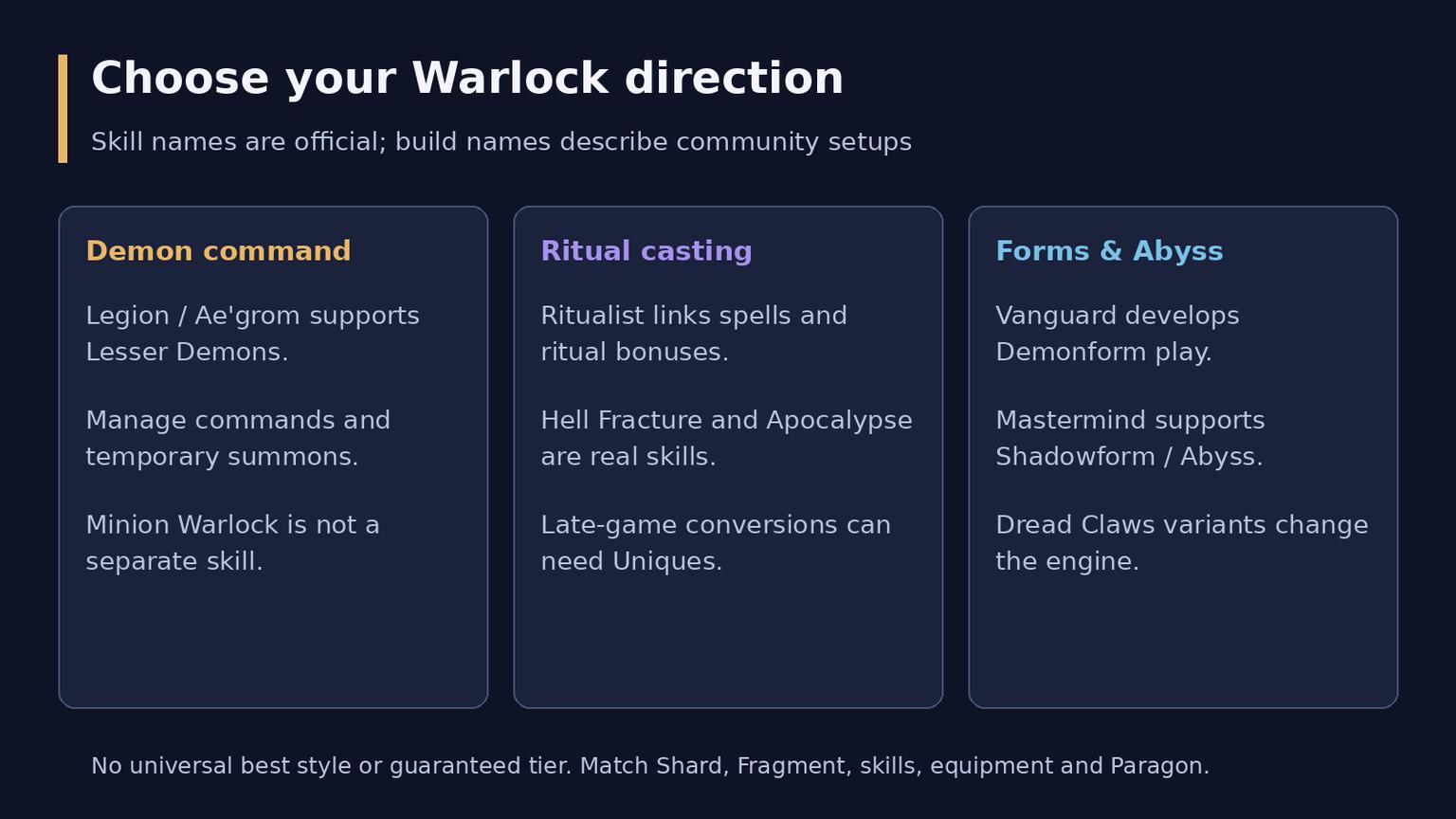
Starting directions: demon command, ritual casting, or transformations and Abyss interactions.
FAQ
Is Warlock playable, and do I need an expansion?
Yes. Warlock is a permanent live Diablo IV class requiring Lord of Hatred access, available on Seasonal and Eternal realms.
When do Soul Shards and Fragments unlock?
Complete Disciple of the Forbidden from level 15 near Ked Bardu for Soul Shards. Fragment selection follows at level 30.
Must every Warlock use a large minion army?
No. Some setups emphasize summons, others personal spells or transformations. Your Primary Shard and selected skill variants determine the role demons play.
Can a beginner start without specific Uniques?
Yes. Keep reliable resource generation, one main attack and an escape. Specific endgame conversions may require Uniques, but ordinary leveling does not require Mythic gear.