How to Rank Up in LoL: A Consistent Climb Plan
The most useful way to accelerate your climb is to reduce games spent repeating the same mistake. One main role, familiar champions and a clear decision after a winning fight provide more control than repeatedly switching to fashionable picks. This is practical guidance, not a promised rank or win rate.
Checked October 22, 2026: ordinary PC League of Legends, patch 26.21, Ranked Season 3 of 2026. The main focus is Ranked Solo/Duo. Ranked Flex is treated separately; Classic, Swiftplay and competitive event rules do not replace ordinary Ranked rules.
The Ranked rules that matter now
Solo/Duo and Flex require account level 30, at least 20 champions and 10 Swiftplay or Normal Draft games. Follow any additional eligibility restrictions shown by the client.
The tier order is Iron, Bronze, Silver, Gold, Platinum, Emerald, Diamond, Master, Grandmaster and Challenger. Iron through Diamond have divisions IV-I. The three apex tiers do not use those subdivisions: LP and regional standings matter instead.
After placements, wins normally add LP and losses deduct it. Reaching 100 LP promotes you with overflow retained, or into the next tier from division I. Promotion series are gone. Within a tier, losing more LP than you hold can demote you. Tier boundaries have protection; after a tier demotion, the system can place you at 25, 50 or 75 LP rather than always 75.
Each queue uses five placement games. Starting position depends on results, opponents and previous rank; a first Ranked entry considers Swiftplay and Normal Draft MMR. Placement defeats do not deduct LP, but still affect placement outcomes. The current starting ceiling is Diamond III.
The year has three seasons, but a mid-year season transition does not mean fresh placements for everybody. The main rank reset occurs at the start of a new Ranked year. July's Season 3 transition refreshed missions and rewards; do not import the old reset-every-split rule.
LP and MMR do different jobs
LP measures visible progression. MMR is the hidden rating used for matchmaking. Wins and losses change it, and its relationship with visible rank affects LP gains and losses. The same match result need not produce the same LP change for two players.
A strong overall win rate can combine an excellent early climb with roughly even recent results. It does not guarantee immediately larger gains. Look at recent games on your main champion and the quality of your decisions rather than one frustrating LP deduction.
Riot does not publish the complete formula or provide a manual MMR reset button. Rating-repair services, purchased accounts and intentional deranking do not replace improvement. Matchmaking aims for closely balanced teams before a game, not a forced lifetime 50% win rate for each person. A losing streak does not establish loser queue or punishment for previous wins.
Commit to a role and a small champion pool
Choose a primary and secondary position you are prepared to play regularly. Neither is guaranteed every match: autofill can happen. Check the client's protection status and priority roles, which vary by queue and region. Autofilling grants temporary protection afterward, but dodging does not remove an assignment.
Start with two to four champions for your main role: a default pick, a backup when it is banned or taken, and an option for awkward compositions. This is a learning range, not a Riot restriction. Prepare your secondary role in advance; a simple fallback plan for other positions is useful too.
Role | How you can influence games | Common trap |
Top | Waves, side-lane pressure, starting fights | Extended splitting without tracking team and map |
Jungle | Pathing, tempo, numbers advantages, neutral objectives | Losing camps for an unwinnable gank |
Mid | Wave priority, movement, river access | Roaming while sacrificing a large wave |
Bot / ADC | Sustained damage, towers, finishing fights | Unsafe positioning for one more attack |
Support | Vision, engage or protection, movement | Entering a dark jungle alone |
No role is universally best for climbing: choose responsibilities you understand and enjoy. A strong patch pick helps when you can execute its plan. Check items and runes after balance changes, but test an unfamiliar option outside Ranked first. Switching after every defeat makes execution problems harder to separate from pick strength.
Aegis of Valor changed in 26.15: when active, wins award double LP without a minimum mastery grade, while defeats no longer receive loss protection. It is not guaranteed on every autofill; swapping the assigned role or receiving a behavior penalty can remove eligibility. Do not base your entire climb on an occasional bonus.
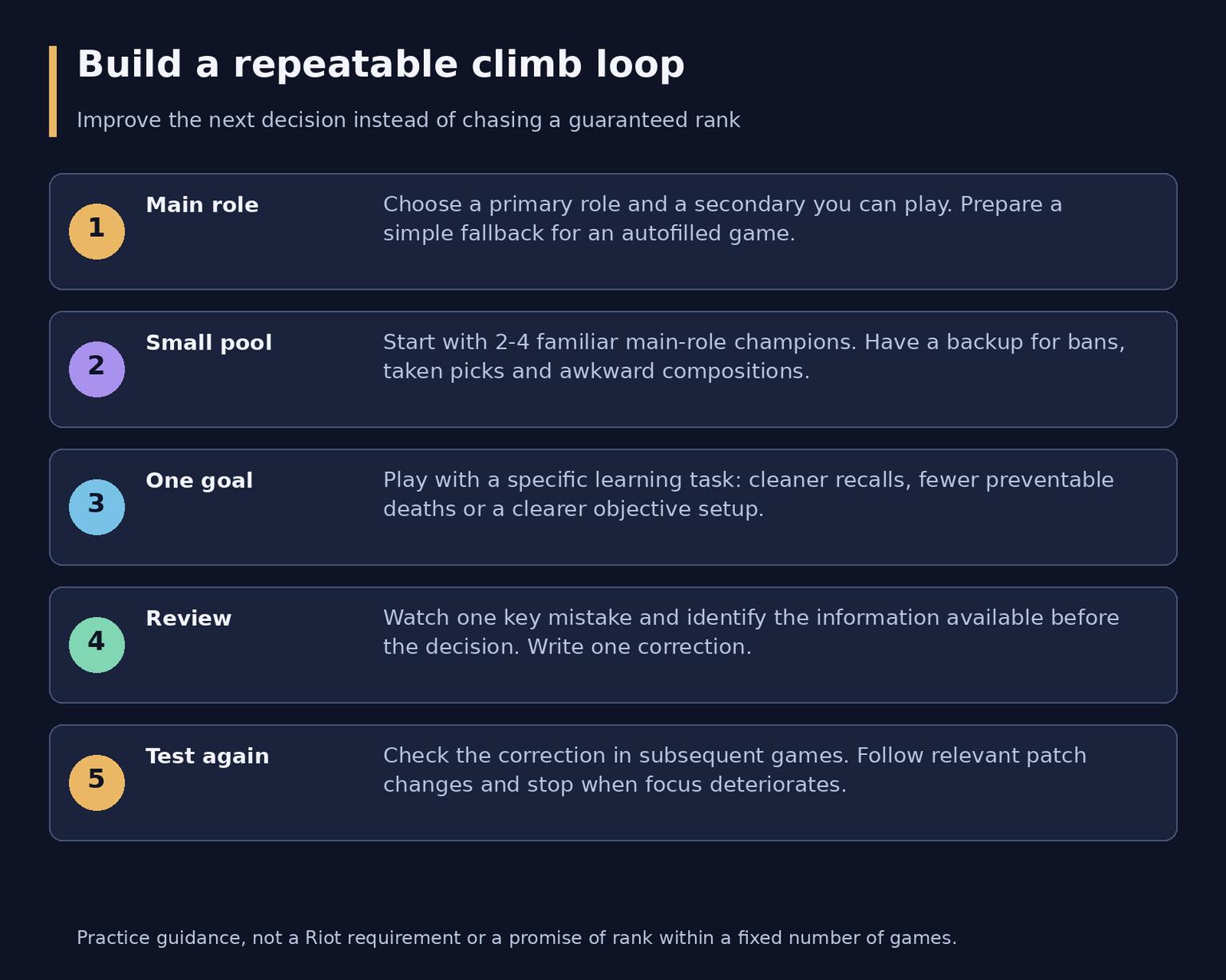
Choose a role and small pool, play with one learning goal, review a key decision and test the correction in subsequent games.
Simplify your opening minutes
In lane, focus on accessible last hits, wave position and the side from which a jungler could threaten you. Do not trade half your health for one minion if that lets the opponent deny an entire wave. Before trading, consider levels, minions and available abilities rather than health bars alone.
Plan recalls to spend gold without surrendering a large wave for free. After a favorable trade, pushing and buying can be better than chasing without resources. If enemies disappear, safer positioning can preserve both your life and the next wave. This is not a ban on aggression: attack when information and an advantage window support it.
In jungle, first practice a reliable clear and route on your champion. Adapt it to lanes and enemy information rather than a compulsory gank timer. A useful visit can create a kill, force an important spell or improve wave control; waiting without achieving anything loses tempo. You do not have to rescue a losing lane if its opponent remains stronger even when outnumbered.
Track your role quest too: it affects current character progression. However, do not abandon a favorable team opportunity solely to fill a bar. A new Ranked player benefits from stabilizing early minutes; an experienced player can refine matchup windows and the timing of the next purchase.
Turn advantages into a better map state
After a kill, ask what your team can secure before the opponent returns. It might be a wave, plates or a tower, a camp, vision or a neutral objective. If nothing is safe, spend your gold. A kill without a follow-up decision often leaves the advantage only on the scoreboard.
Ordinary Ranked includes dragons and Dragon Soul, Void Grubs, Rift Herald and Baron Nashor, plus turrets and inhibitors. Atakhan was removed from the Rift in 26.1; mentions in another mode do not restore that Ranked objective. Do not use Swiftplay's objective map, whose selection and pacing differ.
Prepare before an objective appears: manage the wave, buy, restore health and establish an approach. Available teammates, key abilities, jungler positions and an exit route all matter. A valuable reward does not justify an obviously losing fight. If your team cannot contest a dragon, an early tower or resource trade elsewhere beats arriving late and alone.
Baron is a tool for base pressure, not a compulsory call after any convenient kill. Evaluate your take speed, team health and enemy contest risk first. After securing it, synchronize waves and purchases. An inhibitor also needs a follow-up plan: do not linger in the enemy base carrying unspent gold and lacking resources.
Vision and risk control
Place a ward where the information changes your next action. An attacking team needs vision ahead of its movement; a losing team needs safe entrances into its own jungle. Use Control Wards and an appropriate trinket, including Oracle Lens for clearing vision when suited to your role. Do not buy a ward just for a statistic if its position cannot be defended.
Faelight locations enhance a placed ward's vision. Consider them when preparing an objective approach, but do not enter darkness alone just to reach a good spot. An enemy last seen in an area does not remain there indefinitely: update your conclusions using waves and new map sightings.
Prioritize deaths before important objectives, lost large waves and surrendered shutdowns in review. Useful aggression creates advantages; a pointless chase removes you from the map. When allies are far away, a strong champion does not make a fight against several opponents safe.
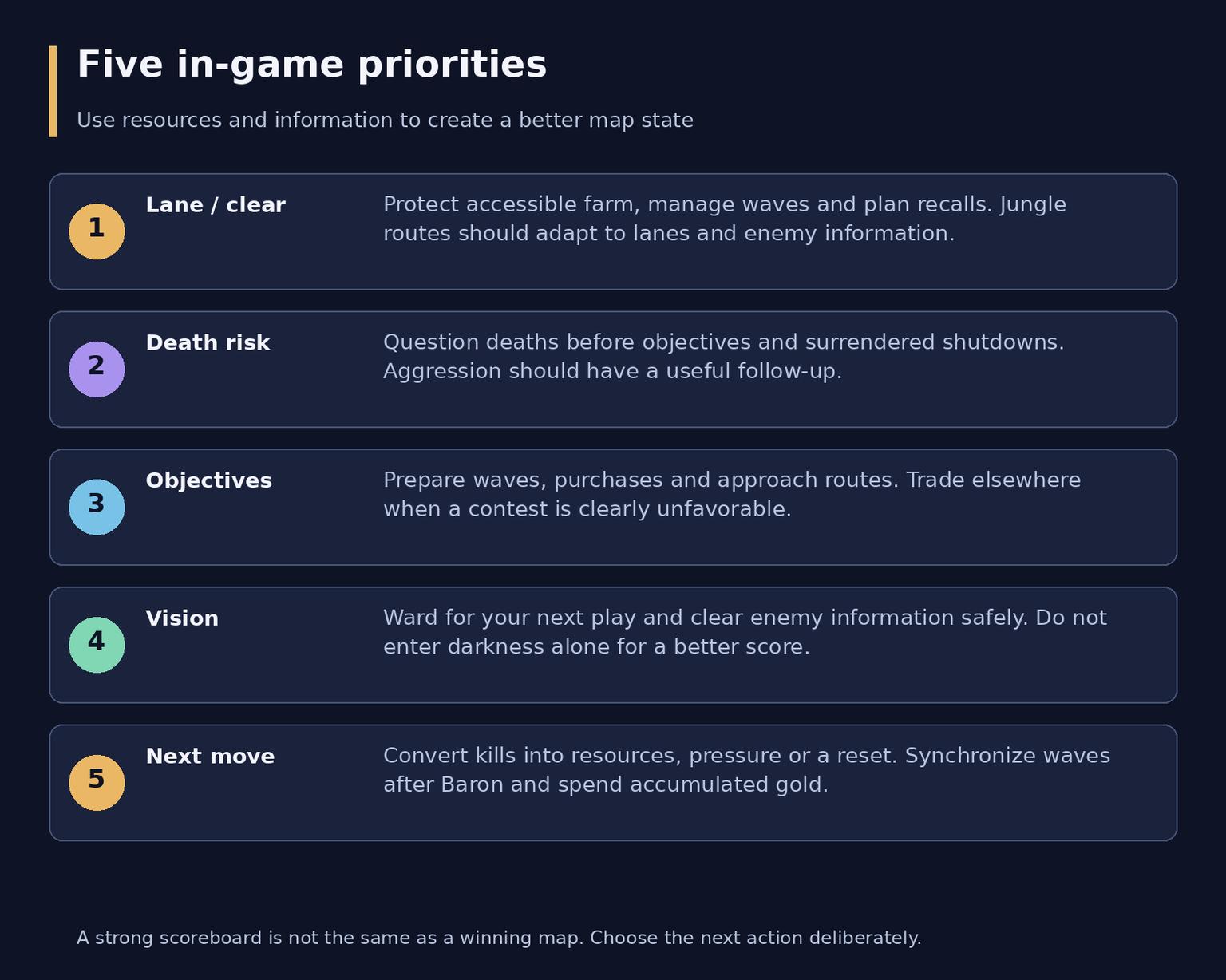
Resources, death risk, objectives, vision and the next decision connect. Do not improve one statistic at the expense of the map.
Duo, Flex and the apex tiers
Solo/Duo allows one or two players within eligible rank bands. Lower-tier restrictions are looser and Diamond's tighter. Master permits close pairs subject to LP limits; Grandmaster, Challenger and corresponding high MMR prevent Duo. KR has a separate restriction starting at Master. Check the actual pairing in the client rather than assuming one universal one-tier-gap rule.
Duo can coordinate waves, ganks and objective timing, but matchmaking considers party composition: no free advantage is promised. Choose a partner with compatible decision-making rather than one who keeps playing while frustrated. Flex supports parties of one, two, three or five, not four; playing with Master or above requires at least Emerald. Flex has a separate rank and does not increase Solo/Duo rank. However, in 2026 Riot uses Solo/Duo strength to improve Flex calibration, so complete independence of every rating mechanism should not be claimed.
Inactivity decay begins in Diamond. Each match banks seven days up to 28, with 50 LP lost per day once the bank is empty. Master and above bank one day per match up to 14, then lose 75 LP per day. Monitor the bank in the relevant queue. Grandmaster and Challenger depend on regional slots and daily recalculation: a single fixed LP total cannot guarantee entry.
Dodging is not a climb plan
For ordinary Ranked below Master, the penalty steps are six minutes and -5 LP for the first dodge, 30 minutes and -15 LP for the second, then 12 hours and -15 LP for the third and subsequent dodges. A penalty tier drops gradually over 24 hours; this is not an unconditional full daily reset. Dodging other queues can also escalate the tier.
Apex has a separate rule: Riot's support guide specifies -20 LP in place of the baseline -5 and an MMR impact, while autofill carries over. The old advice that dodging never affects MMR is therefore wrong as a universal rule. Do not confuse leaving champion select with abandoning a started game. A prepared backup champion is more useful than repeatedly cycling lobbies.
Review something you can change next session
Pick one short replay segment: the first preventable death, a poor recall or a lost objective. Pause before the decision and ask what was visible then. Separate available information from what became obvious afterward. Write one correction, such as pushing before leaving lane or avoiding river entry without an ally.
Compare several games on the same champion and role: CS per minute, deaths, fight and objective participation, and useful vision. Context matters more than a single number. Fewer deaths through refusing every team action is not necessarily better; a high vision score does not justify dying before Baron.
Before a session, check changes to your champion, items, runes and the map. Queue when you can follow events attentively. Take a break when frustration, fatigue or the urge to immediately recover LP dominates; there is no universal mandatory stop after two losses. Mute distracting chat while continuing useful pings. Legitimate improvement comes from your own games, without account sharing or prohibited tools.
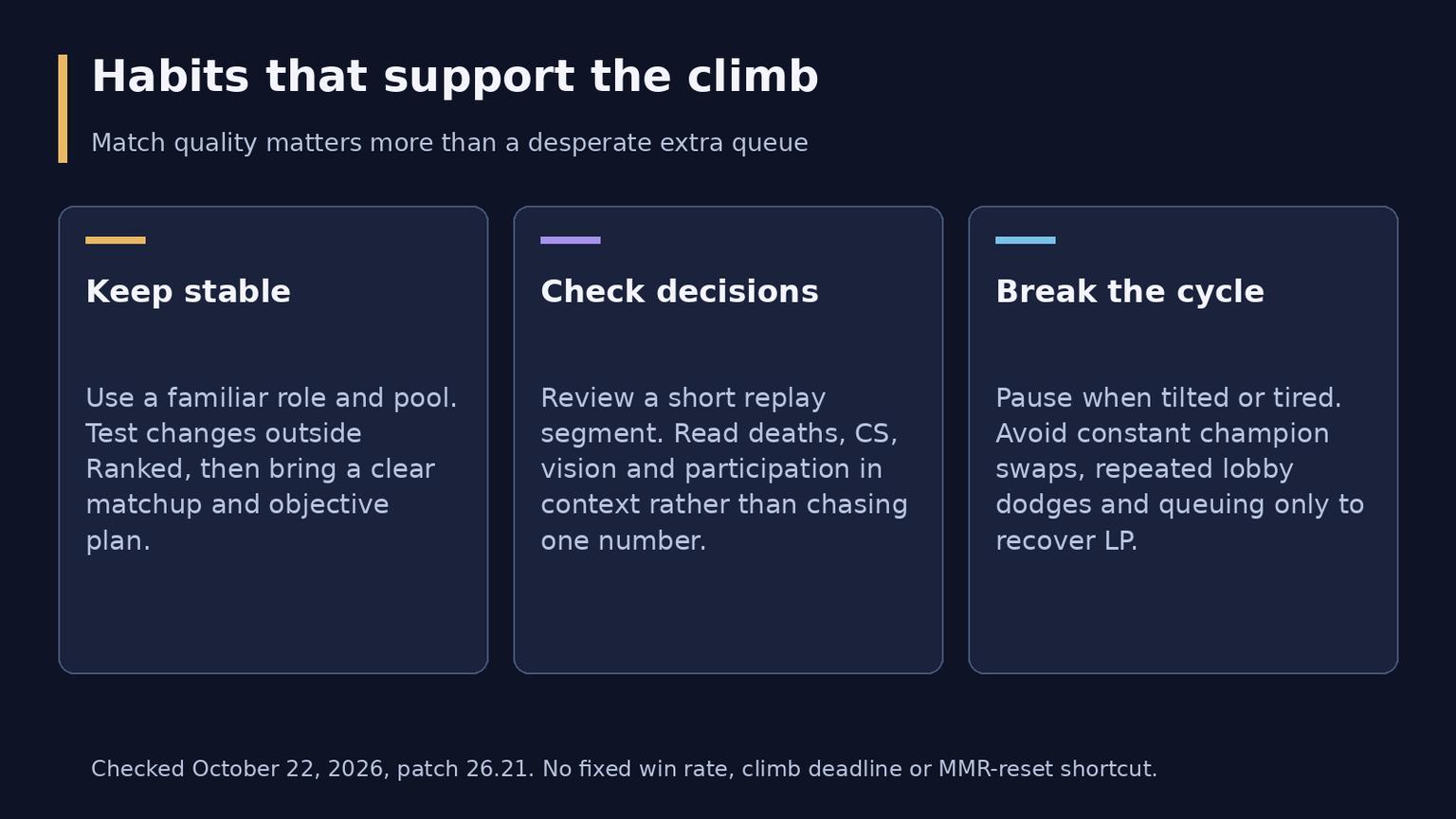
Consistent choices, one testable correction and readiness for the next game. Match volume alone does not guarantee improvement.
Frequently asked questions
How can I rank up faster in LoL?
Choose a role and small pool, then correct repeated resource, risk and advantage-conversion mistakes. Wins drive progression, but making them more repeatable is more useful than simply increasing match volume.
How many champions should I play in Ranked?
Two to four in your main role is a useful starting range, including a fallback. It is practice guidance rather than a Riot rule; prepare the secondary role as well.
Why do MMR and LP differ?
Hidden MMR supports matchmaking, while LP measures visible progression. Their relationship affects gains and losses. Overall win rate does not reveal current MMR or guarantee a particular LP reward.
Should I Duo to climb?
It helps if you coordinate better with that partner. Rank and regional restrictions still apply, matchmaking accounts for the party, and automatic rating gains are not guaranteed.