League Classic champion picks by matchup and power window
A powerful champion can still be the wrong selection. A scaling duelist does little for a team that cannot survive the first grouped fights; another initiator may be unnecessary when the backline has no protection. The useful question in League Classic is which advantage you can create, and what must remain true for that advantage to matter.
This shortlist compares 15 champions across the five roles, with an emphasis on matchup risk and power windows. It covers official live League of Legends Classic in patch 26.21, checked October 22, 2026. The current run is scheduled through January 6, 2027. Queue availability varies by region; Japan and MENA have custom matches only from 26.21. These recommendations concern Classic matchmaking and customs, not ordinary Ranked Solo/Duo statistics.
The rules behind this shortlist
S means a priority candidate for the stated plan when the player can execute it. A means a strong option with a more visible matchup, resource or composition condition. The letters compare the selected options within their roles, not every champion in the game. They are qualitative editorial judgments rather than a statistical win-rate ladder.
The criteria are lane control or first-clear reliability, early pressure, scaling, mobility, durability, crowd control, teamfight impact, objective contribution, item dependence and execution. Consistency matters: missing a difficult sequence is part of a champion's practical cost. Beginner accessibility is assessed separately from maximum strength.
The current official Classic gallery lists 81 champions, rather than the launch 60. Riot combines historical snapshots around a Season 3 anchor, so the same name can conceal a different passive, ultimate or resource pattern. Every shortlisted champion is in that gallery and has a Classic-specific kit page. Modern champion changes elsewhere in patch notes do not automatically apply to Classic.
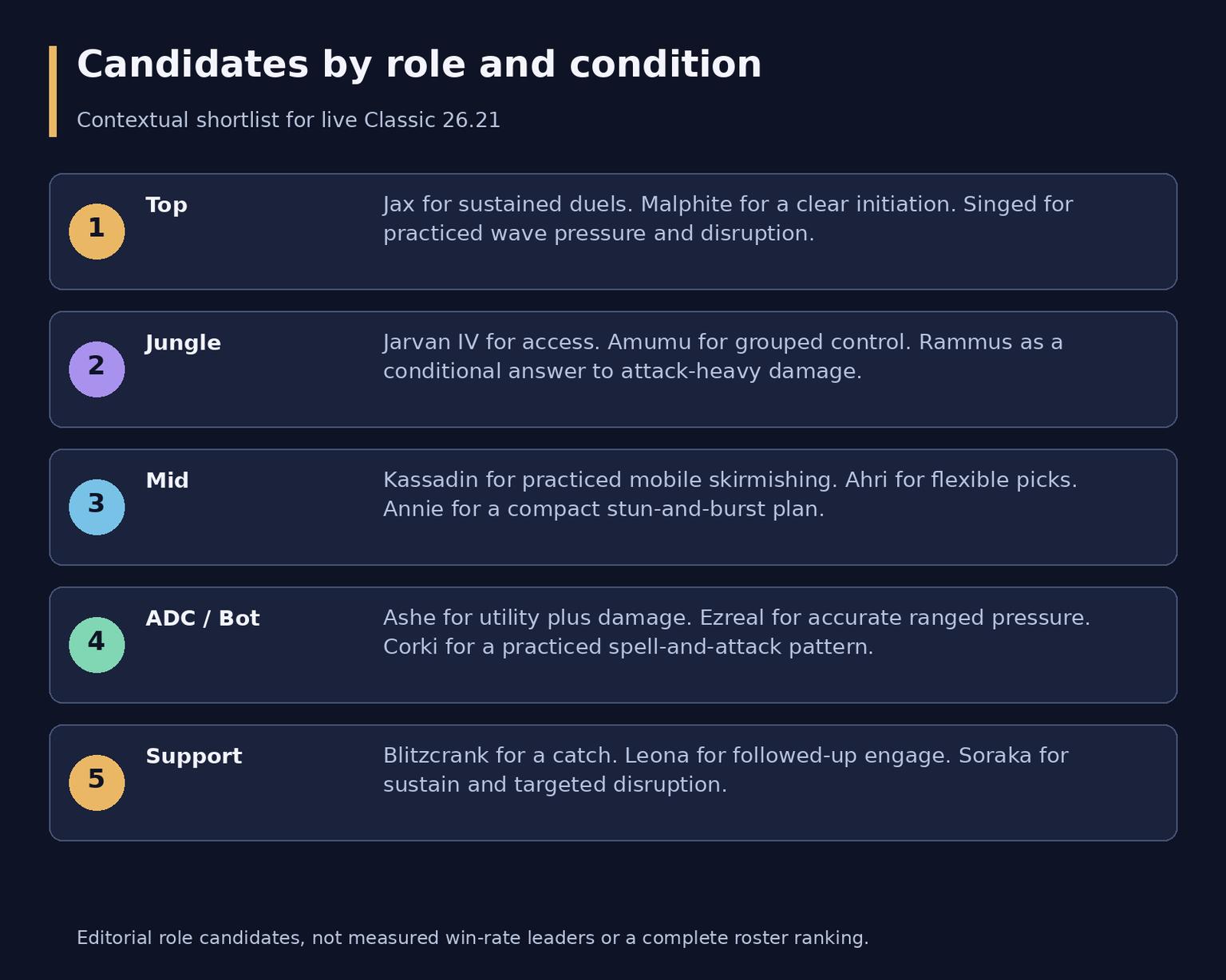
Infographic 1: contextual candidates by role, with the condition that makes each choice useful.
Top lane between side pressure and a reliable frontline
Pick | Tier and plan | Main cost |
Jax | S for extended duels and scaling side pressure | Needs attack uptime, farm and matchup knowledge |
Malphite | A for armor value and grouped initiation | Mana and early ranged pressure |
Singed | A for wave pressure and disruptive movement | Unusual positioning and resource management |
Jax is the carry-oriented option when the team can leave him time to farm and fight on favorable terms. Classic's Equipment Mastery grants health from item attack damage and ability power, while R carries stacking attack speed. His defensive stance handles basic attacks, not every incoming threat. Consider mixed combat stats through the actual Classic shop, but do not turn that interaction into a license to buy random hybrid items. Repeated control and enemies who deny attack uptime can prevent a theoretical scaling lead from becoming a winning duel.
Malphite is the alternative when contributing one good initiation is more realistic than winning every side-lane fight. His shield needs a break from damage to recover; old W provides passive cleave and an active armor and attack-damage increase. Armor purchases are attractive against relevant physical threats, whereas heavy magic damage changes the value calculation. He is a more readable first top pick than Singed, but a simple ultimate does not solve a lane where repeated harassment empties his health and mana.
Singed offers a different answer to a difficult front-to-back fight: pressure a wave, draw attention and make enemies move through awkward space. His Classic passive converts maximum mana into health. Rod of Ages is therefore worth evaluating for its mana, health and ability power, rather than assuming modern passive interactions. Chasing a spectacular proxy route without tracking enemy movement can simply donate kills. Learn ordinary wave control before relying on a specialized farming pattern.
Jungle between early access and composition value
Pick | Tier and plan | Main cost |
Jarvan IV | S for early gank access and initiation | Commitment and allied follow-up |
Amumu | A for area control in grouped fights | Vulnerable early decisions and a missed Q |
Rammus | A into attack-heavy opponents | Less general value against unsuitable damage profiles |
Jarvan IV is the flexible pressure pick in this shortlist. The flag and spear create access, while E's Classic passive includes armor and the placed flag helps allied attack speed. R damages its selected target rather than using a modern area-damage assumption. His value is getting the right fight started, not pressing every spell whenever an enemy is visible. A damage-focused purchase route increases the cost of a failed entry; retain enough durability for the job your team expects.
Amumu is easier to understand mechanically, especially when allies can exploit a grouped control window. His attacks reduce magic resistance, and his area tools support clearing and teamfights. Classic Q has no extra charges, so the failed first attempt is not followed by a stored second bandage. Defensive jungle purchases can support repeated participation, but cannot repay the experience lost to a speculative invasion. Choose him for a controllable route into useful fights, not because every camp or early duel is automatically safe.
Rammus is a deliberate response to enemies whose important damage comes through attacks. His passive converts armor into attack damage, and Classic R is repeated damage around him rather than a modern leap. Armor and survivability can support both his combat identity and staying beside a target. Against heavy magic damage, ranged disengage or a composition that does not need to keep attacking him, that plan is less reliable. The A label is conditional, not a claim that he leads every jungle matchup.
Classic camps hit harder and return faster; wraiths and the older buff-camp companions are part of this map. Hunter's Machete and the available jungle upgrades replace modern pet assumptions. Test your first route with the actual rune page, sustain and Smite, and preserve health for the intended gank. There is no universal clear order or guaranteed solo-objective threshold here. An uncontested camp can be worth more than a low-probability chase that loses both health and the next spawn.
Mid lane between burst access and an escape budget
Pick | Tier and plan | Main cost |
Kassadin | S for practiced mobile skirmishing after his buffs | Early pressure and escalating mana use |
Ahri | A for wave control and pick flexibility | Landing Charm and preserving a dash |
Annie | A for a clear stun and burst window | Range, approach and survival after the cast |
Kassadin has the clearest current-patch reason to reassess an old ranking. Classic 26.21 increases Q's damage and silence and restores R's ability-power ratio to 80%. His E still requires nearby spell casts, and successive R casts raise both damage and mana cost. This makes resources part of target selection: reaching a carry is not useful if the next escape is unaffordable. Mana and spell-power purchases matter, but first survive the lane. Physical pressure and denied farm can postpone the point at which his mobility becomes threatening.
Ahri is the more forgiving compromise between range, wave management and making a pick. Classic Charm amplifies her damage against the victim, and R offers its limited sequence without takedown resets. Reserve a repositioning option rather than treating all dashes as damage buttons. Deathfire Grasp can support a burst plan in this shop, but an active item cannot land the control for you. Her A placement here reflects repeatability and skillshot dependence rather than a claim that she is weak at high execution.
Annie offers a compact plan that makes errors easier to diagnose: prepare control, find an approach and deliver the damage while remaining alive. In Classic, E does not grant movement speed, death removes passive stacks, and Tibbers dies with her. Those rules make a reckless trade of her life less attractive than modern muscle memory might suggest. Spell power and a useful burst completion help, but boots, positioning and a survivable approach may be the real bottleneck. She is this shortlist's starting mid pick for learning execution.
Bot lane between damage delivery and team utility
Pick | Tier and plan | Main cost |
Ashe | S for a repeatable utility-and-damage role | No dash and strict spacing |
Ezreal | A for ranged spell pressure and repositioning | Accuracy, mana and purchase timing |
Corki | A for a practiced spell-and-attack pattern | Mana, exposure and a coherent core purchase |
Ashe is the utility priority, rather than a promise of the highest late-game damage. Her arrow gives the team a way to create or stop a fight even from a modest personal lead. Classic Q toggles slowing attacks, the passive builds a critical strike out of combat, and E includes bonus gold on kills. Preserve damage purchases and attack uptime instead of becoming only an ultimate launcher. Against a lane that can repeatedly reach her, straightforward controls do not make her a safe blind pick.
Ezreal can maintain pressure from range and keep a repositioning tool for danger, but missed shots make that apparent safety expensive. Classic W is a wave through units with an allied attack-speed effect, not the modern attached mark. R loses damage through successive enemies. Trinity Force's Classic spell-then-attack effect is relevant to his item planning; the complete build still needs to support mana and consistent damage. Do not judge a page by poke alone if the team needs him to keep attacking in a sustained fight.
Corki is a specialist alternative for players who can combine attacks and spells without wasting their movement tool. His Classic passive adds true damage to attacks and Q is an instant explosion. That is the kit to evaluate, rather than a remembered modern conversion passive or Package-centered play pattern. Trinity Force is a plausible core consideration for the repeated ability-and-attack sequence, but reaching a purchase does not guarantee lane control. He is not an automatic S pick just because older tier lists celebrate his mixed damage.
Support between a catch and a sustainable lane
Pick | Tier and plan | Main cost |
Blitzcrank | S for picks before a fight | Hook accuracy and choosing the correct victim |
Leona | S for committed control with follow-up | Cannot disengage every failed entry |
Soraka | A for sustain and targeted disruption | Positioning against hard engage |
Blitzcrank creates value when pulling one exposed target produces a numbers advantage before the objective fight. Classic R passively strikes nearby enemies as well as offering its active effect. Choose a hook that your team can punish: delivering the enemy frontline into your carry can be worse than not casting. His control does not need a carry-sized income, so vision and team purchases can remain useful. Skillshot reliability, enemy minions and available escape routes determine whether the catch plan actually works.
Leona fits a lane whose partner can damage the target immediately. Allied champion damage triggers her passive's bonus, making follow-up a real part of the evaluation. When your carry lacks health or mana, holding an engage can be stronger than proving you can connect it. Budget durability and vision help her participate without demanding damage-item income. Against long poke or disengage, repeated failed commitments can cost more than a cautious lane would have conceded.
Soraka suits a lane trying to keep resources and health for repeated exchanges. This is an older kit with an allied magic-resistance passive and targeted silence, rather than the modern basic-ability package. Her role is more accessible at the button level than landing repeated Blitzcrank hooks, but she remains punishable when caught. Buy enough resource support and vision to sustain the plan; an expensive damage route is not required for her basic team function. Sustain should not become an excuse to accept every unfavorable trade.
Sightstone, purchasable wards and gold-per-time items are relevant to the Classic support budget. Do not assume the current modern support quest supplies the same income and ward schedule. The strongest low-income choice is one whose control, protection or sustain you can deliver while still paying attention to vision.
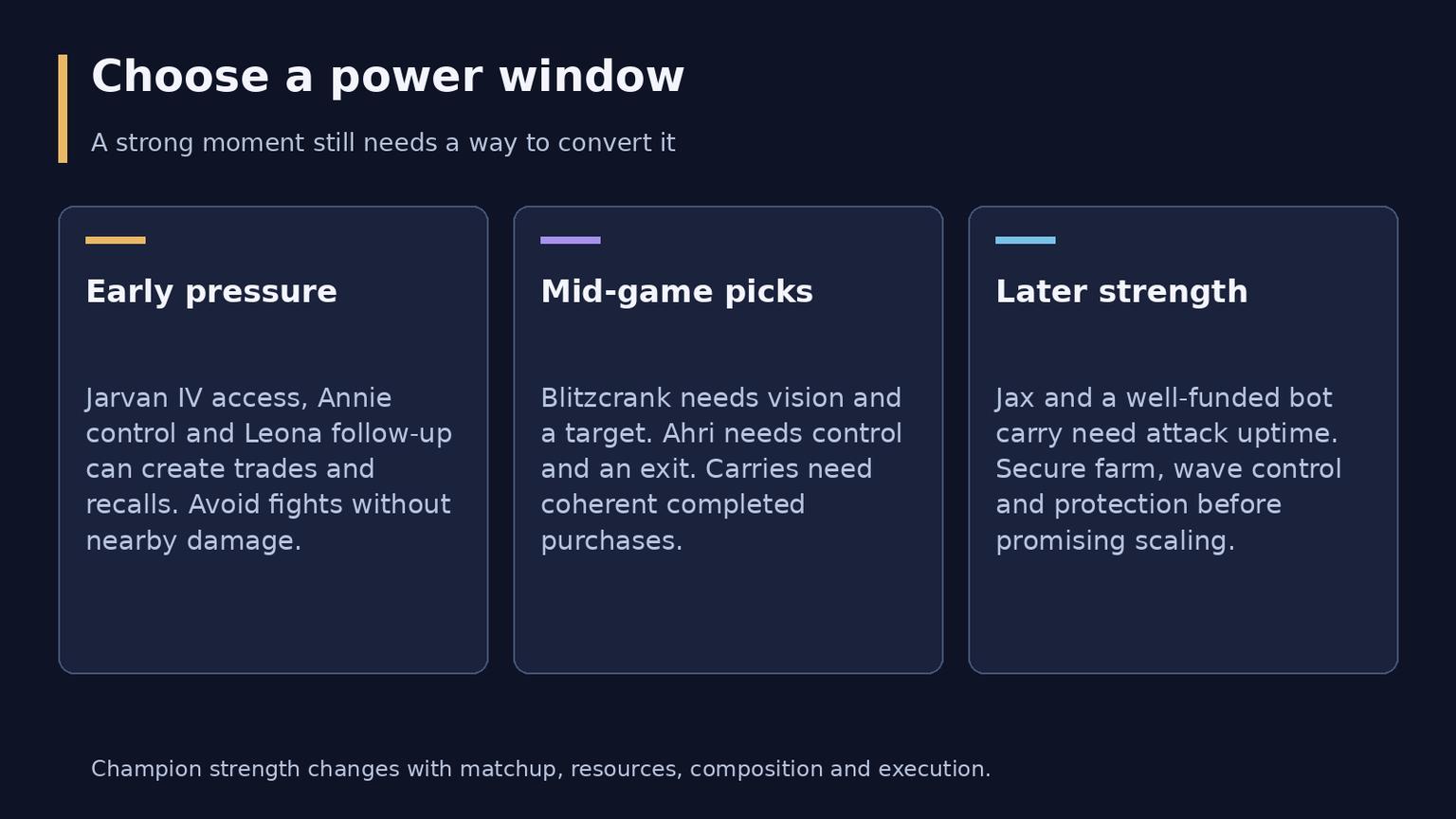
Infographic 2: each power window needs a conversion plan and carries a different failure risk.
Power windows that change the draft
For early pressure, compare Jarvan's access, a prepared Annie stun and a Leona lane with actual follow-up. Their opportunity is turning control into a favorable trade, recall or objective setup. It is not permission to fight on every cooldown. Kassadin's later mobility and Jax's sustained combat should not be mistaken for guaranteed early-lane dominance.
During the middle game, catches and completed purchases become easier to convert when lanes can move. Blitzcrank wants vision and a punishable victim; Ahri wants a control hit and a remaining exit; spell-and-attack carries want a usable completion. A team without nearby damage cannot manufacture follow-up just by selecting another initiator.
For longer games, Jax's repeated attacks and a well-funded bot carry can remain valuable. Ask who clears the incoming wave, who protects the damage source and who can safely occupy a side lane. Scaling is a plan for reaching and using later strength, not a prediction that the match inevitably lasts long enough.
New arrivals and preparation deserve a separate check
Mordekaiser, Yorick, Hecarim and Lucian enter in 26.21. They are available additions, not future Council selections. Their historical kits require new matchup testing, so this shortlist does not assign them settled tiers immediately after arrival. Mordekaiser uses a damage-generated shield and an enemy ghost; Yorick uses his original summons and allied revenant. Modern kit familiarity alone is insufficient.
Also reassess Irelia after the current durability and tenacity-stacking changes. Aatrox and Karma receive help, while Atma's Impaler changes its health-to-attack-damage conversion. None of those changes proves a universal new best pick. Check the Classic section of later updates before preserving a recommendation indefinitely.
Prepare Classic stat runes and separate mastery trees for the intended lane or first clear. Armor or magic resistance, early damage and resource choices can change whether the initial plan works. Empty rune slots have fallback bonuses, so do not assume missing purchases mean zero contribution. Modern keystones and modern shard presets are not equivalent preparations.
Build a pool with different answers
For a newcomer, Malphite, Amumu, Annie, Ashe or Soraka each offers a readable first task in a different role. Pick one role first. Add an alternative because it handles a different threat, not because another tier letter looks impressive. An experienced player may prefer Jax, Kassadin or Ezreal, but execution and matchup knowledge must justify the extra demand.
Before locking in, ask whether the lane is playable, whether your team needs entry or protection, and which purchase makes the chosen pattern work. In less coordinated matches, favor a repeatable action you can perform without perfect communication. In a group, agree on the follow-up and objective before choosing multiple champions that all want someone else to begin.
After a game, review the failed condition: denied farm, an unhealthy clear, missed control, an unaffordable escape or no allied damage in range. Change the decision that caused the problem before abandoning the champion. That review is more useful than treating a shortlist as an instruction to change mains after every loss.
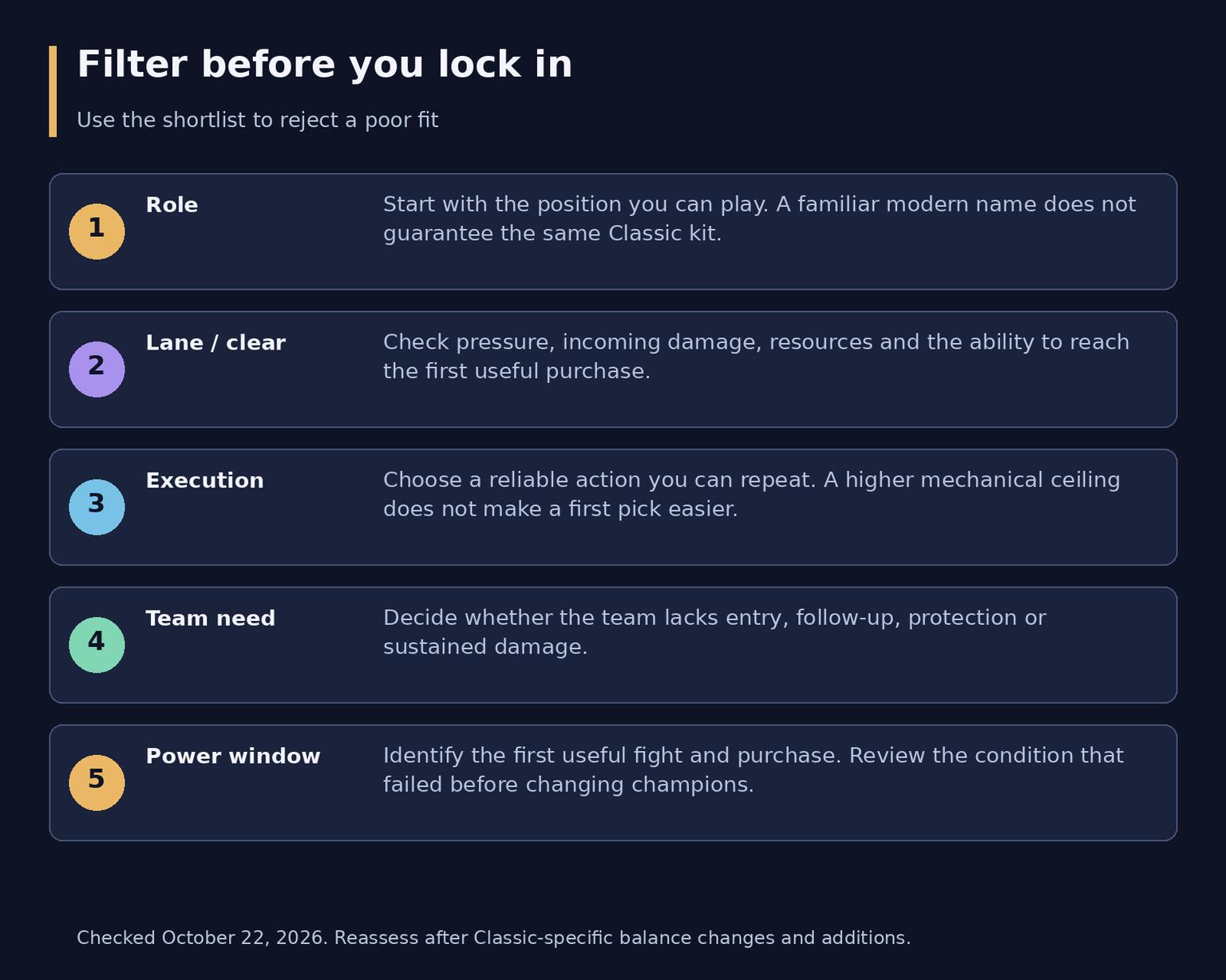
Infographic 3: filter the role shortlist by pressure, execution, team needs and the first useful power window.
Frequently asked questions
Is there one best League Classic champion in 26.21?
No. Kassadin has important confirmed buffs, but his lane and mana demands remain. Jax, Jarvan IV, Ashe, Blitzcrank and Leona are priority candidates here for different tasks, not interchangeable universal answers.
Which picks are easiest to begin with?
Try Malphite, Amumu, Annie, Ashe or Soraka in the role you want to learn. Their starting plans are readable, but each still requires positioning and the actual Classic kit to be understood.
Should I choose early pressure or late scaling?
Choose the plan your lane and team can support. Early pressure needs a way to convert control into an advantage; scaling needs farm, survival and a usable later fight. A strong final build does not guarantee reaching it.
Why does a Classic shortlist differ from modern League?
Champion snapshots, legacy items, stat runes, mastery trees and jungle conditions change what works. Some kits are substantially different, and Classic is still receiving balance changes and additions. Use its current rules rather than a modern role label or old launch ranking.