League Classic runes and masteries guide
League Classic brings back separate stat runes and mastery trees. This guide covers that live mode in patch 26.21, checked October 22, 2026. Its current run is scheduled to end January 6, 2027. These rules belong to Classic, rather than the ordinary modern League rune page.
Start with a page that supports the champions you actually play, then adapt its defenses and mastery choices to the match. Buying every available rune is unnecessary. An extra page stores another configuration; it does not make the configuration stronger.
Classic and modern League use different systems
Historically, Runes Reforged replaced the old runes and masteries in patch 7.22 during the November 2017 preseason for the 2018 season. Classic deliberately restores a separate preparation system. The presence of Masteries here does not mean they have returned to ordinary modern League.
System | Classic | Ordinary modern League |
Rune page | Marks, Seals, Glyphs and Quintessences | Primary and secondary rune paths |
Additional choices | Separate mastery trees | Keystone, lesser runes and stat shards |
Purchases | Individual Classic runes and extra pages | No Classic stat-rune purchases |
Practical rule | Use Classic descriptions and unlocks | Use the current modern rune interface |
Modern paths are Precision, Domination, Sorcery, Resolve and Inspiration. They are not the names of Classic mastery trees. A modern recommended page containing a keystone cannot be copied into a Classic page, and Classic Quintessences are not modern stat shards.
In modern League, a primary path supplies one keystone and three lesser runes; a secondary path supplies two lesser runes from different rows. Three stat shards sit alongside those choices. This comparison identifies the systems, rather than prescribing a modern setup for Classic.
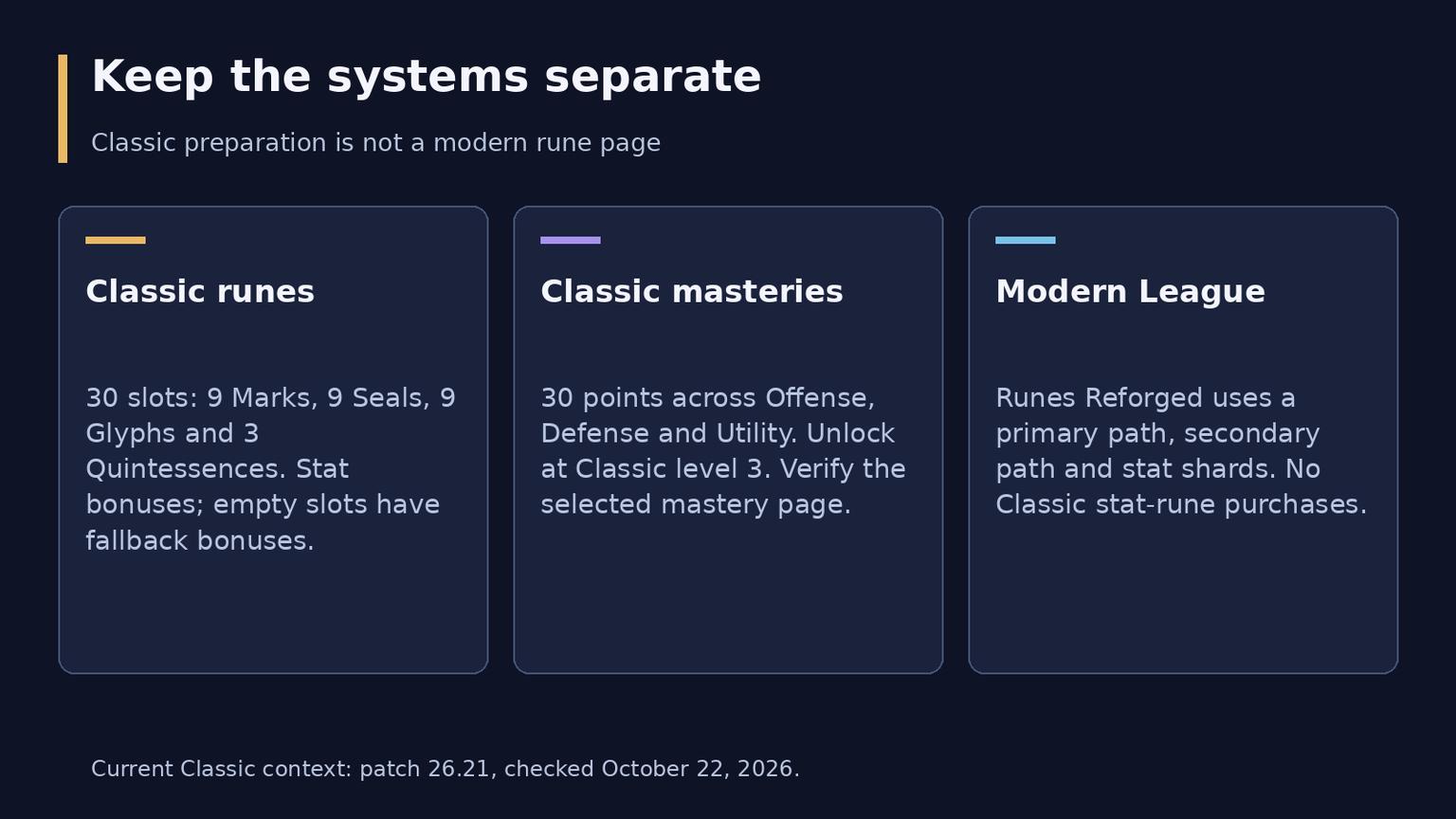
Infographic 1: Classic runes, Classic masteries and modern Runes Reforged have different structures.
Unlocks and the first useful page
Classic has its own account progression, separate from the ordinary account level. Play Classic and complete its missions to advance it. The current progression track starts at level 0 and ends at 30; a high ordinary account level does not bypass these Classic milestones.
Classic level | Preparation unlocked | Maximum equipped |
3 | Mastery pages | 30 mastery points across three trees |
4 | Marks | 9 |
6 | Seals | 9 |
7 | Glyphs | 9 |
8 | Quintessences | 3 |
A full rune page therefore holds 30 runes. Classic uses the old Tier 3 baseline, so there is no need to buy weaker tiers and upgrade them. Your historical rune inventory is not restored. Importantly, empty rune slots receive fallback bonuses: the absence of a purchased rune does not mean every empty slot contributes nothing.
Open the Rune tab in Classic and review the complete page, including its stat summary. The current content FAQ also permits customization during champion selection. Prepare your usual pages beforehand for convenience, then check the selected page in the lobby instead of assuming a remembered page is active.
Getting runes and spending Influence Points
Runes come through Classic missions, account milestones, the Classic Pass and direct Classic Store purchases with Influence Points, abbreviated IP. Treat those routes as sources to inspect before spending. A reward you already earned may cover the exact gap you intended to buy.
Purchase | Current IP cost |
One Mark, Seal or Glyph | 500-650 |
One Quintessence | 1,250-1,500 |
One additional rune page | 1,500 |
These are individual purchase prices, not the cost of a finished build. You start with three rune pages. The current level track grants another at Classic levels 13, 17 and 20. More pages can be acquired through the store and pass. Do not plan purchases from an older announcement that described fewer level-up pages.
Act II uses a free Classic Pass with coins earned through missions. Its tier 3 offers a rune page for 50 Classic Pass Coins, after reaching that tier. Random Skinned Runes are cosmetic and do not improve combat stats. Buying a cosmetic appearance is a different decision from completing a functional page.
For a small champion pool, prioritize reusable stats and a meaningful improvement over the fallback. Check what each purchase replaces, rather than buying a rune merely because a slot looks empty. Delay a narrow specialist configuration until you can explain which matchup or gameplay problem it solves.
Choose stats for the way your champion deals damage
A rune's slot type and its stat are separate questions. The same kind of stat can appear in more than one type with different efficiency. Compare the total page, not just the biggest-looking individual bonus. Current Classic values take priority over archived Season 3 screenshots.
For an attack-based champion, consider whether damage improves last-hitting and trades, or whether attack speed improves repeated attacks and the first jungle clear. For a spell-based champion, compare direct spell power with penetration according to the champion's actual damage pattern. An ability-power ratio alone does not prove that every point of the page should be offensive.
Build defensive choices around the threats you must survive. Armor addresses physical damage; magic resistance addresses magic damage. Health can support a more general defensive plan, but it does not erase the need to consider damage type. An early flat bonus and a scaling bonus solve different time windows: choose for the part of the match that threatens your plan.
Movement and economy choices deserve a clear reason. A roaming setup can be useful when it produces timely arrivals, but movement does not compensate for a lane you cannot survive. A support economy choice should be judged against the pressure and deaths caused by losing combat strength. Neither category is automatically correct or automatically a trap.
Mastery trees and point allocation
Classic masteries unlock free at Classic level 3. Their three trees are Offense, Defense and Utility. Each contains six rows, with deeper rows gated by investment in that tree; linked nodes can also require a lower node to be completed. Reaching and taking the final mastery requires a 21-point commitment.
The total budget is 30 points. A familiar 21/9/0 split describes investment in Offense/Defense/Utility, in that order. It is an allocation pattern, rather than a complete build: the specific nodes still need to support your champion. A 21-point investment is useful only if the bonuses on the way and the final choice serve your plan.
Main emphasis | Useful starting question | Avoid |
Offense | Can I apply this damage reliably? | Spending for a damage type I barely use |
Defense | What must I survive to perform my role? | Assuming durability replaces positioning |
Utility | Which resource or team function limits me? | Sacrificing essential combat strength without a purpose |
Do not spread points across all three trees simply to collect many different bonuses. First identify a coherent main investment, then compare the value of the remaining points. Conversely, a familiar historical split is not a requirement when a different allocation better addresses the actual champion and match.
Classic supplies a default mastery page if you forget to set one. It is a safety net, not proof that its choices suit your role. Check the final allocation alongside the rune page before loading in.
Apply the plan to your role
Role | Main preparation question | Matchup adjustment |
Top | Can I farm and trade through the early lane? | Match defenses and early power to the opponent's pressure |
Jungle | Is the first clear healthy and repeatable? | Balance clear speed, health and the intended first fight |
Mid | Do I win through repeated spells, burst or control? | Account for incoming damage and the cost of surviving lane |
ADC | Can I farm safely and keep attacking in fights? | Balance damage delivery with the protection the lane requires |
Support | Am I engaging, protecting or applying pressure? | Preserve enough durability or trading power to perform that job |
Role is a filter, not a complete prescription. Two champions in the same position may need different stats, and one champion can need a different page when moving between roles. In particular, a jungler's first clear and a laner's first trades are not interchangeable tests.
For burst, value choices you can apply inside the actual combo. For sustained damage, judge uptime and resource limits. For poke, ask whether the page lets you repeat the pattern without losing lane control. For engage, surviving the commitment matters alongside the initial hit. These are selection principles, not a hidden ranking of every rune.
Adapt the page without buying a new collection
Keep a few configurations with names that describe their purpose, such as attack-based lane, spell-based lane and frontline. A useful name reminds you what problem the page solves. Separate damage type from role so that a mage in top lane does not accidentally receive a generic attack-based top setup.
Before a match, check the likely lane opponent, the enemy team's damage, your own team's frontline and the intended timing of your champion. Against sustained poke, prioritize reaching playable trades and farm. Against an all-in, evaluate whether your page survives the engage rather than maximizing a theoretical damage total.
If the opposing lineup has heavy crowd control, do not assume every Classic rune menu contains a modern tenacity shard. Read the actual available effect. Likewise, a modern page's adaptive force or movement shard is not a purchasable Classic Quintessence merely because both affect stats.
Recommended modern rune pages and external automatic-import features should not be presumed to configure Classic's separate runes and masteries. A Classic-specific simulator can help compare a complete allocation; confirm its mode and patch, then reproduce and verify the page in the client. A third-party recommendation is not a Riot guarantee of the strongest setup.
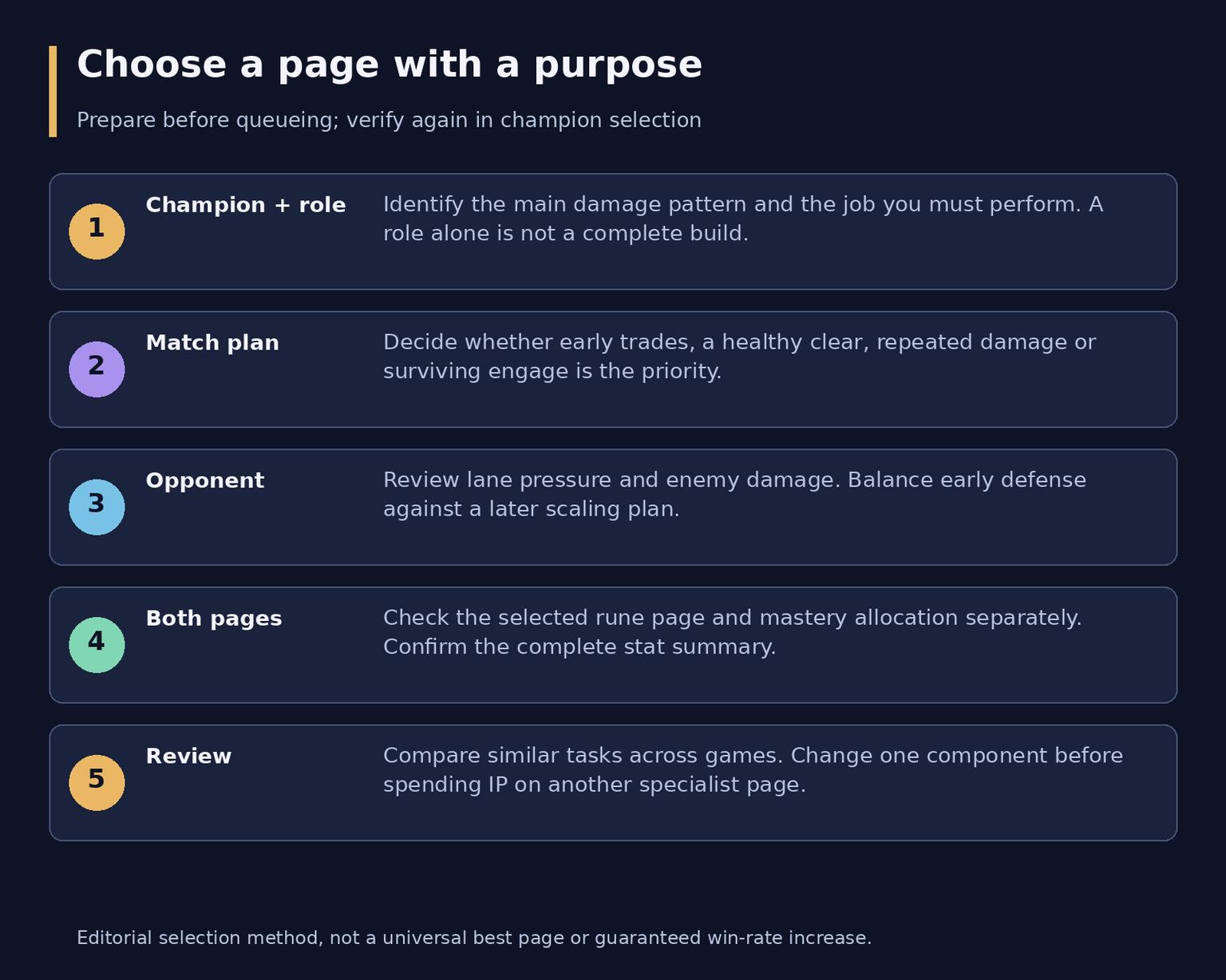
Infographic 2: choose a champion and role, define the plan, check the opponent, verify both pages and review the result.
A practical purchase and testing routine
Start by playing a few games with the available pages and fallback bonuses. Record the problem that repeatedly limits you: missed last-hits, an unhealthy clear, losing trades, or dying before using your abilities. Then select a change that addresses that problem without removing another essential part of the setup.
For a player who mainly uses attack-based champions, an appropriate reusable attack page can be the first project. A player who mainly uses mages should start with a spell-oriented page instead. Building both immediately is unnecessary if one would sit unused. Spend scarce IP on a clear improvement for your actual pool before buying more storage for configurations you do not need.
Change one component at a time when possible. Compare similar matchups and early-game tasks, rather than treating a single win as proof. A page can feel stronger because the opponent was weaker or a teammate helped; the useful question is whether the change reliably improves the intended action.
Avoid copying exact historical stat values, assuming that a cosmetic rune grants power, overlooking a free level-up page, and spending on a scaling setup when the early game repeatedly prevents you from reaching its payoff. Also verify the saved mastery page: a correct rune page cannot fix an unrelated mastery allocation.
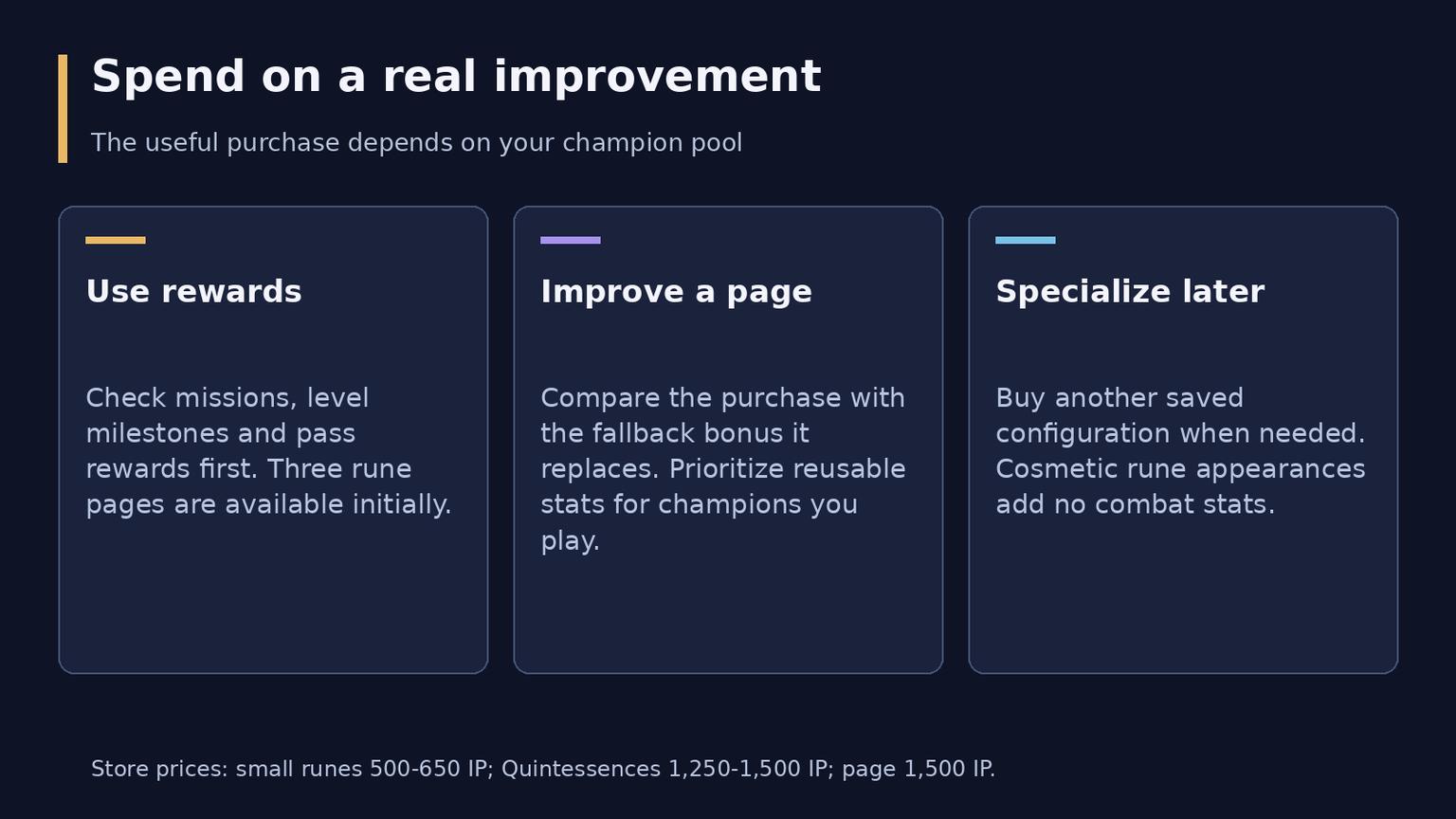
Infographic 3: use available rewards, improve a reusable page and postpone narrow purchases until they have a clear purpose.
Frequently asked questions
Are Masteries still in League of Legends?
They are separate trees in League Classic. Ordinary modern League uses Runes Reforged, which replaced historical runes and masteries in patch 7.22. Always check the mode before following a page guide.
What should my first Classic rune page be?
Build for your main champion pool: an attack-oriented page for champions that rely on attacks, or a spell-oriented page for mages. Include appropriate defenses and compare purchases with the fallback bonuses already available.
Can I change Classic runes during champion selection?
Yes. Riot's current Classic content FAQ lists customization in the Rune tab and champion-selection lobby. Preparing saved pages beforehand still makes selection quicker. Confirm the active rune and mastery pages separately.
Should I buy extra rune pages before individual runes?
Usually only when another saved configuration solves a real need. Three pages are provided initially, with more through progression. An extra page adds configuration space; it does not increase the stats of an existing page.