League of Legends Classic Guide to the Mode and Its Current Status
League of Legends Classic, shortened by Riot to League Classic, is an official alternative way to play League inside its current client. It is not a community server, an unofficial nickname for ordinary Summoner's Rift or a separate old executable. Two teams of five still fight through lanes and structures to destroy the enemy Nexus, but the champions, shop, preparation systems and map draw on early League.
Checked October 22, 2026: Classic is live on patch 26.21. It launched on July 29 with 26.15, following the June 26 teaser and July's detailed reveal. Its current run is scheduled to finish on January 6, 2027. Riot hopes to bring it back later, probably as an event mode with changes, but has not announced a return date. Treat it as a time-limited opportunity rather than a permanent second version of League.
Season 3 is the historical anchor, not a promise of one exact 2013 patch. Riot combines selected systems and champion snapshots from different years with readability improvements and new progression. An old champion name or item icon is therefore a reason to inspect the Classic tooltip, not proof that every remembered interaction works unchanged.
How to enter and when you can queue
Update League, sign into your Riot Account and open the Classic tab next to League and TFT in the client. There is no separate Classic installation, and the old appearance does not restore old system requirements. Existing champion ownership carries across when that champion is included in Classic; otherwise use the rotation or the available unlock options.
Classic launched with a PvP draft queue, Co-op vs AI and custom games. Role preferences replace the old need to race teammates to call a lane in chat. Your highest preference is a goal rather than a guarantee, so prepare at least one fallback role. The competitive progression attached to Classic matches is separate from modern Ranked Solo/Duo or Flex.
Starting in 26.21, matchmaking availability depends on the shard. Riot confirms that custom games remain available at all times across regions while the mode is running.
Region group | Current access pattern |
NA, BR, EUW, EUNE | The support schedule lists queues as always open |
KR, LAN, LAS, TW, VN, TR, Southeast Asia, OCE, RU | Restricted queue windows; weekdays are listed as 16:00 to midnight in server time |
Japan and MENA | Custom games only from 26.21 |
Check the client before planning a weekend session. Riot's October developer post lists 10:00 to 01:00 weekend windows for the restricted regions, while the support overview displays a simpler 16:00-to-midnight window. Those descriptions should not be silently treated as identical. Server time is also not automatically your local clock.
Classic Level 10 unlocks Summoner's Journey, not the entire mode. Do not import the modern Ranked level-30 requirement or ranked party restrictions as Classic entry rules. A complete Classic-specific matrix of account gates, party limits, ban allocation and remake/surrender thresholds was not established in the material checked here. Follow the current lobby and in-match prompts rather than an old season's rule sheet. No fixed match duration is guaranteed.
Classic and modern League at a glance
System | League Classic | What a modern player should change |
Map | Early Summoner's Rift layout with updated lighting and readability | Relearn paths, approach angles and ward positions |
Champions | Selected historical kits and a smaller growing roster | Read each kit before using modern combos |
Items | A mixture of legacy items with Classic balance | Check recipes, actives and unique restrictions in this shop |
Preparation | Legacy Runes and Masteries with faster unlocks | Build Classic pages instead of importing Runes Reforged |
Jungle | Wraiths, older buff camps and different clearing demands | Test a first clear and health budget rather than copying a modern pet route |
Objectives | Old Dragon and Baron framework | Do not plan around elemental souls, terrain changes or Rift Herald |
Combat | Slower missiles and dashes, sharper strengths and punishments | Budget mana and respect control and burst |
Progression | Classic Levels, IP, a Classic Pass and Summoner's Journey | Keep these separate from modern ranked and pass systems |
Slower movement does not mean lower damage or an automatically easier game. Riot deliberately brings back costly, hard-hitting abilities and more crowd control. A wasted spell or an unsupported entry into a fight can be expensive. Modern fundamentals such as last-hitting, wave control, tracking enemies and coordinating recalls still matter.
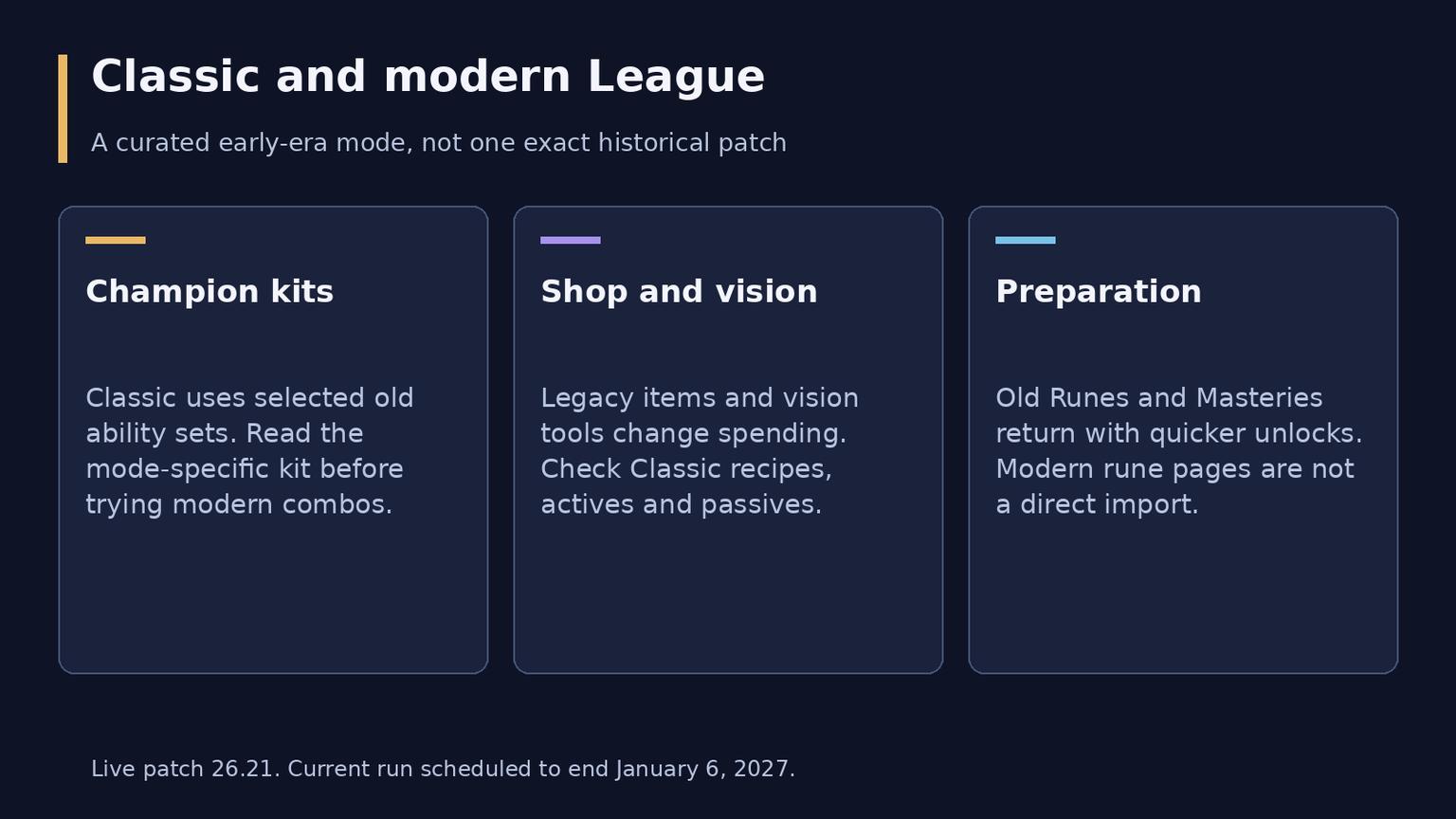
Historical kits, a legacy shop and separate preparation change decisions before and during a match.
The Rift and neutral objectives
The map keeps three lanes, a jungle, river approaches, towers, inhibitors and the Nexus. Lane pressure still creates access to neutral objectives, and an inhibitor opening is useful only if the team converts it into pressure or a finish. The nostalgic layout is not the current Rift with a different texture pack.
Wraith camps return in place of familiar modern camp expectations. Blue and red buff monsters have smaller companions, alongside wolves, golems and the separate Great Wraith camp. Riot warns that early monsters hit harder and return faster. Community game-data references distinguish ordinary camps, buffs and the Great Wraith rather than giving every camp one shared respawn timer.
Dragon and Baron Nashor are the major neutral contests. Classic does not use the modern elemental-dragon soul and terrain cycle, and Rift Herald is not a Classic objective. Do not infer that a monster spawns just because its name or asset appears in extracted map files. Likewise, a modern Baron strategy, buff assumption or objective timer should not be copied without checking the Classic rules.
For this overview, a complete current Classic epic spawn/respawn schedule was not reliably confirmed. Old Season 3 timer charts are historical references, not sufficient proof of every live 26.21 timing. Use the match information and actual spawn state, communicate recorded deaths, and prepare vision and lane pressure before committing. The same caution applies to unverified exact tower and inhibitor timing values.
Champions use selected old kits rather than one blanket rollback
Classic launched with 60 champions: the original 40 plus 20 selected releases from 2009-2013. The roster is no longer only 60. The community roster tracker reaches 81 in 26.21, with Riot's patch notes confirming the addition of Mordekaiser, Yorick, Hecarim and Lucian. More additions are planned through 26.23; a future release or Council poll result is not a champion already selectable today.
The snapshots differ by champion. Patch 26.21 explicitly brings back Mordekaiser's 2010-2015 kit and Yorick's original 2011-2016 version. Mordekaiser's ultimate can raise a defeated cursed champion as a controlled ghost, while old Yorick uses ghouls and a temporary allied revenant. These are not their modern ability sets. Conversely, some returning champions have changed less dramatically over the years.
Riot also balances Classic after launch. In 26.21 it adjusts Aatrox, Irelia, Karma and Kassadin rather than freezing them at the release state. Do not apply the same patch's modern champion section to the Classic version. A current guide must identify the mode as well as the patch number; an old reputation alone does not establish today's strongest pick.
Classic visual versions are automatically granted with the base champion when available and replace the modern base appearance. Compatible owned skins may be usable, but not every cosmetic is guaranteed to work across versions. Early PBE claims that players must buy back the basic old appearance were superseded. Appearance and gameplay snapshot are related choices, not proof of a perfect historical restoration.
Items vision and the support budget
The in-match shop brings back items such as Atma's Impaler, Frozen Mallet and Deathfire Grasp, along with older jungle and vision options. It mixes eras, so items that never coexisted historically can appear together. Boots, consumables, component recipes, active effects and unique passives must be read in the Classic shop. A modern build import is not a reliable shopping list.
Current Classic item databases show Hunter's Machete, Sightstone, purchasable wards, Health and Mana Potions and both Yellow and Red Trinkets. The presence of trinkets is a useful reminder that Classic is not an untouched Season 3 client. Do not assume the modern jungle-pet purchase, support quest economy or current ward behavior applies simply because the role is the same.
Gold-per-time items and vision purchases change support decisions. Plan money for useful control and protection instead of spending everything on a damage component. Before roaming, consider the carry's wave and safety; a ward that lets the team approach Dragon safely can serve the game plan better than an unsupported fight.
Classic item balance changes too. Patch 26.21 changes Atma's Impaler, so a launch screenshot is no longer enough to establish its current value. This guide does not attach modern item stats or a single historical recipe to a name. Before buying, check what the completed item actually does and whether its passive stacks with the rest of the inventory.
Runes Masteries and Summoner Spells
Classic uses the older Rune and Mastery concepts rather than modern Runes Reforged. Runes provide starting stats; Masteries supply a separate set of modifiers through Offense, Defense and Utility trees. Riot accelerates access and uses the old Tier 3 baseline instead of asking players to upgrade through weaker rune tiers. Old pre-reforging account runes are not restored.
Classic Level | Useful unlock |
3 | Mastery pages |
4 | Mark slots |
5 | The Council voting |
6 | Seal slots |
7 | Glyph slots |
8 | Quintessence slots |
10 | Summoner's Journey |
Default pages and bonuses for empty rune slots prevent a fresh player from starting with no preparation at all. Customize when unlocked, but do not treat an empty slot as a reason to stop playing. Rune pages are a separate Classic setup: check the page and Masteries before champion select finishes. Current support data lists additional level-earned pages at 13, 17 and 20, overriding the launch blog's older simplified count.
The spell selection includes familiar Flash, Smite, Teleport, Ignite, Exhaust, Heal and Ghost alongside returning older options such as Fortify, Rally and Revive. Choose the role's required tools in the Classic selector. Smite and Teleport should be checked here rather than assumed to use modern effects, progression or cooldowns. A familiar icon does not certify an identical version; no unnecessary cooldown catalogue is needed to start learning.
Five roles with different habits to relearn
Role | First practical priority | Habit to reconsider |
Top | Manage waves, sustain and a safe recall | Assuming a modern matchup combo or mobility window |
Jungle | Plan a survivable clear and coordinate early help | Copying a modern pet-assisted full clear |
Mid | Balance spell cost, wave control and movement | Spending every cooldown because modern sustain allows it |
ADC | Secure farm, positioning and suitable item spikes | Importing a modern critical-strike build unchanged |
Support | Budget vision, protection and low-income utility | Assuming the same support quest and free ward flow |
Treat a lane swap as a coordinated trade, not a universal opening. Before moving multiple players, decide what happens to the abandoned wave, tower and jungle. Old strategy memories can suggest an experiment, but they do not prove the 26.21 metagame or override a teammate's role preference.
In fights, identify the first reliable control effect, the protected damage source and the route out. Slower dashes can make a committed entry harder to undo; strong targeted control can punish a carry who steps forward alone. Convert an advantage into waves, structures or a safe objective instead of chasing indefinitely. These are practical recommendations rather than a measured final tier list.
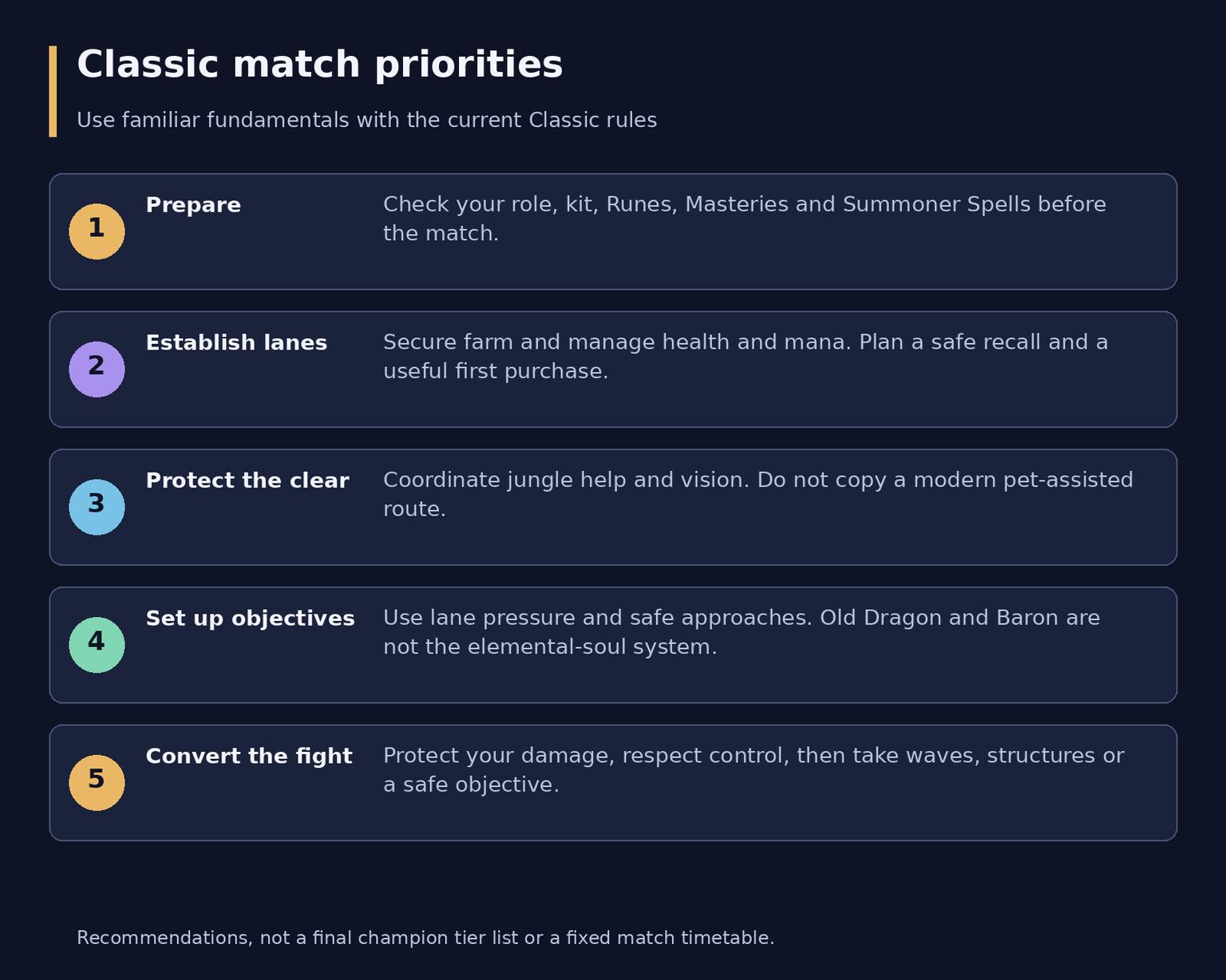
Prepare pages, establish lanes, protect the jungle clear, set up objectives and convert fights into map progress.
Classic Levels the Journey and the current free pass
Classic Levels are a dedicated free progression track from 0 to 30, separate from standard account level. Classic matches and missions supply Classic XP and unlock systems, currencies and selected cosmetics. The Council is the community-voting system, not a guarantee that every proposed champion or mechanic will ship. Riot retains responsibility for balance and game health.
Summoner's Journey opens at Classic Level 10. It adds visible Seasonal Points and hidden MMR to the Classic experience rather than creating a separate ranked queue. Initial placement uses five matches; wins and losses then affect Seasonal Points. The emblem names run from Salt and Wood through Silver, Gold, Platinum and Diamond to Legend. Do not mistake that progression for modern ranked LP or promise modern ranked rewards.
Act II's Classic Pass is now a unified free track. Its progression comes from missions earning Classic Pass Coins, then spending them within the tier system, rather than ordinary passive pass XP. The current support schedule separates the dates: progress ends January 4, 2027 at 23:59 PT, and the pass deactivates January 5 at 23:59 PT. Those become January 5 and 6 in Moscow, respectively. The mode's listed end date is January 6; these are not interchangeable deadlines.
From 26.21 the Classic store is limited to champions, runes and rune pages. Riot has announced refunds for affected Classic-only content, with eligibility depending on how it was obtained. Check the support policy rather than assuming every purchase is refunded identically. Do not promise that a custom match completes a mission whose wording requires matchmaking, or that every Classic activity advances modern mastery, challenges or a standard event pass; those rules need their own confirmation.
Who should try it and how to start
Veterans can revisit old kits and team strategies, but should expect a curated mixture rather than a museum copy of their favorite patch. New players face fewer champions to learn than in modern League, yet older resource costs, control and unfamiliar preparation still create difficulty. Neither version is simply easier in every respect.
Start with a champion whose Classic kit you have read, check the current region window, and use a bot or custom game to learn the shop and first clear before a competitive match. Keep a simple page, two workable roles and a small item plan. Last-hitting, map awareness and teamwork transfer; camp routes, item interactions and specific ability timings often need relearning.
Plan the experience around the remaining live period. A dated launch guide, a PBE build or a rumor about an indefinite return should not determine what you buy or expect to keep using. The immediate goal is to enjoy the current Classic rules while they are available, with the client schedule and latest Classic patch section as the final check.
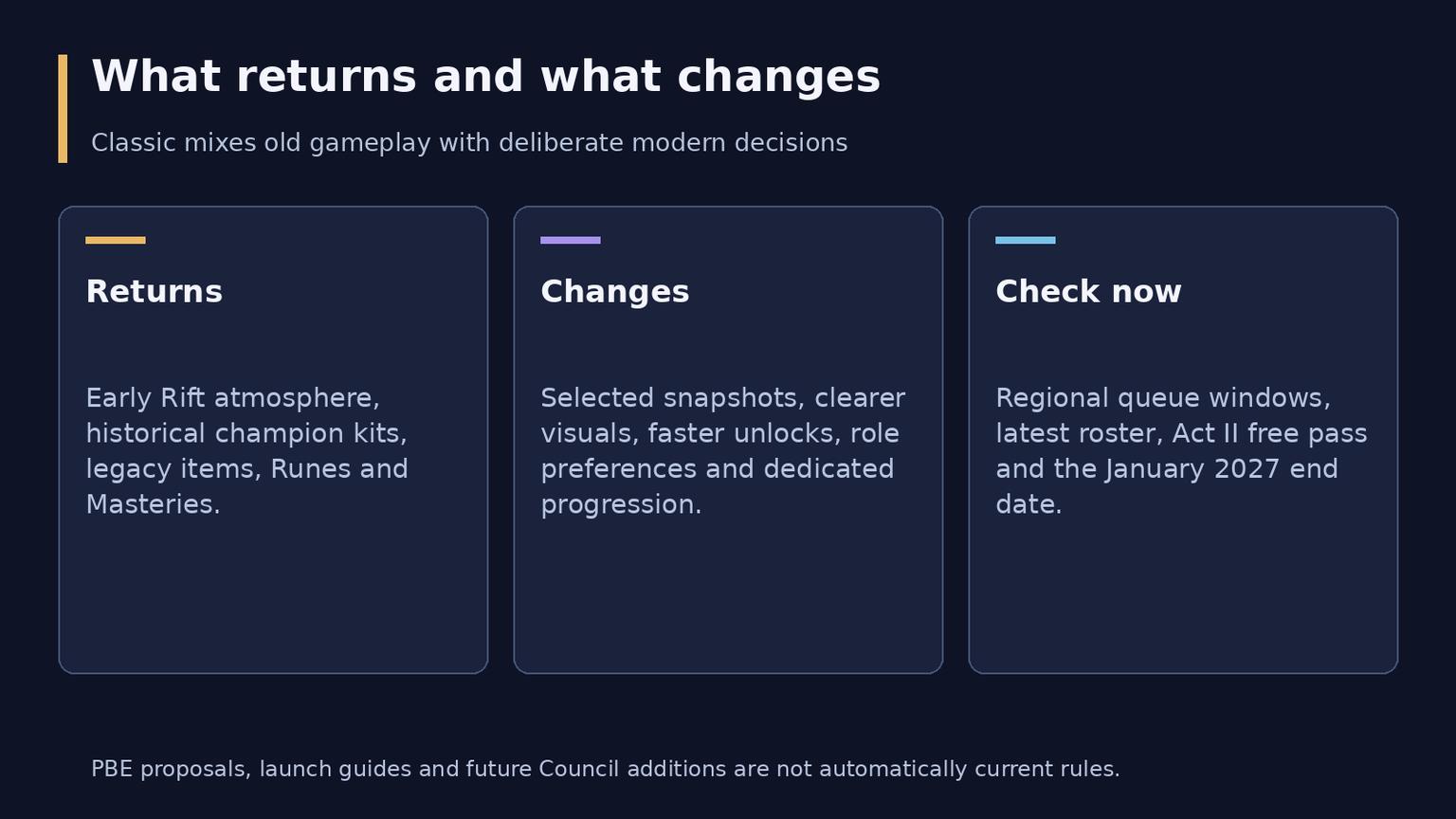
Old gameplay concepts coexist with selected snapshots, clearer visuals and new progression.
Frequently asked questions
Is LoL Classic an official Riot mode
Yes. Riot calls it League of Legends Classic or League Classic. It is accessed inside the current League client and combines early-era gameplay with selected changes, rather than restoring one exact old patch.
Is League Classic permanently available
No. The current run is scheduled to end on January 6, 2027. Some regions already use restricted queue windows, and Japan and MENA have custom matches only from 26.21. A future return is a goal, not a dated commitment.
Which champions and systems return
The mode launched with 60 champions and has expanded to 81 in 26.21 according to the current roster tracker. Old kits, legacy items, Runes and Masteries return in selected versions. Read Classic-specific tooltips because the snapshots and balance are not uniform historical copies.
What should a modern player relearn first
Check the champion kit, preparation pages and item shop, then test resource costs and jungle paths. Vision purchases and the old objective framework also change decisions. Modern map awareness and team coordination remain useful, but modern builds and timings should not be copied automatically.