LoL tier list 26.21: best champions for every role
For an ordinary Solo Queue player, a useful shortlist starts with Sett or Mordekaiser top, Warwick or Wukong jungle, Ahri or Malzahar mid, Miss Fortune or Jhin bot, and Leona or Nami support. These are editorial starting points for different jobs, not ten interchangeable blind picks. Your familiarity and the draft can make an A-tier champion the better choice.
This guide covers modern PC League of Legends on live patch 26.21, checked October 22, 2026, during Season 3. Riot published the patch notes on October 20. The ranking is an early assessment, not a settled end-of-patch verdict. No mid-patch update section appeared in the notes checked for this edition; recheck them before using this list after a hotfix.
How to read this tier list
The intended reader is a regular Solo Queue player who wants a repeatable champion pool, particularly around Gold through Diamond. This is an editorial audience choice, not a claim that the supporting statistics were filtered to those ranks. The checked METAsrc role tables displayed patch 26.21, All Ranks and All Regions. They provide broad context; they do not establish Emerald+ or Challenger performance.
The assessment weighs a usable lane or clear, a clear damage or utility plan, survival tools, teamfight contribution and execution demands. Matchup sensitivity, item timing and reliance on coordinated follow-up reduce general accessibility. A high skill ceiling can improve a specialist's result without improving the recommendation for an unfamiliar player.
Tier | Meaning | How to use it |
S | Strong practical starting point with a clear, repeatable job | Learn its losing situations before blind picking |
A | Strong with suitable mastery, matchup or team composition | Prefer it when its strengths answer the draft |
B | Specialist choice or a pick needing extra caution in this update | Keep it if experienced; do not switch solely for a headline |
These are selected champions, not a complete roster ranking. B does not mean unplayable. There is no numerical score or claim that every S pick beats every A pick. Provider tier labels were not copied: popularity, ban rate and a composite site score are different from win rate. Low-volume results, one-trick selection and early-patch movement can all distort a simple leaderboard.
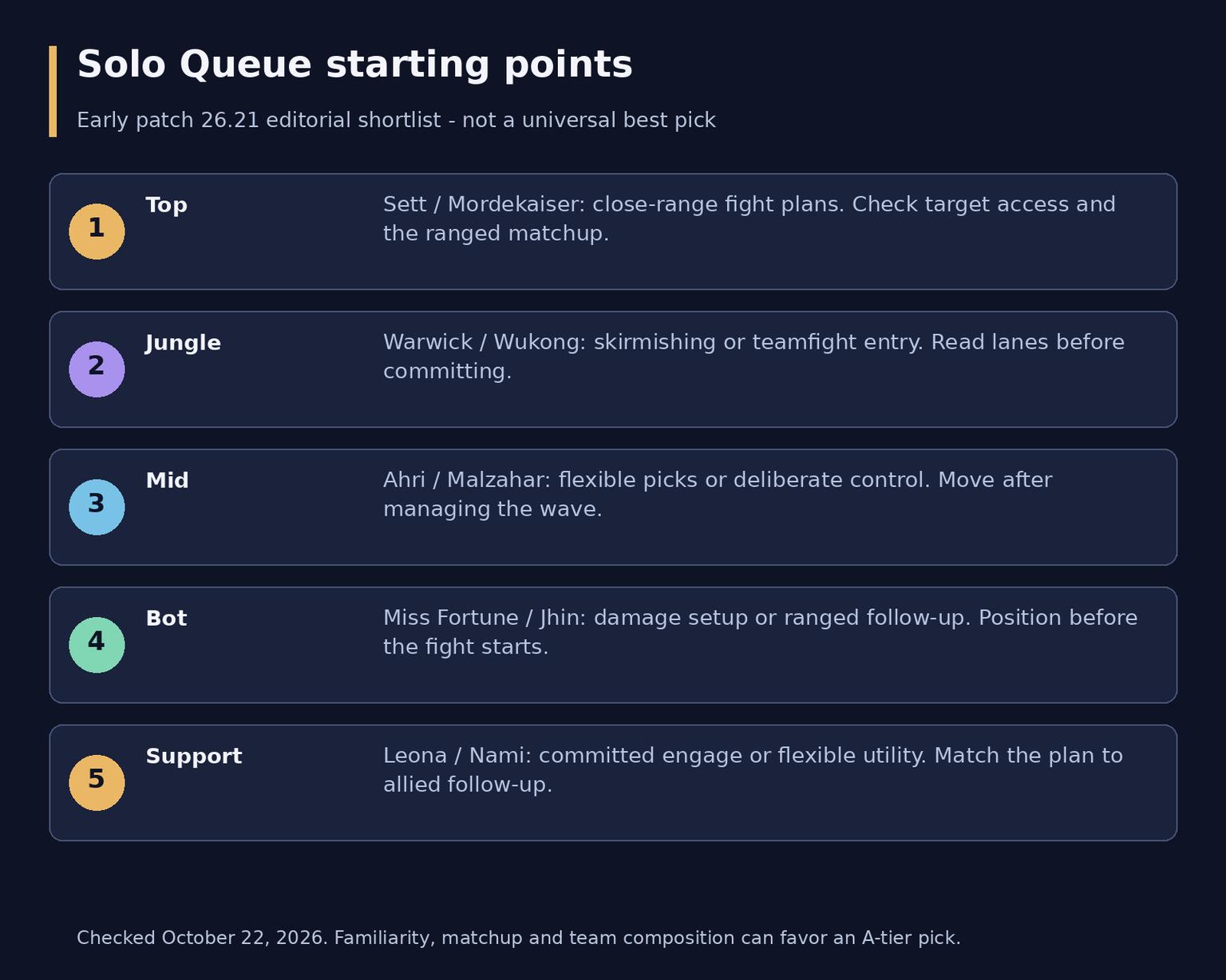
Five role-specific starting points. These pairs serve different team needs and are not a ranking across positions.
Top lane: choose a fight you can actually reach
Tier | Champions | Practical strength | Main constraint |
S | Sett, Mordekaiser | Clear close-range fight plan and meaningful threat in sustained combat | Ranged spacing and kiting can deny access |
A | Darius, Garen | Punish avoidable melee trades; relatively direct execution | Getting ahead does not remove target-access problems |
A | Jax, Malphite | Jax rewards dueling investment; Malphite supplies engage into suitable threats | Jax needs matchup knowledge; Malphite's value changes with damage profile |
B | Yone | Carry potential and access to the back line | Mechanical demands and the 26.21 Q adjustment warrant caution |
Sett is a practical choice when you want to contest close fights and punish an enemy who commits into your range. Mordekaiser offers a different route: sustained magic damage and the ability to isolate a target. Neither solves a ranged lane simply by being in S. If the enemy can disengage repeatedly, plan wave position and access rather than forcing every available duel.
Darius benefits from a shorter late-rank Q cooldown in 26.21. That improves repeated fighting, not his ability to cross open space against a mobile composition. Garen is a useful simpler fallback. Pick Jax when you can manage the lane and want a side-lane threat; choose Malphite for a concrete defensive and engage purpose, not because every team automatically needs the same tank.
Yone's Q attack-damage ratio was reduced. His popularity and specialist ceiling do not erase that change or the execution gap. An experienced Yone player may reasonably keep him over an unfamiliar S pick; a new top player has little reason to begin there just to follow a tier label.
Jungle: reliable access beats a highlight reel
Tier | Champions | Practical strength | Main constraint |
S | Warwick, Wukong | Accessible skirmishing or repeatable teamfight entry | Bad entrances and unsupported fights remain punishable |
A | Master Yi, Viego | Carry and cleanup potential when a fight develops favorably | Crowd control and denied resets punish premature entry |
A | Graves, Kayn | Strong specialist routes for farming or adapting a carry plan | Positioning, pathing and form planning require practice |
B | Lee Sin, Nidalee | High agency in experienced hands | Direct 26.21 nerfs plus substantial execution demands |
Warwick offers a straightforward way to learn when a nearby fight is worth joining. Wukong is a useful alternative when the team needs an entry point and disruption in a grouped fight. Neither should abandon farm for a lane that cannot help. Judge the wave, ally health and escape route before converting a theoretically strong gank into lost tempo.
Master Yi and Viego are more conditional recommendations: wait for dangerous control and important defensive tools to be committed before expecting a cleanup. Graves asks for disciplined spacing and efficient routes. Kayn's form and game plan need deliberate preparation, so a high placement on a general table does not make him a universal beginner pick.
Lee Sin's W cooldown and other damage tools were nerfed; Nidalee lost damage and attack-speed power. This list therefore places them below more accessible choices for its intended reader. It does not claim their high-level ceiling disappeared. A failed invade on either champion can be much more costly than a modest statistical advantage would suggest.
Mid lane: connect wave control to a useful next move
Tier | Champions | Practical strength | Main constraint |
S | Ahri | Flexible movement and pick opportunities around fights | Missing the key control spell can remove the opening |
S | Malzahar | Clear wave plan and reliable single-target suppression when available | Limited mobility and dependence on allies finishing the play |
A | Yasuo, Orianna | Yasuo rewards practiced execution; Orianna offers wave and teamfight control | Different mechanical and positioning requirements |
B | Azir, Ryze, Qiyana | Specialist carry or map-pressure potential | Recent changes do not establish an easy general-purpose pick |
Ahri suits a player who wants to clear a wave, move with information and create a catch rather than commit to every all-in. Malzahar is an alternative for a more deliberate lane and target-control plan. His ultimate is valuable only if its use does not leave him exposed and the team can act on it; reliable control is not a solo-kill guarantee.
Yasuo's strong broad-table presence deserves attention, but he asks for repeated matchup practice and a suitable fight setup. Orianna received Q and W ability-power scaling buffs. They make her worth testing for players already comfortable with range and ball positioning; they are not proof that she instantly becomes the best mid laner.
Azir and Ryze also received help in this patch. Their demands and the short observation period keep them in the specialist group here. Qiyana's Q base damage was reduced, so older burst expectations need checking. Do not interpret these three placements as the same playstyle or a shared item build.
Bot lane: damage matters only while you can deliver it
Tier | Champions | Practical strength | Main constraint |
S | Miss Fortune | Direct damage plan and threatening ultimate with a suitable setup | Immobility and interruptible or badly positioned damage windows |
S | Jhin | Useful ranged follow-up and catch contribution | Reload rhythm and limited uninterrupted sustained damage |
A | Kai'Sa | Flexible carry potential with a practiced build and entry plan | Range, item timing and risky commitment |
A | Caitlyn, Jinx | Caitlyn can exploit range; Jinx can convert an opening into a reset fight | Both changed in 26.21 and still need positioning and protection |
B | Ezreal | Range and escape tools for a practiced player | Skillshot accuracy and damage uptime make him less automatic than he looks |
Miss Fortune gained early E damage and stronger critical-strike scaling on R, while ranged Hubris was weakened. This is compensation with a build context, not a blanket statement that every lethality setup improved. Prioritize a safe channel and allied control; an attractive damage build cannot rescue an ultimate used in the wrong location.
Jhin is the alternative when follow-up and a controlled fight pace fit your team better than continuous front-to-back damage. Kai'Sa rewards stronger understanding of entry timing. Do not follow an isolated target into fog merely because your champion has a way to reach it.
Caitlyn's late Headshot scaling was reduced, with some Q compensation. Jinx lost base health and attack-damage growth. Both remain reasonable familiar picks, but an older tier list that ignores those changes is a poor reason to learn one immediately. Ezreal's safety tools help only when his player still contributes damage; surviving far behind the fight is not the same as carrying it.
Support: match the champion to the team's follow-up
Tier | Champions | Practical strength | Main constraint |
S | Leona | Clear engage and layered crowd-control plan | Commitment becomes a liability without follow-up |
S | Nami | Flexible lane assistance and fight utility | Fragility and timing demands under hard engage |
A | Thresh | Versatile catch, protection and repositioning tools | More execution and teammate coordination required |
A | Lulu, Lux | Lulu supports a carry plan; Lux offers ranged pressure and catches | They answer different drafts and should not be treated as interchangeable |
B | Zyra | Damage and zone pressure with a favorable setup | The seed cooldown buff does not remove vulnerability to being caught |
Leona is a strong recommendation when allies can reach the same target and want to commit. Nami is the alternative when the lane and team benefit more from flexible support than a one-way entrance. A support champion can be powerful and still be wrong for a bot partner who cannot follow the chosen fight.
Thresh gains value from practiced decisions with his protection and catch tools. Lulu is more attractive when a useful carry can exploit her help; Lux needs a lane and team plan that converts pressure into something more than damage numbers. Zyra's improved seed cooldown gives more opportunities, but does not establish her as the strongest support in every matchup.
Do not transfer these grades to another lane. Lux support and Lux mid have different income, responsibilities and opponents. The same applies to a marksman or melee champion appearing in more than one position: a role-specific result is not a license to copy the grade elsewhere.
Items and runes can change the recommendation
Two checked build examples show the principle without prescribing complete pages. Sett's current top profile includes Conqueror with Stridebreaker; Ahri's current mid profile includes Electrocute with Malignance. They support different fight patterns: sustained close-range pressure versus a catch-and-burst plan with repeated ultimate opportunities. These are examples, not an immutable best build for every opponent.
Item changes matter alongside champion changes. The ranged Hubris nerf qualifies Miss Fortune's direct buffs, and the Dawncore improvement is relevant to suitable enchanter builds rather than every support. Check the actual path your champion uses. A champion buff and an item nerf can pull the final result in opposite directions.
Recommended pages are a starting point; defensive choices, trade pattern and item timing still depend on the matchup. Do not use a page from another mode or an older update just because the champion portrait matches.
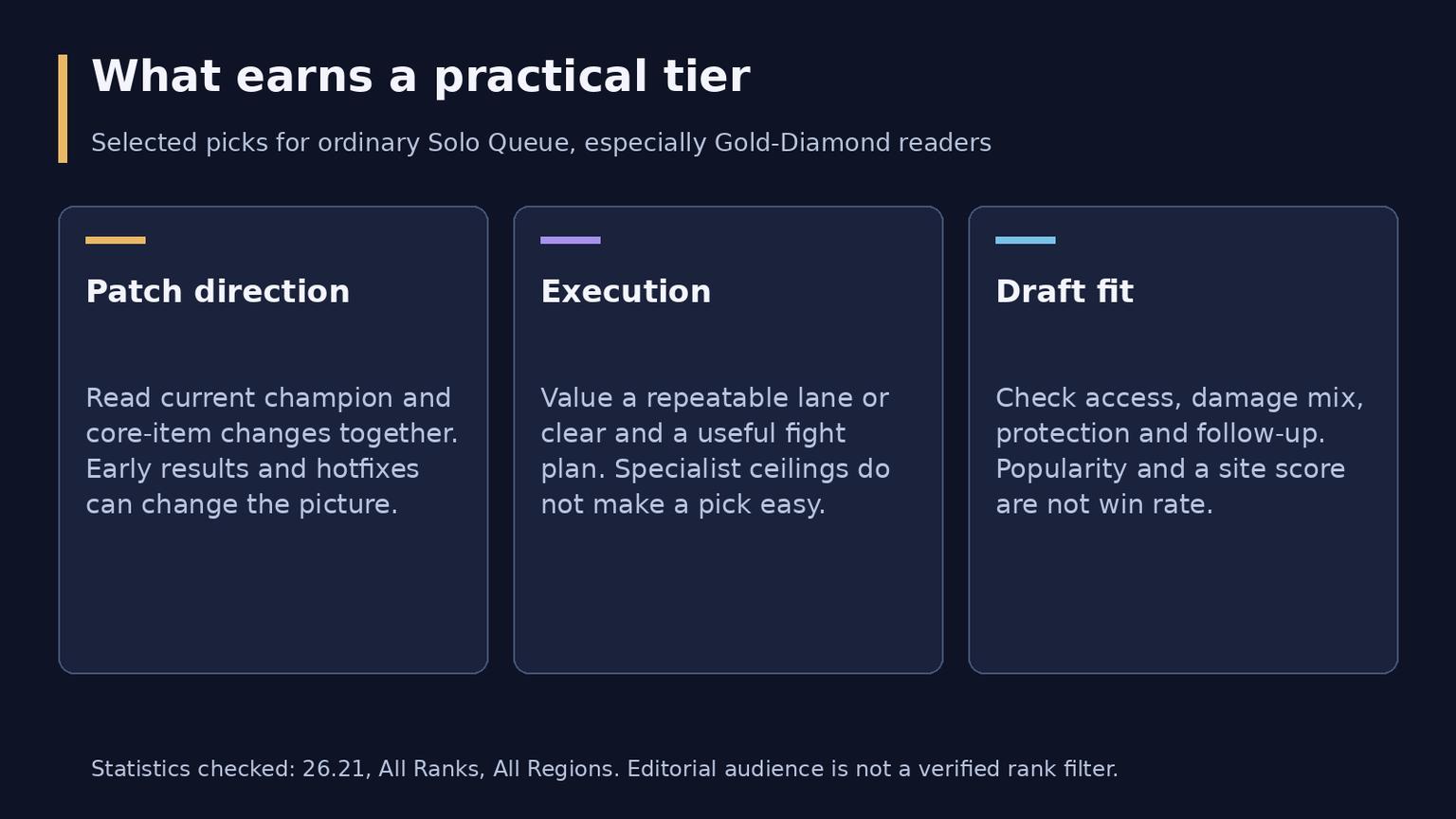
The ranking combines current patch direction, practical execution and draft fit. A site score is not a measured win-rate advantage.
Match the tier list to your experience and draft
For a new role, start with a clear job: Garen for a direct top-lane plan, Warwick for accessible jungle skirmishing, Malzahar for deliberate mid control, Miss Fortune for a straightforward bot damage plan, or Leona when allied follow-up is available. These are learning suggestions, not a claim that every matchup is easy. Practice the vulnerable situation before focusing on the highlight combo.
For an established player, familiar A or B picks can be more effective than a champion learned yesterday. Lee Sin, Nidalee, Yasuo, Yone, Azir and Ryze demand different kinds of mastery; their specialist placement is about accessibility here, not a verdict that their mains should abandon them. At very high ranks, coordinated punishments and execution can change the ordering substantially.
A blind pick needs tolerable losing lanes and a useful fallback role in fights. A counterpick can accept a narrower purpose. Before locking in, check your team's damage mix, ability to start or stop a fight, and whether anyone can safely damage the enemy front line. Choose a champion you can execute that fills a real gap instead of adding a second incompatible win condition.
Pick and ban rates are contextual signals. Frequent bans can make a backup important, while popularity may reflect familiarity or recent exposure rather than strength. For your own ban, consider a matchup that consistently defeats your champion pool. There is no universally correct ban for all five roles.
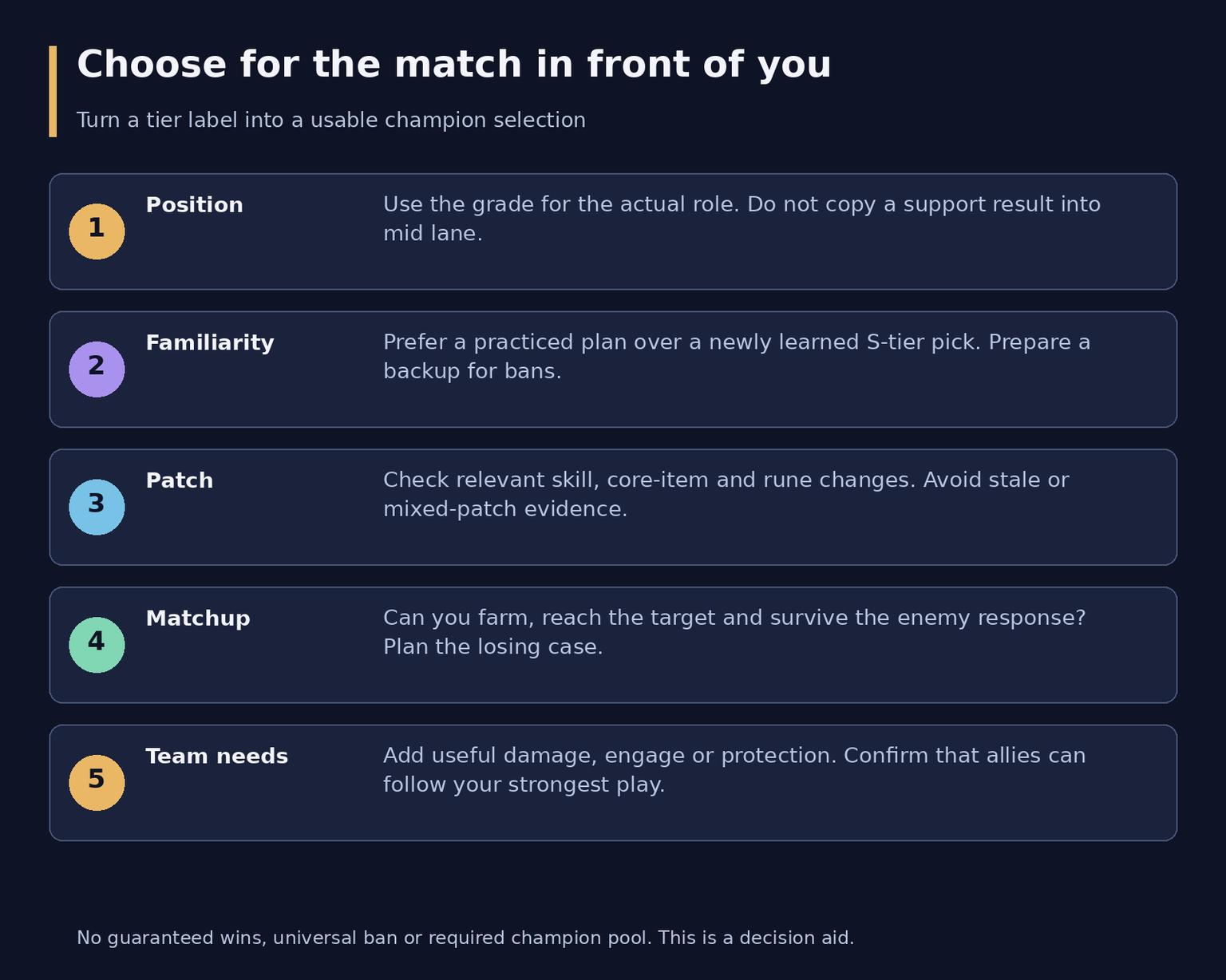
Choose the position and a familiar plan first, then account for the patch, matchup and team needs.
Why Solo Queue and professional rankings differ
Organized teams can prepare drafts, synchronize waves, protect a vulnerable carry and execute a planned engage repeatedly. A professional tournament can also use a different patch. That makes its priority list unsuitable as direct proof of ordinary Solo Queue strength on 26.21.
This article does not combine tournament pick rates, Challenger-only statistics and all-rank results into one supposed average. When checking a live database yourself, keep patch, role, region and rank filter together. Read sample size and pick or ban context before treating a high win rate as a recommendation; a tiny specialist sample can be misleading.
Update your shortlist after a relevant champion, core item or rune change, then give comparable new-patch evidence time to develop. A hotfix affecting your main deserves an immediate check. Otherwise, avoid replacing a practiced pool every time a site moves a champion one tier.
Frequently asked questions
Who are the best champions right now?
For this early 26.21 Solo Queue shortlist, start with Sett or Mordekaiser top, Warwick or Wukong jungle, Ahri or Malzahar mid, Miss Fortune or Jhin bot, and Leona or Nami support. Select between them by familiarity and draft; there is no single best champion across roles.
How often should a tier list change?
Review it after patches and relevant hotfixes, including core item and rune changes. Early results can move quickly. This edition was checked October 22, 2026, so later balance changes require another check.
Should I always choose an S-tier champion?
No. A familiar A-tier pick that fits the matchup and team can be more useful than an unfamiliar S-tier option. The grades describe practical starting points for the stated audience, not guaranteed wins or a required champion pool.
Why is a Solo Queue list different from professional play?
Professional teams have coordinated drafts and practiced execution and may compete on another patch. Those conditions change champion value. A tournament's priority pick does not automatically become the safest choice for an ordinary ranked game.