How to Play Arcane Mage in WoW Forever After the Redesign
Arcane in WoW Forever asks you to manage a timed damage window, an increasingly expensive spell and two different kinds of free casting. The useful question is not simply which button comes next. It is whether the target will survive, whether you can finish the cast and whether spending more Mana now will leave you able to act later.
This guide covers the beta as checked on October 19, 2026, including the October 15 development notes and October 16 client changes. The current level-30 context matters: deeper talents and higher-level spells are conditional. The priorities below are a practical learning framework for the redesigned toolkit, not a proven final level-60 damage optimum.
What changed in Arcane Blast
Arcane Blast now has a 1.5-second base cast. Each stack adds Spell Damage equal to 15% of your Intellect, up to four stacks, while raising the cost of subsequent Arcane Blasts. The window lasts 15 seconds from its first application. Casting another damage spell no longer spends the stacks, and additional Blasts do not restart that original timer.
Four stacks therefore add Spell Damage equal to 60% of Intellect. That is an addition to a character stat, not a promise of 60% more final damage. The redesign also reduced Blast's own damage and coefficient, so treating it as the same old spell with a longer buff is misleading.
Arcane Wrath is the new 16-point milestone: a 3.5-second base cast with a six-second cooldown. Its damage calculation includes additional Spell Power equal to 5% of maximum Mana. Spending Mana does not directly reduce that maximum-Mana term. Neither these stacks nor this spell should be replaced with a modern Arcane Charges and Arcane Barrage cycle.
Build around the spells you actually have
Missile Barrage is now a two-point talent in the first row. Arcane Missiles hits can trigger it as well. Arcane Blast remains an 11-point milestone; Arcane Wrath follows at 16 points, Presence of Mind at 21 and Arcane Power at 31. These are talent investment milestones, not character levels.
With the ordinary 21 talent points at level 30, a committed Arcane character can reach Presence of Mind. Arcane Power needs a deeper budget. Check selected Legacy benefits separately instead of assuming every displayed talent is available. Mage Armor is normally learned at level 34, so it is not an automatic part of the ordinary level-30 setup.
A focused Arcane setup prioritizes access to Blast and Wrath, Missile Barrage and the actual Mana talents it can afford. A hybrid that buys Frost control or other utility gives up part of that investment. Choose the trade for a specific job; do not combine the strongest deep talents from several trees into an impossible build. Hero Talents from the modern game do not belong in this talent plan.
Read the two procs differently
Missile Barrage makes the next Arcane Missiles channel free and faster. Use that opportunity while the target is alive, in range and unlikely to force an interruption. It is not permission to channel while moving, and one activation does not guarantee two free channels. React again if a fresh activation appears.
Clearcasting is a separate Mana-saving effect. A free Arcane Blast can be valuable when you want another stack without paying its current high cost. It still changes the stack count and the price of a later paid Blast. A free area spell may be more useful when several enemies need to die together. Do not spend Clearcasting automatically on an already-free Missile Barrage channel without considering the available alternatives.
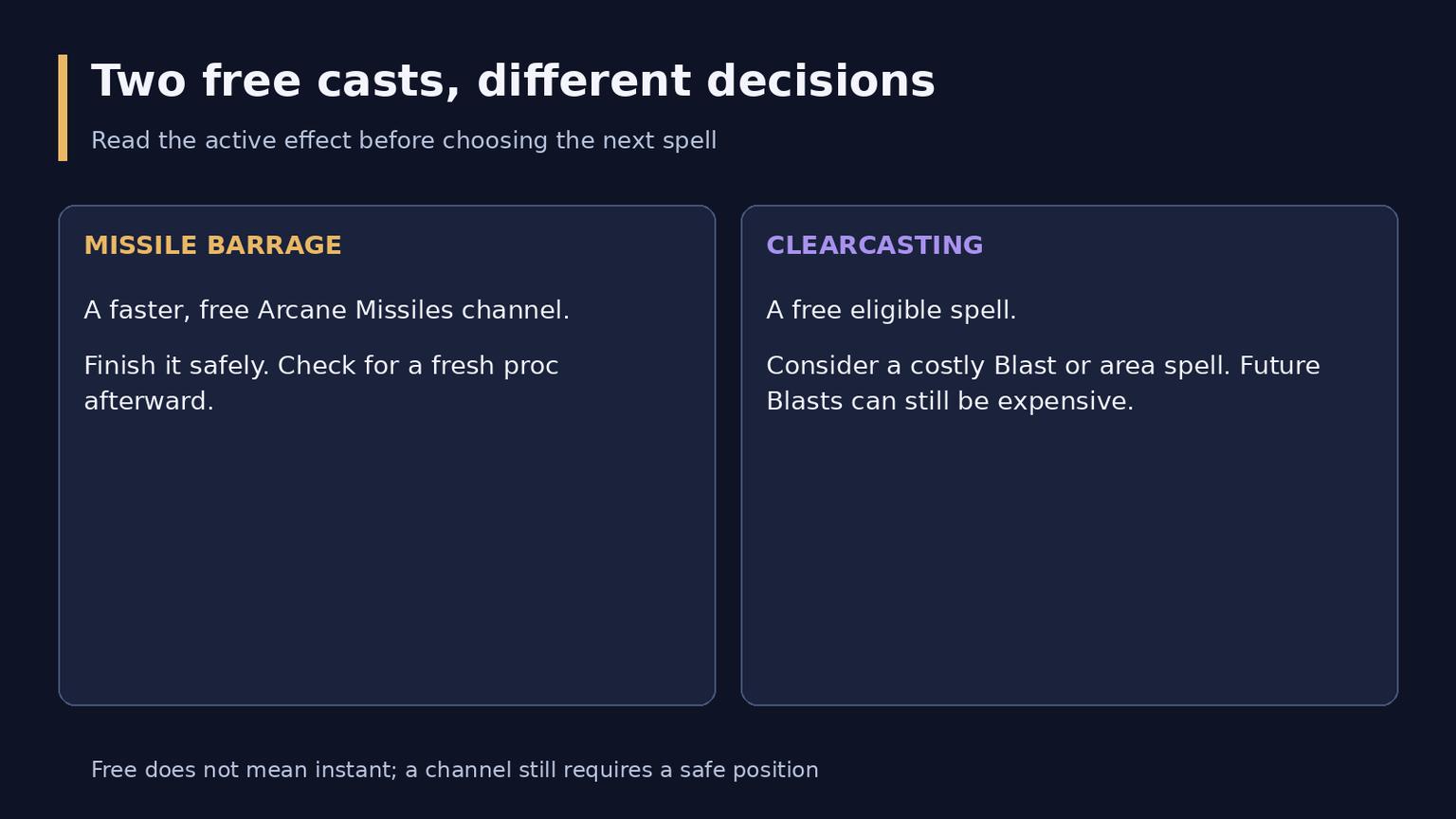
Different decisions for Missile Barrage and Clearcasting
Keep both proc indicators visible alongside Mana, Blast stacks and the remaining window. The October fixes removed incorrect extra Clearcasting rolls from every individual area target. Pulling more enemies is not a guaranteed way to manufacture unlimited free spells.
A practical single-target priority
Start with survival, interrupts and target lifetime, then evaluate the damage buttons. The following order is deliberately conditional; it is not a macro to repeat without looking at the fight.
1. Move out of danger or stop a dangerous enemy cast. Losing a channel is preferable to dying with a full resource bar.
2. Use a Missile Barrage channel when you can complete it. Avoid holding a free opportunity merely to reach four Blast stacks if the target or window is about to end.
3. Fit Arcane Wrath into a useful damage window when it is learned and ready, and the target will live through its cast. Existing Blast stacks improve the opportunity. Treat this as a starting approach to test, not proof that hard-cast Wrath always beats every alternative.
4. Build Blast stacks when you can afford the next cast and have time to exploit their remaining duration. Clearcasting can make this step cheaper.
5. When expensive Blasts are no longer sustainable, use affordable learned damage spells, available free channels or resource recovery until the timed stack window ends. Arcane Missiles without Missile Barrage still costs Mana; it is not a free recovery button.
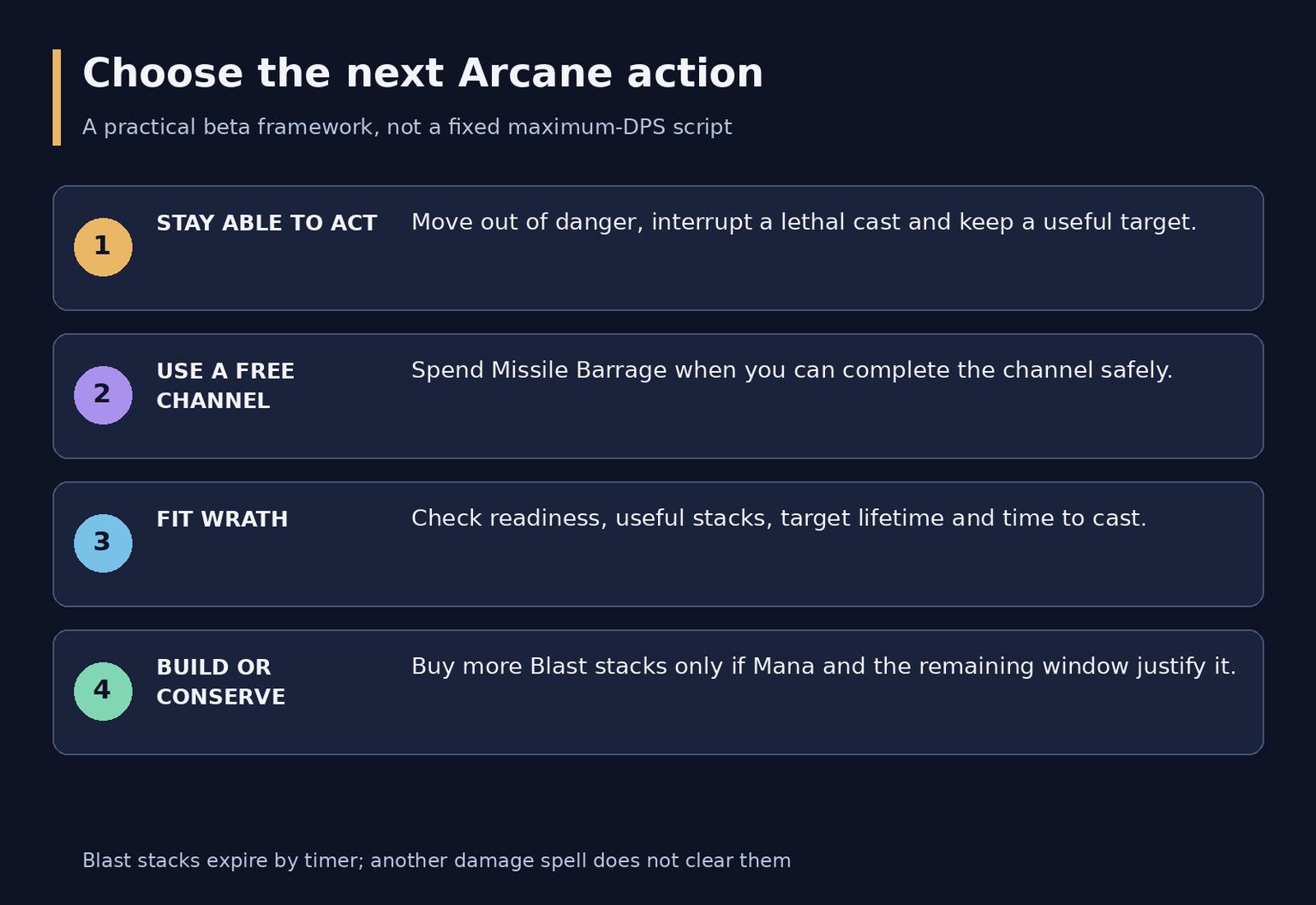
A conditional Arcane decision order
Example opening with a normal Arcane talent budget
Before the pull, restore Mana, apply available buffs and check the tank's target. Start Blast only when its hit will coincide with the agreed pull. Its first stack starts the clock, so repeatedly casting early wastes the window and risks pulling ahead of the tank.
If the opening is safe and resources are plentiful, build toward a stronger window, taking useful free Missiles along the way. With Presence of Mind available, an instant Arcane Wrath is an option once you have useful stacks. This saves the long cast time; it does not make the spell free. If the enemy is almost dead, spend on damage that can land instead of completing a decorative four-stack setup.
After that opening, reassess the target and Mana bar. There is no instruction to clear stacks with Fire Blast or Missiles: those spells no longer reset Blast's cost. A weak remaining timer can be a reason to wait for natural expiry rather than buy another expensive Blast.
Manage Mana over the whole encounter
Choose how aggressively to build from the length of the fight and your recovery options. On a short final enemy, remaining Mana may have little future value. In a long boss fight or a chain of pulls, exhausting the bar in the first window can cost more damage than an extra early stack produced.
Use the actual next Blast cost as a warning signal. A four-stack window is an option, not an obligation. A modest stack count can be a sensible learning choice when Mana is tight, but no fixed two-stack or three-stack rule is established for every gear set and encounter after this redesign.
Situation | Decision | Reason |
Plenty of Mana and a safe window | Build more stacks and use available damage tools | You have time and resources to benefit |
High Blast cost, long fight ahead | Stop paying for repeated Blasts; use cheaper options | Another spell does not remove the cost stacks |
Free Missiles available | Channel if the target and position allow it | Useful damage without that channel's Mana cost |
Recovery tool available | Use when its restoration will fit and the fight warrants it | Avoid wasting restoration at a full bar |
A safe pause | Recover before the next dangerous phase | An interrupted recovery can waste the opportunity |
Evocation needs a safe channel. Plan it around a lull or protected position rather than waiting until enemies have forced you into a desperate retreat. Mana gems and potions depend on what you can currently create, equip or use; do not copy a level-60 shopping list onto a lower-level character. Drink between pulls when the group can pause.
A wand can preserve Mana while still contributing damage, but the updated rules require half a second standing still before it fires. It is not a solution for uninterrupted damage while running. Spirit and regeneration talents also need their actual casting rules; a displayed regeneration number is not automatically the amount you receive during continuous spellcasting.
Burst windows and cooldown choices
Presence of Mind is particularly useful for a long eligible cast such as Wrath, or when a brief movement requirement would otherwise prevent that cast. Decide whether you need immediate damage or the flexibility to reposition. Do not spend it on a spell that was already instant simply because a fixed sequence says to press the button.
Arcane Power belongs only in setups that can actually reach it. When available, place it where you can keep attacking, have the Mana to support the increased spell cost and can exploit the current damage window. Combining every cooldown at the pull is poor practice if the boss immediately becomes untargetable.
There is no universal Mana percentage for starting a burst phase here. The next mechanic, remaining fight duration, accessible restoration and actual spell costs determine whether you can sustain it. Reserve enough Mana for a necessary interrupt, escape or defensive action instead of calculating the whole bar as disposable damage.
One target, cleave and area damage
Two enemies do not automatically justify abandoning a dangerous priority target. Blast and Wrath are single-target tools; changing targets does not turn them into splash damage. Keep the important target selected when its death prevents more harm than evenly damaging the pack.
Arcane Explosion becomes relevant when enemies are grouped and you can safely reach them. The cost is not only Mana: moving close exposes you to melee attacks and dangerous effects. Let the tank establish control. Avoid hitting enemies assigned to Polymorph or another breakable control effect.
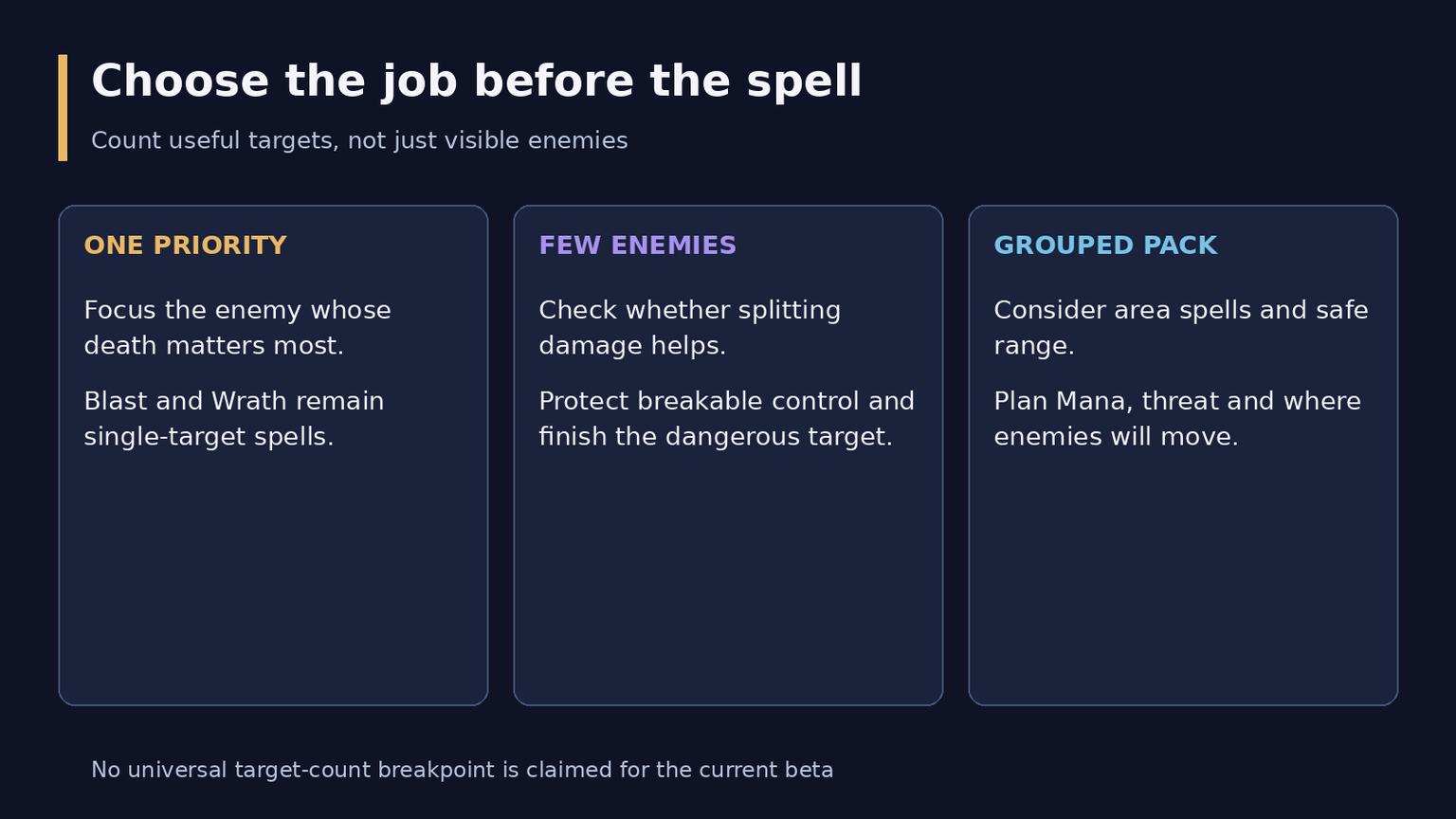
Compare target priorities before choosing area spells
Blizzard can offer ranged area pressure and control, while Flamestrike needs enemies to remain in its area to gain full value from its lingering damage. Their usefulness depends on learned ranks, selected talents, pack movement and survival. There is no verified universal target-count breakpoint in this guide. Compare real pulls with similar conditions instead of importing a threshold from another version.
For short-lived packs, prioritize damage that will actually land. For durable grouped enemies, plan Mana across the full pull. If enemies scatter or the tank must kite, reconsider a stationary ground effect or close-range Explosion rather than chasing a theoretical area rotation.
Movement, defense and group value
Plan your casting position before starting a long Wrath or Missiles channel. Use a required movement interval for an available instant such as Fire Blast, a planned Presence of Mind cast or needed utility. Taking unnecessary steps between every spell creates downtime even when no mechanic required movement.
Blink creates distance or crosses a short danger zone when the destination is safe. Frost Nova can buy separation from susceptible enemies, but roots can break and do not protect against everything. Polymorph removes a suitable enemy from the immediate problem only while teammates avoid breaking it. Counterspell should stop the dangerous cast, not the first harmless one you happen to see.
Mana Shield absorbs physical damage at a Mana cost. Treat it as a survival trade, not a free all-school barrier. Fire and Frost wards answer their matching damage types. Ice Block is a Frost talent choice, not a guaranteed baseline spell in every Arcane build. A dispel or well-timed interrupt can be worth more to the group than another damage cast.
Improve decisions before chasing a final build
Intellect matters to the redesigned Blast window; maximum Mana also participates in Wrath's calculation. That does not establish a universal stat weight or make Spell Damage, hit chance and other relevant stats irrelevant. Compare equipment in the context of your level, target, talents and actual time spent casting. Final raid gear rankings and fixed damage shares are not established by this guide.
After a pull, check why casts were lost: movement, target death, an interrupted channel, a late proc response or a bar emptied by costly Blasts. Practice one change at a time. A short sequence you can adapt reliably is more useful than an elaborate opener that fails whenever the tank moves.
Frequent mistakes
· Treating another spell as a Blast-stack reset after the redesign.
· Assuming every free-casting effect has the same purpose.
· Waiting for a fifth stack, although the cap is four.
· Starting Wrath on an enemy that will die before it lands.
· Paying for repeated expensive Blasts with no plan for the next phase.
· Assuming an instant cast is also free, or a free channel permits movement.
· Equipping a future talent or armor spell in a plan for a character that cannot access it.
Should I always cast Wrath on cooldown?
Use readiness as a prompt to evaluate it. Stacks, remaining window, target lifetime and movement can justify another choice. Its long cast makes blindly pressing it every six seconds unreliable; current beta mechanics do not establish one permanent answer for every encounter.
Is four stacks always the goal?
Four is the maximum, not a mandatory minimum before doing useful damage. Build when the remaining time and Mana support it. Spend a useful free channel or finish a dying enemy rather than losing the opportunity while chasing a perfect-looking resource display.