WoW Forever Beast Mastery Hunter Guide
Beast Mastery turns the Hunter and a trained companion into a damage pair. Let the pet establish contact, keep your ranged attacks firing, and use the pet's family skill for the actual encounter. It is an accessible solo style because the pet can hold ordinary enemies while you shoot. Pet deaths, poor pathing and targets that cannot be reached are its main weaknesses. Marksmanship invests more heavily in the Hunter's own shots; Beast Mastery invests in pet damage, recovery and control. That distinction does not make the Hunter's weapon irrelevant.
This guide is checked on October 24, 2026. The Forever beta closed October 23 at 10 AM PDT; its last ordinary level cap was 30. The latest checked extracted client is 1.60.1.70532, patch family 1.60.1. That is a client-data reference, not a complete server hotfix log. November 4 launch gameplay at levels 1-60 is still future content. The recommendations below describe the last beta rules and preparation for release, rather than a currently playable live endgame meta.
Talents for the last beta cap
Without bonus Legacy talent points, level 30 gives 21 points. This 21/0/0 template prioritizes an active pet, Summon Hawk and Intimidation. It is a practical allocation, not a measured best-in-slot damage ranking.
Talent | Points | Purpose |
Deadly Aspects | 5/5 | Improves Auto Shot output with Aspect of the Hawk active. |
Focused Fire | 2/2 | Increases Hunter and pet damage while the pet is active. |
Pathfinding | 2/2 | Travel utility between pulls. |
Improved Revive Pet | 1/2 | Reduces the cost of recovering a dead companion. |
Bestial Swiftness | 1/1 | Pet movement and the prerequisite for Intimidation. |
Unleashed Fury | 5/5 | Increases pet and summoned hawk damage by 15%. |
Summon Hawk | 1/1 | Adds the new temporary ranged companion attack. |
Ferocity | 3/5 | Adds 6 percentage points of pet and hawk critical chance. |
Intimidation | 1/1 | Delivers a stun through the pet's next successful attack. |
A valid route is five Deadly Aspects, then the six points across Focused Fire, Pathfinding, Improved Revive Pet and Bestial Swiftness, with four Unleashed Fury points before buying Summon Hawk as point 16. Finish Unleashed Fury, add three Ferocity, then take Intimidation as point 21. Bestial Swiftness must already be learned. These row gates matter more than copying an old talent string.
For safer solo leveling, replace two Deadly Aspects points with 2/5 Endurance Training. It improves pet health and armor; it does not require a separate imported Thick Hide talent. For a PvP utility variant, keep the main template but replace two Ferocity points with 2/2 Improved Mend Pet. This trades pet critical chance for cheaper healing with a dispel chance. Neither variant changes the 21-point total. Keep the movement and control talents; choose the damage or recovery flex points for your actual opponent and downtime.
Higher-level preparation
Bestial Wrath needs 31 points in Beast Mastery, normally reached at level 40. It is not part of the ordinary level-30 beta kit. The Legacy Talented perk can add points earlier, but does not make the normal 21-point build a 31-point build.
A future 31/20/0 planning template extends the main allocation with two more Ferocity, 2/2 Bestial Discipline, 5/5 Frenzy and Bestial Wrath. Its Marksmanship side is 5/5 Lethal Attacks, 5/5 Efficiency, 5/5 Careful Aim, 3/3 Hawk Eye and 2/3 Improved Stings. This is a 51-point level-60 plan based on the current tree, not a fully tested release raid build. Recheck the final tree before spending.
Frenzy rewards pet critical hits with faster attacks. Bestial Discipline at 2/2 increases pet Focus regeneration by 20% and permits 50% of normal Mana regeneration while casting. Bestial Wrath's recorded effect is 50% more pet damage for 18 seconds, with a two-minute cooldown and a cost of 12% base Mana. Its control protection belongs to the pet; do not automatically grant the Hunter the same immunity. Kill Command, The Beast Within, Ferocious Inspiration, Animal Handler and Serpent's Swiftness are not assumed baseline buttons or talents here. A searchable spell record alone does not prove a learnable Forever ability.
Getting and keeping a pet
Start the Hunter pet quest chain at level 10 and finish its follow-up training quest. Stopping after the first successful tame can leave essential management abilities missing. The completed chain supplies the taming and training tools, feeding and resurrection.
Choose a tameable beast no higher than your level. Use Beast Lore to inspect it, clear nearby enemies, and protect the taming channel from interference. A dismissed current pet still occupies your active slot: put it in the stable before acquiring another companion. Never abandon a valued pet merely to make room for a test.
The beta arrangement is one active pet and two purchasable stable slots. Swap at a Stable Master. Pet leveling is separate from Hunter leveling: fight suitable enemies with the companion, and keep it near your own level. Do not expect handing in a batch of quests to train a newly tamed low-level pet instantly.
Training, food and recovery
Teach compatible abilities through Beast Training. To learn a rank from another beast, stable your main pet, tame a beast that knows the rank, let it use the ability until the learning message appears, then retrieve your main pet and teach it. A Pet Trainer supplies Growl and passive training. Family compatibility, pet level and available Training Points still apply.
Loyalty grows through time and activity with a fed companion and supplies more Training Points. A newly tamed pet can initially have few or negative points. That is a development problem to solve through normal pet care, not proof that the pet is unusable. Do not indiscriminately reset every trained ability: a beta bug could also remove its attack-speed passive.
Happiness affects damage: Happy is 125%, Content 100%, and Unhappy 75%. Carry food that matches the family's diet and feed outside combat. Beta reporting identified a happiness-decay bug; do not build a release routine around never feeding. After death, use Revive Pet and restore happiness. Mend Pet heals a living companion; Call Pet is not a substitute for resurrection. Dismiss Pet is temporary, while abandonment removes the companion.
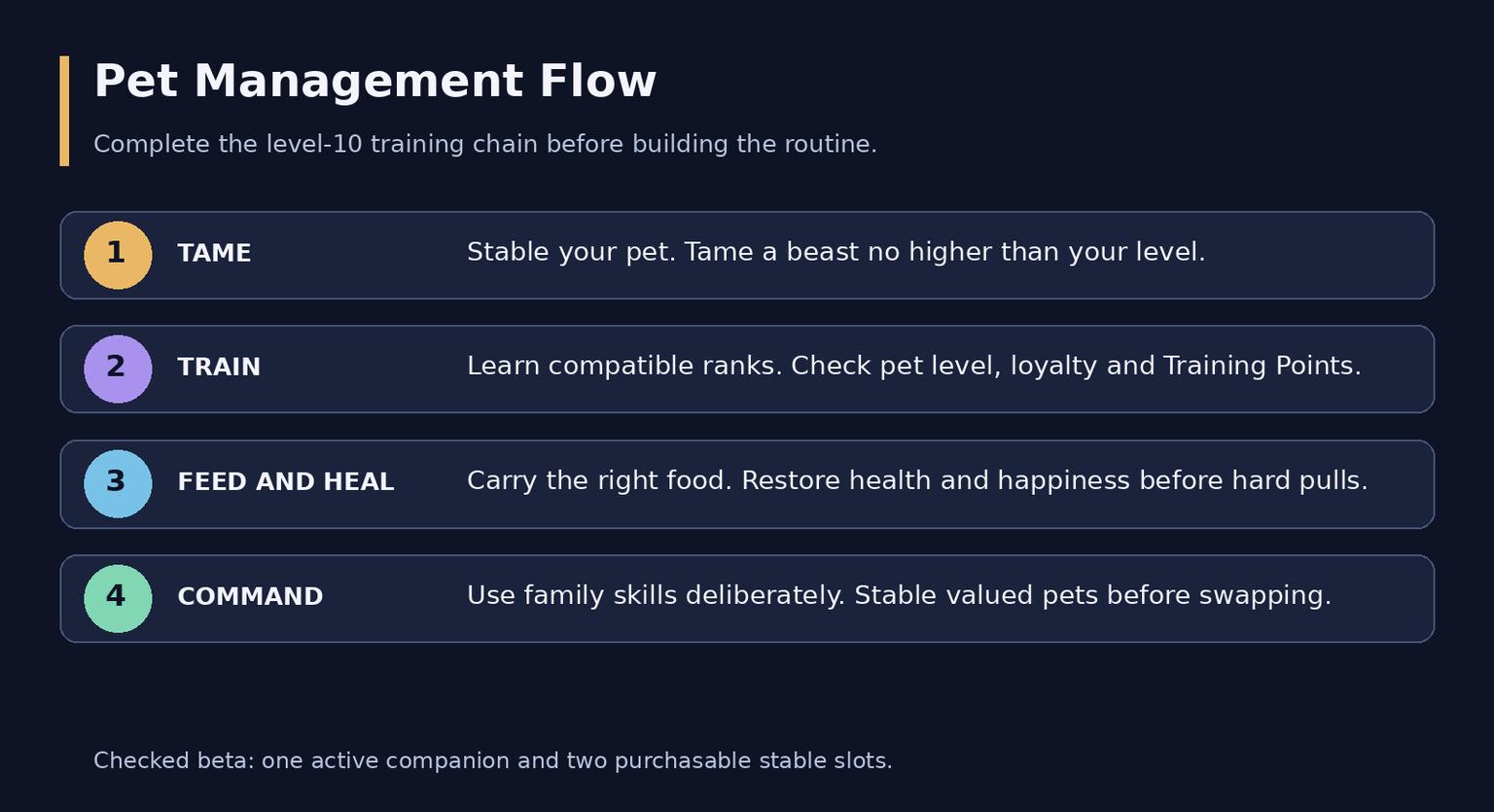
Taming is the beginning of pet training and care.
Choosing a family
The checked beta catalog has 18 families, including the new Fox family; the old Owl label is now Bird of Prey. Family choice determines the available special tool, not a license to copy Vanilla family damage multipliers or a modern pet talent tree. Exotic pet access has not been established for this guide.
Situation | Useful family tool | Practical choice |
Ordinary solo pulls | Bear Swipe can hit three enemies. | Useful for small packs; control extra pulls and train the required rank. |
Planned PvE damage | Cat Prowl adds an opening option; other families offer group tools. | Prefer a trained, happy pet that stays in range over an untested rare-pet ranking. |
Defensive solo work | Turtle Shell Shield reduces incoming damage at an attack-speed cost. | Use it to survive a dangerous interval, rather than treating it as free damage. |
Healing pressure in PvP | Crocolisk Dismember reduces healing by 25% for six seconds; 15-second cooldown. | Time it with pressure. Old 50% descriptions are outdated. |
Caster or weapon utility | Bat Sonic Blast slows casting; Bird of Prey Mine! disarms. | Sonic Blast is not an interrupt. Mine! lasts three seconds with a 90-second cooldown. |
Closing distance or holding a target | Boar Charge or Spider Web. | Choose the control effect needed by your plan; inspect its actual rank. |
A confirmed early example is Young Forest Bear, a level 8-9 tameable bear in Elwynn Forest. Return after your level-10 pet training. Its family makes it a sensible solo candidate, but that does not mean this low-level beast already knows every Swipe rank. Verify the pet spellbook and learn the ability when eligible. Its appearance is not evidence of superior attack speed.
Attack speeds can differ through Faster Attack or Slower Attack passives. Check the actual creature and its learned effects. Neither “all pets attack every two seconds” nor “the old fastest rare is automatically best” is a safe Forever rule. Use current ability, uptime and survival evidence before spending hours on a rare spawn.
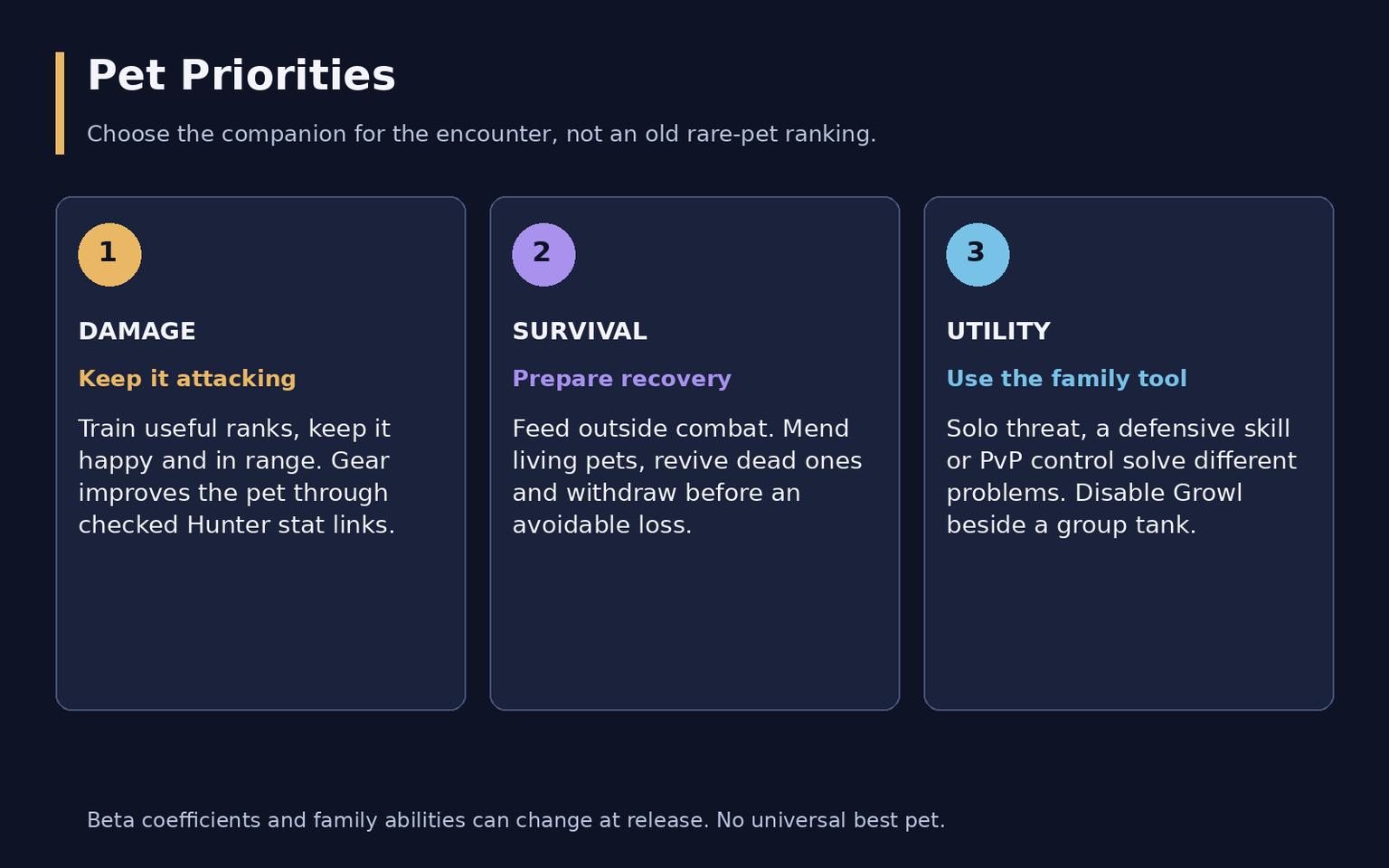
Damage, survival and family utility require different decisions.
How Hunter gear improves the pet
The beta's observed scaling makes equipment relevant to both halves of the pair. Read these as checked beta coefficients, not a promise that every Hunter stat is copied wholesale.
Hunter stat | Observed pet gain | How to use it |
Stamina | Two pet health per Hunter Stamina. | Helpful for solo and PvP survival. |
Armor | 30% of Hunter armor. | Adds physical durability; does not replace positioning. |
Attack Power | 10% of the higher applicable Attack Power source. | Do not add melee and ranged pools together. |
Critical chance | 100% of the higher melee or ranged critical chance. | The October update fixed inheritance; do not sum both percentages. |
The exact Hit and resistance inheritance formulas are not established here. The October notes also corrected pet expertise behavior, but do not justify publishing a universal copied expertise cap. Gear can benefit the pet indirectly through the Hunter's stats; this is different from assuming every player buff can be cast directly on a pet.
For PvE, first address misses against the enemies you fight, then compare Agility, ranged damage, Attack Power and Crit as a package. Do not impose a universal old raid Hit percentage on level-30 targets. Intellect supports Mana, and the future Careful Aim allocation gives it another role. Haste exists in Forever, but its exact transfer to the pet is not assumed. In PvP and hard solo pulls, Stamina and reliable control can be worth more than a small paper damage gain.
Shots, hawks and positioning
Before pulling, check ammunition, pet health, happiness, abilities and your Aspect. Apply Hunter's Mark to a worthwhile target, send the pet, and allow contact before unloading. Keep Auto Shot active while the companion attacks. On short ordinary enemies, avoid spending more Mana on setup than the remaining fight warrants.
Summon Hawk is a central new tool: its recorded cooldown is six seconds, it shares a cooldown with Arcane Shot, each hawk lasts 18 seconds, and you can have two. The October update makes a hawk spawn at its cast target and stay on that target. Existing hawks are not a free retargetable army. Summon them on an enemy that will live long enough, maintain available hawk slots, and avoid replacing or wasting them just to press the button every six seconds.
Use Aimed Shot when a cast can complete safely. It is a baseline ability from level 20 and shares its cooldown with Multi-Shot. Multi-Shot can hit three targets: use it on a safe pack, not into crowd control or an unpulled enemy. Arcane Shot is a flexible instant attack, but must not delay an important hawk summon through their shared cooldown. Extra shots are conditional on Mana and target life, rather than a fixed sequence to mash.
Auto Shot changed on October 15: you must stand still for its 0.5-second firing preparation. Move between firing windows and stop again in time. It can continue during Aimed Shot and Sniper Shot casts; this does not mean it fires freely while running. Practice the rhythm on ordinary enemies before attempting dangerous kiting.
On a target switch, send the main pet deliberately, re-establish ranged positioning, and decide whether the new target deserves a mark and hawks. Do not chase a doomed enemy with expensive setup. Against several enemies, choose one priority target, control the others and use only the cleave you can safely sustain. Beast Mastery has no verified modern poison-like spreading or unlimited pet AoE system to substitute for this planning.
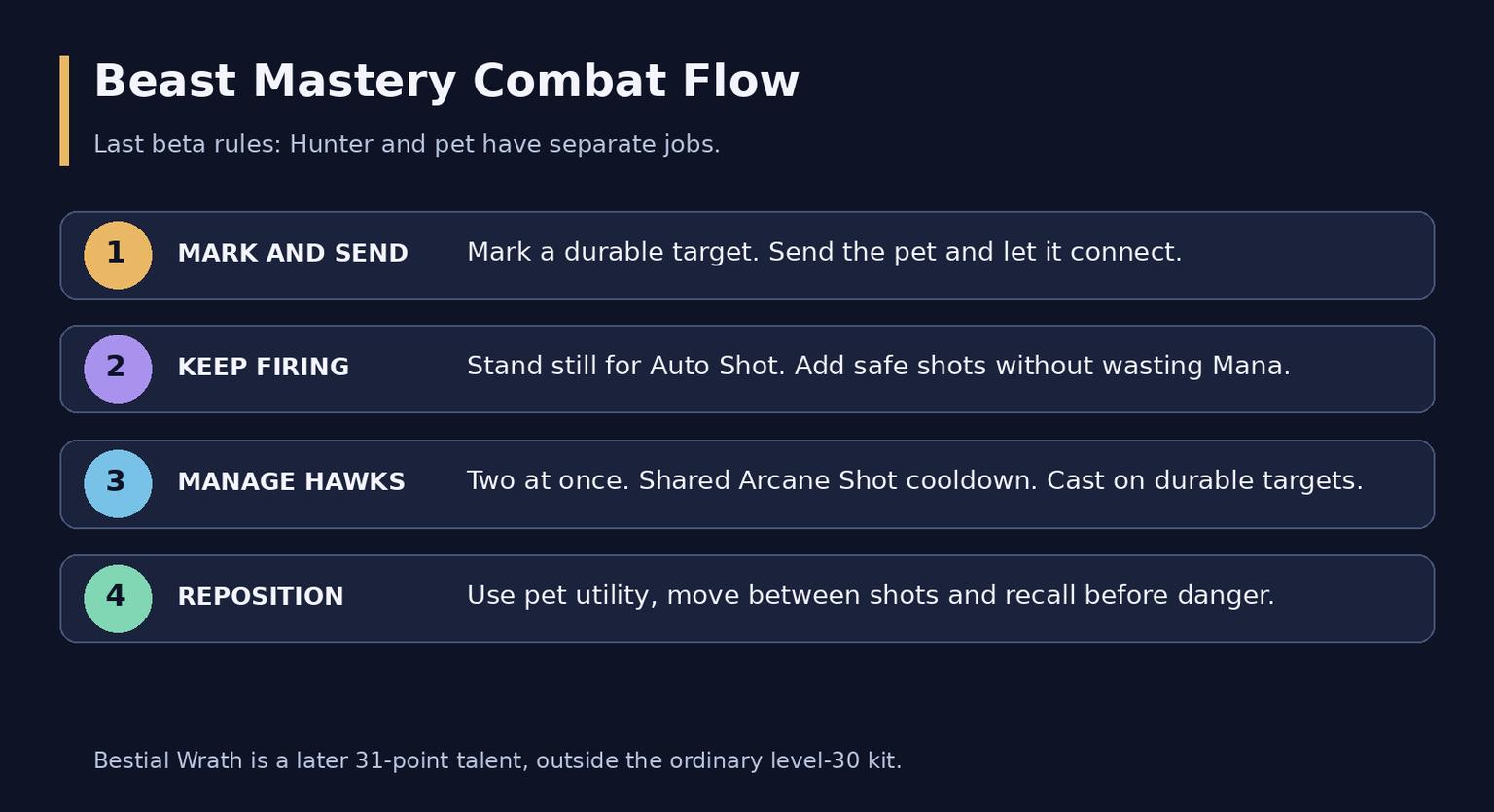
Coordinate the pet, stationary shot windows and useful hawk summons.
Threat, resources and utility
Growl spends pet Focus to add threat. It is useful on autocast for solo enemies, but its checked effect is threat generation, not a guaranteed forced-target taunt. Give the pet time to connect. In a group with a tank, turn Growl off unless the group has agreed that your pet will hold an add. Heal early, retreat before the pet is overwhelmed, and do not promise that every elite is soloable.
The Hunter spends Mana; the pet spends Focus, which regenerates continuously. Too many pet autocasts can delay the ability you actually need. Keep the basic damage skill active, then reserve control or defensive family skills for a useful moment. Auto Shot and pet attacks let you conserve Mana between expensive shots. Carry drinks and pet food, replenish ammunition, and save a recovery margin for Mend Pet or resurrection.
Aspect of the Hawk is the normal ranged damage stance. Aspect of the Monkey is a defensive option when enemies reach you; its improved talent can also pass part of the benefit to the pet. Aspect of the Cheetah helps travel, but taking damage can daze you for four seconds. Remove it before an unsafe exchange. Aspect of the Pack is a later level-40 group travel tool, with a similar risk to allies; it is not a level-30 combat buff.
Intimidation is a pet control cooldown: the next successful attack stuns for three seconds and gains critical chance. It cannot stun a distant enemy while the pet is unable to attack. Save it for an escape, a dangerous cast that can be stunned, or coordinated pressure. Later Bestial Wrath belongs in a window with the pet alive, in contact and able to attack throughout. Rapid Fire supports your own ranged window once learned; do not label it a pet steroid.
Feign Death, traps and pet commands solve different problems. Recall or redirect the pet before escaping: dropping your own threat does not automatically save a pet still fighting. Forever permits traps in combat; the October rules separate Fire and Frost trap cooldowns and allow one active trap of each category. Do not break your own control with the pet or Multi-Shot. Bind attack, follow/passive and the family utility separately.
Weapons, PvP and race choice
Compare bows, guns and crossbows using actual damage, stats, ammunition and trained weapon skill. Keep a suitable quiver or ammo pouch stocked. Weapon speed changes firing and movement opportunities, but Beast Mastery is not automatically governed by an old Marksmanship slow-weapon breakpoint. Do not discard a strong overall upgrade just because another bow has a slower listed speed. Check scope compatibility on the exact item.
In PvP, sustained pet contact and your range matter more than an uninterrupted PvE cast sequence. Use Concussive Shot and, when necessary, Wing Clip to create space. Combine Intimidation with a pet family tool, traps and planned target pressure. Protect the companion from avoidable damage and crowd control. Future Bestial Wrath can protect its attack window, but does not make the Hunter immune to every control effect. A heal-reduction pet, a disarm pet and a rooting pet solve different matchups.
Choose faction and racial utility after reading the current Forever tooltip. October changes gave Human Ruthless 2% Crit, Orc Savage 1% Crit with Blood Fury on a three-minute cooldown, and Skyborne Wind Blessed 3% Haste. Tauren Endurance now gives 2% critical damage and healing; older recommendations based on a Tauren Hit bonus are outdated. These are different tradeoffs, not proof of one universal best race. Check that the race/class combination is available, then prioritize the faction and utility you want to play.
Frequently asked questions
Is Beast Mastery Hunter good in WoW Forever?
It is a practical solo and leveling style under the last beta rules because the pet adds damage and can hold ordinary enemies. Its release raid ranking is not established, and pet uptime, training and survival strongly affect results.
Which pet should I choose?
Use a trained bear for manageable solo packs, or select a family tool for the encounter: crocolisk healing reduction, bird disarm or spider root for suitable PvP plans. A happy, level-appropriate pet is more useful than an unverified rare-pet recommendation.
How does the pet system work?
Finish the level-10 training chain, tame an eligible beast, train compatible ability ranks and maintain food, happiness and loyalty. The checked beta has one active slot and two purchasable stable slots. Heal living pets and resurrect dead ones before returning to combat.
What is the basic Beast Mastery PvE priority?
Mark a durable target, send the pet, keep Auto Shot firing from stationary windows and maintain useful hawk summons without wasting their two-slot limit. Add appropriate shots when Mana and safe positioning allow, and use pet control or later Bestial Wrath when the pet can actually attack.