Best WoW Forever Classes for Leveling, Groups and PvP
For a first solo character in WoW Forever, Hunter is a practical starting recommendation if you enjoy controlling a pet. Mage suits players who prefer controlling enemies themselves, while Warlock offers a different balance of demons, sustained damage and recovery. If your priority is changing group roles on one character, start by comparing Druid and Paladin rather than looking for the highest damage label.
These are recommendations by purpose, not a measured damage ranking. This guide was checked on October 18, 2026 against official beta updates and current class overviews. The beta's level-30 context and ongoing redesigns do not support treating an early impression as a final level-60 raid hierarchy. No class is assigned a permanent S, A or B grade here.
The useful choice is a class whose responsibilities you want to learn. A high theoretical ceiling means little if you dislike managing its pet, positioning, resources or healing decisions for the whole journey.
A practical shortlist by scenario
Your priority | Start by comparing | Why these fit |
First character, pet-assisted questing | Hunter, Warlock | Companions and control tools help manage ordinary solo encounters. |
Ranged spells and enemy control | Mage | Dedicated spellcasting, crowd control and travel conveniences. |
Tanking, healing and damage options | Druid, Paladin | Several group roles on the same character, with different equipment and builds. |
Healing as the main interest | Priest, Druid, Paladin, Shaman | Compare prevention, direct healing, ongoing effects and group support. |
Tactical melee and choosing engagements | Rogue | Stealth and control make preparation part of the class's appeal. |
Weapon combat or shield tanking | Warrior | Melee damage paths and a dedicated defensive role. |
Melee, casting and totem support | Shaman | Different damage styles and healing without a shapeshifting focus. |
The table is an editorial shortlist based on available tools and role coverage. It does not claim that one candidate always levels faster, survives every pull or wins every matchup. Several choices can fit the same player.
How the recommendations are evaluated
For solo play, consider recovery between fights, control, the consequences of an additional enemy and how many separate units you must manage. For group PvE, assess the actual role, useful support, required positioning and the encounter's damage pattern. For PvP, consider the opponent, terrain, objectives and whether you have allies.
Difficulty is also contextual. A Hunter can feel approachable while questing and still require careful pet commands, movement and trap use in a group. A durable Paladin can be forgiving during routine fights without making tanking decisions automatic. These judgments are about learning demands, not a numerical difficulty score.
All nine classes and their available roles
Class | Role options | Main playstyle commitment |
Druid | Tank, healer, melee or ranged damage | Forms and several sets of responsibilities. |
Hunter | Ranged or melee damage | Pets, positioning, ranged attacks or a melee-oriented build. |
Mage | Ranged magical damage | Spell timing, control and Mana decisions. |
Paladin | Tank, healer, melee damage | Armored support with a build for the selected role. |
Priest | Healer or ranged damage | Healing and prevention, or Shadow spellcasting. |
Rogue | Melee damage | Stealth, Energy, finishing moves and control. |
Shaman | Healer, melee or ranged damage | Totems, elemental spells and weapon interactions. |
Warlock | Ranged magical damage | Demons, damage over time and resource management. |
Warrior | Tank or melee damage | Weapon attacks, Rage and defensive decisions. |
Role flexibility is not simultaneous mastery. A healing allocation and equipment set do not automatically make a character ready to tank. Nor should roles from Season of Discovery be imported into Forever: Mage healing and Rogue or Warlock tanking are not listed here as dedicated class roles. Shaman has unusual defensive build possibilities, but no dedicated tank specialization in the checked class overview.
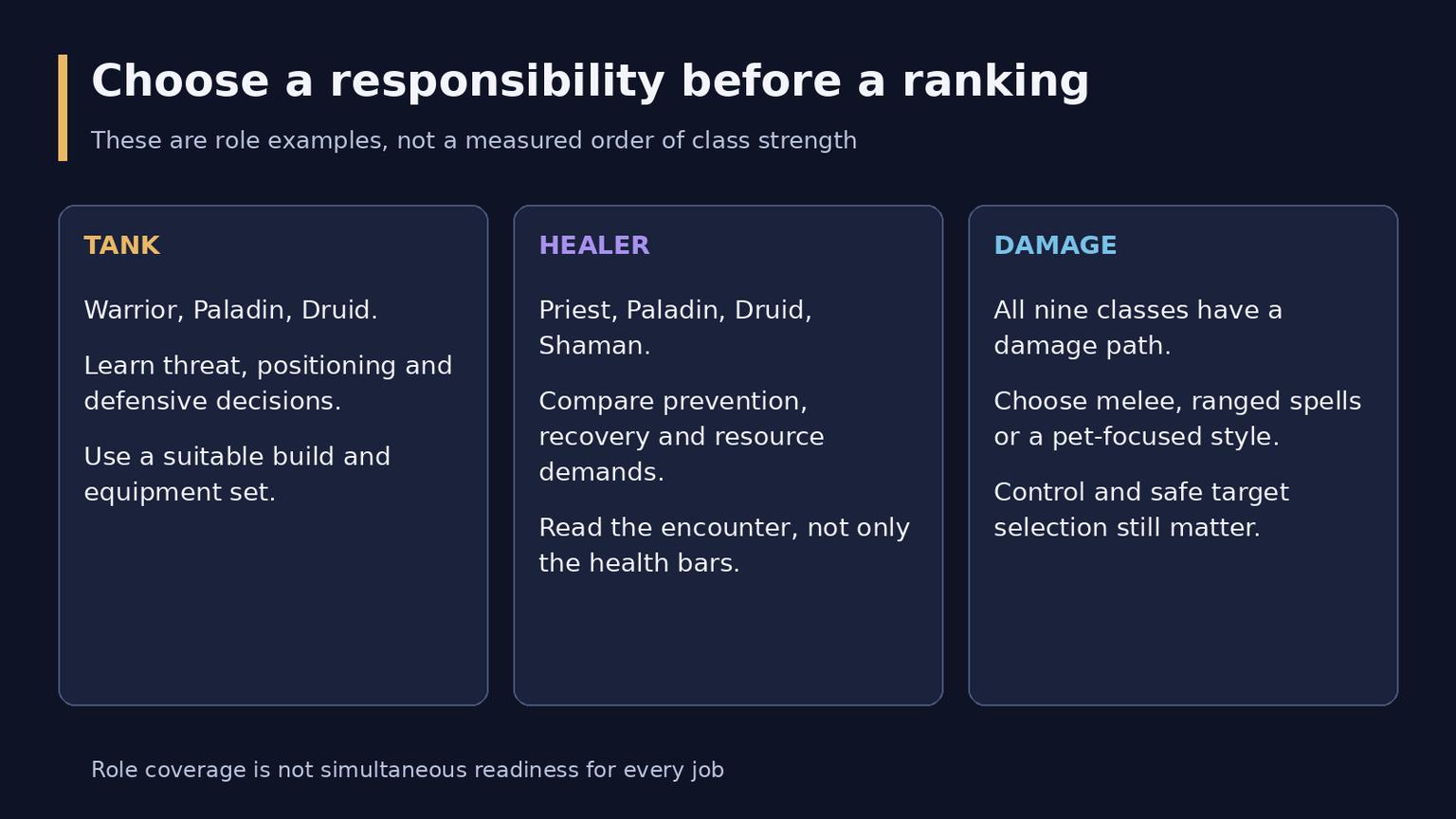
Three group responsibilities compared in equal cards
What each class offers and what you must learn
Hunter: a sensible first look for pet users
Hunter's companion can occupy an enemy while you attack from range. That gives a new player room to learn the world, but the pet is another unit to direct. Practice recalling it, choosing its target and avoiding unintended pulls before treating the class as an easy solution to every encounter.
Beast Mastery emphasizes the companion, Marksmanship emphasizes the Hunter's attacks, and Survival supports melee play. Decide whether you actually want that melee option; choosing Hunter no longer commits every build to standing at range. This is a recommendation for comfort and style, not proof that all three trees lead damage charts.
Mage: control with a visible cost for mistakes
Mage offers three ranged spellcasting paths, together with food, water and travel tools. Frost's control is an appealing starting point if you like creating distance; Fire and Arcane place different demands on spell interactions and resources.
The tradeoff is that control must be used. Being able to slow enemies does not mean a large pull is safe, and an interrupted or mistimed escape can turn a short fight into a death. Start with manageable encounters rather than assuming old mass-pull farming strategies transfer unchanged.
Warlock: sustained solo tools and group preparation
Warlock combines demons, periodic damage, drains and health-to-Mana conversion. It deserves consideration for solo play even when an unsupported general tier list places it below other casters. A damage grade and the ability to complete quests comfortably are different assessments.
Manage the demon and resources together. Spending health to continue casting is a decision, not free Mana in a dangerous situation. Summoning, recovery tools and assigned curses can also matter to a group, even when those contributions do not appear as personal damage.
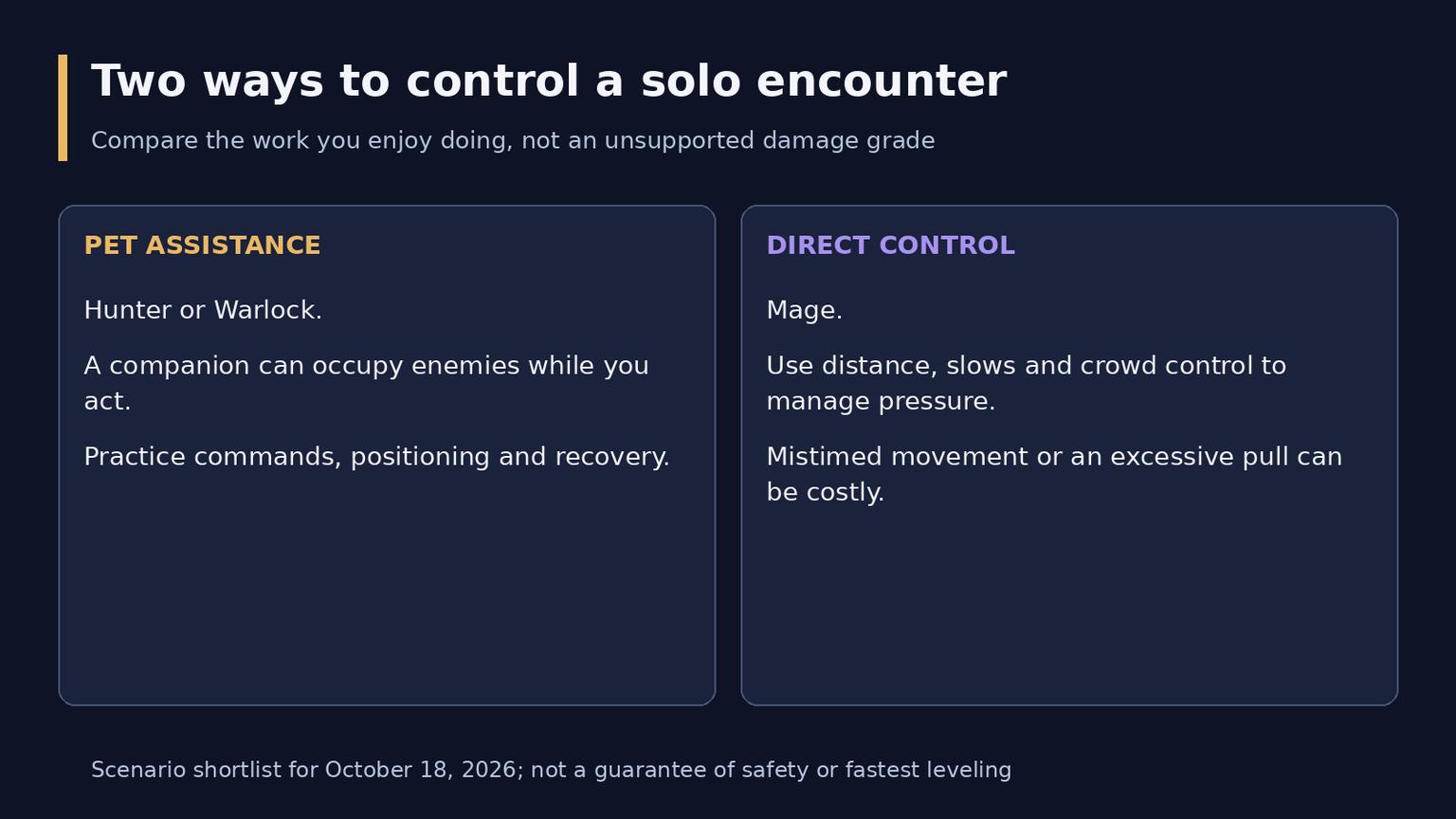
Pet assistance compared with direct control for solo play
Paladin: several roles behind an armored identity
Paladin offers healing, tanking and melee damage. Its defensive and support tools make it worth considering if you want room to change direction later. Forever also addresses old Classic tank-tool gaps, including a taunt interaction through the tanking seal.
Choose a role deliberately. A tank still needs threat, positioning and enough resources for the next pull; a healer still has to respond to incoming damage. Having access to emergency help does not make every specialization equally simple or equally effective in every encounter.
Druid: the broadest role menu
Druid covers tanking, healing and both melee and ranged damage. Forms and travel tools make it attractive to a player who values variety, but that variety brings additional learning. You need to know which form, resource and responsibility apply to the current task.
Begin with one primary role and learn the others as separate projects. Do not interpret flexibility as evidence that every Druid specialization shares one performance grade. A successful healer says little by itself about a tank's equipment or a caster's damage in the same group.
Priest: a focused place to compare healing styles
Priest provides two healing paths alongside Shadow damage. Healing and shields make it a natural class to investigate if keeping others alive is the main attraction. Shadow offers a damage route when that is the role you want to play instead.
Evaluate healing by the problems you want to solve: predictable incoming damage, sudden injuries, group recovery and Mana management. An overall class ranking cannot tell you which healing approach feels comfortable. Nor does choosing Priest remove the need to learn encounter timing and dispels.
Shaman: support that depends on active decisions
Shaman combines ranged spells, melee damage and healing with totems. This is a good alternative for a player who wants several roles but does not enjoy Druid forms. Totem placement and choosing useful support remain part of the work, even with Forever's improved handling tools.
Distinguish support coverage from raw output. A totem can be useful without proving the specialization is the best damage dealer or healer. Likewise, an experimental defensive build should not be presented as an established replacement for a dedicated tank specialization.
Rogue: deliberate melee and control
Rogue rewards players who enjoy deciding when and how an encounter begins. Stealth, poisons, Energy and finishing moves create a different rhythm from simply repeating weapon attacks. It is a compelling style for tactical melee and control-focused PvP interests.
The learning demand is execution and awareness. Control has to be timed, resources have to be managed and an escape tool must be available when you need it. Rogue is not assigned an automatic PvP win rate merely because its toolkit can create strong openings.
Warrior: choose the weapon role you want to practice
Warrior offers two melee damage paths and shield-focused tanking. It suits players who want weapon combat and are willing to pay attention to positioning, Rage and defensive choices. Equipment upgrades can change how the class feels, particularly while leveling.
Solo play can be less forgiving than a pet-assisted alternative because natural healing is limited. A regular partner or a group changes that experience. Do not carry over a Classic-era claim that Warrior must inevitably dominate every later raid; Forever's class and item changes require fresh evidence.
What the latest beta changes mean for a tier list
The official update labeled October 15 contains changes substantial enough to invalidate older assumptions. Arcane Mage has a redesigned core spell and a new talent, while Frost damage and control interactions changed. Paladin's spell scaling, Holy threat and Mana return were adjusted together, so a damage reduction alone does not describe the complete tanking effect.
Hunter now has a half-second stationary requirement for Auto Shot, while pet scaling and trap behavior also received changes. Several Shaman totems and other class support effects became raid-wide. These changes alter practical play and group coverage, but they do not establish a numerical order of winners and losers.
The checked independent tier-list directory still lists several role-specific rankings as forthcoming. That is a limit of the evidence used here, not proof that nobody has published an opinion elsewhere. Without a comparable dataset for the same level, build, equipment and encounters, a precise class-wide placement would imply more certainty than the material supports.
When reading a future ranking, ask whether it measures single-target damage, several targets, survivability, healing, tank control or team contribution. A class can score differently in each. Small test samples and exceptional players also cannot establish what every new player will experience.
Choosing for dungeons, raids and PvP
For dungeons, start with the responsibility your group needs. A reliable interrupt, controlled pull or properly timed defensive action can prevent more lost time than a small theoretical damage advantage saves. Choose a build that serves that responsibility and make sure your equipment matches it.
For raids, compare specializations within the same role and encounter context. A tank and a healer do not belong on one damage ladder, and the presence of a useful raid-wide effect does not guarantee a place in every roster. Group composition, repeated coverage and player execution all matter.
For PvP, distinguish solo world encounters from organized battleground objectives. Rogue control or Mage control may fit the experience you want, while a support or healing role can be more valuable to your team. No universal duel winner or battleground tier is established by the sources checked for this overview.
Check faction and ruleset before choosing with friends. Paladin is available to Horde through Undead, and Shaman to Alliance through Dwarves, but that does not enable cross-faction parties. Forever also does not support grouping across rulesets. Older race recommendations need review because racial traits changed during the beta as well.
A short decision process before you commit
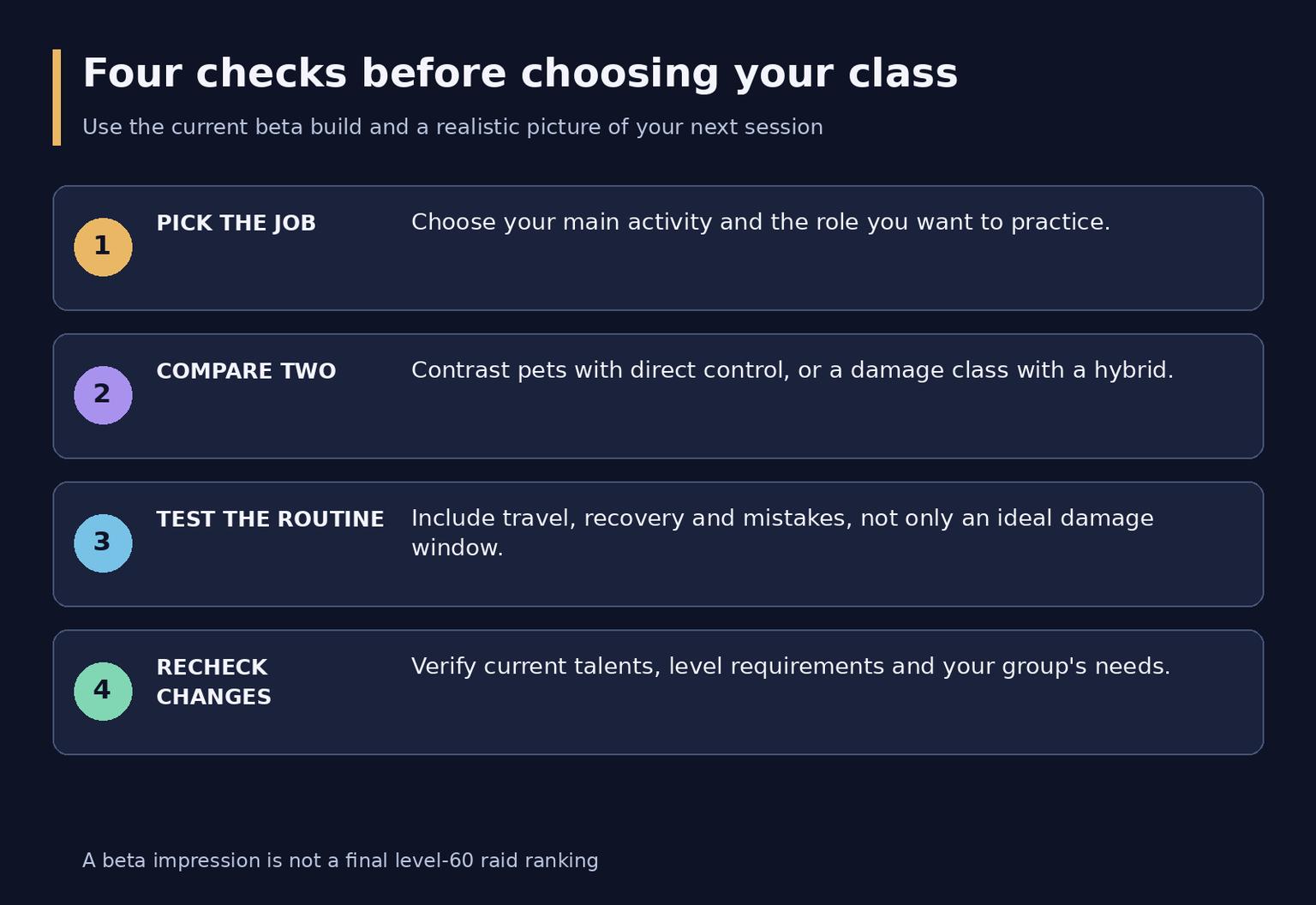
Four checks for choosing a class
1. Choose a primary activity and role. Decide what you want to do on an ordinary evening, rather than imagining every possible endgame role at once.
2. Compare two candidates with different tradeoffs. For example, test pet commands against direct enemy control, or a dedicated damage class against a hybrid.
3. Play representative encounters. Include travel, recovery and an imperfect pull. Assess whether you enjoy fixing mistakes, not just the fastest successful kill.
4. Recheck the current build before investing heavily. Confirm talent changes, ability availability at your level and whether your planned group needs that role.
Frequently asked questions
What is the best class for a beginner?
Hunter is a practical first recommendation for someone happy to manage a pet. Mage and Paladin are alternatives for different preferences, with control and role responsibilities that still need practice.
Which class gives the most role flexibility?
Druid covers all four broad combat options. Paladin covers tanking, healing and melee damage; Shaman covers healing and both damage ranges. Flexibility requires suitable builds and equipment.
Is there a confirmed best damage class at level 60?
This overview does not establish one. Level-30 beta impressions and ongoing redesigns are insufficient for a final raid damage order across all specializations.
Should I abandon a class after one balance change?
First check what changed in your actual build and activity. A corrected bug, altered support effect or damage adjustment has different implications; none alone establishes that you should replace a character you enjoy.