WoW Forever Best Healers: Practical Picks for Dungeons and Raids
For a first healing character, our editorial starting pick is Holy Priest: it offers a clear way to learn direct healing and reacting to damage. Choose Discipline Priest if you prefer shields and preparation, Holy Paladin for focused single-target recovery, Restoration Druid for healing over time while repositioning, or Restoration Shaman for totems and resource support.
These are recommendations by task, not an established first-to-fifth healing-output ranking. This guide was checked on October 19, 2026, and primarily discusses the level 30 beta. Announced deeper talents are separated from that playable toolkit. The reviewed material does not establish a comparable, current level 60 raid dataset that would justify a universal S-to-B order.
The useful question is what your group needs you to solve: a tank taking repeated hits, several injured allies, predictable damage or a dangerous debuff. A healer who handles that problem reliably can be more useful than a theoretical favorite whose tools do not match the pull.
The five healing paths at a glance
Healing path | Practical reason to choose it | Main consideration |
Holy Priest | A broad direct-healing foundation; Binding Heal for self and ally | Cast planning and Mana; no native movement burst |
Discipline Priest | Shield preparation and Penance with the appropriate talents | Shield timing and channel commitment; still needs direct heals |
Holy Paladin | Focused healing plus blessings and auras | Mana and cast time; deeper group healing comes later |
Restoration Druid | Healing over time and instant options while moving | Prepare effects and respond directly to lethal damage |
Restoration Shaman | Healing Wave, totems and Mana tools | Totem placement; later spells change the group-healing profile |
The rows are equal categories, not tiers. A favorable toolkit description does not quantify healing per second, Mana efficiency or survival against every attack. Build, equipment, group composition and encounter duration all affect those comparisons.
Holy and Discipline: two Priest priorities
Holy Priest: a useful first healing framework
Holy gives a new healer an understandable decision loop: assess who needs help, choose a suitable heal, and avoid paying for healing that cannot be used. Binding Heal is a 16-point Holy talent that heals the Priest and an ally together. It can solve two health deficits with one cast rather than forcing a choice between yourself and the tank.
Do not treat the quick heal as your only response. If danger is not immediate, a slower, appropriate heal can preserve Mana for the next emergency. If the party is moving, start repositioning early instead of assuming a movement ability will rescue a late cast. The current Priest profiles lack a native horizontal movement burst.
Holy's broader preview includes Prayer of Mending as a 31-point talent. It is not part of an ordinary level 30 talent budget. That distinction matters when comparing current dungeon recovery with a future bouncing heal. Our beginner recommendation is about a readable learning process, not proof that Holy has the highest output or is easiest in every encounter.
Discipline Priest: prevent the next problem, then repair damage
Discipline emphasizes Power Word: Shield and talents that improve shielding. Soul Warding is the 16-point milestone, while Penance is the 21-point milestone. A character with the ordinary 21 talent points at level 30 can reach Penance through a sufficiently deep investment; splitting points into another tree changes that access.
Penance can heal an ally or damage an enemy. Those are alternative uses of the channel. They do not establish a modern damage-to-healing rotation, and offensive casts should not displace a necessary rescue. Plan for the channel and the possibility that you will need to move.
Shields buy time; they do not remove the need to restore health. The current notes also clarify that Divine Aegis is triggered by non-periodic critical heals. Do not assume every periodic critical tick creates another absorb, or add a deep-tree effect to a build that has not taken it.
A valuable version-specific change is that the official Warrior Rage calculation ignores absorbs when generating Rage from incoming damage. The old blanket instruction never to shield a Warrior because it starves Rage is therefore inappropriate here. That correction concerns the specified Warrior mechanic, not proof that shields are always the best use of Mana on every tank.
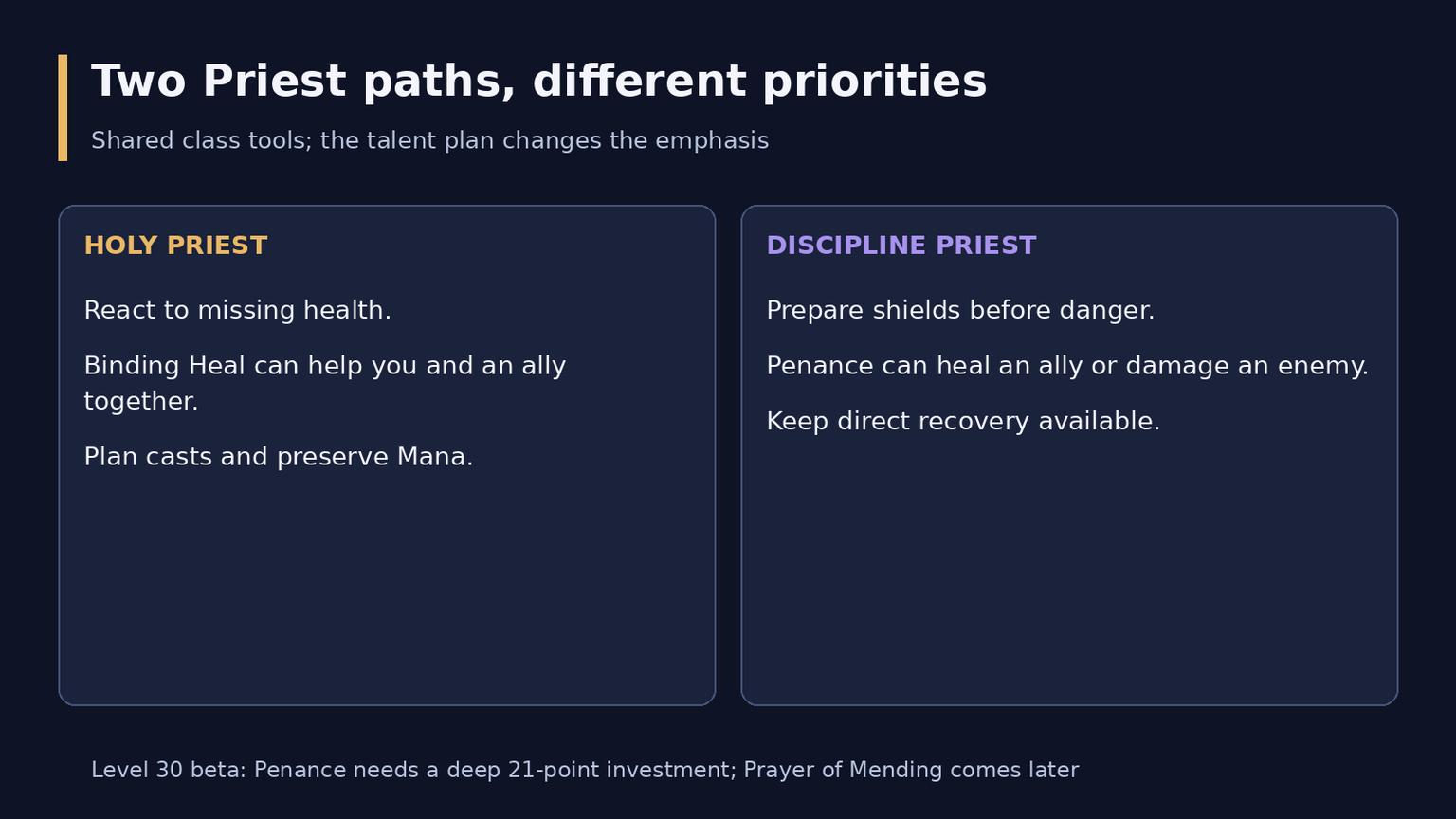
Holy and Discipline healing priorities compared in two equal cards
Paladin, Druid and Shaman: different ways to sustain a group
Holy Paladin: focused recovery with support decisions
Holy Paladin is a sensible pick when you enjoy watching a priority ally closely while maintaining useful support. Flash of Light and Holy Light provide different cast and resource choices. Holy Shock has moved to the 21-point milestone in the official redesign, giving a deep Holy level 30 build access to an instant healing or damage option.
The resource is Mana. Do not import modern Holy Power spending or a contemporary melee-healing cycle. Illumination refunds 50% of the affected healing spell's base Mana cost, not the entire cost and not unlimited resources. A critical heal does not make careless overhealing free.
Light's Vigil is a 31-point Holy talent in the announced deeper toolkit. Its friendly-target effect heals that ally's party, and its interaction with Holy Shock supports prepared group recovery. It should not be used to advertise current level 30 raid-wide healing. Setting up several parties later is also different from instantly recovering an entire raid with no preparation.
Blessings, auras and emergency support can matter as much as another heal. Decide whether the group needs a particular protection or buff, but do not stop healing a dying ally to refresh a routine effect. Armor is an additional survival consideration; it is not evidence that the healer can ignore mechanics or use a higher-level armor proficiency early.
Restoration Druid: prepare healing, keep moving, react when needed
Druid rewards a player who notices damage before it becomes an emergency. Rejuvenation can continue working as you reposition, while Healing Touch provides direct recovery. Swiftmend is now the 16-point Restoration milestone and no longer consumes the target's Rejuvenation or Regrowth effect. It still belongs in a talent plan, not every Druid's baseline spellbook.
The practical distinction is between movement-compatible healing and unlimited healing while moving. Instant effects give you options, but a critically injured ally may still need a direct response. Refreshing a healthy target's effects while another ally is about to die is a priority error, not an unavoidable weakness of healing over time.
Wild Growth is a 31-point talent for later progression. Its announced Forever version applies healing over time to the selected ally's party, including pets, rather than freely selecting injured players across the entire raid. Do not credit a normal level 30 build with this spell or use a different expansion's targeting rules.
Forms add flexibility, but changing form can interrupt your healing plan. Druid mobility is a reason to consider the class, not a guarantee of uninterrupted throughput or the best overall dungeon result. Compare how much useful healing remains available during the movement your actual fight requires.
Restoration Shaman: totems and Mana are active responsibilities
Shaman is a good match if you enjoy maintaining support while healing with a direct spell foundation. At level 30, Healing Wave is central. Water Shield is an 11-point Restoration talent, and Mana Tide Totem has moved to the 16-point milestone. These create identifiable resource tools without establishing a measured best-Mana ranking.
Use the updated rules. Water Shield can now trigger from any critical spell cast by the Shaman, rather than only critical heals. The latest notes add a Mana Tide rank at level 38 and correct Restorative Totems to affect the whole Healing Stream effect. These are specific changes, not a reason to claim every heal received a numerical buff.
Totem support depends on choosing and placing the right effect. Several physical support totems are now raid-wide, but that does not make every Shaman totem raid-wide. Windfury and Flametongue Totems remain mutually exclusive; Grace of Air is no longer exclusive with them. Check which support the group already has before duplicating a job.
Chain Heal and the 31-point Riptide talent describe a later group-healing package. They are not the basis for a level 30 dungeon victory claim. Riptide's announced interaction improves Chain Heal on a target carrying your effect, but the benefit still depends on access, placement and incoming damage. Shaman should not be assigned a low overall tier while simultaneously being called the unconditional winner in every group scenario.
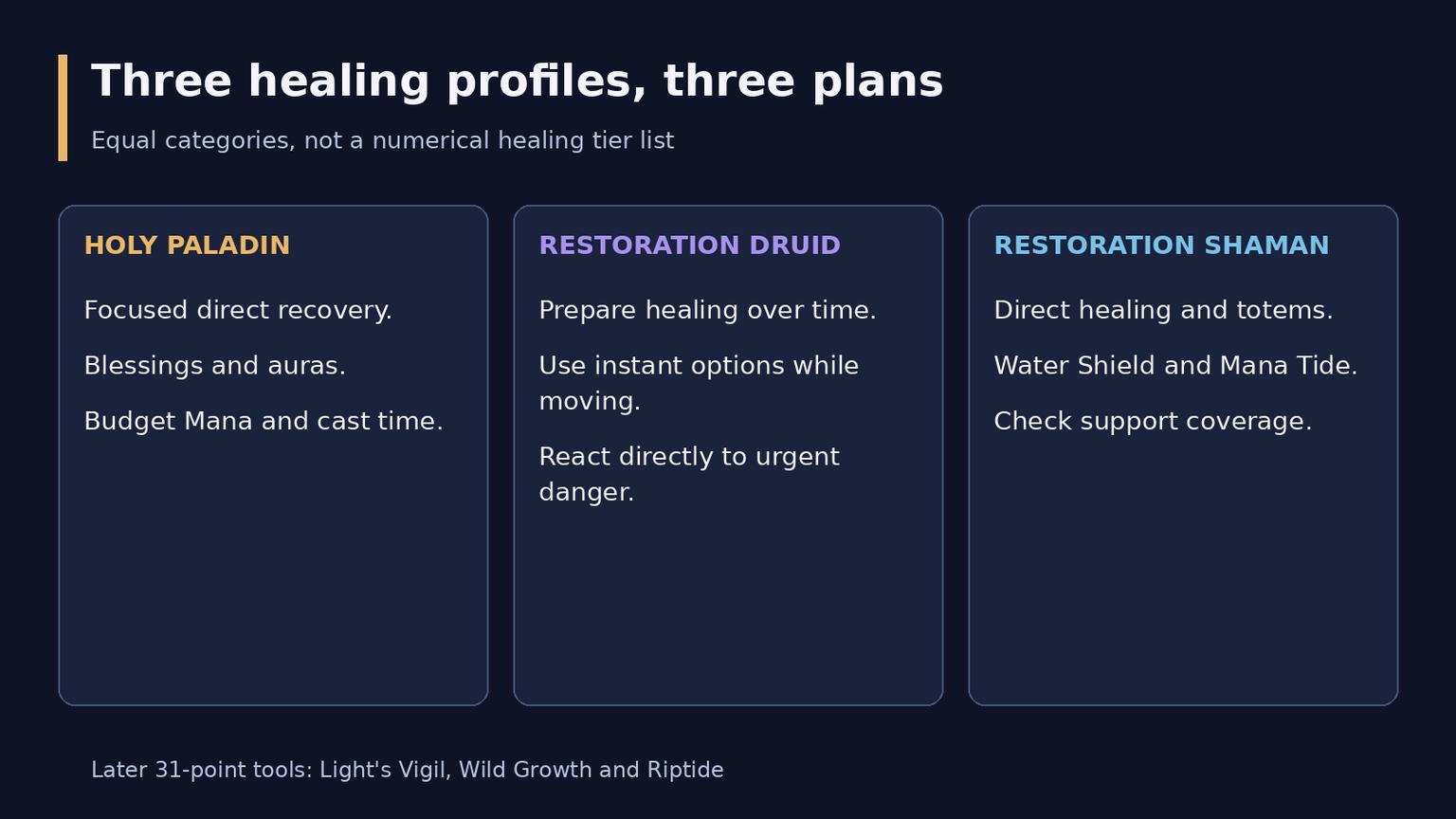
Three equal healing profiles for Paladin, Druid and Shaman
Choose by content and responsibility
Level 30 dungeons
Start with the healing problem. Holy Priest is our first option for learning reactive triage. Discipline suits a player who wants to prepare shields and manage a channel. Paladin suits focused recovery and support, Druid rewards preparation during movement, and Shaman rewards totem and resource management. None of these recommendations requires declaring the other paths incapable.
Group damage also reflects coordination. Lost tank control, missed interrupts and poor positioning can create an impossible healing requirement. Before changing class, check whether the group can remove that damage source. A healer comparison should not reward the player who happened to receive the easier pull.
Raids and later progression
Assign jobs before ranking output. A tank-focused healer, a group-recovery healer and a player covering dangerous debuffs can all contribute to success in different ways. Absorbed damage and effective healing are not interchangeable raw meter totals, and excess healing on healthy targets does not demonstrate superior performance.
The deeper talents materially change the available tools. Prayer of Mending, Light's Vigil, Wild Growth and Riptide must be evaluated in the progression where they can actually be used. A finished raid order needs comparable encounter data, builds and equipment. This guide does not substitute beta previews for that evidence.
Solo questing and mixed group play
Being a good healer does not establish fast solo leveling. All five healing paths spend talent investment on support rather than purely on killing enemies. Priest damage options and Druid forms create choices, but neither proves a universal solo winner.
If most of your time is spent alone, consider a damage-oriented leveling plan that can still cover appropriate early group content. Check its healing limitations before promising a difficult dungeon. Compare the cost of changing talents and the actual group schedule rather than choosing a healing character from an imagined solo tier.
Four checks that make a healer comparison useful
1. Match the setting. Record level, talents, extra Legacy investment, equipment, group and encounter. A 21-point build and a 26-point build are different test conditions.
2. Track outcomes. Note deaths, dangerous debuffs, failed rescues and damage prevented or healed effectively. A large raw total alone cannot explain a successful pull.
3. Inspect Mana and timing. Separate excessive overhealing, wasted support refreshes and late positioning from a genuine lack of available recovery.
4. Recheck changes. Use the latest official notes and repeat a comparable fight after a relevant update. Keep any performance claim tied to its date and conditions.
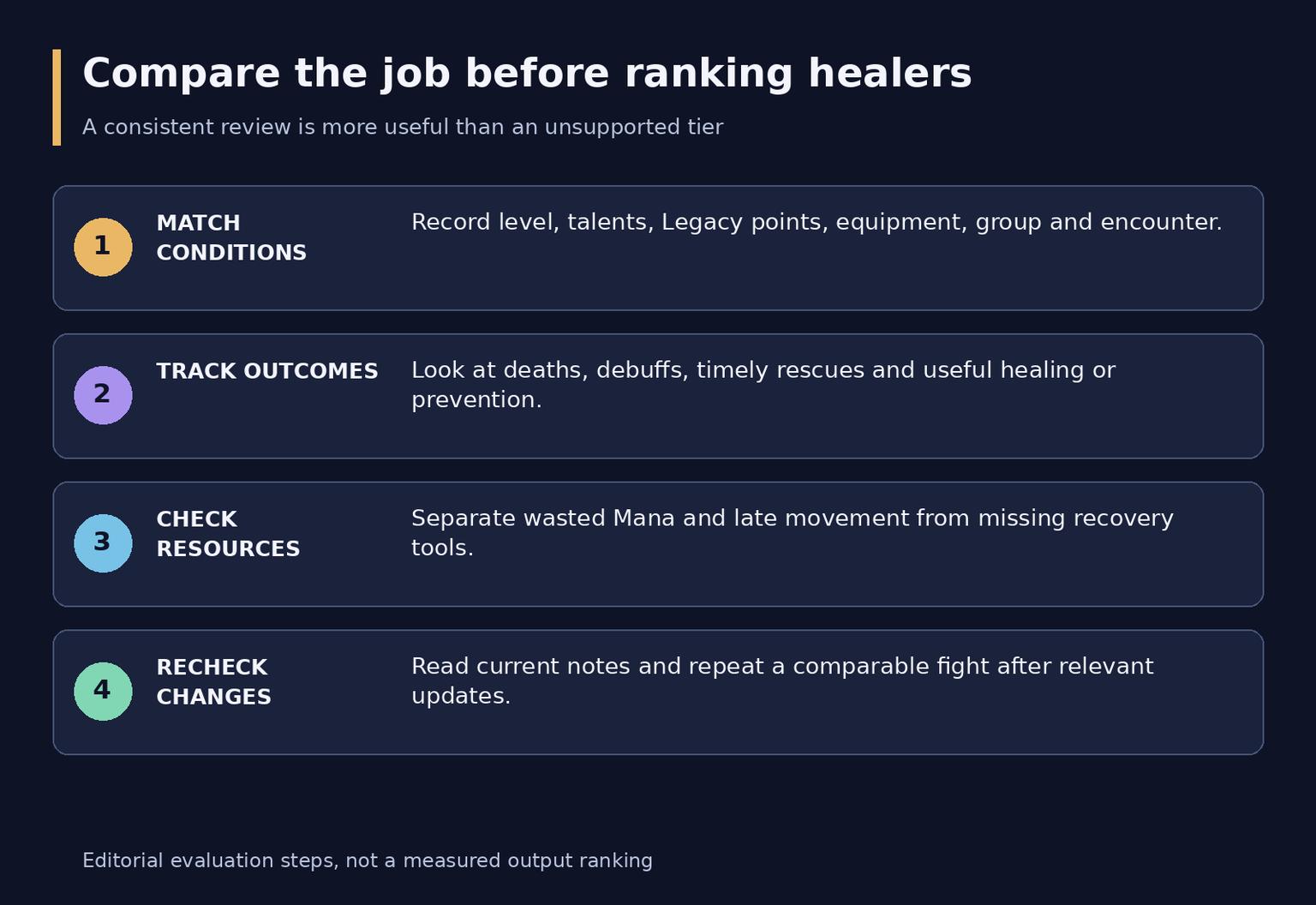
Four checks for a fair healer comparison
Questions before choosing a healer
Is Restoration Druid confirmed as the best healer overall?
No universal order is established by the reviewed evidence. Its movement-friendly effects and direct recovery are real strengths; they do not prove superiority across every level, group or encounter.
Which healer has the best Mana efficiency?
Several have explicit resource talents. A reliable comparison needs equivalent conditions and useful healing delivered, including downtime and support costs. Counting the number of Mana tools does not produce that ranking.