Best WoW Forever Professions for Your Goals
For a first character with little gold, two gathering professions are a sensible starting point. If you want to make useful items immediately, choose a craft and a way to supply it: Herbalism with Alchemy for consumables, Mining with Engineering for devices, or Skinning with Leatherworking for suitable armor. These are practical starting recommendations, not a universal profit ranking.
Checked October 20, 2026. This guide covers the WoW Forever beta, where characters currently stop at level 30. Recipes, requirements and the economy can change. An impressive high-level item in a complete database is not necessarily something your present character can make or use.
Decide whether you want to sell materials, supply your own consumables, replace weak equipment or gain additional tools. Then consider training costs, gathering time and your willingness to trade. No profession automatically wins across all those goals.
The available professions and your two primary slots
A character can learn two primary professions. The gathering choices are Herbalism, Mining and Skinning. The six primary crafts are Alchemy, Blacksmithing, Enchanting, Engineering, Leatherworking and Tailoring.
Cooking, First Aid and Fishing are secondary professions. You can learn all three alongside your two primary choices. Jewelcrafting, Inscription and Archaeology are outside this roster. Their recipes and Retail's crafting-order systems should not be assumed to exist in Forever.
Visit an appropriate trainer to learn a profession, its starting recipes and later ranks. You need not wait for a capital if a suitable trainer is already nearby. Check what that trainer teaches: an introductory trainer is not necessarily your source for advanced ranks. Some actions need tools, while certain crafts also require an anvil, forge or another workstation.
Choose by goal, rather than one overall tier
Your goal | Starting option | Trade-off to accept |
Questing with little starting gold | Two gathering professions | Lower production spending, but no primary craft of your own |
Your own consumables | Herbalism + Alchemy; First Aid separately | Relevant herbs, recipes, gathering time and replenishment |
Combat and travel devices | Mining + Engineering | Metal, training and item-use requirements |
Leather equipment and armor improvements | Skinning + Leatherworking | Suitable recipes and a steady supply of leather |
Cloth gear, bags and enchanting materials | Tailoring + Enchanting | Cloth and disenchantable items have a value even when self-found |
Weapons and heavier armor | Mining + Blacksmithing | Metal competes with raw-material sales; the craft must suit your character |
For relaxed play, one understandable supply chain is enough. Someone who dislikes the Auction House may get more value from personal supplies than from chasing a rare commercial niche. For income, actual server sales matter more than an S next to a profession's name.
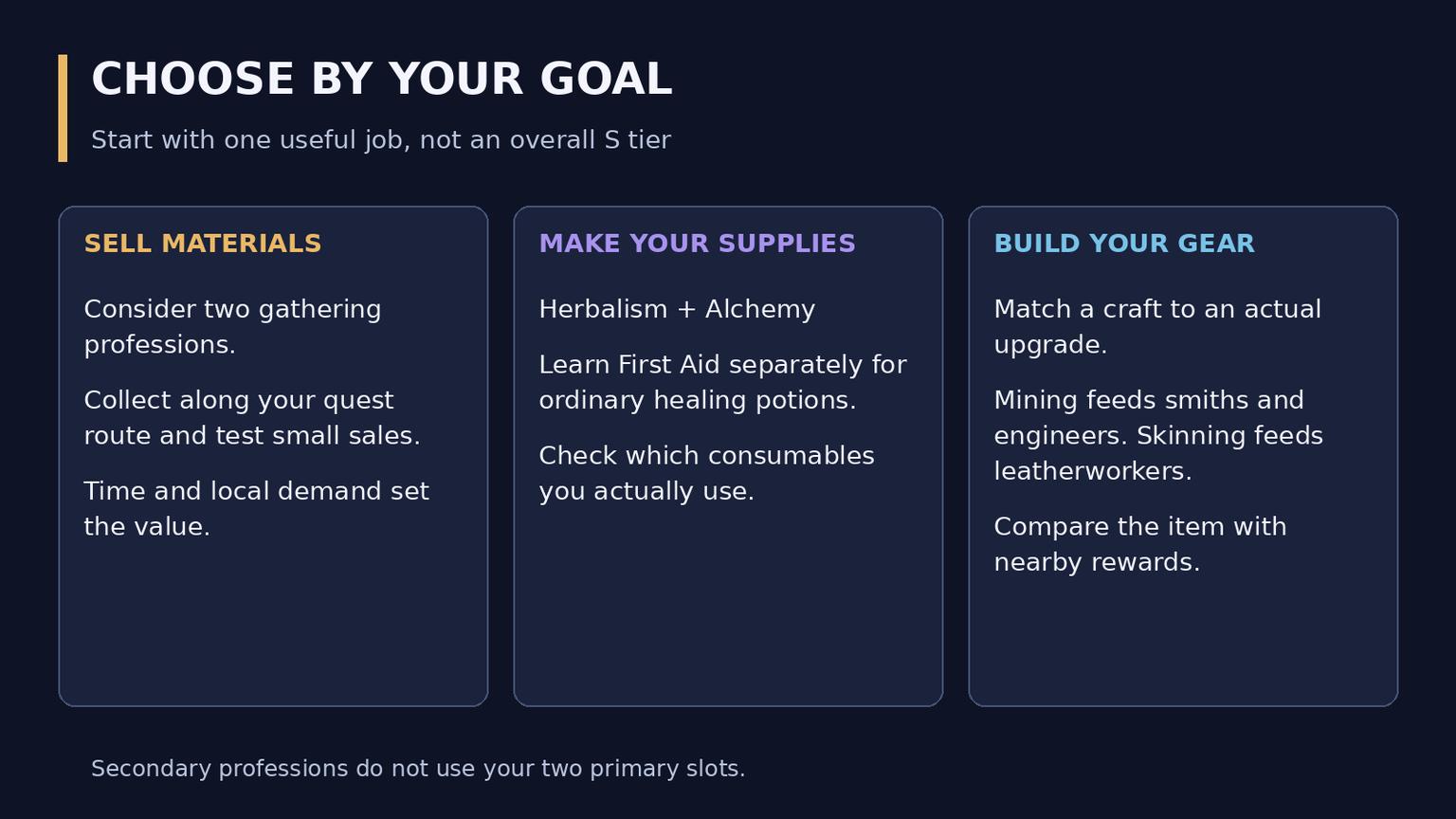
Set your priority: material sales, personal consumables or suitable equipment
Gathering while leveling
Herbalism
Herbalism suits players willing to notice plants along their quest routes. Herbs support Alchemy, but a double gatherer can simply sell them. Startup spending is easier to control than a large crafting-material purchase; time and detours are the main costs.
It works best when you regularly travel through useful areas. Do not assume every herb is equally valuable or abandon a quest for a distant plant without checking its worth. For personal production, identify the exact herbs your recipe consumes. A large stock of the wrong plant does not replace the ingredient you need.
Mining
Mining supplies ore, stone and other components for Blacksmithing and Engineering. Some ore must be smelted into bars at a forge. Before committing to a recipe, distinguish ore, bars and combined materials rather than comparing names that merely sound related.
It suits players comfortable making short detours toward hillsides and mines. Cave hazards and competition for deposits can slow questing. Compare raw ore with the value of its smelted output before selling or processing. Your own metal is not free: using it gives up whatever another player might have paid for it.
Skinning
Skinning fits routes where you already kill suitable beasts. Leather and hides feed Leatherworking, making the connection easy to understand without continually buying the main material. Its usefulness drops when quests take you toward enemies that provide nothing relevant to skin.
It is an approachable choice with modest starting expenses. Its limitations are enemy selection and local demand for leather. Killing everything solely for the profession may be a poor trade if time and sale value compare badly with normal progression. Frequent drops alone do not guarantee good income.
Crafts for supplies and useful devices
Alchemy is not just about healing
Alchemy turns herbs and other ingredients into potions, elixirs, flasks and reagents. Choose it for supplies you actually consume, such as mana restoration or temporary enhancements. Repeated consumption creates a reason to replenish stock, but does not prove that every recipe is profitable.
Forever moves ordinary healing potion recipes to First Aid. You therefore do not need Alchemy solely to make those potions. Inspect unusual alchemical items separately rather than applying the rules of an ordinary healing potion to the entire profession.
Herbalism covers much of the material supply, though not every extra purchase. Begin with a few useful, accessible recipes and small batches. Test demand before buying a large reserve of herbs for commercial production.
Engineering puts utility before payback
Consider Engineering for devices, explosives and additional tactical options. It suits a player willing to read item restrictions and spend components on personal goals. Mining supplies metal and stone, but cloth, leather or particular parts may still need another source.
Many devices require Engineering to use, not merely to manufacture. Buying a finished item will not always replace learning the profession. Check character level, skill, charges, cooldowns and use restrictions before crafting. A high-level device shown in the database should not count as an immediate advantage for a new beta character.
This is a recommendation for personal utility, especially if you enjoy actively using items. Commercial value is less straightforward: buyer restrictions and component costs can narrow the market. Something useful to you does not necessarily repay the cost of leveling the profession.
Enchanting needs a real material budget
Enchanting improves equipment and consumes materials obtained by disenchanting suitable items. In Forever it also creates caster equipment, including wands, staves, off-hands and class relics. Each product still has its own recipe and item requirements.
Starting requires a source of unwanted magical equipment and an appropriate enchanting rod. Tailoring can supply items to disenchant without needing a dedicated gathering profession. However, selling cloth or the finished piece may be worth more than turning it into dust. The pairing supports gradual progress; it does not produce materials without an economic cost.
Avoid spending your entire budget enchanting a piece you expect to replace shortly. For trade, consider material prices and access to customers. Every class can benefit from equipment improvements without every character having to learn Enchanting personally.
Crafts for equipment
Tailoring
Tailoring makes cloth armor, cloaks and bags. Cloth comes from defeated enemies without a separate gathering skill. It is a straightforward option for Mage, Priest or Warlock when an available recipe replaces a weak item. Bags serve a wider audience, including characters who never wear cloth armor.
Forever adds a dedicated reagent-bag slot. Distinguish a reagent bag from a general bag: restrictions on what it holds affect its usefulness. Tailoring also competes with First Aid for cloth, and recipes can require additional ingredients. Do not consume the entire supply making unwanted armor merely to gain skill points.
Leatherworking
Leatherworking uses leather, hides and scales for leather and mail equipment as well as armor kits. Combined with Skinning, it can progress naturally along beast-heavy routes. Choose it because a specific item's stats suit your role, rather than because the armor category alone matches your class.
Compare a proposed craft with nearby quest and dungeon rewards. An armor kit can help without replacing an entire piece, but its effect and target requirements still need checking. The profession's value is not restricted to one class: the accessible recipe, your role and actual item stats matter.
Blacksmithing
Blacksmithing produces weapons, shields, mail and plate armor, plus selected improvements and components. Mining supplies much of the material. Most work needs a Blacksmith Hammer and an anvil; some operations also require a forge.
It makes sense for a planned weapon or a specific weak slot. Spending all your bars on a speculative piece is a bigger mistake when a suitable reward is already close. Do not treat every plate recipe as equipment available before level 30, or use late-game crafts to justify an immediate beta purchase.
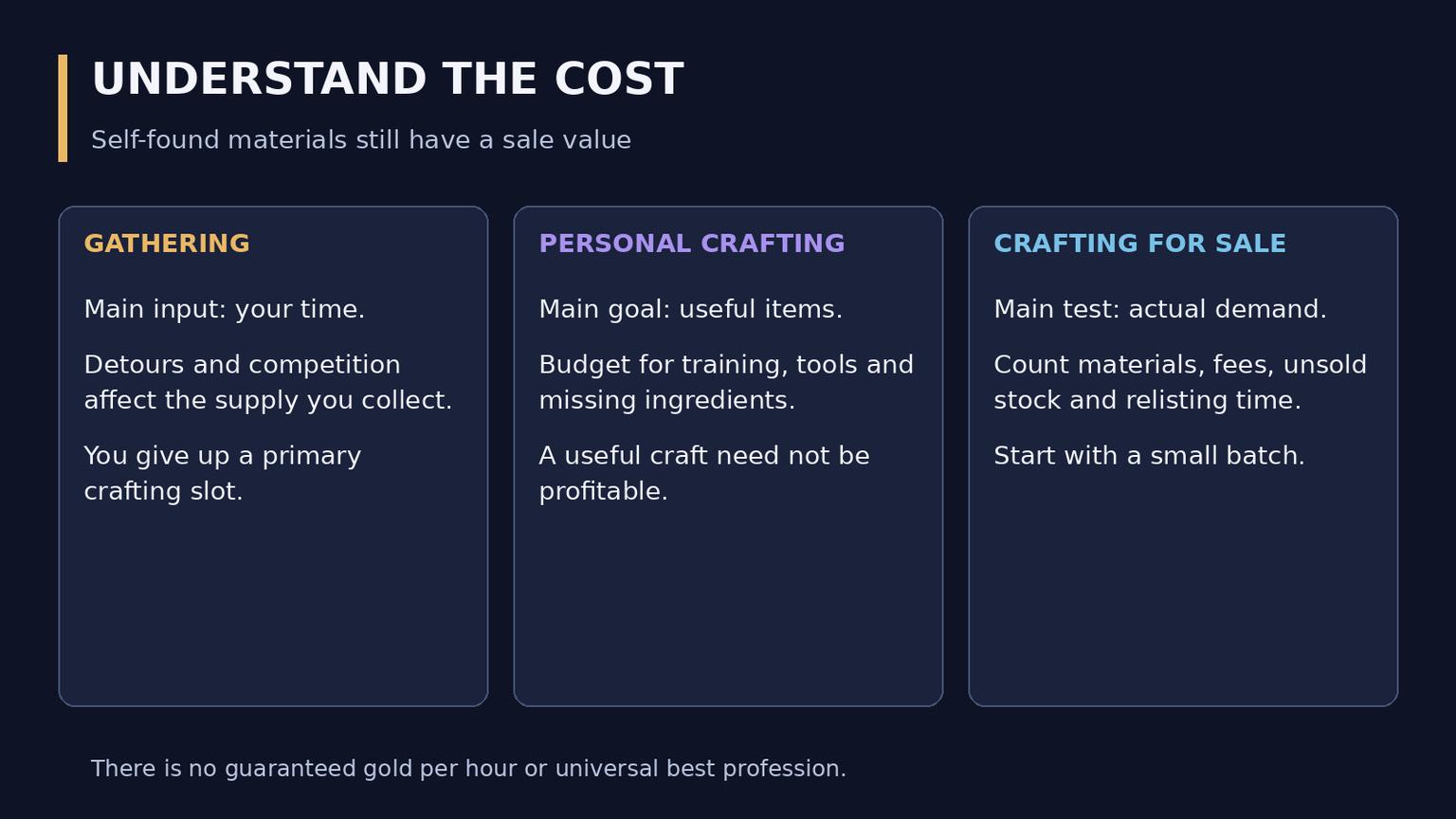
Gathering, personal crafting and production for sale involve different costs
Secondary professions without sacrificing a primary slot
First Aid is useful even to a class with healing spells. Bandages restore health without mana, but movement or incoming damage can interrupt their use. Find a safe moment instead of expecting the full effect while continuously taking hits. Bandages also compete with Tailoring for cloth.
Cooking uses meat, fish and other ingredients for food and drinks. Match the effect to your character and wait until the food buff appears. Many Forever foods also grant extra experience from kills; check the tooltip rather than assuming quest rewards increase. This supports leveling independently of your two primary choices.
Fishing supplies Cooking with fish but takes dedicated time beside the water. It suits relaxed breaks and personal food preparation; it is not compulsory for every crafting pair. Before a long session, check that your catch serves an accessible recipe you actually want.
Pairings and the cost of your second slot
Herbalism supplies Alchemy with herbs; Mining feeds metal and stone to smiths and engineers; Skinning supplies leather to leatherworkers. Those pairings are justified by the material flow, not just familiarity from another version. None guarantees every ingredient for every recipe.
Tailoring with Enchanting links cloth to an eligible crafted item and then to disenchanting materials. Not every crafted result can be disenchanted. Test one item and its economics before making a large batch. First Aid also uses cloth, so the pairing has competing consumption even without ore or herbs.
Two gathering professions give you more freedom to sell raw goods. Skinning can accompany Herbalism or Mining when your route supports both. Two crafts instead require more purchases, help from friends or materials supplied by another character. A regular group's support changes the calculation: if a friend reliably provides metal, a second craft may be more useful than maintaining Mining yourself.
Changing a primary profession removes its learned skill and recipes. Dropping a rare recipe collection for a brief price spike is risky. Work out the replacement supply chain and spending before making that decision.
Develop skill without buying blindly
Profession skill and character level are separate gates. The usual rank caps are 75, 150, 225 and 300. A later rank requires training, and primary crafts also have character-level requirements. For example, the checked guides require 200 skill and character level 35 for Artisan, so normal crafting progression to 300 should not be promised to a current beta character. Gathering has different level requirements.
Learn the profession and useful available recipes, check your tool and collect supplies along your quest route. Orange actions give a skill point below the current cap; yellow and green actions become less reliable, while gray actions do not raise skill. Continuing to make a gray item will not solve a leveling block.
Before a large purchase, identify your next recipe and where it comes from. Some are trained, while others come from vendors, quests or drops. Check reputation, specialization, workstation and level requirements where listed. A database entry does not establish that you can learn the recipe now.
Engineering has Gnomish and Goblin directions; Blacksmithing has Armorsmithing and Weaponsmithing; Leatherworking offers Dragonscale, Elemental and Tribal. These concern access to particular recipes, rather than Retail-style knowledge trees. Choose a later specialization for an actual item you want, not its name alone.
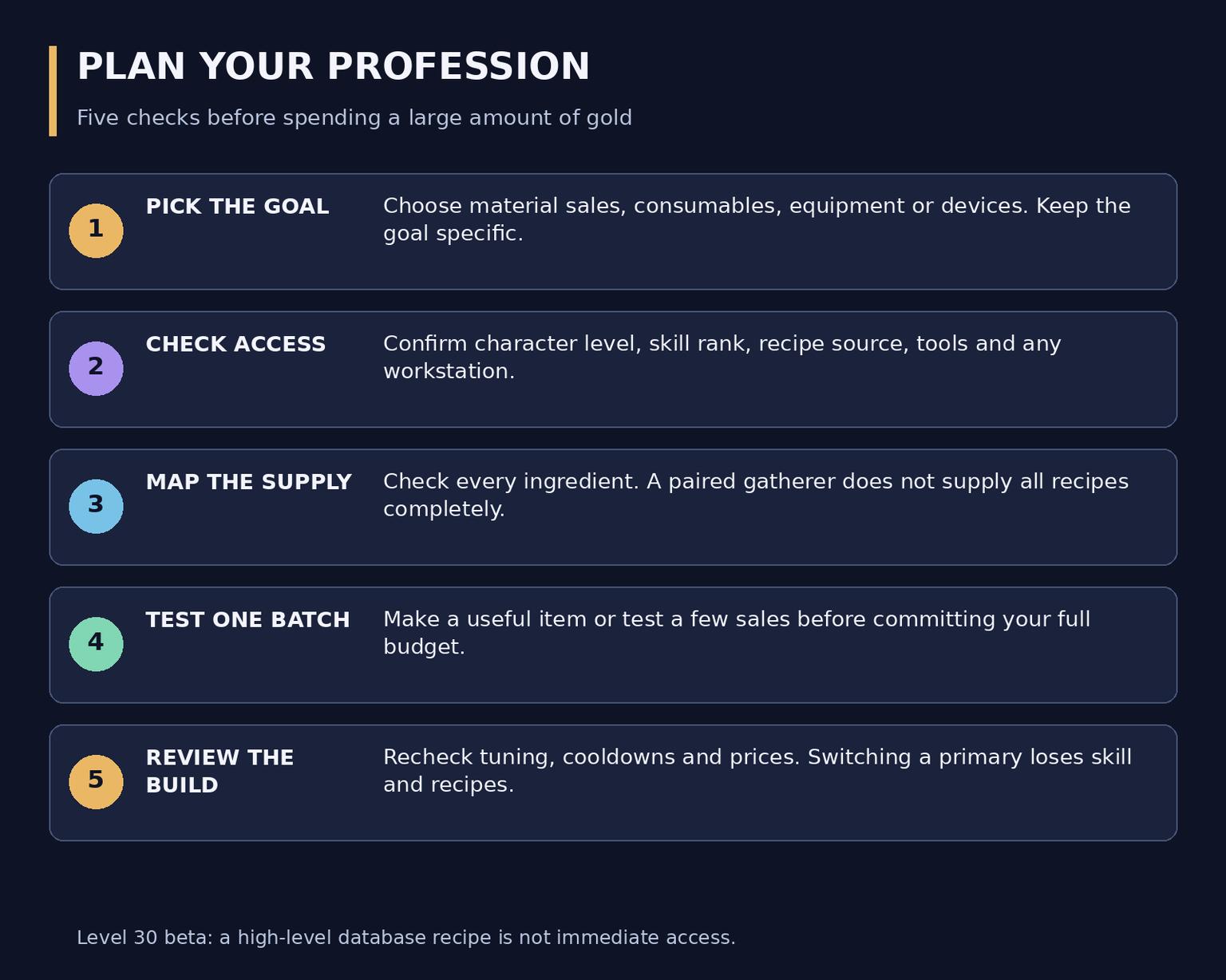
Five checks keep profession progress tied to a real goal and an affordable budget
Camping, Legacy and restrictions
Blizzard announced more than 600 new recipes across professions and skill ranges. That describes Forever's broader offering, not hundreds of immediately available crafts for a level-30 character. Additions include campsite objects, extra workstations and Blueprint recipes from particular dungeon bosses.
The first camping objects are learned at profession skill 20. A Basic Campfire accepts three special objects, with one contribution per player and a shared one-hour placement cooldown. Camping benefits that duplicate class buffs do not stack with those buffs. A regular group can coordinate contributions instead of everyone duplicating the same profession.
Legacy Points are account-wide, but each character allocates them separately. The system includes profession perks; Blizzard describes Dedicated Study as a daily option for faster skill development. Shared points do not automatically mean shared learned recipes. Check access to a particular perk independently.
When planning your activities, distinguish camp placement, item-use cooldowns and specific production cooldowns. Read the current recipe before committing to a large batch. The checked material does not establish one universal daily or weekly quota for all profession progress.
Gold and later-game planning
Look beyond the listed price to the likelihood of a sale. Subtract all material costs, training, extra purchases and Auction House expenses. Allow for gathering, travel and relisting time. A small batch and a few real transactions are enough for an initial test.
Self-found materials have a value because you could sell them. If a finished item costs less than its ingredients, crafting may still serve personal use or skill gains, but it is not automatically profitable. A scarce component and an expensive recipe increase the risk of tying up gold in unsold stock.
The latest checked Blizzard notes, dated October 15, reduced vendor sell prices for many crafted items. Recalculate any old advice to craft goods and sell them to NPCs. For later levels, plan recipe access and supplies without promising today's margins in future raids. Beta changes can alter both demand and costs.
Frequently asked questions
Do I need Alchemy to make healing potions?
Not for ordinary healing potions: First Aid makes them in Forever without taking a primary slot. Drinking a purchased potion does not require learning First Aid either, although the item can have a character-level requirement.
Can I manage without a gathering profession?
Yes, with materials from another player, another character or the Auction House. Before choosing two crafts, budget for ongoing supplies rather than only the first recipe.
Why has my skill stopped rising while materials are still consumed?
Check the current rank cap and recipe color. Gray actions cannot raise skill, while a new rank may need training and a character level. Investigate before buying another batch.
Should I switch immediately because one item has a high auction price?
Check completed sales and the full production cost first. Changing a primary profession removes its skill and learned recipes; one expensive listing does not guarantee that the switch will pay for itself.