WoW Forever Best Tanks: Practical Picks and the Threat Ranking
Choose the tank whose tools match the work your group needs. Protection Warrior offers a shield-based control kit, Protection Paladin combines pack threat with party support, and Feral Druid brings Bear tanking alongside Cat flexibility. Those are useful starting points, not a proven first-to-third survival ranking.
This comparison was checked on October 19, 2026. The playable beta discussed here is capped at level 30. A separate level 60 threat simulation appears below, with its own assumptions. It must not be read as a measurement of level 30 dungeons or finished raid balance.
For a first dungeon character, our editorial starting pick is Protection Warrior if you want to learn positioning, shield use and enemy control. Choose Paladin if managing Mana and protecting allies appeals more, or Druid if you want tanking and a damage role within the Feral tree. Familiarity can matter more than a small theoretical advantage.
A practical comparison of the three tank profiles
Tank | Main reason to choose it | Main planning cost |
Protection Warrior | Shield tools, enemy control and a Rage-based combat loop | Stance and Rage management; limited independent recovery |
Protection Paladin | Consecration, a Seal-based taunt and support for allies | Mana spending, grouping enemies and defensive restrictions |
Feral Druid in Bear Form | Bear threat with Cat flexibility between tanking duties | Form discipline, Rage allocation and different utility limits |
The table compares play patterns. It does not claim that every Warrior survives better, every Paladin controls every pack, or every Bear has enough healing to ignore a healer. Equipment, talents, enemy attacks and the player's decisions change the result.
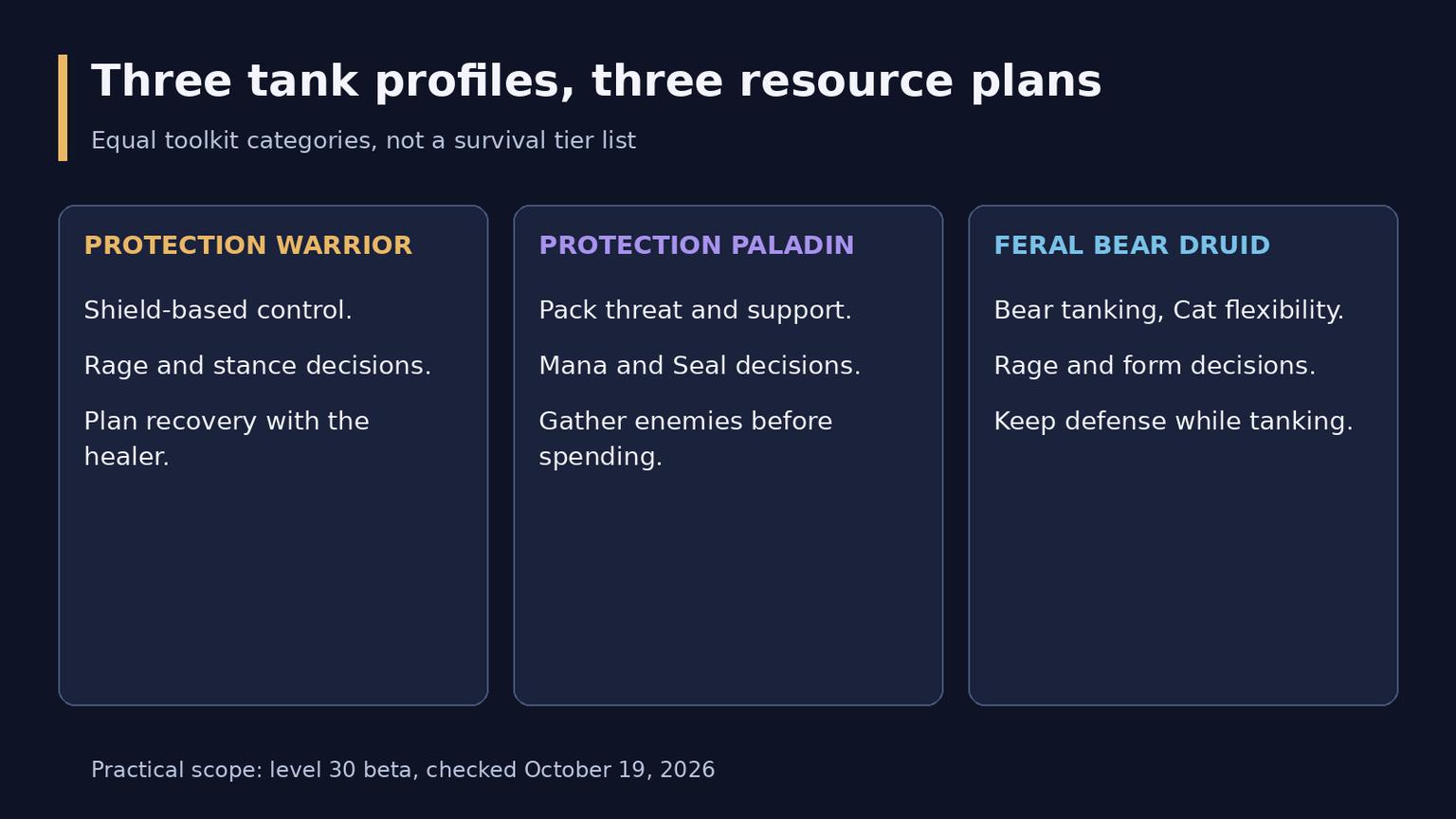
Three equal tank profiles and their resource tradeoffs
Protection Warrior: a structured shield-and-control choice
Warrior suits a player who wants to respond directly to enemies: position the pack, use the shield, interrupt an important cast and spend Rage without losing the next useful action. The official redesign lets Thunder Clap work in Defensive Stance. Shield Specialization and Master of Defense can reward defensive events with Rage when the required shield and talents are present.
That connection between defense and resources is a reason to learn the shield setup rather than copy an offensive hybrid immediately. Defiance also requires a shield for its increased Defensive Stance threat. A Fury-heavy configuration should not inherit every defensive claim made for deep Protection.
Warrior's recovery needs qualification. Victory Rush is learned at level 20 and heals after a qualifying kill; it is not an on-demand heal throughout a boss fight without adds. Plan healer support and damage reduction before health collapses. The presence of a shield does not make spell damage disappear.
Movement also has conditions. Vanguard lets Charge work in Defensive Stance, but that does not turn every movement ability into an unrestricted escape button. Read the ability's combat and stance requirements before building a pull around it. We favor Warrior as a learning framework, not because current data proves it easiest for every player.
Protection Paladin: pack planning and party support
Paladin is attractive when you enjoy managing both the enemies and your party's needs. Consecration provides area threat, while Judgement with Seal of Fury supplies the taunt function. Keep the correct Seal active and account for range when recovering a loose enemy. An emergency support spell can save a pull, but spending attention on an ally still requires awareness of your own position and health.
The important limitation is resource control. This version uses Mana, Seals and Judgement rather than the modern Holy Power spending loop. The latest checked beta notes raise Righteous Fury's Holy threat bonus to 90%, but reduce Shield Specialization's Mana return to 4% of maximum Mana with a three-second internal cooldown. Old descriptions of effectively unlimited Mana are a poor basis for choosing the class.
Consecration is also not uniform control of any number of targets. Its stronger effect applies to the first four enemies entering it, with a much weaker effect on others. Gather carefully, agree on a priority target and watch enemies outside that initial group. A pack of scattered casters is a different problem from four melee enemies standing together.
Deep Protection can reach Templar's Bulwark at level 30 through the normal talent budget. It is a finite absorb with Forbearance restrictions, not permanent invulnerability. Holy Shield belongs to later progression, so do not count it as a current level 30 advantage. Paladin is our support-oriented pick, not an unconditional dungeon or raid winner.
Feral Druid: Bear tanking with a flexible second role
Feral is useful when you want to tank and also enjoy playing Cat between tanking assignments. The shared tree supports both forms, but changing your job still requires appropriate equipment and talents. Flexibility is a reason to choose Druid; it is not a promise of maximum performance in both roles with every setup.
Bear builds Rage and spends it on threat. The level 30 profile uses Primal Bite, Swipe for multiple enemies and Maul when there is enough spare Rage. Maul replaces an auto-attack, so its practical resource cost includes the Rage that attack would otherwise generate. Filling every possible attack queue can leave you unable to perform the next important action.
The redesign makes equipped weapon DPS matter in forms. A weak weapon can therefore hurt threat even when the character never visibly swings it. Defense skill also has a specific interaction through the redesigned Thick Hide, rather than being a reason to copy another version's gearing rules unchanged.
Do not award Bear a finished endgame kit at level 30. Lacerate is announced at level 42, and Berserk is a 31-point Feral talent. Both sit beyond the ordinary level 30 progression discussed here. Likewise, stronger later healing does not make leaving Bear Form under active melee pressure a safe default. Arrange a handoff or a safe interval before casting out-of-form healing.
The numerical ranking: single-target threat, not survival
There is a concrete ranking available, but its question is narrower: how much gross threat per second do three configured level 60 tank models produce? In the checked MythicSim snapshot, the order among these core tank presets is Bear, Protection Warrior, then Protection Paladin.
Core tank preset | Threat per second | Damage per second |
Feral Bear Druid | 1,569 | 548 |
Protection Warrior | 1,096 | 597 |
Protection Paladin | 1,052 | 629 |
These rows are the October 18 entries on engine 37c2dfb, viewed October 19. The page also displays a newer October 19 engine header; that header does not make every listed result a fresh run. The comparison uses level 60, a two-minute single-target fight and 10,000 iterations, with the listed trinket-equipped configurations.
The configurations differ: Night Elf Bear uses 0/41/10, Orc Warrior 0/20/31 and Human Paladin 8/33/10. Bear and Warrior use Hand of Justice plus Blackhand's Breadth; Paladin uses Briarwood Reed plus Burst of Knowledge. These are preset results, not a controlled experiment with identical race, gear and talent investment.
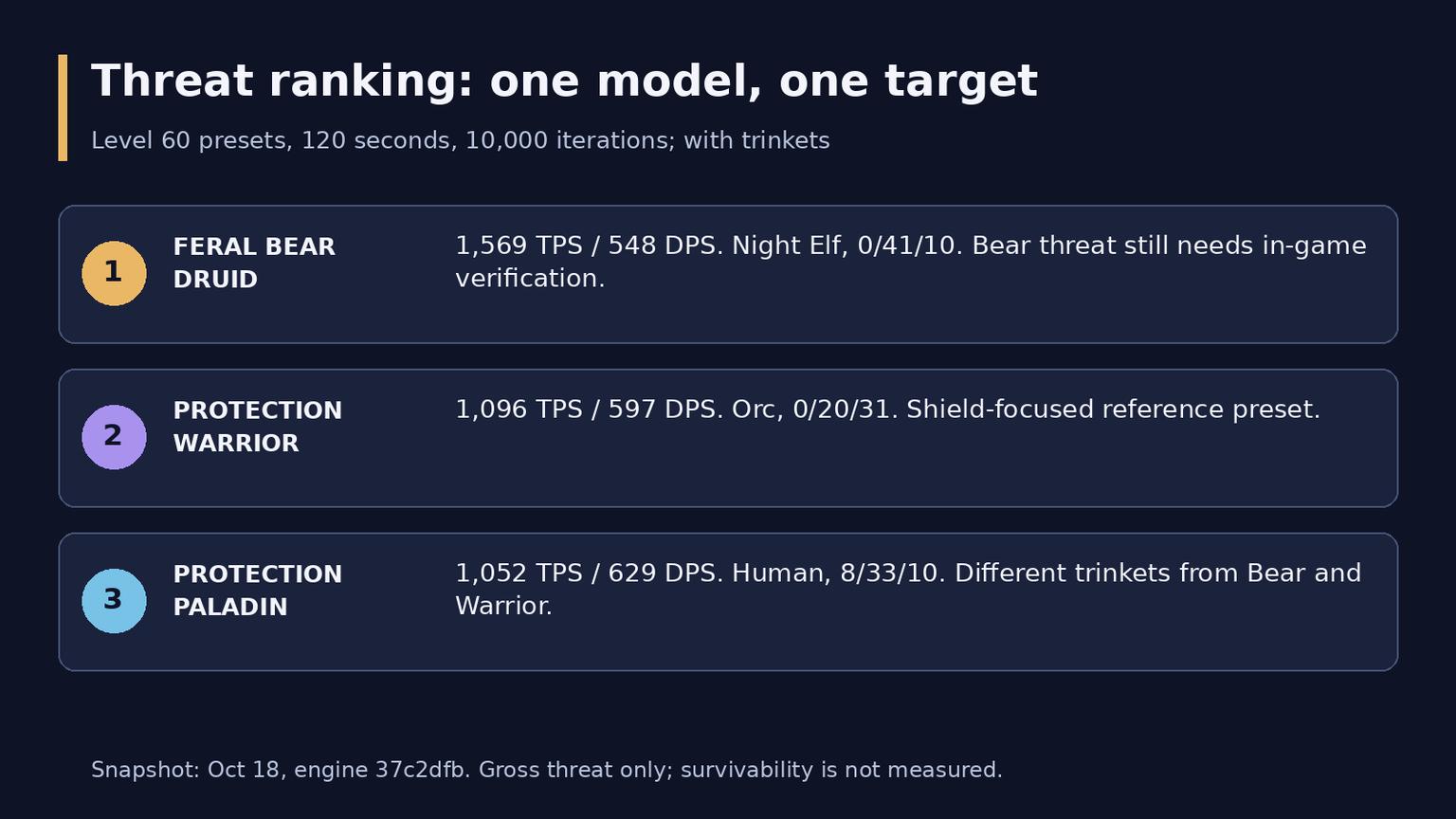
Three core tank presets ranked by gross threat per second
The simulator includes threat modifiers and resource-related threat, but excludes taunts, threat drops and Salvation from this gross threat comparison. It does not measure survivability, and its Bear threat implementation still carries an explicit in-game verification caveat. The table therefore cannot establish the safest tank, the best emergency recovery, or the strongest dungeon pack control.
Warrior's lead over Paladin here is 44 threat per second, about 4.2% relative to Paladin. That is a difference in this model, not proof of an enormous gameplay gap. Paladin's higher listed damage also demonstrates why a damage ranking and a threat ranking can have different orders.
Hybrid entries on the same page answer additional build questions. They do not add new tank classes, and a damage-oriented hybrid should not receive the survival assumptions of a shield-focused build automatically. Use the table as a threat research checkpoint, not as a character-creation command.
Choose by content before choosing a tier
Level 30 dungeons
Look at the pulls you actually run. For shield practice and direct cast control, start by evaluating Warrior. For a coordinated group that gathers enemies and uses support well, evaluate Paladin. For a player comfortable with forms who wants a second Feral role, evaluate Druid. These are editorial recommendations based on tools, not measured win rates.
Do not equate more targets with a better test. If the healer cannot keep line of sight, the tank loses a caster or damage dealers attack different enemies immediately, the pull is testing coordination as much as class balance. Try comparable routes and group sizes before blaming the specialization.
Raids and later progression
A level 60 threat model is useful for identifying questions to test when that progression is available. It cannot replace encounter evidence. A raid tank may need to handle a particular damage pattern, a swap, an add wave or a defensive gap while another tank covers the boss.
No universal raid survival order is established here. Before assigning a permanent main tank, compare actual encounter demands, available defensive tools, equipment and support. Recheck the build after balance updates instead of treating a beta label as a season-long verdict.
Solo play
Solo comfort is a separate choice from holding a raid boss. Warrior's kill-triggered recovery can matter while fighting ordinary enemies. Paladin can heal and support, but needs Mana for those actions. Druid can change roles, but healing outside Bear Form changes its defensive situation.
Pick the rhythm you enjoy and can sustain. A theoretical threat lead does not measure travel, downtime, recovery between enemies or how often you make mistakes. None of these solo observations proves a fastest-leveling ranking.
A short test before committing to a tank
1. Fix the context. Use the same level range, similar equipment quality and a comparable dungeon pull. Record your talents and any extra Legacy investment.
2. Diagnose the failure. Was it lost threat, an unhandled cast, a resource shortage or lethal incoming damage? Those problems require different solutions.
3. Change one variable. Adjust positioning, target priority, spending or a defensive choice before replacing the class.
4. Recheck after updates. Compare the current tooltips and official notes, then repeat the same pull. Keep simulation results tied to their dated configuration.
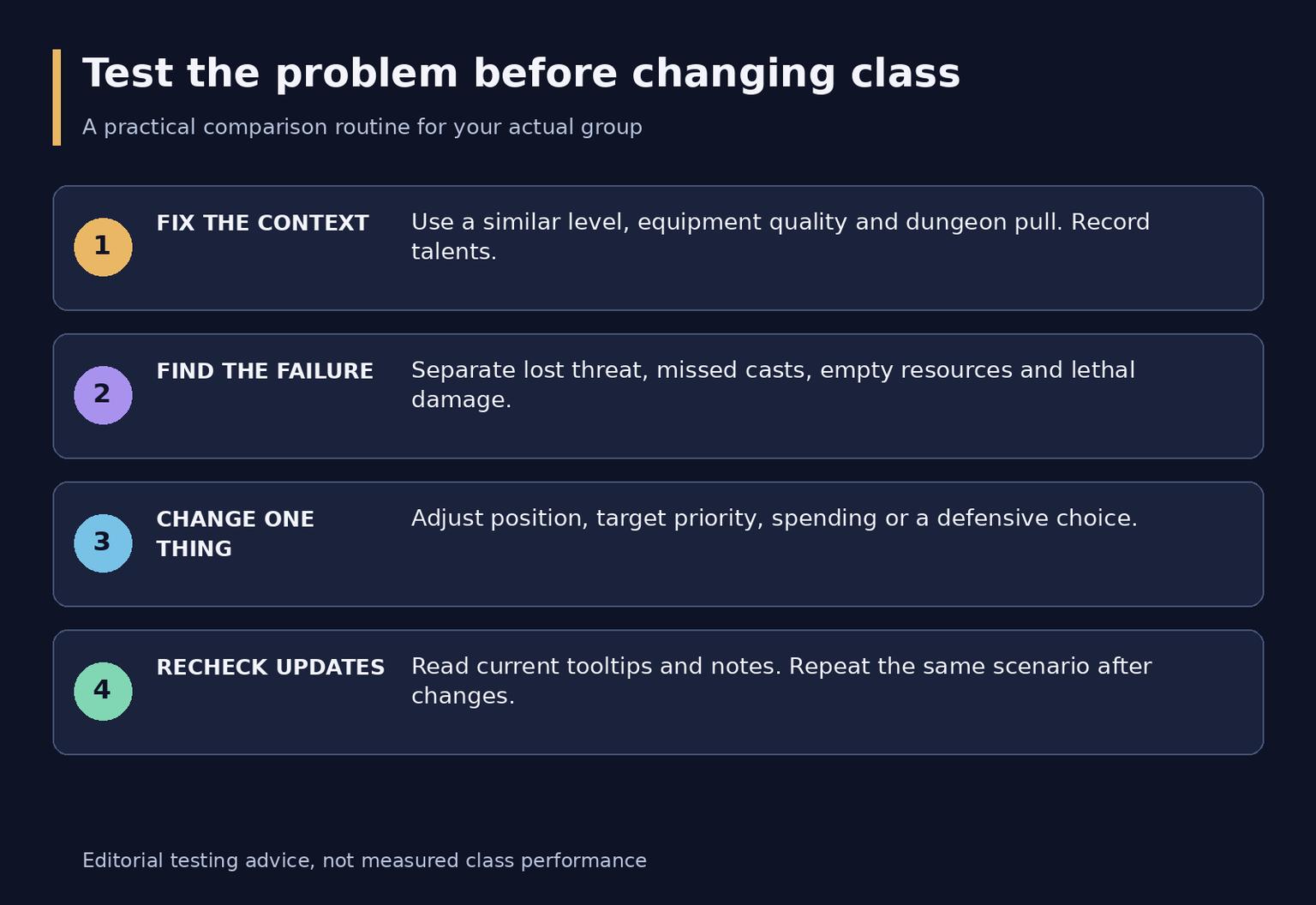
Four steps for evaluating a tank in a consistent scenario
Questions before you choose
Is there a confirmed best tank overall?
Not from the evidence used here. All three have meaningful tank tools, while the available numerical comparison measures a limited threat scenario. A universal survival tier would require evidence this table does not provide.
Should Bear's threat lead decide my character?
Only if that specific simulated question is your priority and you accept its assumptions. It says nothing direct about current level 30 survival or your group's ability to control a difficult pull.
Can I use modern tank guides instead?
Use a guide written for this version. Modern resources, specializations and Hero Talents do not describe this beta's class structure. Even familiar ability names can have different requirements or scaling.
What is the most useful starting decision?
Choose Warrior for a shield-and-control learning plan, Paladin for support with Mana management, or Druid for Bear/Cat flexibility. Then build a reliable pull routine. Reassess the choice when comparable encounter evidence becomes available, rather than turning a provisional model into an absolute tier list.