WoW Forever Camping Guide: Campfires, Professions and Benefits
Camping in World of Warcraft: Forever turns a cooking fire into a shared roadside stop. The fire creates space for profession objects; those objects supply the actual services and benefits. A tent can help with rested experience, a robot can repair equipment, and a workstation can let someone craft without returning to town.
This guide was checked on October 18, 2026, during beta. The broad system is officially announced, while recipes, requirements and individual effects remain subject to testing changes. Treat the current client tooltip as the final check before spending materials on an upgrade.
Camping is not a separate profession or a permanent house. Cooking creates and expands the campsite, and existing professions contribute its features. You can visit another player's camp without owning every profession represented there. For a new character, a useful first goal is learning Cooking and carrying a small supply of kits, rather than trying to build an entire camp alone.
Set up your first campsite
The Great Outdoors introduces the system around level 5 and leads into Cooking and profession introductions such as Camping 101. These introductory quests teach the process; beta profession guidance reports that they are not a prerequisite for receiving campsite benefits.
1. Learn Cooking and locate Basic Campfire Kit in its crafting list. The current basic recipe uses one Simple Wood, available from ordinary trade or general goods vendors.
2. Craft the kit, then use it from your bags in an allowed outdoor location. Choose somewhere away from hostile patrols and the edge of a busy fight.
3. Add an available profession feature, or ask another visitor to contribute one. Check its skill requirement, materials, your shared cooldown and the camp's remaining capacity.
4. Sit beside the camp with `/sit` and wait for the resting countdown to finish. Expect roughly a minute, then verify that the benefits appeared before leaving.
The crafted-kit workflow matters. An older instruction to keep Flint and Tinder beside loose wood is not the current basic-kit recipe. Prepare several kits while at a vendor and carry the finished items; this makes a rest stop easier to arrange when your bags are already crowded.
Do not expect a bare fire to provide every profession bonus. If the feature you need has not been placed, waiting longer will not create it. Ask what other players can add before using a limited slot.
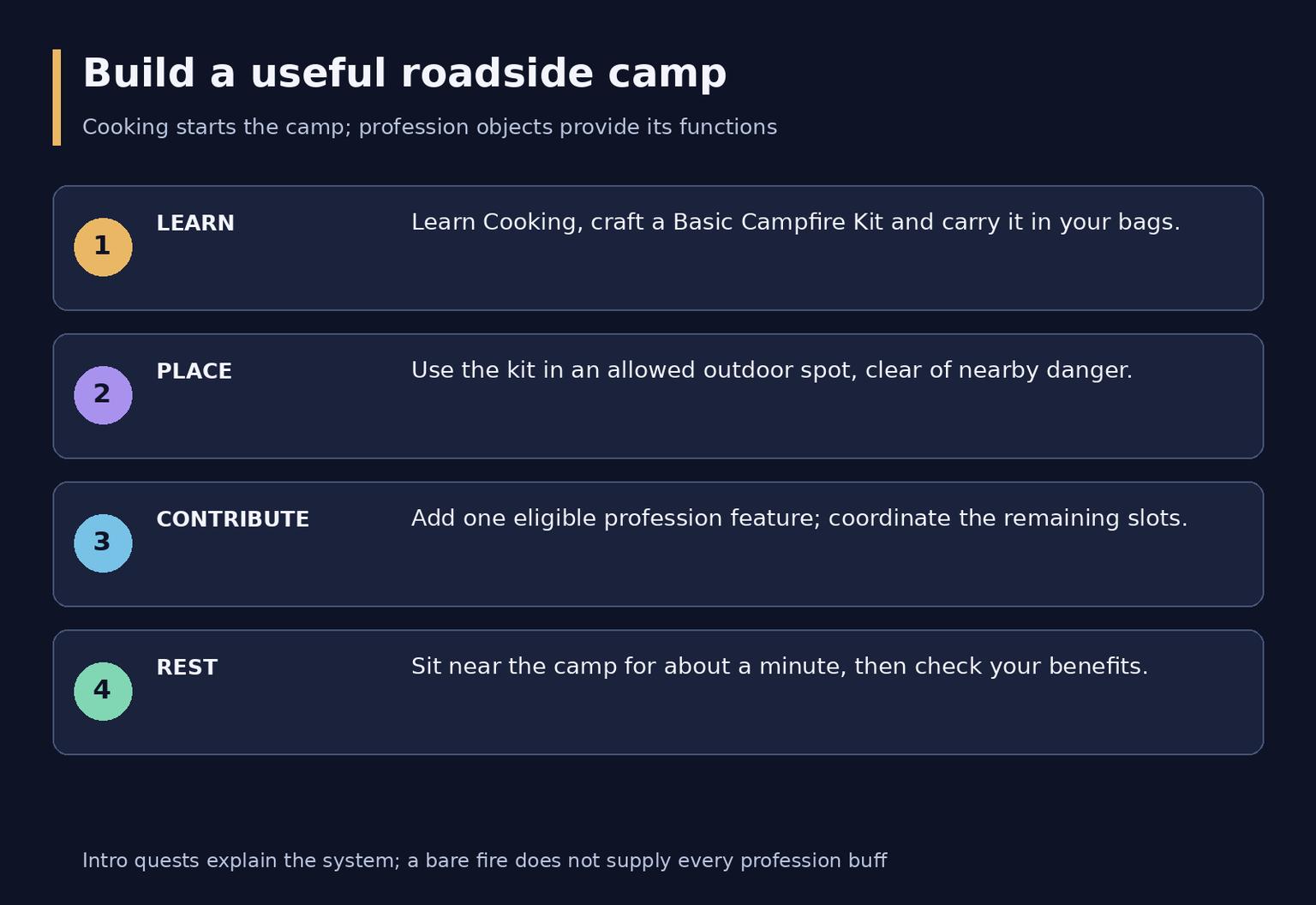
Four steps from Cooking to campsite benefits
Placement, capacity and shared use
Current beta guidance describes outdoor placement with exceptions, including major cities and a minimum separation between campfires. This is not permission to place one at every coordinate. If the client rejects a location, check the displayed reason and move to a clearer outdoor spot. No fixed universal spacing distance is established here.
Campfire | Additional feature slots | Practical use |
Basic Campfire | 3 | A small stop with carefully chosen contributions |
Journeyman Campfire | 5 | More room for buffs alongside a useful service |
Expert Campfire | 10 | A larger shared stop with several professions represented |
The fire is the center; these numbers count additional features. They do not mean that the owner can personally place three, five or ten objects. Each player contributes one feature, and profession features share a one-hour placement cooldown before relevant reductions. The campfire itself has a separate cooldown, currently five minutes in beta guidance.
Feature items can be traded, but possession alone does not satisfy the profession skill needed to place them. Buying an advanced object is not a substitute for learning the required profession. Visitors can benefit from contributed objects without themselves being qualified to place those objects.
In a three-slot camp, coordinate before anyone contributes. For example, a group preparing for another quest circuit might value a tent, repairs and a missing resource buff more than a workstation nobody needs. This is a planning example, not a universal best setup.
What professions add
Higher-tier features generally preserve their profession's earlier benefit while adding a service or crafting function. A bigger campfire increases capacity; it does not automatically create those advanced objects or teach their recipes.
Profession | Examples of campsite contributions |
Alchemy | Mana Well restores mana; Fermenter and Alchemy Laboratory support particular recipes |
Blacksmithing | Sharpening Wheel grants Strength in current beta data; Anvil and Master Forge provide workspaces |
Enchanting | Enchanted Lute offers defensive and attribute benefits; later objects support disenchanting and crafting |
Engineering | Reagent Bot sells supplies; Repair Bot adds equipment repairs |
Herbalism | Incense Candle grants Intellect; Greenhouse and Seed Hybridizer support growing and combining seeds |
Leatherworking | Camp Tent supplies rested experience; Tanning Rack and Sewing Machine support advanced work |
Mining | Lodestone supplies melee Attack Power; Rock Garden and Molten Foundry add resource or crafting functions |
Skinning | Camp Chair grants Critical Strike; later objects add tracking and trapping utility |
Tailoring | Faction Banner grants Spirit; Spinning Wheel and Loom support profession work |
The secondary professions also contribute. First Aid provides Stamina and later medical supplies. Fishing offers an attribute benefit and later fishing-related utilities. Cooking supplies the campfire sizes as well as more advanced food or workspace features. These are functions of particular placed items, not services automatically available at every fire.
Before a long journey, inspect what you can actually place and bring its materials or crafted item. A repair service does not solve an empty bag of reagents, and a workstation does not supply every ingredient needed for the recipe you planned to make.
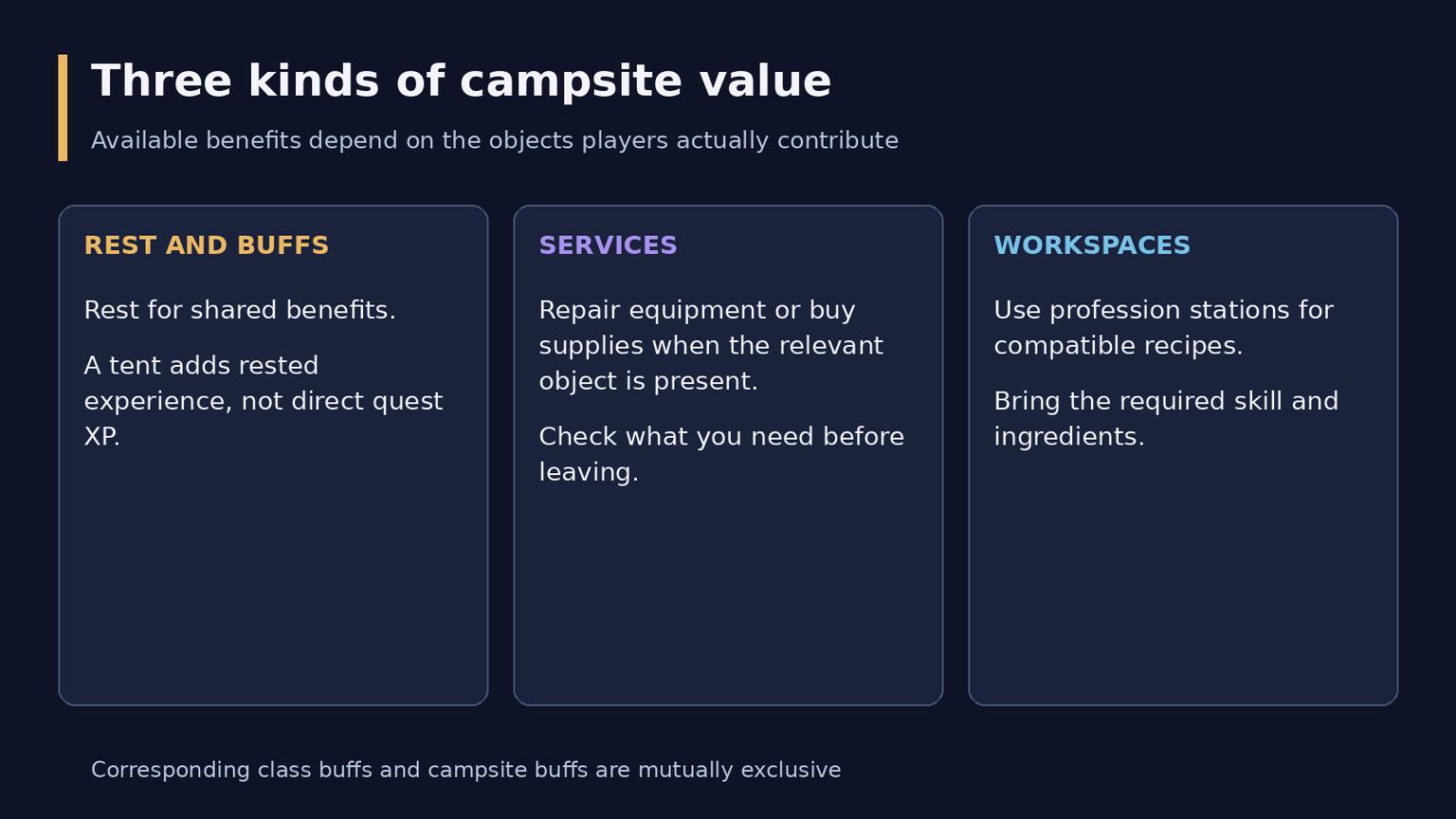
Three kinds of campsite value
Buffs, rested experience and cooldowns
After resting, the camp's benefits normally last one hour. They are variants of familiar class buffs and are mutually exclusive with their corresponding class effects. Do not add the camp value to an equivalent class buff when estimating your total stats. The October beta notes explicitly clarified the wording to reduce this confusion.
Camp Tent's rested experience is a different benefit: current beta descriptions give up to 5% of a level, once per hour, with Boosted Rest preventing repeated immediate gains. This adds a rested-experience allowance; it is not a direct award of 5% of a level and not a permanent 5% bonus to every quest.
Keep three separate questions in mind. Can you place another feature? Have you finished resting to receive benefits? Can you receive another tent rest benefit yet? A placement cooldown, a resting countdown and the tent's repeat restriction answer different questions. Moving to another fire should not be treated as a way to erase your restrictions.
Check active effect icons after the rest. If the expected stat increase is absent, first inspect the contributed object and any equivalent class buff. If only the tent benefit is unavailable, look for Boosted Rest rather than assuming that the entire campsite has failed.
Improving your camp over time
Initial profession features generally begin at skill 20; later tiers are listed at 140 and 300 in beta references. Advanced recipes require Blueprints rather than simply appearing with every trainer visit. Dungeon rewards are one route: the Journeyman Campfire Blueprint is associated with Lord Serpentis in Wailing Caverns.
Separate learning a recipe from using its crafted item. Current references disagree about upgraded campfire skill requirements, and some distinguish lower learning thresholds from higher use thresholds. Read both tooltips before buying materials or a Blueprint. The Expert Campfire Blueprint's exact drop source is not confirmed here, and a full list of advanced features should not be read as proof that every recipe is already obtainable.
Legacy perks provide another layer of improvement. Field Guide reduces feature-placement cooldowns, Permanence extends campsite benefits, and Reagent Economy removes materials from tier-one feature crafting. They improve an existing activity; they do not remove the need to obtain higher-tier recipes or qualify to place their items.
Choose an improvement around a repeated inconvenience. If you regularly travel with several contributors, more slots may be valuable. If you rarely use a particular workstation, pursuing it immediately may be less useful than carrying a reliable basic setup. There is no confirmed separate Camping reputation or camp-only cosmetic reward track to plan around in this guide.
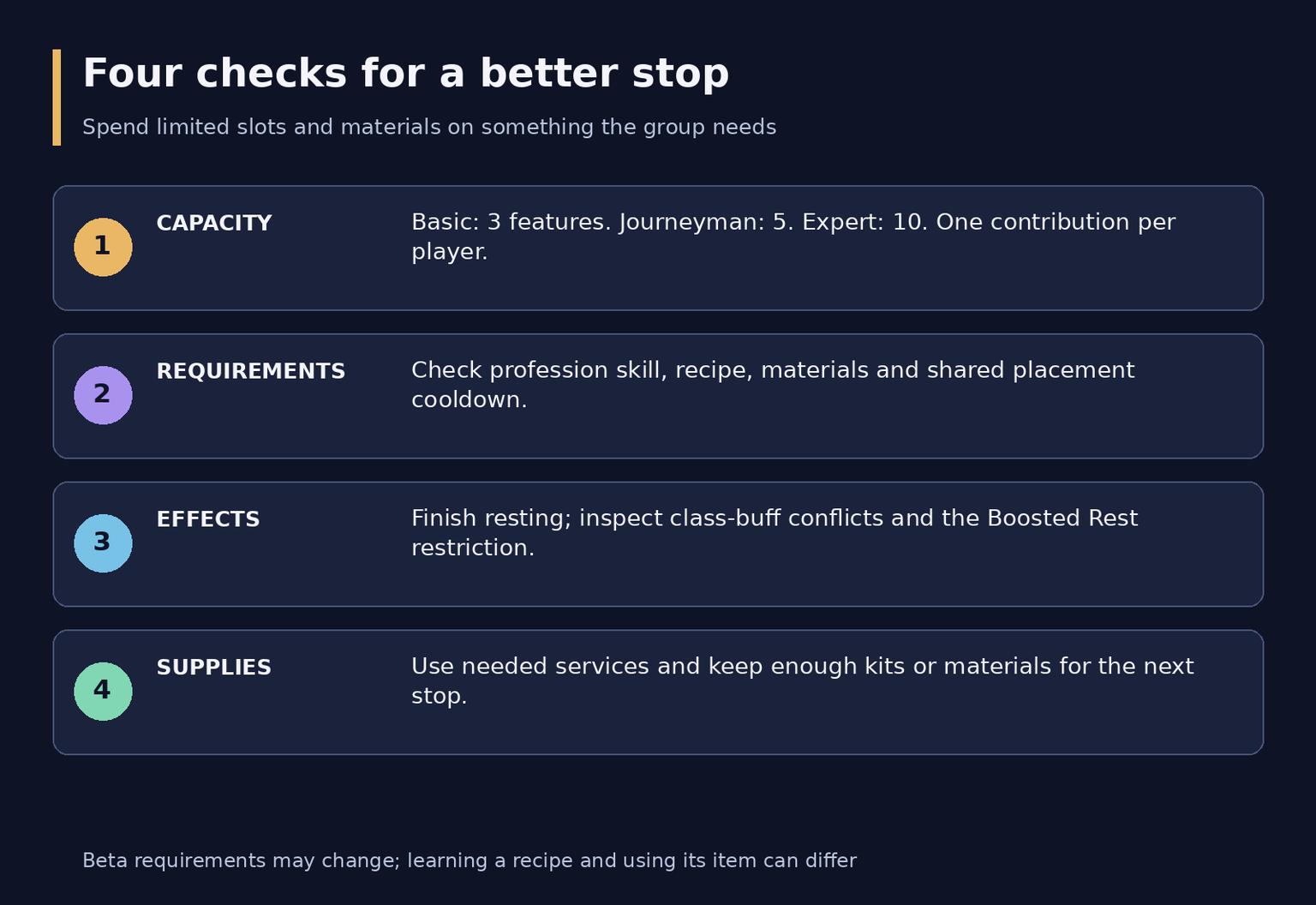
Four checks before spending an object or leaving camp
Common campsite questions
Must I own a profession to receive its buff
No. Visitors can use a camp's shared benefits. The profession requirement applies to contributing the relevant feature, so receiving a benefit and placing its object are different activities.
Does a campsite make an area safe
No. Choose the location with nearby enemies and other players in mind. A fire is not a protective barrier. October beta changes reduced some campfire damage, but they did not turn the flame into a place to stand safely.
Can I replace inns with camping
Camping is a temporary outdoor stop with useful shared functions. Inns remain fixed resting places; a camp is not persistent player housing. Use the option that fits the journey rather than assuming their mechanics and permanence are identical.
What should I do before heading out
Check the benefits you actually received, use needed repairs or workspaces, and leave enough supplies for the next stop. Thank contributors and ask before consuming a scarce slot. A short coordinated pause is more useful than a large camp filled with objects nobody currently needs.