WoW Forever Class Tier List: Choose Your Beta Main
For ordinary solo quests without a regular party, Hunter and Warlock are the first classes to consider. A companion helps divide the incoming pressure, while ranged attacks give you room to react. If your priority is tanking, healing or PvP, start with that role instead: this recommendation does not identify a winner across every activity.
Checked October 19, 2026. The current WoW Forever beta caps characters at level 30. Nine classes are available, each with three talent trees. These are not level-60 characters with complete builds and raid equipment. Abilities found deeper in a tree cannot automatically count as strengths of a character you can play today.
This is an editorial ranking for comfortable solo leveling, not a measured damage chart. Its assumptions are ordinary equipment, quest progression and no permanent healer. Classes within a tier have no internal order. With balance still changing, a playstyle you enjoy is a firmer basis for choosing than one temporarily generous spell coefficient.
What S, A and B actually mean
The criteria are independence: who takes hits, how much recovery is needed, what happens when another enemy joins and how strongly progress depends on weapons and execution. Control, movement and resource management also matter. These are qualitative judgments without invented scores or guaranteed leveling speeds.
S means a particularly convenient starting point for pet-assisted solo quests. A offers strong answers with a more noticeable cost in mana, preparation or attention. B asks for more planning under these particular conditions. A B rating does not mean poor party damage, weak healing or an unplayable class.
Tier | Classes | Reason in solo quests |
S | Hunter, Warlock | A companion helps take hits; control and self-sufficiency support continued fighting |
A | Mage, Druid, Paladin | Control, flexibility or protection compensate for limitations, with resource and pacing costs |
B | Priest, Shaman, Rogue, Warrior | Support or melee tools remain useful, but recovery, equipment and setup more often shape the experience |
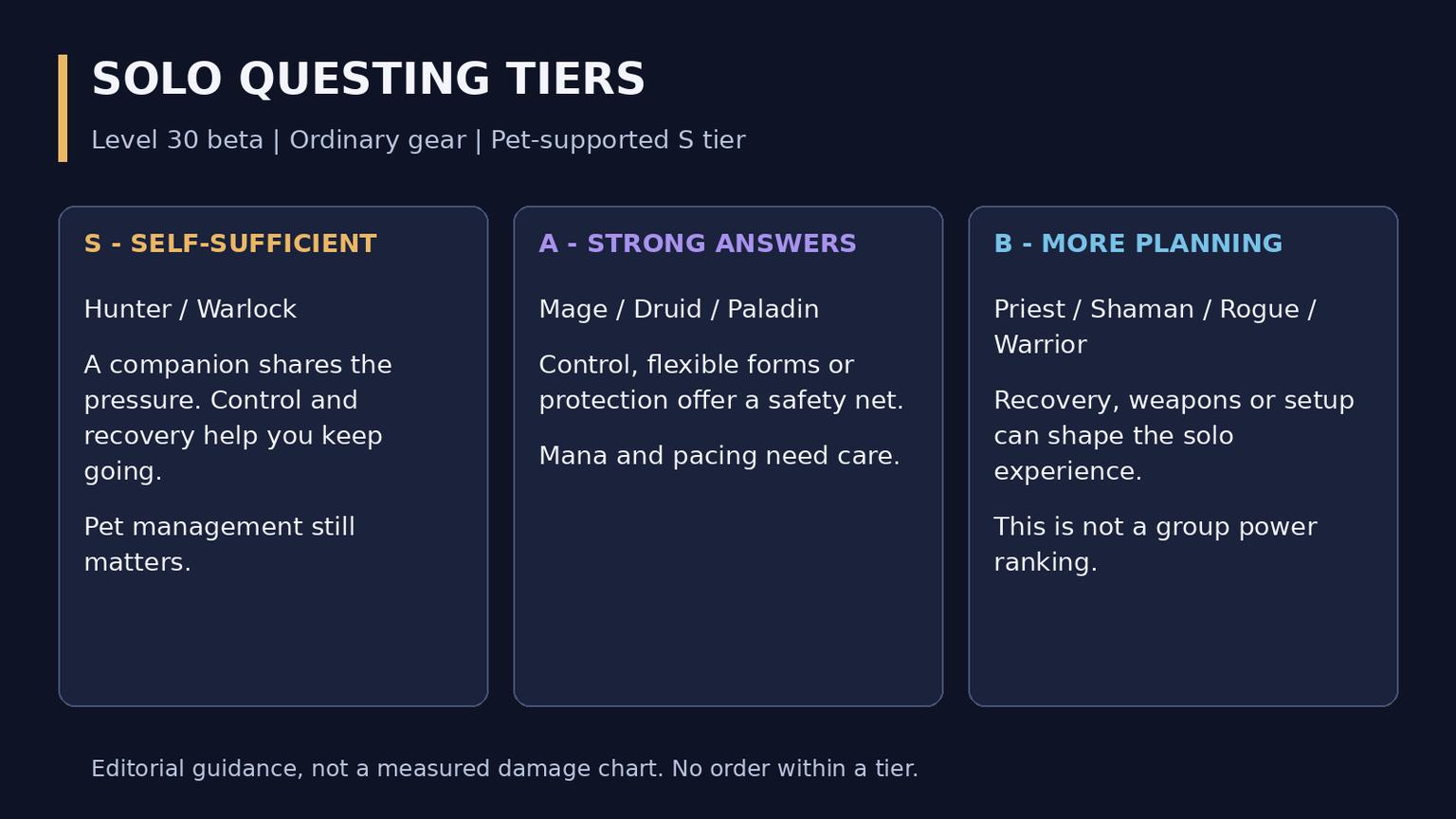
These tiers concern solo quests up to level 30, not every role and activity
Hunter's placement assumes a pet-supported approach, rather than every possible talent allocation. Warlock's rating also assumes a useful demon and sensible pulls. Gathering the largest possible pack is not the baseline: poor companion control can remove the practical advantage of either class.
Nine classes, 27 talent trees
A talent tree describes a direction, not a fully unlocked toolkit at level 30. Druid's Feral tree covers both cat damage and bear tanking; a separate Retail Guardian tree does not belong in this list. Hunter's Survival direction focuses on melee combat.
Class | Talent trees | Roles and direction |
Druid | Balance / Feral / Restoration | Ranged damage, melee damage, tanking and healing |
Hunter | Beast Mastery / Marksmanship / Survival | Ranged damage; Survival focuses on melee |
Mage | Arcane / Fire / Frost | Ranged spell damage |
Paladin | Holy / Protection / Retribution | Healing, tanking and melee damage |
Priest | Discipline / Holy / Shadow | Healing and damage prevention; Shadow deals ranged damage |
Rogue | Assassination / Combat / Subtlety | Melee damage and control |
Shaman | Elemental / Enhancement / Restoration | Ranged damage, melee damage and healing |
Warlock | Affliction / Demonology / Destruction | Ranged damage, demons and curses |
Warrior | Arms / Fury / Protection | Melee damage and tanking |
Death Knight, Monk, Demon Hunter and Evoker are outside this roster. Do not import Shaman or Warlock tank roles from other versions. Paladin and Shaman are available to both factions, so the original Classic faction restriction is not a valid shortcut when planning your character.
Why each class lands in its tier
Hunter - S: a companion and distance
Hunter suits someone who wants to separate incoming pressure from the player character and work through targets steadily. Beast Mastery is a logical first direction for that approach. Marksmanship and especially melee Survival change the assumptions. The advantage is a manageable division of jobs between player and pet, rather than a promise of maximum damage.
Companion control is the main responsibility. Avoid sending your pet through another pack and call it back before skipping enemies. Range and weapon upgrades still matter. October tuning makes Auto Shot require a brief stop, so movement is not uninterrupted shooting. In groups, learned traps and control tools can contribute beyond personal damage.
Warlock - S: a demon and recovery tools
Warlock is a strong starting option if you enjoy damage over time and managing a companion. A demon can hold enemies, while converting health into mana and draining life provide ways to keep going. The price is tracking your own health, mana, target effects and demon at the same time.
Independence is not invulnerability. Fear can send an enemy toward another pack, and spending health before a dangerous hit leaves little margin. In dungeons, Healthstones and other support tools offer value. Choose a demon for the situation: the best answer for damage need not be the best answer for protection or opposing a caster.
Mage - A: control instead of a companion
Choose Mage if controlling distance and preparing a pull sound enjoyable. Frost is an accessible direction for learning slows and roots. Its placement reflects control of the situation, not demonstrated damage superiority over Fire and Arcane.
A positioning mistake is less forgiving without a pet taking hits. Mana use and drinking affect the actual pace. Large-pack leveling requires room and execution, so it is not the assumed baseline. In a party, control and interrupts matter, but coordinate them rather than breaking a controlled target with area damage.
Druid - A: flexibility with extra decisions
Druid suits players who want to explore different roles and use forms. Moving between melee combat, bear tanking and healing is appealing for a small regular group. However, changing form does not replace appropriate talents, equipment and resources.
Several action sets make the learning curve steeper. For solo quests, establish a reliable fighting and recovery rhythm instead of constantly changing your job. Declare your main role before a dungeon. Older descriptions of particular talents need care: Blizzard already redesigned parts of Feral during October, so a familiar name is not enough to establish a current build.
Paladin - A: room to recover
Paladin suits players who prefer a protected melee character with healing and ways to help an ally. The solo rating reflects safety. It does not guarantee quick kills: weapons, mana and time spent healing still shape progress.
For group play, choose healing, tanking or damage deliberately. Timely defensive abilities are valuable, but do not replace threat management, positioning or role preparation. October tuning changed damage, threat and mana return in different ways. A headline about one buff therefore cannot describe the entire class.
Priest - B: reliability with a pacing cost
Priest is a good choice for an aspiring healer or someone who enjoys keeping allies alive. Self-healing helps recover from mistakes in solo quests, but mana use and time to defeat a target need attention. Shadow and the healing directions solve different problems; this letter is not a healer ranking.
The challenge is deciding when to keep attacking, protect yourself or stop to recover. In a party, look beyond healing totals to prevented damage, removal of suitable effects and the mana available for the next pull. Those contributions are not captured by solo kill speed.
Shaman - B: support with resource decisions
Shaman is appealing if you enjoy combining combat with party support. Elemental, Enhancement and Restoration lead toward distinct roles. Totems add decisions, but placement and mana spending make a first solo character less straightforward.
Weapon upgrades matter for the melee direction; casters and healers must manage resources and find safe casting windows. Shaman is not included as a standard tank here. Party value can be substantially better than the solo tier suggests through support and interruption, provided the relevant tools are available in the actual build.
Rogue - B: preparation pays off
Choose Rogue for stealth, picking an opening and controlling an individual opponent. Skipping unnecessary enemies helps questing, but does not make every unavoidable fight comfortable. Weapons, energy, combo points and the sequence of actions strongly affect results.
Without continuous healing, an additional attacker can quickly become dangerous. Learning one opener is easier than controlling several targets while planning an escape. In PvP these tools carry different weight: a solo B rating does not assess the ability to arrange a coordinated attack with a teammate.
Warrior - B: preparation and allies matter
Warrior suits players interested in melee combat or tanking who are willing to maintain their weapons. A solo Warrior has fewer direct self-healing answers, so a sequence of demanding fights more often needs recovery breaks. Rage, incoming damage and target selection connect offense with survival.
A healer or dependable party changes the starting conditions, making the solo ranking less relevant. Tanking depends on controlling enemies and timing defenses rather than a letter next to the class. A better weapon helps, but cannot turn a pull with several unwanted enemies into a sound plan.
Dungeons and PvP need different criteria
Tanks and healers
The main tank directions here are Protection Warrior, Protection Paladin and Feral bear Druid. Compare survival during a dangerous attack, control of several enemies, resource use and recovery after something goes wrong. Without equivalent gear and encounters, declaring one the toughest tank throughout the beta would overstate the evidence.
Priest, Paladin, Druid and Shaman can heal. Think about whether you enjoy preventing damage, quickly restoring one target or supporting a moving party. Priest's Discipline and Holy offer different approaches. Effective healing depends on learned talents, fight length and composition: a large single heal does not tell you whether your mana lasts until the end.
Damage and the party's missing tools
A short fight favors damage that arrives quickly; a longer encounter tests resources and repeatable output. Effects that need time may contribute little against an ordinary target that dies almost immediately. Area damage is also a separate question from sustained boss damage.
Before assembling, ask what is missing: healing, a reliable tank, an interrupt, control or removal of an effect. Check the actual learned abilities rather than the class name alone. Being wanted by one party does not prove first place on a general damage chart. This guide does not turn today's level-30 beta into a level-60 raid ranking.
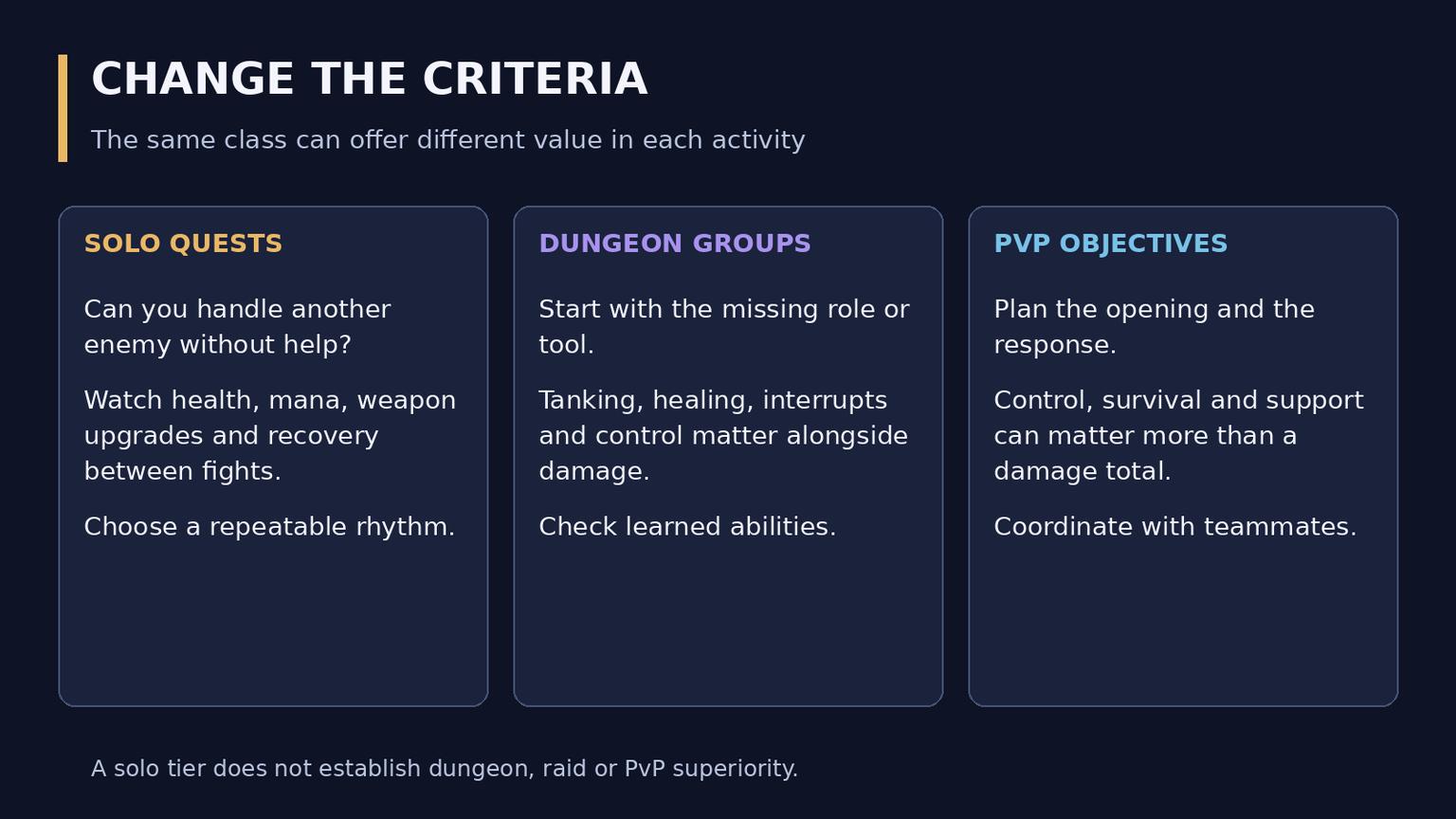
Solo quests, dungeon groups and PvP require different selection criteria
PvP
For PvP, assess opening a fight, controlling an opponent, surviving a response and completing an objective with teammates. Rogue's stealth, Mage or Hunter range, Warlock pressure and a healer's support address different jobs. Winning a duel is not the same as contributing on a battleground.
Do not choose from one clip featuring a large critical hit. Ask about equipment, level, talents, support and conditions. Stopping an enemy spell or helping a flag carrier at the right moment may matter more than personal damage. Ordering all 27 directions without comparable evidence would create false precision.
What to check after another update
The latest checked Blizzard development notes are dated October 15. They change more than numbers: Warrior's Battle Shout extends to the raid, while different Priest attacks received cooldown changes in opposite directions. These are reasons to revisit your toolkit, rather than automatically moving the whole class into S.
This ranking does not use Retail's Hero Talents system. Check Forever's actual trees, available points, level and allocation. A talent visible deep in a full calculator is not necessarily usable by your character. Requirements for additional points also need checking separately; they should not be treated as every new player's starting package.
After tuning, repeat an ordinary fight and compare remaining health and mana, control of an additional target and recovery time. That test is more useful than an invented precise gap between adjacent tiers. Results from a well-equipped character should not be transferred unchanged to a fresh one.
Make a choice you can keep
Choose your activity first: solo quests, a regular party, healing, tanking or PvP. Decide on range, pets, forms and support responsibilities. Agree on a role with regular teammates.
Test two classes on comparable quests. Notice mana use, weapon dependence, companion control and recovery breaks. Hunter or Warlock is a useful starting point for independent questing; for other goals, prioritize the role. Keep the character whose routine and limitations suit you rather than chasing temporary tuning.
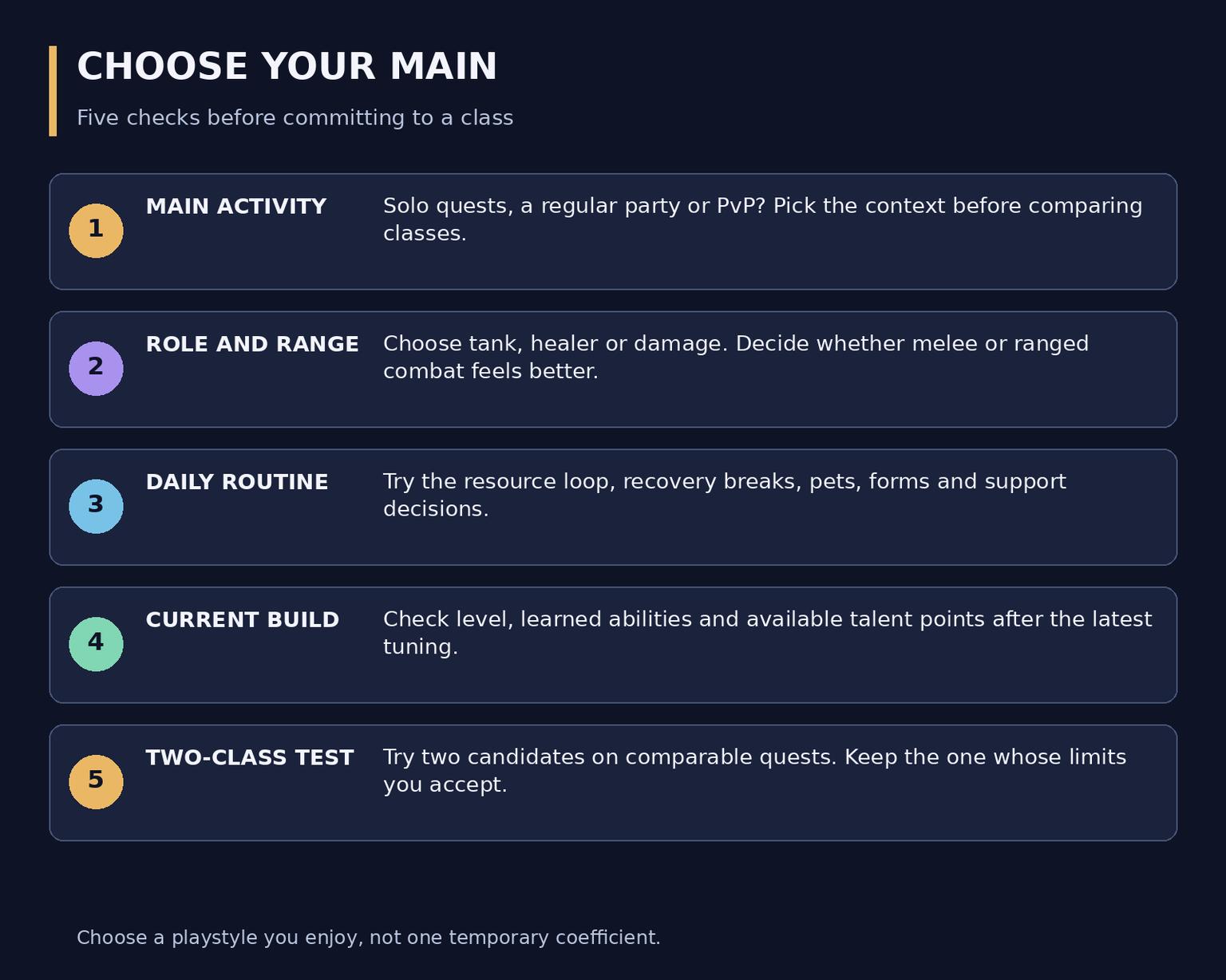
Five questions help you choose a suitable class instead of chasing a temporary buff