WoW Forever Combat Rogue Guide
Combat Rogue in World of Warcraft: Forever is a dual-wield melee damage dealer built around weapon attacks, Sinister Strike and well-timed finishers. Keep Slice and Dice useful, spend spare Combo Points on damage and reserve Blade Flurry for a window you can actually attack through. A strong main-hand weapon and uninterrupted melee contact matter more than memorizing a long fixed sequence.
Checked October 24, 2026: the beta ended October 23 at 10 AM PDT, with launch scheduled for November 4. There is no playable live release on the check date. The last beta cap was 30; the latest independently extracted client is 1.60.1.70532, in patch family 1.60.1. The latest located official gameplay development notes are headed October 15. This guide uses that closed-beta toolkit and labels deeper talents as future options. Final launch tuning and level-60 performance still need verification.
Strengths and limitations
Combat offers straightforward sustained weapon damage, useful interrupts and a short two-target damage window. Its physical core remains useful when a particular enemy resists or is immune to poisons or bleeds, although losing those damage sources still matters. It can level solo, contribute in dungeons and apply pressure in PvP.
Weapon quality, contact time and Energy constrain the build. Blade Flurry is temporary cleave, not unlimited area damage. Deflection and Riposte help when enemies attack you, but a Rogue behind a boss should not expect constant parry triggers. Group utility includes Sap, Kick and situational Expose Armor; the absence of a permanent party buff does not mean the class has no utility. No final raid ranking is established by the level-30 beta.
Changes that affect the build
Forever reshapes the Combat tree. Precision has three ranks and reaches 3% hit chance for attacks and spells, including poisons. Flawless Execution is the 16-point milestone and lowers Eviscerate's Energy cost by 10. Dual Wield Specialization now increases off-hand damage by 5% per point, reaching 25% rather than the old 50% maximum. Endurance reduces Sprint and Evasion cooldowns by 30% or 60%.
Hack and Slash combines the former weapon specializations. At five ranks, swords and axes gain a 5% extra-attack chance, daggers and fist weapons gain 5% critical strike chance, and maces ignore 15% of the target's armor. The mace benefit is not the old random stun. Rogues can learn one-handed axes, but must train and develop the appropriate weapon skill.
Weapon Expertise now reduces the target's chance to dodge or parry your attacks, rather than granting weapon skill. Aggression also supports Backstab. Puncturing Wounds replaces Improved Backstab and adds a chance for Backstab to generate another Combo Point. These changes make a dagger route possible without making it identical to a Sinister Strike build.
Do not assume Combat Potency is an accessible off-hand Energy engine. Records with that name exist in the Forever database, including unresolved zero-percent text, but they do not establish a usable talent in the verified Combat tree. Likewise, do not import Restless Blades cooldown reduction from another version or an inconsistent fan tree. The allocations below use the corroborated Flawless Execution milestone.
Talent examples at level 30
There are 21 ordinary talent points at level 30. Both examples below spend all of them in Combat, reaching Blade Flurry. They are editorial starting allocations based on beta guides and the current tree, not measured best builds. The PvP variant trades a little off-hand damage and dodge for reliable movement-effect removal through Improved Sprint.
Talent | PvE and solo example | PvP example |
Improved Eviscerate | 3/3 | 3/3 |
Improved Sinister Strike | 2/2 | 2/2 |
Lightning Reflexes | 1/5 | 0/5 |
Deflection | 3/3 | 3/3 |
Precision | 3/3 | 3/3 |
Endurance | 2/2 | 2/2 |
Riposte | 1/1 | 1/1 |
Improved Sprint | 0/2 | 2/2 |
Flawless Execution | 1/1 | 1/1 |
Dual Wield Specialization | 4/5 | 3/5 |
Blade Flurry | 1/1 | 1/1 |
Total | 21 | 21 |
For the non-dagger plan, cheaper Sinister Strike, Precision, Flawless Execution and Blade Flurry define the damage route. The exact allocation of defensive and mobility points is flexible, but earlier-row requirements and Riposte's Deflection prerequisite still apply. You cannot take every desirable talent at this cap.
A legal dagger variant of the PvE example replaces Deflection 3/3 and Riposte 1/1 with Puncturing Wounds 3/3 and Improved Sprint 1/2. Everything else stays the same, still totaling 0/21/0. This suits a main-hand dagger and reliable access to the enemy's back. It loses Riposte and should not be used with that proc listed as part of the priority. Solo enemies that keep facing you make this route less comfortable.
With all five additional class points from the Talented Legacy benefit actually unlocked, either non-dagger example can add Hack and Slash 5/5 for 0/26/0. This is a separate progression-dependent extension, not a free part of the ordinary build. Adrenaline Rush needs 31 points in Combat, so neither 21 nor 26 can reach it. A future level-60 build can include it, Weapon Expertise and Aggression, but no full level-60 allocation or launch meta is presented as tested here. Preparation is absent from all supplied examples.
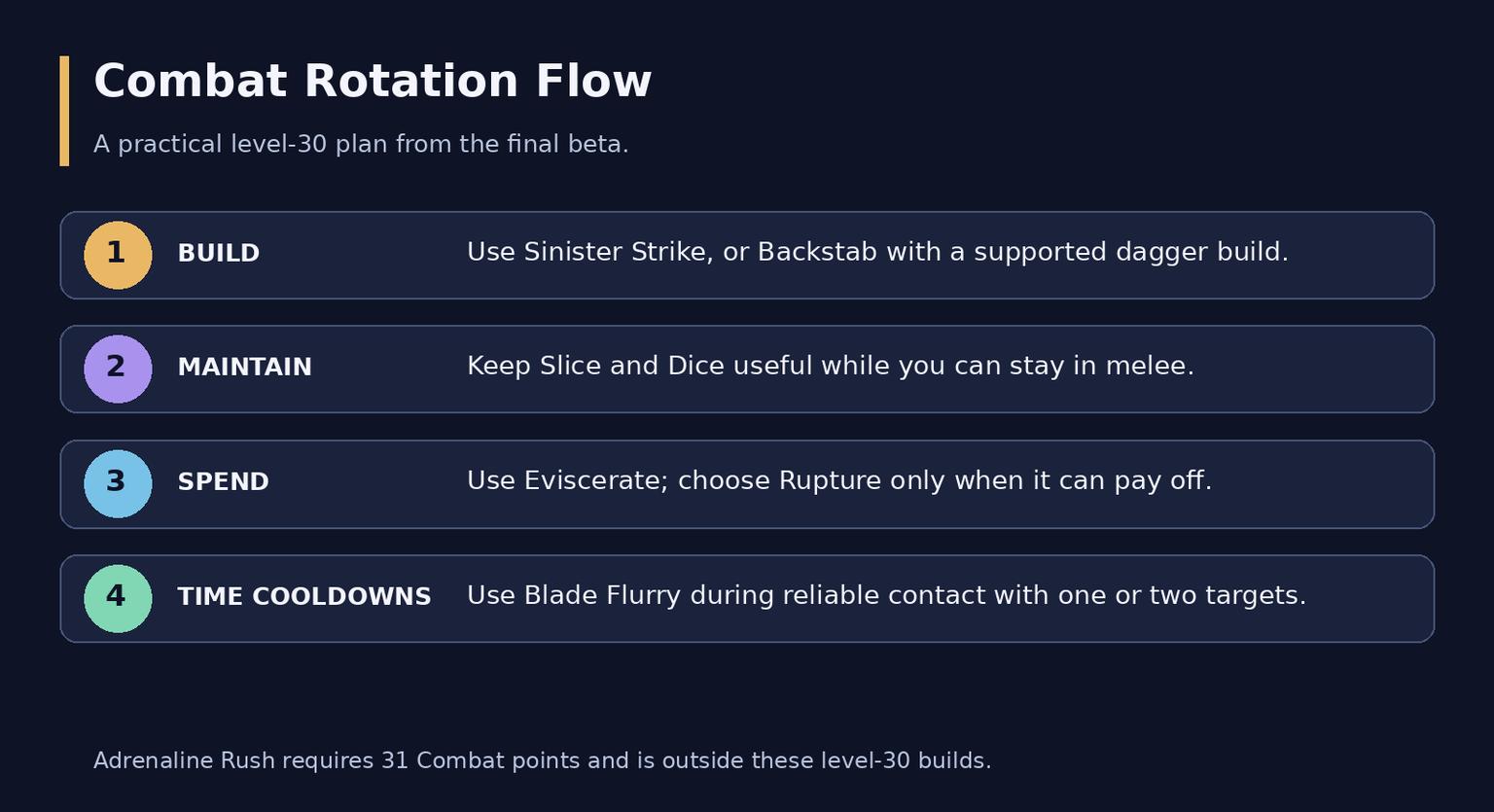
The level-30 priority uses Blade Flurry without assuming access to Adrenaline Rush.
Single-target priority
Start with a plan for melee uptime
Check weapon skill, learned ability ranks and poison charges before pulling. Use Stealth when the approach provides control or a worthwhile opener. Cheap Shot can reduce incoming damage against a stunnable enemy; Garrote needs Stealth and rear access in these builds. A main-hand dagger permits Ambush from behind, but its Energy cost and the approach time can outweigh the benefit in a fast dungeon pull. A Combat Rogue does not need to delay every engagement to force an elaborate opener.
Start auto-attacking and build with Sinister Strike in the non-dagger examples. Its base cost is 45 Energy and it awards one Combo Point; Improved Sinister Strike 2/2 lowers the cost by 5. The dagger variant uses Backstab when its main-hand and rear-position requirements are met, with Sinister Strike available when they are not. Use a trained rank appropriate to your level.
Maintain the buff and choose a finisher
Get Slice and Dice running early when you expect sustained contact. More points give longer duration, but waiting for five points while the buff stays absent can waste valuable attack time. Refresh near expiry with enough time and Energy to avoid a gap; chasing a theoretical last fraction of a second is less useful than reliable uptime.
When Slice and Dice is secure, spend on Eviscerate for direct damage. Rupture is a situational alternative against a durable, bleed-vulnerable target, especially when armor reduces direct damage. Do not automatically maintain both damaging finishers at a cap with limited points and Energy. A target that will die before the bleed runs its course usually favors immediate damage.
Use Riposte when a parry makes it available and the action is useful. It costs 10 Energy, deals weapon damage and can disarm a susceptible target for six seconds. It is conditional utility and damage, not a builder to press on demand or a guaranteed disarm against every boss. Do not stand in front of a boss just to fish for it.
Preserve resources through target changes
Energy regenerates smoothly instead of following Classic's old two-second ticks. Pool for a planned interrupt, finisher or Blade Flurry activation without sitting at maximum Energy. Avoid adding points when five are already available. If an enemy is about to die, a useful Slice and Dice can carry value into the next target, while Eviscerate may secure the immediate kill.
Points remain associated with a target. Switching alone can preserve them, so you can interrupt another enemy and return. Building new points on the second enemy replaces the earlier investment. In the final seconds of a fight, spend on damage that will land rather than refreshing effects with no time to pay off. The supplied Combat builds have no separate execute button or Quietus phase.
Blade Flurry and two-target damage
The verified Forever tooltip gives Blade Flurry a 25 Energy cost, two-minute cooldown and 15-second duration. It increases melee attack speed by 20% and causes melee attacks to strike one additional nearby opponent. That means the primary target plus one extra target, not every enemy in a large pack. It can also be useful on one target for attack speed.
Choose a moment when both enemies will remain in reach. Maintain Slice and Dice, have Energy available after paying the activation cost and continue the same builder-finisher priority. Keep your primary target stable instead of wasting points by alternating builders between enemies. Do not assume poison ticks or bleed ticks are copied just because they contribute damage elsewhere in the toolkit.
Delay briefly for a second durable enemy if doing so improves the window, but avoid saving the cooldown so long that you lose an entire use. Do not cleave into a target your group intends to keep controlled. The current tooltip does not describe Retail's multi-target toggle, an Energy-regeneration penalty or a target-by-target activation surcharge; none is imported here.
Weapons and gearing
Main hand and off hand
For a Sinister Strike build, begin with a slow, hard-hitting main hand whose actual damage is strong for your level. Swords, axes, maces and fist weapons are all supported options. A weaker sword does not automatically beat a better mace, and the ordinary 21-point examples do not yet include Hack and Slash. With the Legacy extension, that talent's benefit follows the weapon type rather than requiring the old separate specialization respec.
For the off hand, compare weapon DPS, useful stats and effects as well as speed. Faster swings can make repeated application attempts useful for a poison or control plan, but they do not prove a universal best off-hand speed or guarantee an Energy refund. Do not justify a mandatory fast off hand using unconfirmed Combat Potency. Dual Wield Specialization improves off-hand damage; it does not remove every dual-wield penalty or make both hands deal identical damage.
A main-hand dagger is required for Backstab and Ambush. An off-hand dagger alone does not enable them. Train the weapon type before judging a new item; an underdeveloped weapon skill can make an apparent upgrade perform badly. Weapon Expertise's dodge/parry reduction is a separate mechanic, not a replacement name for weapon skill. Avoid unnecessary weapon swaps during burst because they can disrupt attacks and cost tempo.
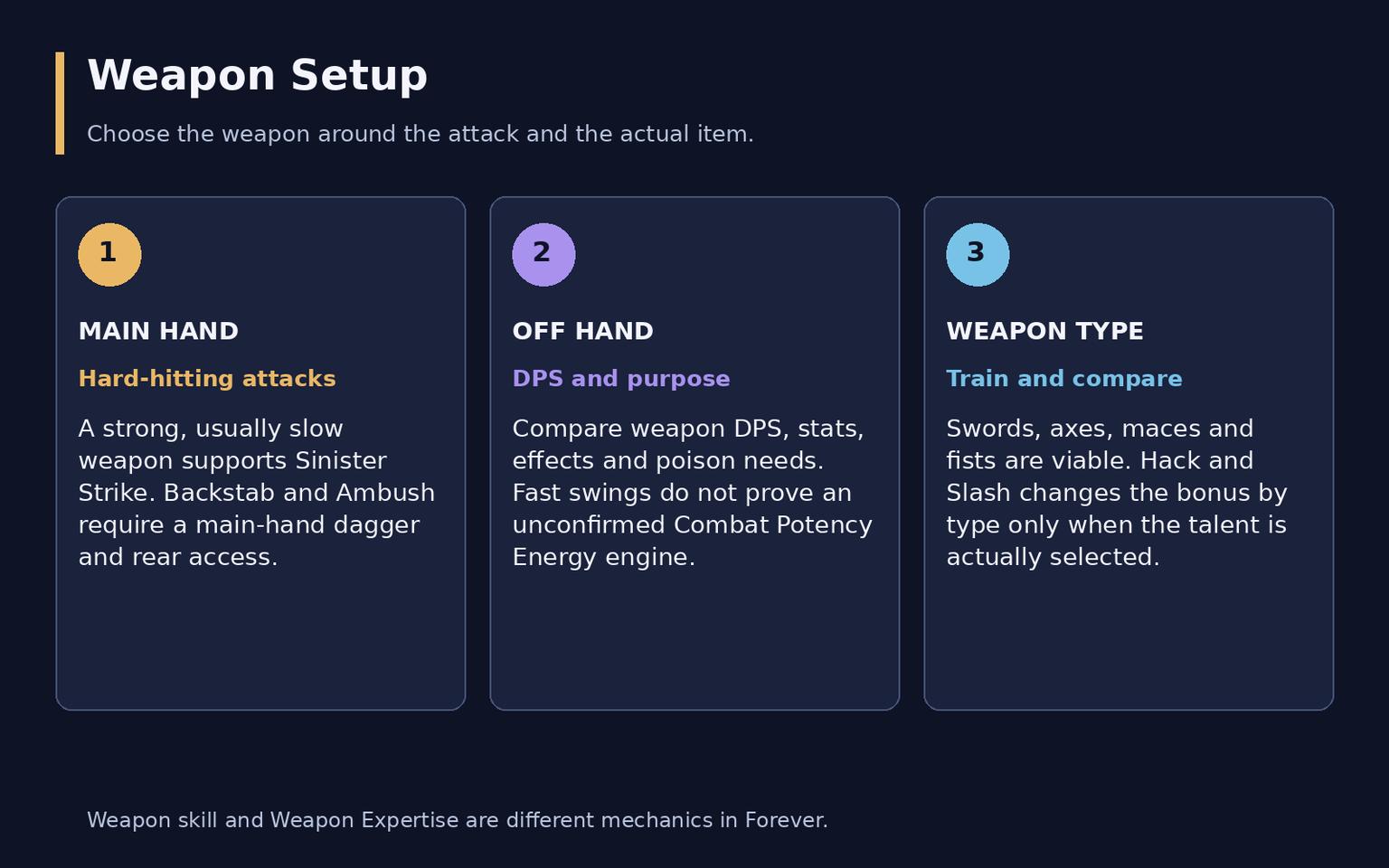
Main-hand damage, off-hand purpose and trained weapon type have different roles.
Practical stat priorities
Prioritize a suitable main-hand upgrade, then consider available Hit, Agility, Attack Power and Crit. Hit reduces failed attacks, while Agility offers offensive value and dodge. Attack Power also supports Forever's scaling poisons. The value of a particular item depends on its weapon damage, other stats and the enemies you face; there is no verified universal numerical weight table at this cap.
Haste does exist in Forever, including the updated Skyborne racial, but that does not establish a Retail-style rating priority. Do not copy old level-60 hit caps, weapon-skill racial thresholds, Mastery or Versatility gearing rules. In PvP, Stamina and staying in melee long enough to act can be more useful than a small theoretical damage gain.
Poison choices
Complete the level-20 poison unlock and use the ranks actually available to your character. Instant Poison on both weapons is a simple starting choice for short PvE encounters and leveling. Deadly Poison can reward a long-lived target that allows its damage to develop; compare it in that context instead of assuming it always wins.
For PvP or fleeing enemies, Crippling Poison helps maintain contact. An off-hand Crippling and main-hand Instant setup is a practical starting arrangement when you want both control and immediate damage, not a measured universal optimum. Mind-numbing Poison can replace a damage coating when a caster matchup justifies it. Wound Poison requires level 32, so it is outside the last beta's level-30 toolkit.
Check the actual enemy for poison immunity or resistance rather than copying an old raid-wide immunity list. Physical weapon damage still functions when poison damage is unavailable, subject to the enemy's own defenses. Maintain charges and duration according to the current rank's tooltip; do not assume all coatings share one timer. Forever allows poisons alongside temporary stones and Windfury effects, so an old exclusion rule is not a reason to leave the main hand uncoated.
Offensive cooldowns and defensive tools
Blade Flurry is the available offensive window in these builds. Pair it with existing Slice and Dice uptime and uninterrupted contact. When Adrenaline Rush becomes available in a deeper future build, its verified beta tooltip gives 100% increased Energy regeneration for 15 seconds on a five-minute cooldown. Spend some Energy before activating it and keep spending so the extra regeneration is not wasted at the cap. Aligning it with Blade Flurry can help a planned two-target window, but waiting excessively for perfect alignment may lose a use. This is future planning, not a level-30 button sequence.
Use Evasion to manage incoming melee attacks, Sprint to connect or escape, and Vanish for threat management, disengagement or another suitable Stealth opener. They are decisions based on danger and position, not automatic entries in a damage macro. Evasion does not prevent every kind of damage, and Vanish is not a guarantee against continued damage or detection. Endurance shortens Sprint and Evasion recovery; it does not reset them immediately.
Improved Sprint 2/2 in the PvP example guarantees removal of movement-impairing effects when Sprint is activated. Removal is not ongoing immunity to a new slow or root. The supplied builds have no Preparation reset. Preserve enough Energy for Kick or control when those actions prevent more damage than one extra builder would deal.
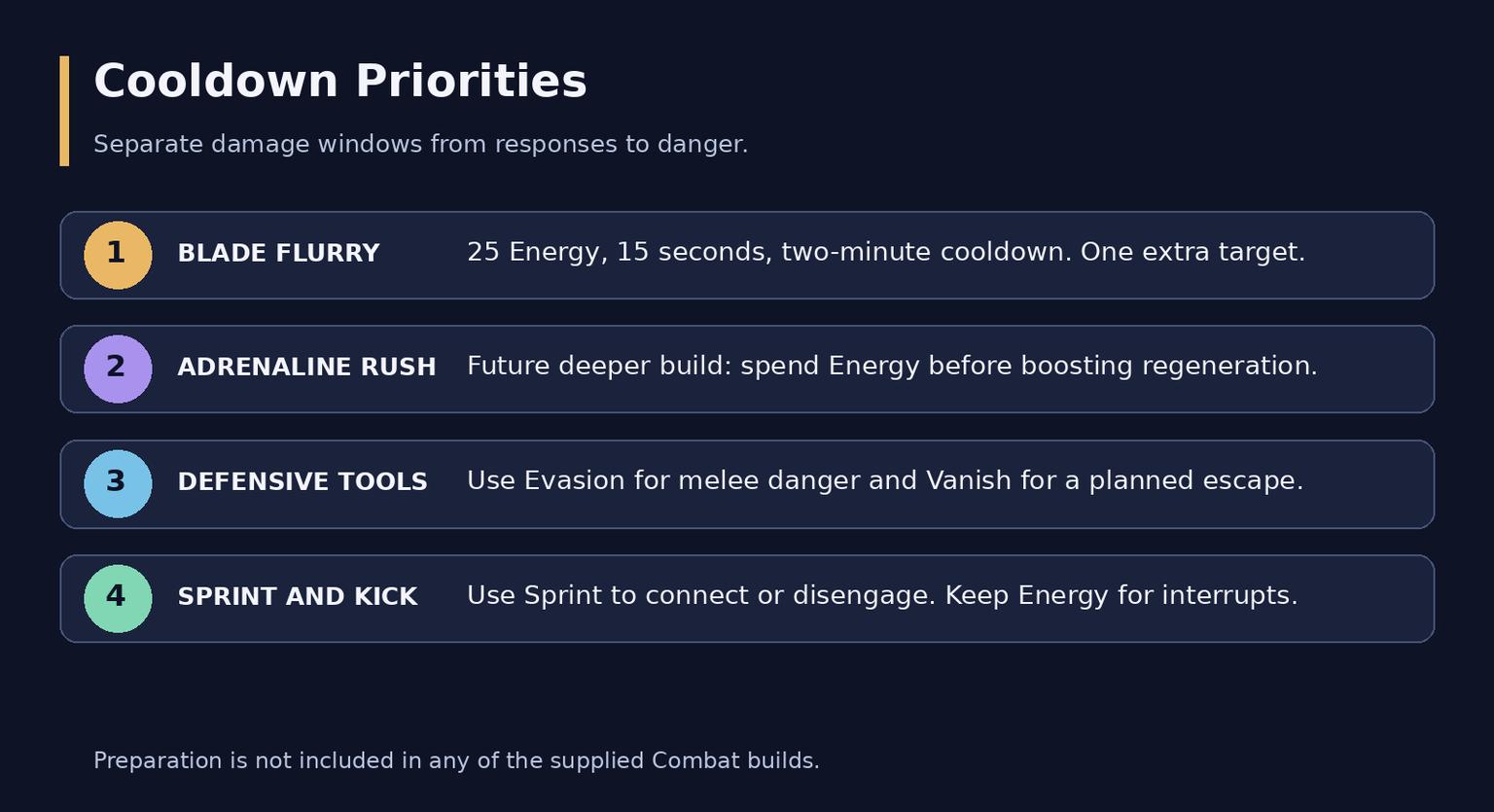
Offensive windows and defensive decisions should be planned separately.
PvP pressure and race choices
Combat favors contact and repeated weapon pressure. Sap can isolate an eligible out-of-combat humanoid while preserving Stealth. Cheap Shot starts a control window; Kidney Shot trades finisher damage for a stun. Riposte is useful after a parry against a disarmable opponent. Use Gouge only when your damage-over-time effects will not immediately break it. Blind requires level 34 and does not belong in the last-beta level-30 chain.
Racial advice must use the October changes. Human Ruthless grants 2% critical strike chance; Orc Savage grants 1%, and Blood Fury has a three-minute cooldown. Skyborne Wind Blessed grants 3% haste. Dwarf Earth Fury grants 2% increased critical damage and healing. These replace the relevant old weapon-specialization assumptions. Gnome Eureka! is now an eight-second buff without charges, so advice about only the next three attacks is outdated.
Choose around sustained damage, burst timing and useful defensive or control answers. Human crit and Orc offensive timing are reasonable damage considerations, but the closed beta does not establish one best race for every weapon and matchup. Follow the current racial tooltip rather than an old Classic or Retail ranking.
Frequently asked questions
How good is Combat Rogue in WoW Forever?
The last level-30 beta supported a direct weapon-damage playstyle with useful control and temporary two-target cleave. It is a practical leveling and dungeon option, but final launch and level-60 rankings remain unverified.
Which weapons should Combat Rogue use?
Use a strong, generally slow main hand for Sinister Strike and compare off-hand DPS, stats and poison needs. Daggers support a separate Backstab route. Hack and Slash broadens weapon support when actually selected, including the optional Legacy extension.
What is the basic PvE priority?
Build points with the appropriate attack, maintain useful Slice and Dice uptime and spend spare points on Eviscerate or a justified Rupture. Use Blade Flurry during reliable contact; Adrenaline Rush is outside the last beta's level-30 builds.
Which poisons are best to start with?
Instant Poison on both weapons is a simple short-fight PvE starting point. Consider Deadly for durable targets, Crippling for contact and Mind-numbing against casters. Wound Poison is unavailable at level 30, and enemy immunity can change the choice.