WoW Forever DPS Ranking: Level 30 Beta and Level 60 Projections
Enhancement Shaman leads the level-30 single-target reference checked on October 19, 2026, followed by Beast Mastery Hunter and Retribution Paladin. That is a useful starting point for comparing current beta builds. It is not a forecast that those three will lead every dungeon, raid or leveling route.
World of Warcraft: Forever is still being tuned. The playable beta cap is 30, while the separate level-60 simulation boards model a later character with different talents, equipment and assumptions. Their numbers belong in different comparisons. A single permanent S-to-D list would hide more than it explains.
This guide gives the complete twenty-specialization level-30 reference, explains the limits of the available level-60 projections, and shows how to choose a damage dealer for the activity you actually intend to play. DPS means damage per second; it describes the measured damage window rather than the character's entire contribution.
Level 30 DPS ranking
The table records ForeverDB's public reference on the review date. Each entry uses a recommended build and best-per-slot gear selected by that tool, a 60-second fight against one target of the character's level, and 1,000 simulated fights. These are model outputs, not an average of player logs or a promise for your current equipment.
Position | Specialization | Reference DPS |
1 | Enhancement Shaman | 113.6 |
2 | Beast Mastery Hunter | 105.3 |
3 | Retribution Paladin | 104.8 |
4 | Marksmanship Hunter | 99.5 |
5 | Demonology Warlock | 97.6 |
6 | Fire Mage | 97.2 |
7 | Fury Warrior | 96.9 |
8 | Survival Hunter | 94.4 |
9 | Affliction Warlock | 92.8 |
10 | Frost Mage | 92.5 |
11 | Destruction Warlock | 90.9 |
12 | Balance Druid | 90.2 |
13 | Shadow Priest | 87.5 |
14 | Arcane Mage | 84.2 |
15 | Elemental Shaman | 84.1 |
16 | Arms Warrior | 82.0 |
17 | Combat Rogue | 81.9 |
18 | Assassination Rogue | 78.8 |
19 | Subtlety Rogue | 78.3 |
20 | Feral Cat Druid | 66.4 |
The ordering applies only to this reference. The simulator also exposes level-40 estimates, explicitly labeled speculative; those are excluded here. Tanks and healers are outside this twenty-entry damage comparison.
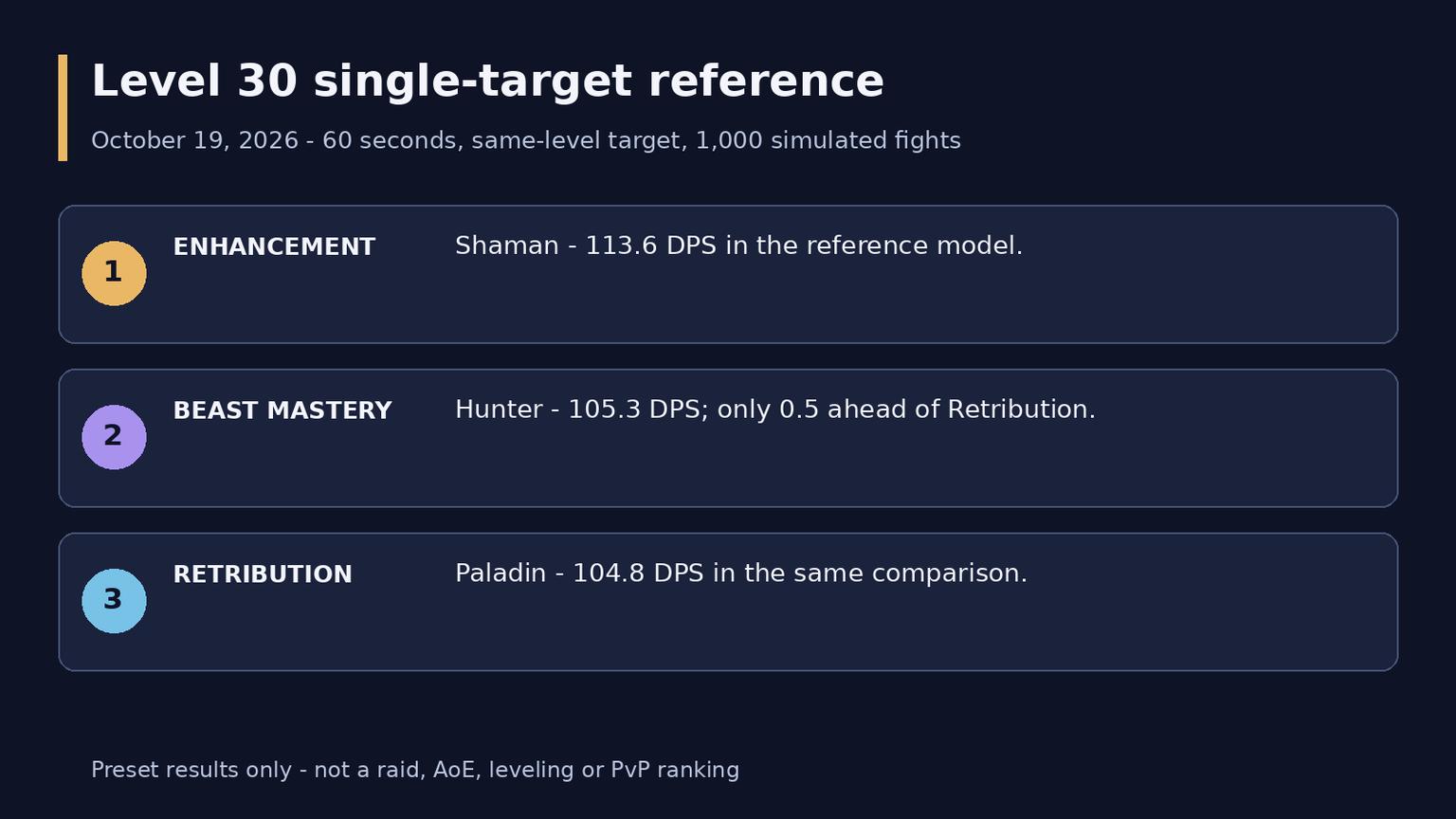
The first three entries in the level 30 reference
Read close results as close results
Beast Mastery and Retribution differ by just 0.5 DPS in the table, roughly half a percent of Retribution's result. Arcane and Elemental differ by 0.1 DPS. Those gaps are not evidence of a meaningful divide in an ordinary player's performance. Decimal precision in the display is not proof that the underlying model is equally precise.
The tool documents assumptions where server behavior cannot be read directly from the client. Some combat rules and base statistics are borrowed from Classic; racial abilities are not simulated. Changing gear, target armor, build or fight length can also change the result. Compare alternatives under matched settings before treating a position as a reason to replace a character.
Why the level 60 board tells a different story
MythicSim's separate level-60 board uses fixed reference builds and a two-minute single-target fight. At the checked snapshot, Survival Hunter leads its displayed board at 1,114 DPS with its reference trinket pair; the same entry reports 1,093 without trinkets. These are two configurations of one model, not two conflicting observations from raids.
There is an important execution condition: the Hunter reference alternates ranged attacks with trips into melee between Auto Shots. Beast Mastery and Marksmanship references also use this technique. Its effectiveness under real encounter movement is not yet established. A Survival player who stays in melee should not expect the ranged-and-melee preset's result automatically.
The board identifies its latest snapshot as October 19, but marks some entries as older snapshots. Its experimental hybrid builds are also listed beside conventional specializations. For that reason, this guide does not turn the mixed board into a new definitive twenty-spec league table. Verify each entry's engine revision, build and trinket setting before making a narrow comparison.
The practical conclusion is limited: a level-60 projection can identify a build worth testing. It cannot establish launch raid standings, and its DPS cannot be divided by the level-30 table to calculate how much a specialization will improve while leveling.
Single target, area damage and damage timing
A ranking has two separate dimensions: what is being hit and when the damage arrives. One target versus several targets is different from a short damage window versus an extended fight. A build can be strong in one combination without leading the others.
Question | Useful measurement | What it does not establish |
Boss damage | One target over a stated duration | Whole-dungeon performance |
Area damage | Target count, spacing and lifetime | Damage on one durable boss |
Burst damage | Damage inside a specified short window | A complete long fight |
Sustained damage | Output across repeated cycles and resource use | Every short priority-target window |
An overall 60-second average includes both the opening and later actions. It is not a dedicated burst test. Likewise, an area attack existing in a talent tree does not prove that its specialization wins a controlled multi-target comparison.
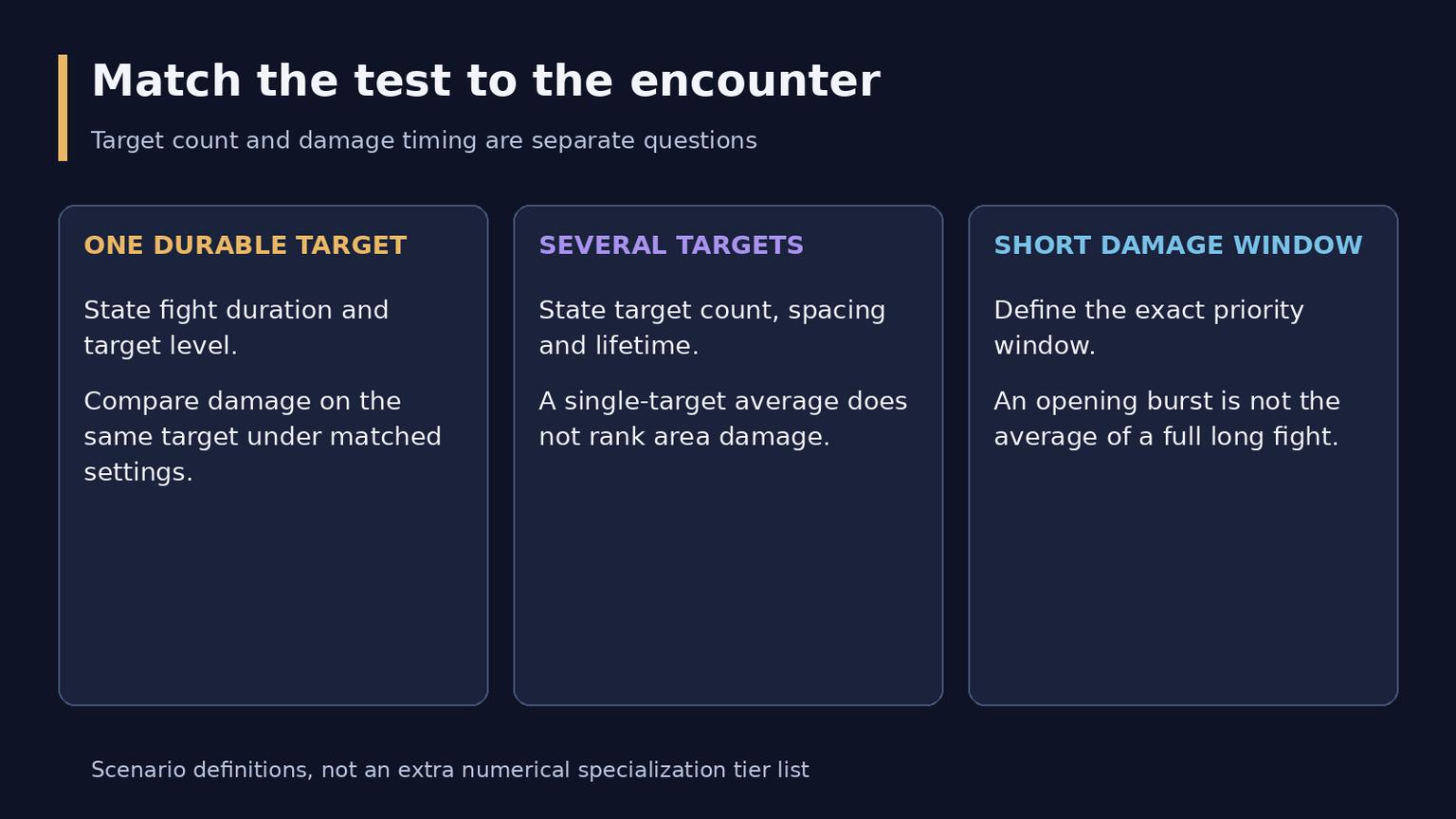
Three encounter scenarios that require different measurements
For a dungeon, ask how quickly the group removes dangerous enemies, whether an important cast is interrupted, and how much recovery is needed before the next pull. These are editorial criteria for judging a run, not extra damage points added to the numerical table. This review does not establish a measured AoE or dungeon-clear-speed ranking.
What the latest balance changes invalidate
The official development thread labeled October 15 contains changes that affect old damage comparisons. Arcane Mage's central spell was redesigned and a new talent added. Frost Mage's damage and control interactions changed. Paladin spell scaling was corrected, and Retribution's conversion from Intellect to spell damage was reduced.
Hunter Auto Shot now requires half a second standing still before firing. Pet scaling and trap interactions were corrected as well. Several support effects became raid-wide. These are concrete reasons to recheck a preset and its movement assumptions rather than carry an earlier ranking forward unchanged.
A change to one coefficient is not the same percentage change to the character's total DPS. New support coverage is not automatically an equal increase for every raid member either. A simulator update can move a result because its implementation or default equipment changed, even without a new Blizzard balance adjustment.
Comparing the damage styles
Hunters and pet management
Beast Mastery is the highest Hunter entry in the level-30 reference, with Marksmanship and Survival lower in that same test. The level-60 weaving example shows why a class name alone is insufficient: equipment, range changes and the chosen attack sequence are part of the result. For your own comparison, inspect pet inclusion and the rotation rather than assuming that all Hunter presets describe stationary ranged play.
Shamans and Paladins
Enhancement's first place and Retribution's third place are results for specific level-30 setups. They do not rank healing, tanking or overall group support. Elemental's separate position also means that choosing Shaman is not equivalent to choosing the leading damage preset. Start with the specialization and the job you want, then compare the appropriate configuration.
Mages
Fire, Frost and Arcane are separate entries, spread across this reference rather than sharing one automatic top tier. Recent redesigns make it especially important to check which talents and spell behavior the model implements. Choose control or spellcasting preferences separately from a claim about measured damage superiority.
Warriors and Rogues
Fury and Arms, along with all three Rogue damage trees, have distinct positions at level 30. A later weapon, a different target or a revised rotation is a new comparison. Classic-era reputation and a high-level projection do not replace the current test, while a lower beta position alone does not prove that a player is unsuitable for a group.
Warlocks, Priests and Druids
Demonology, Affliction and Destruction should not be collapsed into one Warlock score. Shadow Priest is a separate damage choice from Priest healing. Balance and Feral Cat differ sharply in this particular model, but the table does not measure either Druid's other roles. Investigate a large gap for missing interactions, build choices and encounter fit before interpreting it as a permanent class limitation.
Choosing for raids, dungeons and solo play
For a future raid character, use the level-60 reference as a hypothesis and keep its movement and equipment requirements visible. There is no verified live raid ranking established by the evidence used here. Test whether you can maintain the relevant actions while handling mechanics, and consider the actual roster's needs.
For beta dungeons, use the level-30 table to shortlist damage builds, then examine the entire run. Pull size, target lifetime, threat and recovery can change what feels effective. A single-target average is not a license to attack before the tank has control or to ignore priority enemies.
For solo leveling, damage during combat is only part of time spent. Travel, healing, Mana recovery, pet control and failed pulls matter too. A pet or reliable control may suit a particular player without proving the fastest route in a timed comparison. The table does not rank solo leveling or PvP.
Four checks before following a ranking
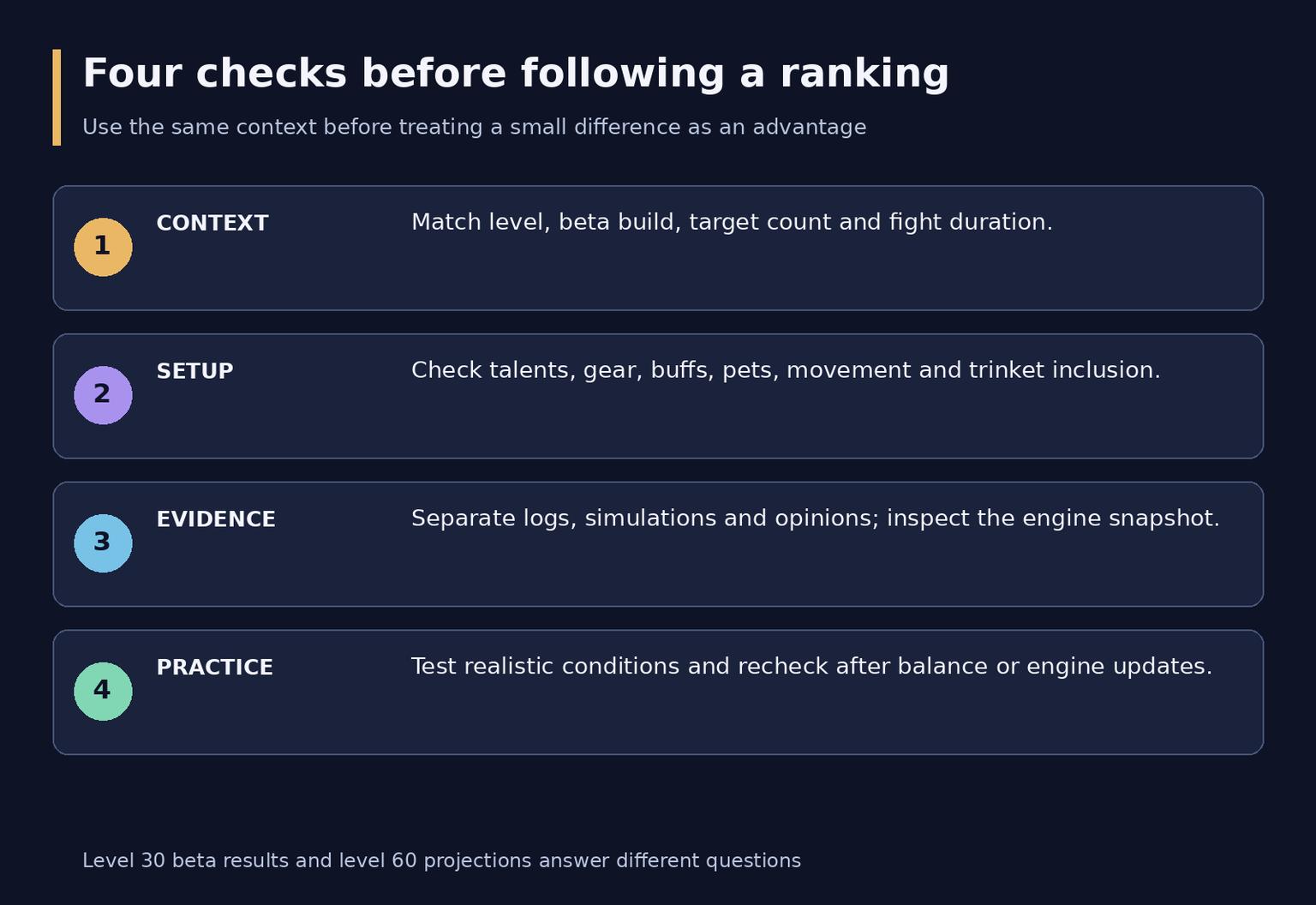
Four checks before acting on a DPS comparison
1. Match the context. Check character level, beta build, target count and fight length. A level-30 result and a level-60 projection answer different questions.
2. Match the setup. Read talents, gear, race handling, buffs, consumables and trinket inclusion. Confirm whether pets, movement and range changes are modeled.
3. Check the evidence. Separate player logs from simulations and editorial impressions. For simulations, inspect the engine snapshot and known limitations; for logs, inspect encounter and sample selection.
4. Test the practical choice. Compare a small shortlist using realistic conditions. Recheck after balance or engine updates, especially when the apparent advantage is small.
Frequently asked questions
What is the best DPS specialization in the current beta reference?
Enhancement Shaman leads the checked level-30, 60-second single-target model at 113.6 DPS. That answer is specific to its settings and review date, not every activity in Forever.
Does Survival Hunter already lead confirmed raid logs?
No such conclusion is established here. The quoted level-60 lead comes from a simulation preset with ranged-and-melee weaving, not verified live raid results.
Which specialization is best for AoE?
The evidence reviewed does not support a comparable numerical AoE ranking. Use a test with explicit target count and lifetime rather than repurposing the single-target table.
Should I switch because another specialization is slightly ahead?
First compare matched settings and consider whether you can reproduce the setup. A small model advantage can be less useful than an attack sequence you execute reliably and a role that fits your group.