How to Earn Gold in WoW Forever: From First Coins to Trading
A new character is better served by accessible quests, ordinary loot and materials gathered along the way than by spending the last few coins on speculation. The first goal is to fund training, repairs and travel while keeping a reserve. Expand trading and production after actual sales rather than after seeing one expensive listing.
Checked October 19, 2026. The current beta caps characters at level 30. Later materials, advanced profession ranks and level 60 demand are discussed as planning, not a tested income route for a current character. Beta prices, inventories and rewards may change.
This guide promises no fixed gold per hour. Results depend on your accessible market, competition, class, route and luck. Compare your own sessions over similar periods, including travel, selling and consumable costs. Unsold inventory is not gold already earned.
First steps without trading capital
Establish a short working loop
Collect nearby quests, clear bag space and learn a suitable gathering profession when training becomes available. Mining, Herbalism and Skinning supply saleable materials, but require skill and ordinary preparation. Check the tools with your trainer. Having no trading capital does not mean every action is free.
Move between several nearby objectives and gather accessible resources without long detours. A miner can inspect rocky slopes; a skinner can favor quests involving suitable beasts. Do not enter a dangerous cave for one deposit if a likely death would erase the trip's gains.
On returning, turn in quests, vendor unwanted ordinary loot and check materials and tradeable items separately on the Auction House. Avoid storing everything indefinitely: free bag space also supports income. Equally, do not automatically vendor a useful reagent merely because it is low level.
Separate operating money
Keep enough coins for the next necessary expenses. A modest bag or useful skill may repay its convenience during subsequent play; an impulsive gear purchase can immobilize the whole reserve. Evaluate a purchase by the actual delay it removes.
Keep the first selling batch small. If the materials sell, repeat the convenient loop and check that demand persists. If buyers are absent, do not automatically gather ten times as much.
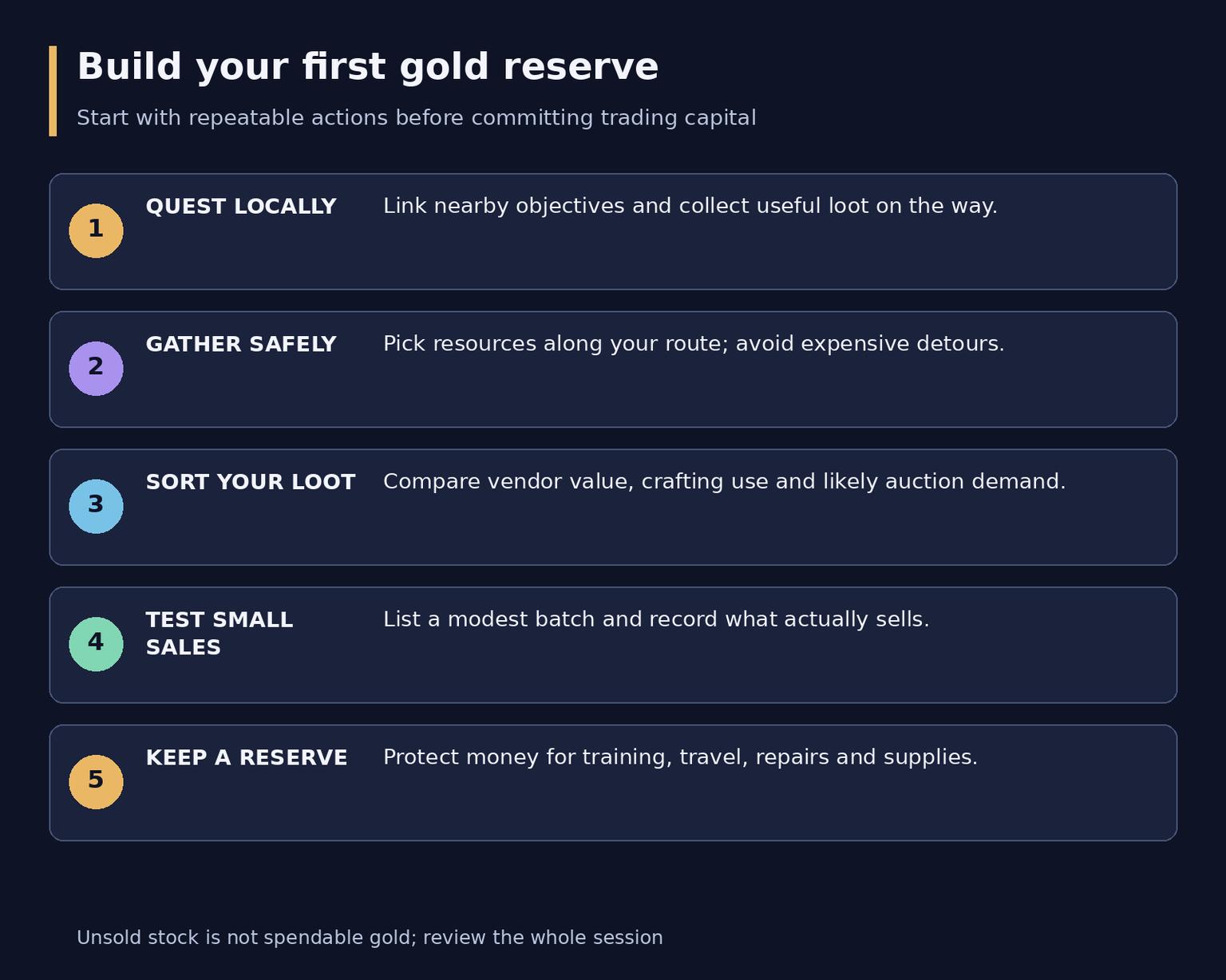
An opening sequence for building a gold reserve
Gathering: sell what fits your route
Match the profession to where you play. Mining suits routes past deposits, Herbalism suits accessible plants, and Skinning fits suitable beast kills. Your two primary professions need not be a gathering-and-crafting pair: early on, gathering and selling the raw output is a reasonable choice.
Before a dedicated circuit, choose a main material and a fallback. Check that your skill can collect it and that persistent competition is not occupying the route. Include recovery after fights and travel to sell. A theoretical circuit with many nodes is unhelpful when most are unavailable.
For ore, compare the raw material price with the result of smelting. A bar is not automatically worth producing: reagent quantities, additional components and completed sales matter. Apply the same reasoning to leather and crafted intermediates. A buyer may prefer the unprocessed input for a different purpose.
Treat a rare extra material as a welcome variation rather than the foundation of the budget. Do not judge an ordinary circuit by one lucky drop. If a rare item has a high listing price, investigate buyers and whether an NPC offers another supply source.
Compare entry costs and risks
Method | What you need first | Main risk |
Quests and ordinary vendor loot | Suitable objectives and bag space | Travel, repairs and inefficient detours |
Gathering and material sales | Profession, skill and an accessible route | Competition and falling prices |
Crafting for sale | A learned tradeable output and a cost calculation | Expensive inputs, binding and weak demand |
Fishing and Cooking | Skill, suitable water and the required recipe | Low raw-catch or finished-food prices |
Auction resale | Spare capital and market observation | Falling prices and money tied up in stock |
Rare items and recipes | An accessible source and time for attempts | Random drops and infrequent buyers |
These are decision guides rather than an income ranking. A beginner benefits from small irreversible costs and an understandable exit. Crafting and resale need more judgment: a high price tag is insufficient without a completed sale after expenses.
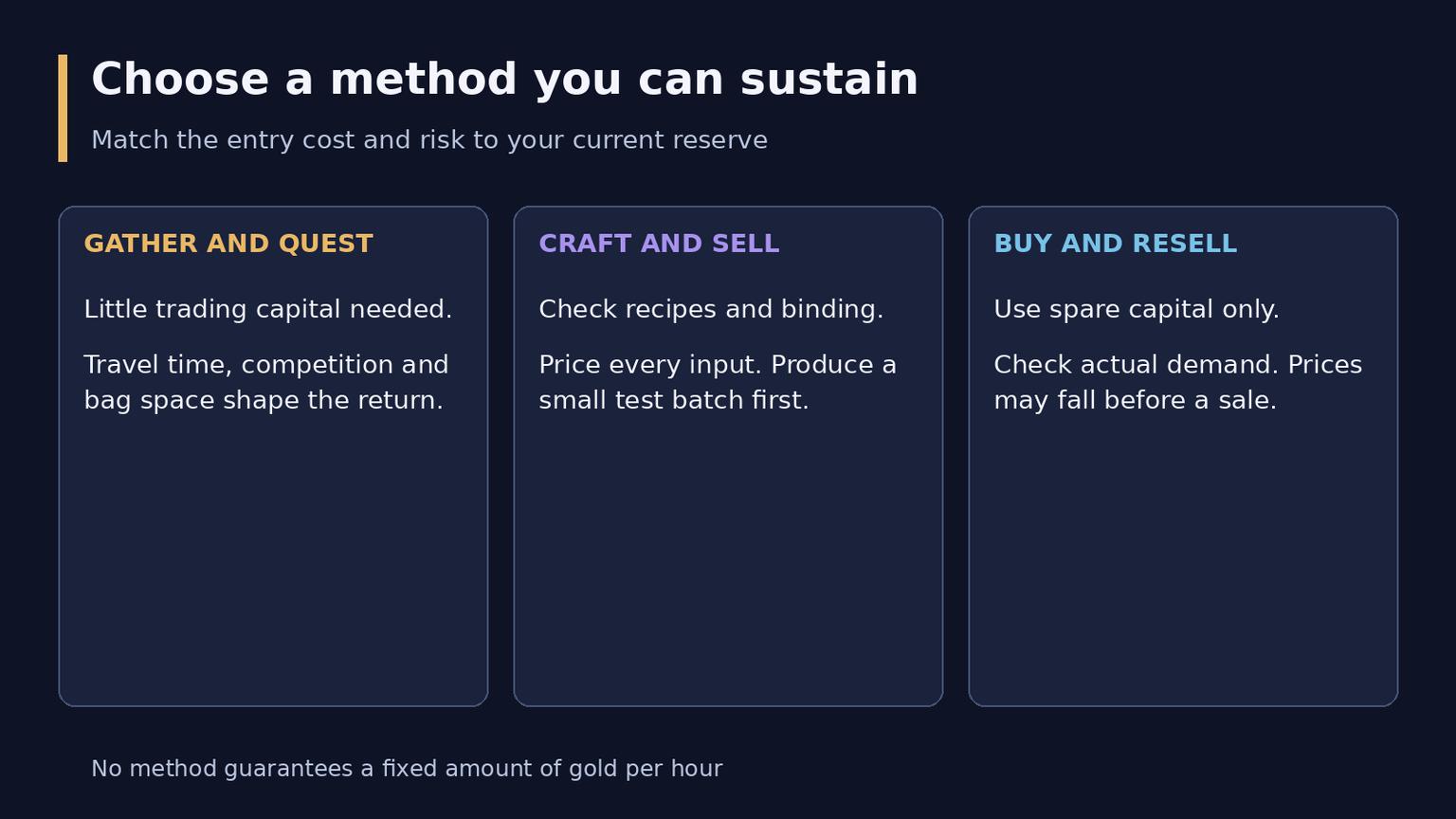
How gathering, production and trading differ
Waylaid Crates: currency is not profit
Waylaid Crates are filled with eligible materials and turned in for Merchant's Favor. The currency buys rewards from profession camps, including recipes. It is a separate resource rather than gold you can immediately record as sales profit.
Read the options on the individual crate first. If it accepts one of several bundles, compare the complete cost of each eligible bundle instead of adding all alternatives together. Self-gathered inputs also have value: you could have sold them to someone else.
If your goal is a recipe, choose the reward and calculate the cost of the missing currency. If you need coins now, compare selling materials and an eligible tradeable crate with filling costs and the displayed turn-in reward. Decide before sealing: the sealed crate binds to the character.
Azeroth Commerce Authority has its camp at Three Corners in Redridge Mountains; Durotar Supply and Logistics is near the Crossroads in the Barrens. Combine the visit with other errands. Before buying reagents, check the recipe's current skill, reputation and character requirements. Seeing an item in a vendor inventory does not mean you can learn it immediately.
Merchant's Favor is earned separately by each character in beta. Do not confuse it with account-wide Legacy Points. When several characters develop professions, decide who actually needs the recipe rather than paying for duplicate unlocks without a practical purpose.
Crafting: verify the item and the customer first
A crafting profession generates sales only when its output can be traded and someone wants it. Some new items intended for the crafter bind on pickup. An attractive recipe and strong stats therefore do not automatically create Auction House stock.
Begin with one familiar product. Add material costs at an available purchase price, extra components, travel and trading expenses. Compare expected proceeds with selling the inputs directly. Track learning and skill development separately: a first profitable sale may not yet have recovered the profession investment.
Alchemy offers consumables that players can buy repeatedly. This is potential demand rather than a promise of a permanent markup. Test bags, crafting components and other tradeable products in small batches too. Do not produce dozens merely because a similar item is listed high today.
For a service using a customer's materials, agree on the item, recipe availability and payment in advance. Do not count somebody else's reagent value as your own earnings. Without a buyer, the service earns nothing regardless of profession skill.
Respect recipe restrictions
Individual transmutes and other recipes may have their own cooldowns. Read the current tooltip, skill requirement and crafting conditions. A material conversion is not free daily income: it requires inputs, recipe access and someone willing to buy the output.
Increase volume gradually until demand is demonstrated. One sold batch justifies another test, not buying the entire market. When prices fall, stop and recalculate whether finishing production or selling remaining inputs is the better choice.
Fishing and Cooking: compare two products
Fishing and Cooking are secondary professions and do not replace your two primary slots. Fish supply food and some alchemical materials. Choose water for the desired catch and your skill rather than only its distance from a capital.
Compare raw fish with the finished product after every ingredient and expense. The need for food does not make every recipe profitable. When many cooks compete, raw ingredients may sell more readily than prepared food.
Fishing fits short, quiet sessions, but that time is not automatically free. It remains play time you could spend elsewhere. If the catch does not sell, change the target product or keep it for personal use instead of endlessly expanding inventory.
Auctions: check unit price and completed sales
Compare identical items and unit quantities rather than listing totals alone. Examine supply volume, the price spread and item requirements. One unusually low or high offer does not establish a normal market value.
Observe a chosen product at several different times, then list a trial batch. Record what actually sold, at what price and after which expenses. An asking price and realized proceeds are different numbers.
Use this calculation: net profit equals gold received after the sale minus acquired material or item costs minus other irreversible expenses. For self-gathered inputs, separately compare production with the gold a direct material sale could have earned. Do not subtract the same commission twice if your received amount already excludes it.
A teaching example, not a market quote: a product sells for 100 silver, its purchase costs 80, and all irreversible expenses total 5. The result is 15 silver. An unsold product has not earned those 15 silver. If part of a batch remains, do not book it as realized profit at the price you hope to receive.
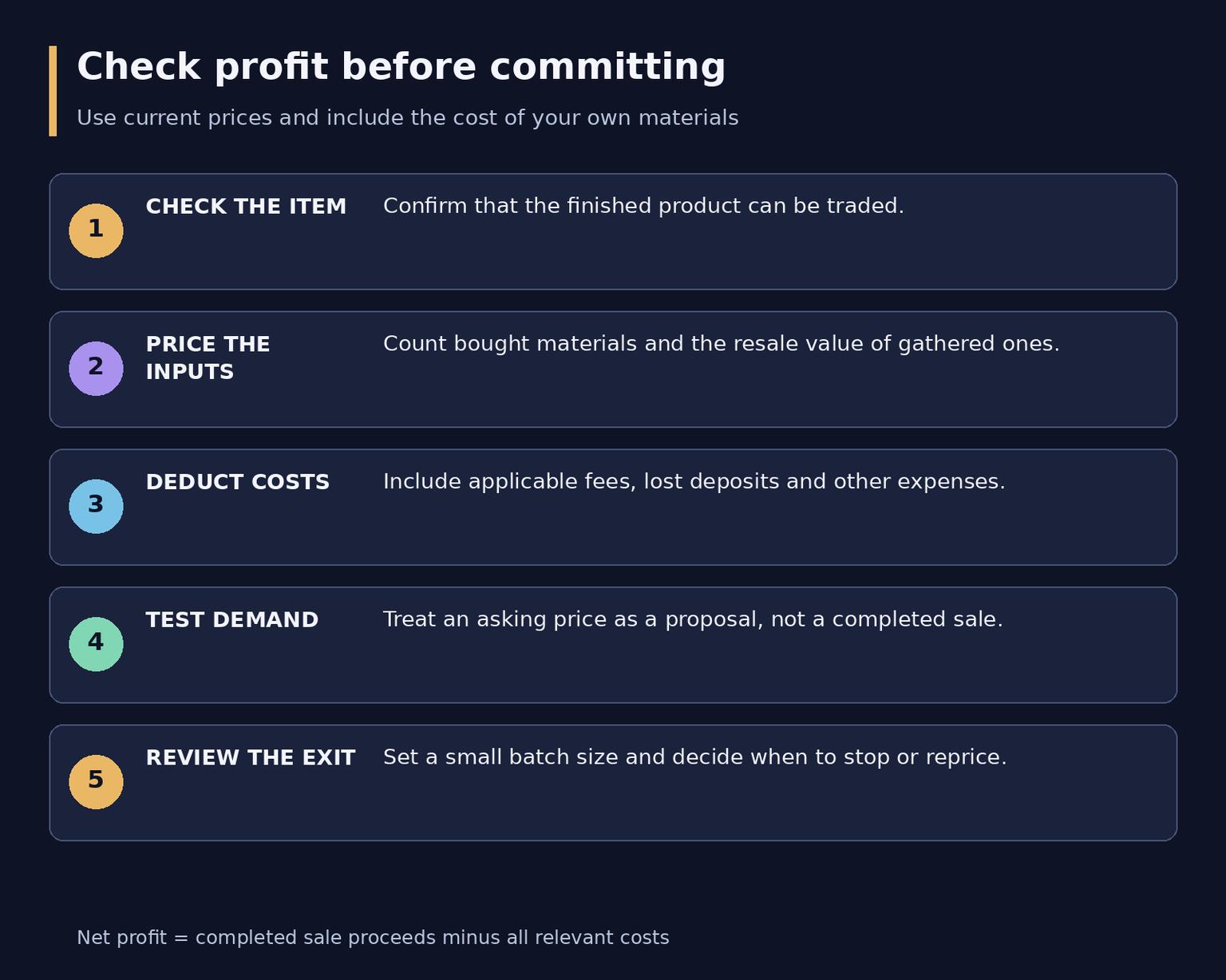
Checks to complete before committing gold
Resale and moving between markets
Begin with an item you already know how to sell. Buy a small quantity with a meaningful buffer after expenses. Do not spend your reserve trying to buy out the entire supply: new sellers may quickly return below your purchase price.
Do not transfer prices from another region, ruleset or accessible market. Forever does not use the ordinary choice of isolated realms, so controlling a tiny server market should not be the foundation of the plan. Verify actual auction access and transaction conditions where your character plays.
A faction price difference is not profit by itself. You need a permitted transfer route, binding checks, expense estimates and allowance for a failed sale. That is more complex than selling your own materials and should not be compulsory in a beginner's opening plan.
Vendors, creature drops and dungeons
Vendoring unwanted ordinary loot avoids waiting for a buyer. Combat, recovery and travel still cost time. Before selling tradeable equipment, compare a realistic auction outcome. With an appropriate profession, you can also evaluate disenchanting, but random material yields do not guarantee the better result.
Recheck every buy-materials, craft-and-vendor scheme after updates. October beta changes reduced the vendor sell prices of many crafted items. Profit shown in an old video or tooltip does not prove that today's batch works.
For repeated creature kills, choose manageable enemies with useful ordinary drops. Long recovery periods, deaths and waiting for spawns reduce the result. A rare recipe should not be the sole reason to call the route profitable.
In dungeons, include group formation, run time, repairs and loot rules. An upgrade another player needs is not guaranteed personal gold. Do not choose a difficult solo run solely because another class or gear setup handles it. Check your own safety and the current repeat-entry restrictions first.
Later progression, Legacy and when to switch
At level 60, possible markets to investigate include consumables, high-level materials and tradeable recipes. These are future demand categories rather than measured routes in the playable beta. Avoid large advance purchases based only on the belief that everything will become more expensive after launch.
Legacy Points are account-wide, while perk choices are made separately for each character. Bountiful Harvest supports Scarce materials; Master Chef and Luremaster relate to additional food and fish output. Perks improve an activity without creating a customer or equal profit for every character.
Bartering lowers the purchase price of vendor items. Following the October 15 fix, do not budget it as a training or repair discount. Dedicated Study has an announced daily cooldown, but that is not a daily gold payment. Check an individual perk's conditions before building a production schedule around it.
Do not assume a seasonal activity, reputation task or repeatable exchange pays unlimited coins. Confirm its actual reward, reset and eligibility. This guide sets no single earnings cap for every method; restrictions belong to the particular action, recipe or system.
Switch when a route consistently underperforms a clear alternative after expenses, its output stops selling or the risk exceeds your reserve. Increase volume gradually when demand grows. Finish a session with three records: gold actually received, gold spent and stock still unsold. This is more useful than a dramatic gold-per-hour promise.