WoW Forever Fire Mage Guide
Checked October 24, 2026. World of Warcraft: Forever is between beta and launch. The beta ended October 23 at 10 AM PDT; release is scheduled for November 4. There is no playable live season today. The last beta cap was 30, and the latest extracted client is 1.60.1.70532 in patch family 1.60.1. Extracted tables do not establish every server-side hotfix.
The practical build below uses the last level-30 toolkit. Level 60 performance remains prospective. October 15 changes supersede earlier guides, particularly Wake of Fire advice and descriptions of Heating Up that still require consecutive critical strikes.
How Fire plays in Forever
Fire is a ranged Mana caster that combines direct spell damage, periodic damage and critical-strike interactions. Fireball supplies sustained casts; Scorch can build a personal Fire vulnerability; Fire Blast supplies immediate damage and Heating Up stacks; Pyroblast becomes a shorter cast after enough stacks. Ignite adds damage from qualifying Fire criticals.
The appeal is a clear payoff from critical hits and a choice between focused casting and dangerous close-range area damage. Low critical chance makes the early experience uneven. Long casts, pushback, threat, Fire resistance and Mana pressure still matter. A few impressive critical hits do not prove a final best-specialization ranking.
Arcane has different amplification and resource interactions, while Frost invests more heavily in control and defensive tools. A Fire build can still use baseline Frost or Arcane utility. It does not automatically receive those trees' talents or turn into a tested level-60 Frostfire hybrid.
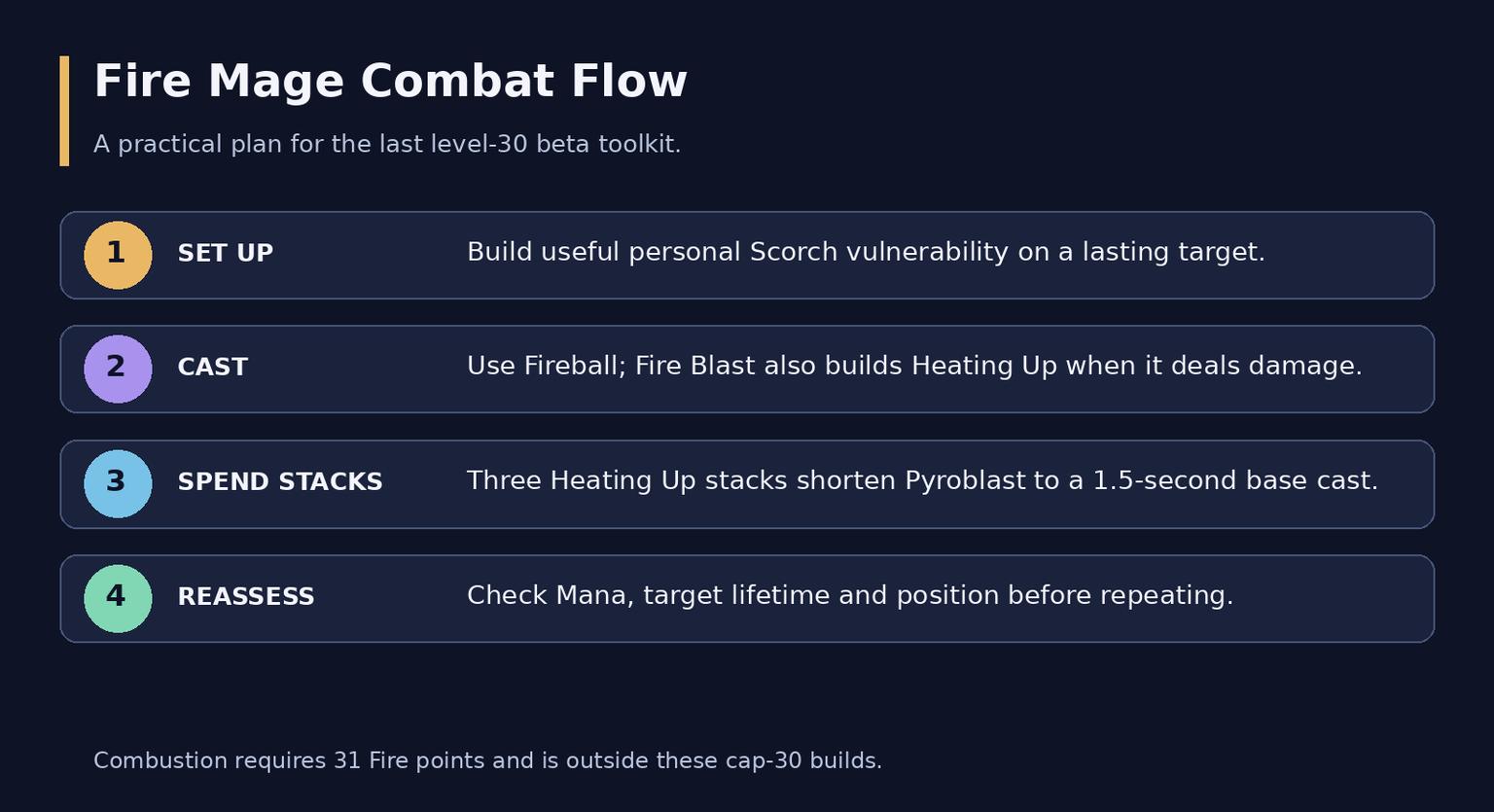
The level-30 loop uses personal setup, Heating Up and a safe shortened Pyroblast.
The changes to learn first
Heating Up requires Pyroblast and is available in the early Fire tree. Non-periodic criticals from Fireball, Scorch, Fire Blast and future Frostfire Bolt grant a stack. Each stack reduces your next Pyroblast's cast time by 25%, up to three stacks within the 20-second buff window. Three stacks reduce its six-second base cast to 1.5 seconds. This is a shorter cast, not an instant or automatically free Pyroblast.
The October update also makes a damaging Fire Blast grant an additional stack: a non-critical hit gives one, a critical hit gives two. Watch the actual stacks before spending another instant spell at the maximum. Pyroblast is not listed among the stack-generating critical spells. Do not import a Retail chain of guaranteed critical Fire Blasts into this system.
Wake of Fire has reverted to Improved Fire Blast. At 2/2 it reduces Fire Blast's cooldown by two seconds and adds 15 yards of range; the old kill-triggered critical bonus is gone. Incineration supports the critical chance of specified spells, including Scorch and Fire Blast, rather than every Fire spell. Improved Fireball also affects future Frostfire Bolt cast time.
Critical Mass now has five ranks for up to 10% Fire critical chance. Fire Power has three ranks and increases damage according to your own qualifying Fire effects, up to 12% at full investment. Both require sufficient points; neither is silently included in the ordinary build below. Living Bomb and Dragon's Breath are not part of the reviewed Forever toolkit recommended here.
A level-30 single-target build
An ordinary level-30 character has 21 class talent points. This editorial 0/19/2 example keeps the shortened-Pyroblast loop and invests in Fire/Frost hit chance. It is a legal practical setup, not a claim that every published guide uses the same allocation. Unlisted talents receive zero points.
Talent | Points | Purpose |
Improved Fireball | 5/5 | Faster sustained Fireball casts |
Improved Fire Blast | 2/2 | Shorter cooldown and useful extra range |
Ignite | 5/5 | Personal damage from Fire criticals |
Pyroblast | 1/1 | The heavy cast required for Heating Up |
Burning Soul | 2/3 | Some pushback protection and Fire threat reduction |
Heating Up | 1/1 | Shortens the next Pyroblast through stacks |
Improved Scorch | 3/3 | Reliable personal Fire vulnerability on landed Scorches |
Elemental Precision | 2/3 | 4% increased chance to hit with Fire and Frost spells |
Spend the first ten Fire points in Improved Fireball and Ignite. Add Pyroblast, Improved Fire Blast 2 and Burning Soul 2 to reach 15, then Heating Up and Improved Scorch 3 for 19 Fire points. Put two points in first-row Frost Elemental Precision. This completes the Pyroblast prerequisite and respects the row gates.
AoE, PvP and Legacy variants
For a dungeon AoE variant, remove the two Elemental Precision points and add Burning Soul's third point plus Blast Wave 1/1. The result is 0/21/0: stronger close-range utility and full Burning Soul, at the cost of the listed hit investment. Take Blast Wave only after reaching 20 Fire points. No ability to withstand unlimited incoming attacks follows from the extra point.
For a situational PvP variant of that 0/21/0, replace Improved Scorch 3 with Impact 3/3. You keep Heating Up, Pyroblast and Blast Wave, but lose the personal Scorch vulnerability. Impact adds a chance to stun; it is not guaranteed control on demand. This is an editorial tradeoff for shorter pressure windows, not a proven best build for every opponent.
With all five relevant Talented ranks unlocked through Legacy, level 30 can offer 26 class points. One extension of the single-target build adds Flame Throwing 1/2 to reach 20 Fire points, then Critical Mass 4/5: 0/24/2. It gains four ranks, not the full five. Additional points are conditional account progression, not an automatic new-character grant.
Combustion still requires the 31-point Fire capstone, so neither 21 nor 26 points reaches it. Future level-60 deep-Fire and Frostfire builds must be judged separately. Frostfire Bolt is trained at 40; Dual Specialization is also announced for 40. No complete future build is presented as tested live meta.
Practical single-target priority
Before pulling, train the available ranks, apply Arcane Intellect and an appropriate learned Armor, prepare a Mana gem and choose a position with an escape route. Let the tank establish threat in a group. A long Pyroblast opener is an option when you have time before contact; it is not mandatory on every short-lived enemy.
Situation | Priority | Practical decision |
Durable target with Improved Scorch selected | Build your own vulnerability | Five stacks give up to 15% personal Fire damage; maintain useful coverage |
Safe sustained casting | Fireball | Use it as the main filler without expecting every cast to crit |
Fire Blast is useful | Damage and Heating Up generation | It can help movement or reach the next useful Pyroblast window |
Three Heating Up stacks and time to finish | Pyroblast | Spend the shortened cast before the buff or target is lost |
Movement or imminent target death | Useful instant damage or repositioning | Do not begin a cast that cannot finish in time |
Low Mana or a nearly dead target | Conserve or use the wand | Avoid paying for excess damage that cannot help the next pull |
Improved Scorch is personal: another Mage's stacks do not maintain yours. Its vulnerability lasts 30 seconds and stacks five times at 3% each. Refresh a useful stack before expiry during a long fight, but do not spend five setup casts on an enemy that is almost dead. The PvP variant without this talent does not follow that maintenance instruction.
Scorch is a short cast, not an automatic cast-while-moving spell. Fire Blast remains an instant with a cooldown, not a charge-based guaranteed crit button. Heating Up does not remove Pyroblast's need for a stationary casting window. Reserve Blink or control for a real positional problem instead of canceling valuable casts through unnecessary movement.
When switching targets, rebuild personal vulnerability only if the new enemy will live long enough. Existing periodic damage can keep working on the old target, but no automatic Ignite spreading is assumed. There is no verified special execute threshold in this level-30 setup.
Ignite: personal damage rather than a shared raid roll
At 5/5, Ignite makes qualifying Fire critical strikes cause additional damage equal to 40% of the spell's damage over four seconds. At lower talent ranks the percentage is lower. This is a fraction of the critical spell event, not an independent reason to add Spell Power a second time in a homemade damage formula.
Blizzard explicitly changed Ignite to a unique debuff per Mage, addressing damage and threat attribution. Two Mages do not contribute to one shared Ignite that a designated owner keeps alive for the raid. Blizzard also states that closely timed critical hits should no longer lose damage in the old way. Those confirmations are stronger than carrying over historical Classic ownership assumptions.
The reviewed official text does not publish every server-side detail of the remaining-damage pool, refresh timing, tick scheduling or overwrite rules. Do not turn a simulator's chosen implementation into a confirmed live formula. There is no verified instruction here to stop casting until a tick, clip a weaker Ignite with a stronger one, or maintain a five-Mage rolling stack. Continue useful casts and track your own effect; its actual remaining damage cannot be inferred from another Mage's debuff.
Heating Up and Ignite are separate consequences of critical hits. Ignite is not a button you press and its ticks are not listed Heating Up generators. More crit can improve interaction frequency, but buying crit does not guarantee a smooth sequence on every pull.
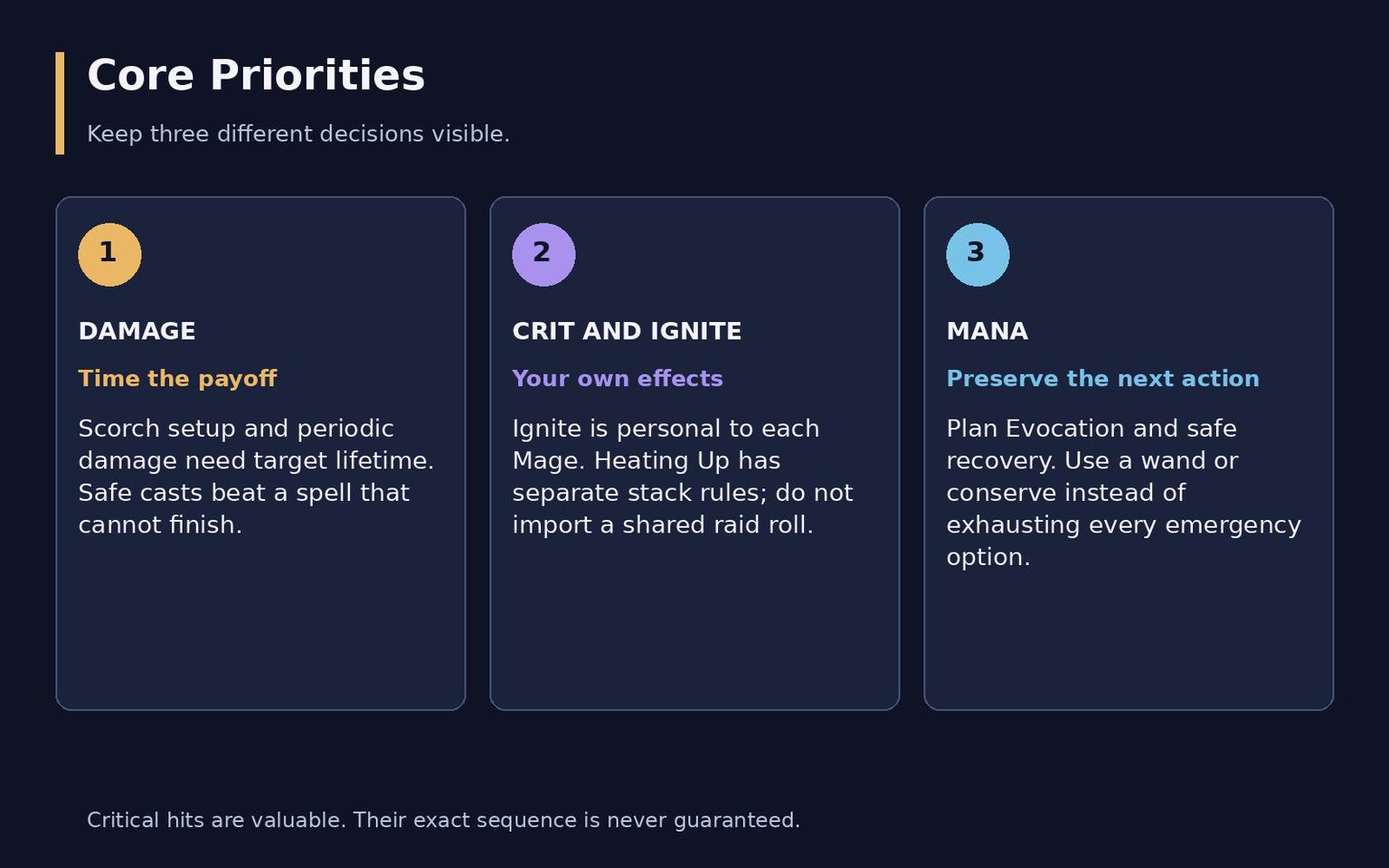
Separate target lifetime, personal critical effects and Mana planning.
Combustion: a future deep-Fire tool
The Forever tooltip describes an instant ability on a three-minute cooldown. After activation, Fire damage spell hits increase Fire critical chance by 10%; the effect ends after three non-periodic Fire critical strikes. It is not a fixed Retail-style window of guaranteed critical hits. The reviewed tooltip does not set a fixed ten-second combat duration, and Ignite ticks do not count as the three non-periodic criticals.
For a future build that actually selects it, a sensible use is a sustained, safe Fire casting window with enough Mana and a target that will remain attackable. Do not activate immediately before immunity, forced movement or a control interruption. PvP additionally requires a chance to finish casts; immunity and line of sight can waste the opportunity. This timing advice is conditional planning, not a tested level-30 rotation or a mandatory snapshot of a large Ignite.
Area damage without importing modern Fire
Use Flamestrike when enemies will remain in its ground area, then consider Arcane Explosion after the tank has stable threat. Blast Wave adds a close-range burst and movement-slowing utility only in builds that select it. Its range requirement is a reason to check danger, not a reason to stand inside every pack.
Arcane Explosion deals Arcane damage; Fire talents do not automatically amplify its whole package. Blizzard is a separate channel, and a Fire build does not gain Improved Blizzard's slow without the talent. Frost Nova, Cone of Cold and the current Frost Blast can help create space, but damage may undermine breakable control.
Large pulls consume Mana and create threat quickly. Plan the available resource pool before adding another Flamestrike or running into close range. Ground effects lose value when the tank moves enemies away. No confirmed shared numerical cap for all these spells is supplied by the reviewed sources, so do not describe this as an unlimited safe-farming method or invent a modern target cap. Critical procs also do not justify assuming every periodic tick generates Heating Up.
Mana, recovery and learned buffs
Evocation is learned at 20. Its base cooldown is eight minutes and it channels for eight seconds, enabling and greatly increasing Mana regeneration. Plan a safe channel before you are completely helpless; movement, attacks and incoming mechanics can reduce the useful recovery. It is not automatically the fixed-percentage refill of another version.
Conjure and use the available Mana gem, carry appropriate Mana potions and drink between safe pulls. Check the actual item and cooldown rather than assuming potion/rune stacking, a free-health rune loop or a level-60 consumable is available at 30. Wands provide a practical finish or conservation tool; the October update requires 0.5 seconds standing still before shooting.
Downranking is not a free substitute for proper resource planning. Blizzard explicitly reduces proc chances for significantly lower-rank spells in relevant effects. The new Frost Blast, trained at 24, supplies a short slowing cast instead of importing an old rank-one Frostbolt trick as a universal solution. Use current trained spells and choose low ranks only for a demonstrated purpose.
Arcane Intellect helps your Mana pool. Frost Armor and later Ice Armor suit physical pressure. Mage Armor is learned at 34, so its improved 50% regeneration-while-casting benefit is future for this guide's cap, not the answer to current Mana problems. Only one Armor is used at a time. No Molten Armor or borrowed Fire self-buff is assumed.
Mana Shield trades Mana for protection and can leave you unable to cast if used carelessly. Fire Ward and Frost Ward answer appropriate damage schools. Counterspell is learned at 24; Blink and Polymorph are utility, not damage-rotation filler. Ice Block requires Frost investment and Presence of Mind requires Arcane investment; neither is in the supplied Fire builds. A future hybrid with Presence of Mind follows the October exception that it does not consume Heating Up for that instant Pyroblast, but the exception does not grant either talent now.
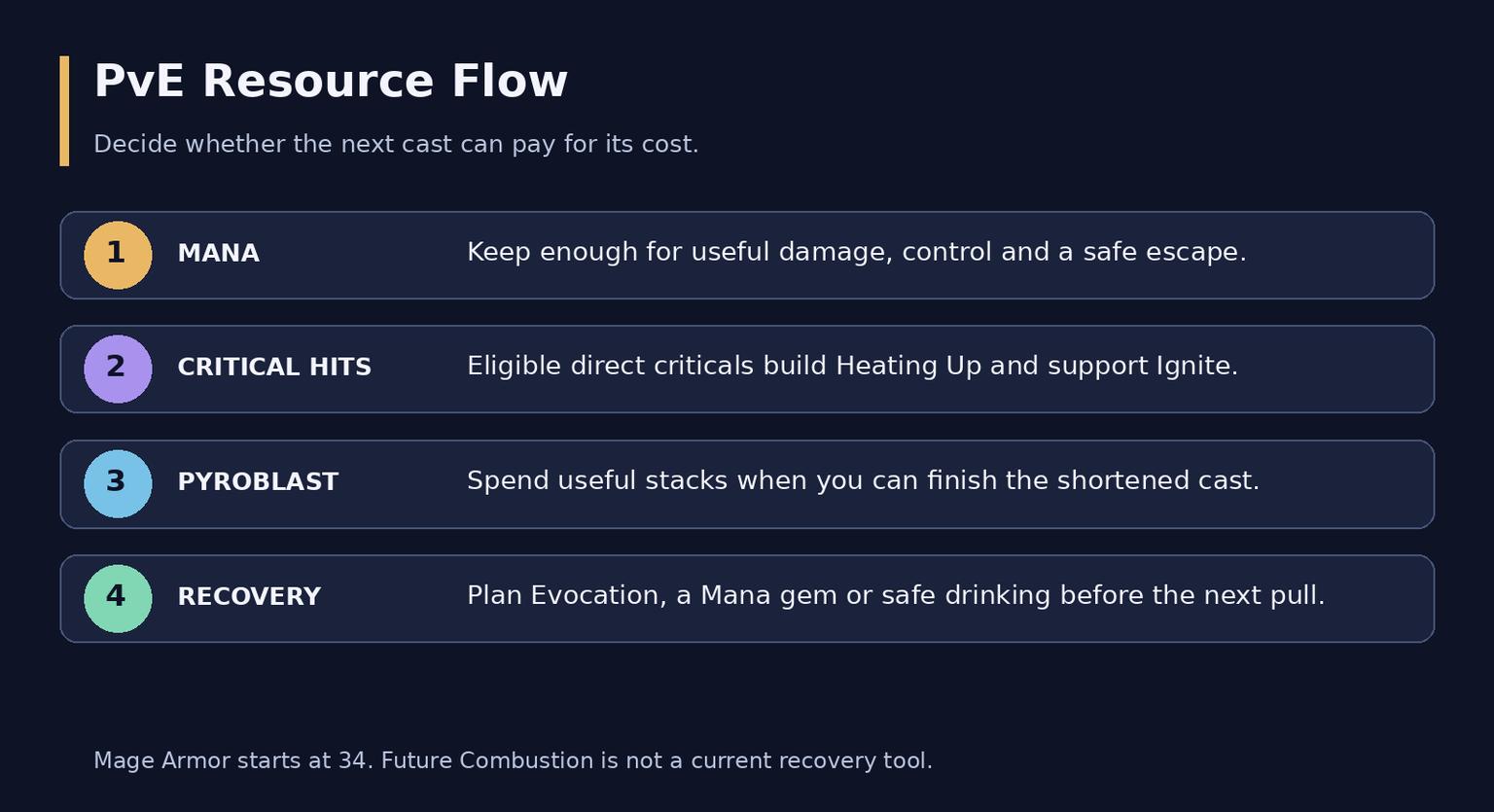
Mana, useful criticals, stack spending and recovery form the practical resource plan.
Stats, equipment and PvP choices
Compare useful Spell Power or Fire damage, spell-hit reliability, critical chance and enough Intellect for the encounter. Hit requirements depend on enemy level and your selected talents. Elemental Precision 2/3 gives 4% Fire/Frost hit in the single-target example; the AoE/PvP variants lose those points. No copied level-60 hit cap, fixed crit threshold or universal item weight is needed to make those distinctions.
Crit supports Ignite and Heating Up, but weak gear cannot be repaired by assuming constant procs. Intellect contributes a larger Mana pool and critical chance. Spirit supports recovery; its value depends on time outside spending and selected regeneration tools. Stamina matters when enemies can actually hit you, particularly in PvP. Haste effects exist in Forever, but no Retail Mastery, Versatility or borrowed rating conversion is recommended.
Judge a staff or one-handed weapon plus off-hand by caster stats and useful effects, not melee damage. A wand is a separate conservation tool. School-specific Fire bonuses are not automatically identical to general Spell Power for Arcane Explosion or Frost control damage. Expensive future raid gear is not presented as a prerequisite for learning the cap-30 loop.
In PvP, a safe Scorch or Fireball cast, well-timed Fire Blast and a shortened Pyroblast can create pressure. Counterspell, Polymorph, Blink and selected Blast Wave help build that opportunity. Do not break your own Polymorph with existing DoTs or nearby area damage. Burning Soul reduces pushback risk; it does not make you immune to interrupts or silence. Save Mana for escape and control instead of spending everything on an opening gamble.
Mage race options are Human, Gnome and Alliance Skyborne, or Orc, Troll and Undead for the Horde. Current Human Ruthless gives 2% critical chance; Gnome Eureka! is an eight-second damage/cost window rather than three charges. Orc Savage gives 1% crit, and Blood Fury has a three-minute cooldown; Shatter Curse dispels instead of granting the old immunity. Skyborne has 3% haste. Compare current utility and faction needs without declaring a universal best race or importing old racial effects.
Frequently asked questions
How good is Fire Mage in WoW Forever?
It offers critical-strike payoffs, shortened Pyroblasts and area-damage tools, but the last level-30 beta had limited crit gear and noticeable Mana pressure. Deep-Fire and Frostfire level-60 rankings remain unproven launch projections.
What is the basic PvE rotation?
On a lasting target, build useful personal Scorch vulnerability, cast Fireball, use Fire Blast to help Heating Up and spend three stacks on a shortened Pyroblast when safe. Conserve on short fights. Combustion is outside these cap-30 builds.
How does Ignite work?
At 5/5 it adds 40% of qualifying Fire critical damage over four seconds through your own debuff. Mages do not share one raid-wide rolling Ignite. Exact server refresh and overwrite rules are not fully documented, so an old shared-Ignite script should not guide your casts.
Which stats matter most?
Compare useful spell damage, hit, crit and enough Intellect, with Spirit for recovery and Stamina for expected danger. Account for actual Elemental Precision investment and target level. No universal borrowed hit cap or crit threshold is confirmed for every cap-30 fight.