How to Play Holy Priest in WoW Forever
Holy Priest chooses a heal by how long an ally can survive the next dangerous hit. When a long cast would finish too late, buy time first. When nobody is in immediate danger, recover health more economically and keep Mana for the group's next mistake. A single sequence cannot cover every encounter.
Checked October 19, 2026. The current Forever beta caps characters at level 30. The working plan below uses abilities available by that stage, with talents depending on your actual point allocation. Prayer of Mending and other later tools are discussed separately, without suggesting that the current beta character can already use them.
This guide does not use the modern Holy Word system or separate Hero Talent trees. The verified Forever tree revolves around direct heals, Renew, shields and its own talents. Casting Heal should not be treated as a way to reduce a modern Holy Word cooldown or start a rotation imported from another version.
Prepare the group and your controls
Before the first pull, check trained ranks, selected talents, drinking water and access to party frames. Give Flash Heal, Power Word: Shield, Dispel Magic and Fade convenient bindings. An emergency tool is of little use if you must search the spellbook for it.
Maintain Power Word: Fortitude and your own Inner Fire. Divine Spirit is trained at level 30 regardless of tree choice. Every Priest can learn Fear Ward from level 20; assign it to the player whose fear would most endanger the group when that mechanic is expected.
Agree with the tank about Mana breaks and responsibility for dangerous casters. Stand where you can observe the fight and reach key allies without taking frontal attacks. A clear healing line matters more than a few extra yards of distance.
Assess the party before the next cast
Choose the player who cannot wait
Check your own safety and the immediate group threat first. A dying tank often takes priority because losing them exposes everybody else. An ally under an imminent lethal effect may nevertheless need help before a tank with a comfortable health reserve.
Health percentage is only one clue. Consider the next hit, continuing damage, range, cast time and the ally's own protection. A half-health damage dealer outside danger may be able to wait; a healthier player facing a heavy attack may not.
Removing a dangerous effect can prevent more harm than another heal, particularly when it also stops the group from acting. Stabilize an ally first if they would die before the next action. Reassess after every cast rather than finishing a sequence merely because you started it.
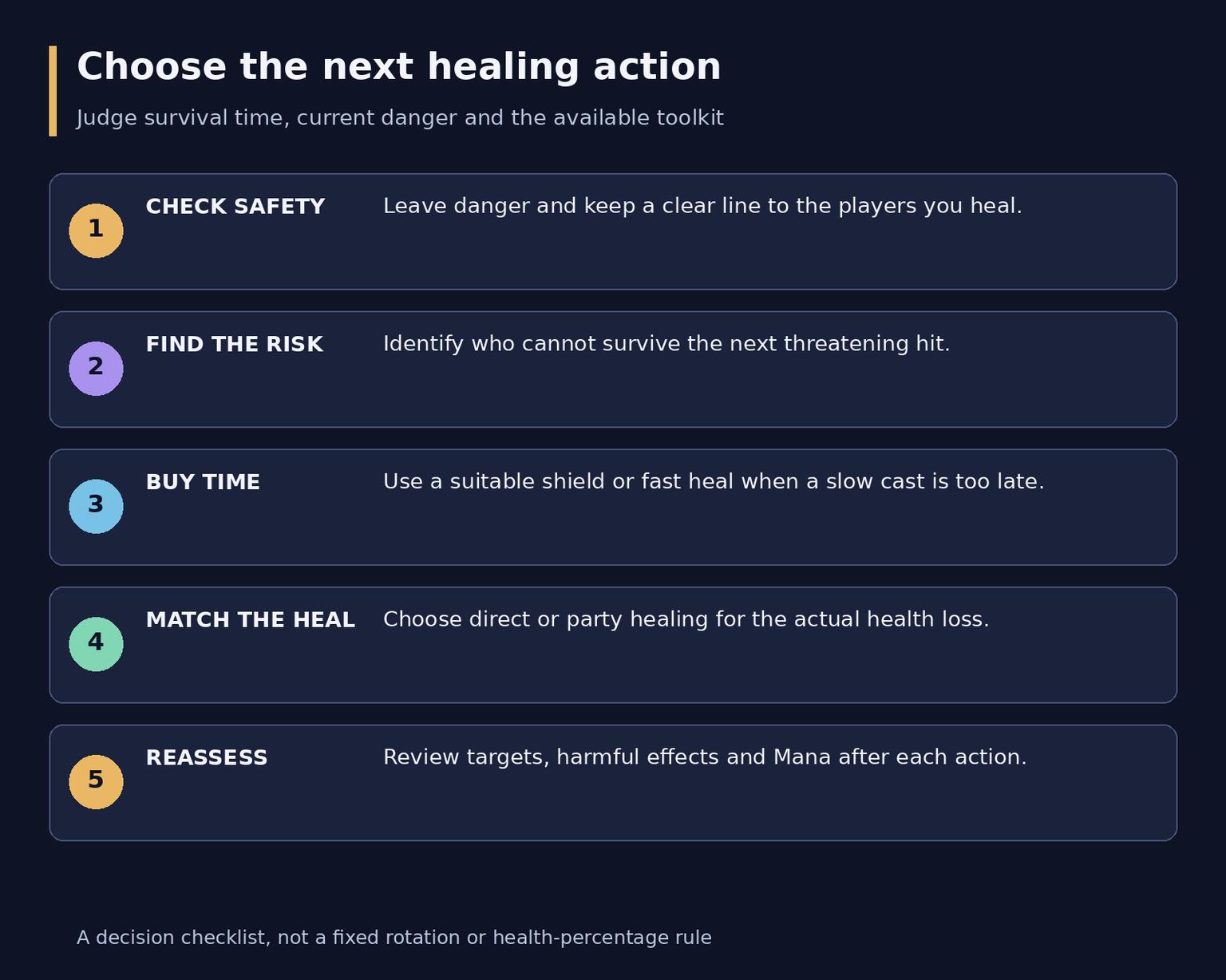
An assessment sequence before the next heal
Do not fill every bar immediately
Once the party can survive the next attack, stop spending as if the emergency continues. Renew or a measured direct heal can cover moderate losses. A safe fight that is nearly over does not always require every player to reach full health immediately.
After sudden party damage, save the most vulnerable player before recovering the rest. A three-second group heal cannot rescue someone with less time to live. Repeated emergencies also warrant a discussion about interrupts, control and leaving dangerous ground.
Choose the right single-target heal
Heal fits predictable damage when there is time to complete its cast. Start early enough for the result to arrive before the next threatening hit. If another heal has already covered the loss and danger has passed, canceling can conserve Mana. Do not cancel when the delay would expose the target again.
Flash Heal is appropriate when a slower spell would arrive too late. Its higher cost is justified by saving the player. The mistake is continuing to use it after stabilization, leaving no resource for the next difficult moment.
Renew smooths continuing moderate damage and lets you help while repositioning. It does not restore all its healing instantly. Apply it for useful expected ticks, rather than refreshing automatically after every small hit. Check the remaining duration before replacing it unnecessarily.
With the talent selected, Binding Heal restores an ally and the Priest through one cast. It is especially convenient when both need health. When you are healthy, decide from current cost, healing and timing instead of assuming a single button must always be correct.
Situation | First decision | Check before committing |
Steady damage on one player | Time Heal ahead of the next hit | Whether the cast can finish safely |
An ally is close to death | Flash Heal or a shield to buy time | Shield eligibility and survival until the heal lands |
You and an ally are injured | Binding Heal if talented | Whether both healing components are useful |
Several members of one party are hurt | Prayer of Healing if nobody will die waiting | Target party, positions and Mana reserve |
You must reposition | Renew or a shield when needed | Leave danger before returning to casted healing |
The table supports a decision rather than replacing encounter awareness. Sometimes the useful response is removing an effect, changing position or asking an ally to use protection instead of increasing healing casts.
Use shields to create time
Power Word: Shield absorbs future damage. Use it to survive an incoming hit, cover movement or create an opportunity to begin healing. Check Weakened Soul and an existing shield: choosing the right player does not always mean a new application is possible.
Do not shield the whole party simply because you can. Its cost should solve a particular problem. Absorption on someone already safe may consume Mana needed later.
Do not import the old Classic prohibition against shielding a Warrior. Blizzard's Forever description states that Rage gained from incoming damage ignores absorption, so Power Word: Shield should not reduce that Warrior Rage gain. This does not remove the need to consider shield cost, threat and the encounter.
Group healing and preparing for party damage
Prayer of Healing is learned at level 30. In Forever it heals the selected target's party and their pets, rather than automatically healing the entire raid. Confirm which party will benefit and whether its members can receive the heal.
Choose it when several players will receive meaningful recovery. A direct heal normally makes more sense for one injured player. If one ally is critical while the others have minor losses, save that ally first; the group option does not automatically lead the priority.
Before a known party hit, finish repositioning, find a suitable casting location and retain enough Mana. The heal must meet a real health deficit. Preparation should not become an expensive cast that finishes before the damage and restores almost nothing.
Holy Nova, when talented, works close to the Priest. Do not enter dangerous ground solely to reach more players. With the appropriate Searing Light trigger, the next Holy Nova can cost no Mana. Take advantage when useful, without delaying necessary direct healing.
Plan powerful tools around an event
What you can prepare now
Fear Ward is better assigned before expected control than remembered after it has removed your ability to act. Choose shields and racial tools for a specific player and threat too. Read their duration, target conditions and actual cooldown on your character.
If you invested in Inner Focus from Discipline, pair it with a useful expensive cast. A free spell that mostly overheals still wastes an opportunity. Consider the talent tradeoff: a level 30 character cannot simultaneously acquire every powerful node in both trees.
Racial abilities differ. A Dwarf's Desperate Prayer helps the Priest; a Human's Divine Grace targets an ally and cannot be used on yourself. A Gnome's Contingency Plan is protection placed in advance with a trigger condition. These are individual racial options, not a common kit every Holy Priest possesses.
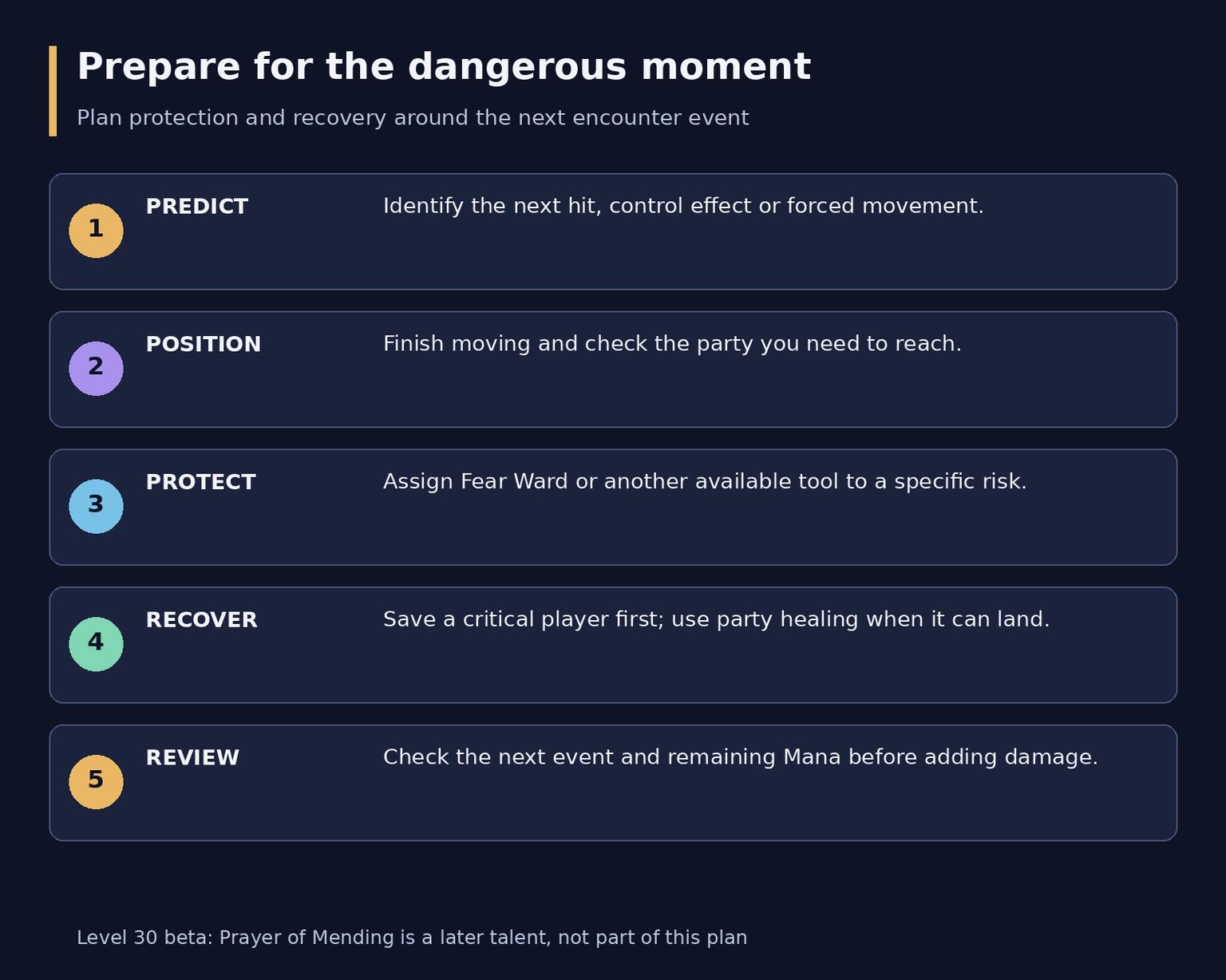
Prepare for a dangerous event and recover afterward
The later Prayer of Mending
Prayer of Mending occupies the 31-point Holy milestone. It remains unavailable in the current level 30 beta even with five additional Legacy talent points. Do not build your first dungeon plan around it. Greater Heal also belongs to later progression rather than the core level 30 plan.
In its published description, Prayer of Mending heals its holder after incoming damage or non-periodic healing, then moves to a nearby party or raid member. It provides up to five heals in total. This supports successive damage across allies; it does not immediately heal everybody at once.
After unlocking the talent, place it where a useful trigger and suitable allies for its movement are expected. Do not rely on it alone to rescue a critical player. This later interaction and its conditions may still change during beta.
Manage Mana without inventing a rotation
The main saving comes from healing that is needed. Compare useful recovery with Mana spent, not merely the cost of one cast. A cheap spell that fails to arrive in time does not solve the problem; an expensive spell with no useful recovery is wasteful too.
Spirit regeneration interacts with the five-second rule after spending Mana. Meditation lets part of that regeneration continue during casting. This does not mean every form of Mana recovery stops without the talent: separate effects follow their own rules.
Litany of Light refunds part of the cost when the new healing spell has a different name from the previous one. If talented, alternate useful tools naturally. Do not cast an unnecessary heal just to obtain a refund: partial reimbursement does not make excess spending free. Do not assume changing the rank of one spell name bypasses the condition.
Ranks and talents changed in October updates. Check current results on your character rather than importing an old routine of endlessly casting the first rank. Divine Fury shortens Heal and certain other casts; Inspiration interacts with non-periodic critical healing. These benefits matter only when the talents are actually selected.
Use safe pauses and water between pulls. Report low Mana before the next enemy. Waiting until empty for an impressive recovery action is dangerous when the party still faces another heavy attack.
Support the party and protect yourself
Dispel Magic handles Magic effects; Cure Disease handles Diseases. Neither is a universal answer to Poisons and Curses. Prioritize effects that are dangerous to leave or prevent the group from handling the encounter, including any particular consequences of removal.
If enemies threaten you, use Fade and move where the tank can help. It temporarily reduces threat rather than guaranteeing an exit from combat. Avoid fleeing around a corner and losing your ability to heal while the party pursues the enemy.
Psychic Scream can create time, but fleeing enemies may bring additional opponents. Shackle Undead fits eligible targets. Mind Control demands separate attention and prevents ordinary healing while you maintain it. Coordinate this with the group. These tools are not a universal instant interrupt.
Priests have no ordinary built-in dash. Move early, use instant spells when helpful and resume healing from safety. Later, Levitate supports falling and water travel; it does not turn the Priest into a healer who continuously casts long spells while running.
Add damage when the next threat is covered
Use Smite, Holy Fire or wand attacks when the party can survive the immediate threat, your position is safe and Mana permits. Abandon the damage plan for needed healing. Following an October change, wands require a brief stationary setup before firing, so do not assume they provide uninterrupted damage while running.
Do not spend Mana solely to chase a free Holy Nova from Searing Light when healing will soon be needed. The trigger depends on your talent and combat events. Time and resources invested in damage must fit the whole party's safety.
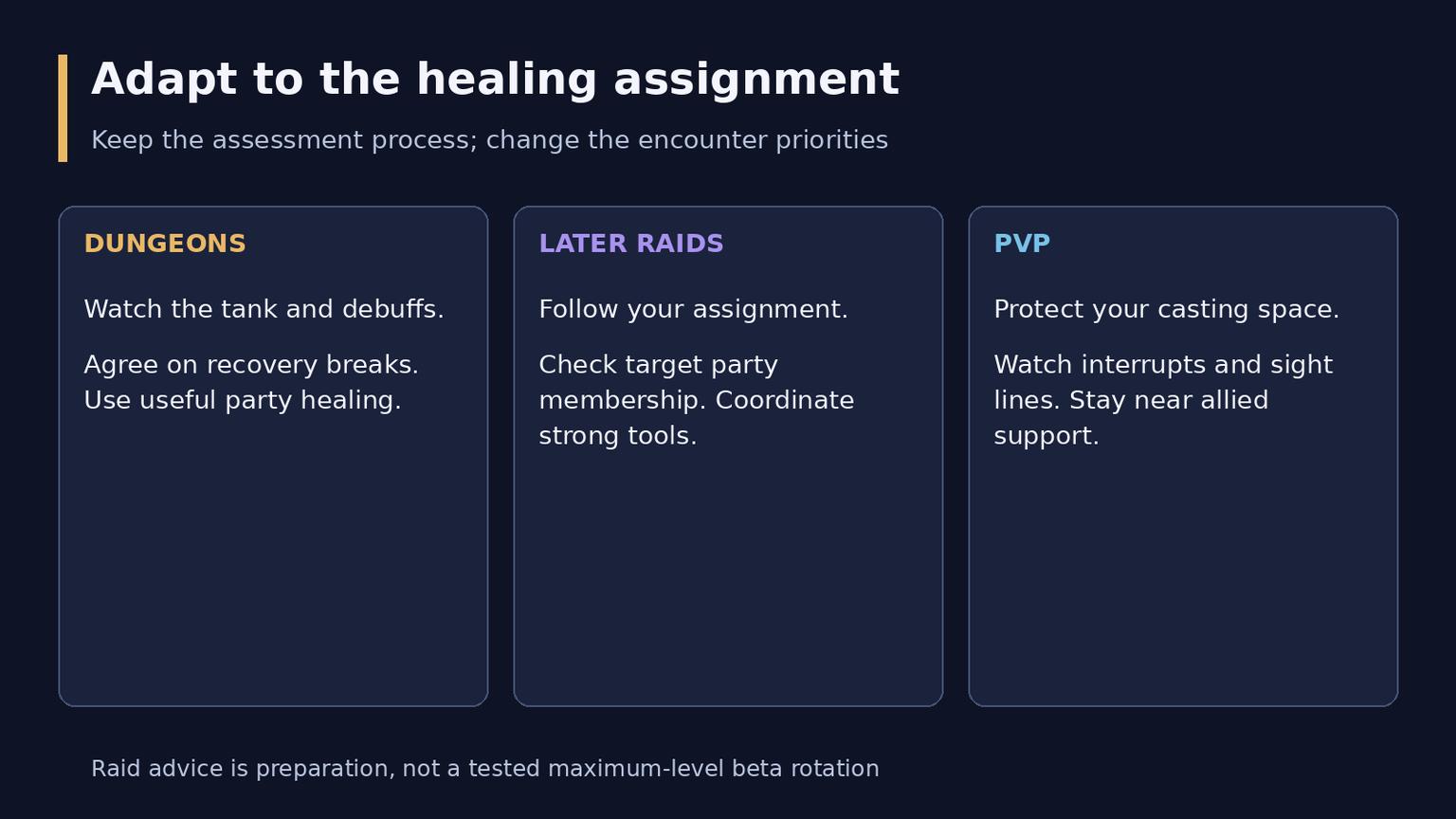
How the healing assignment changes with the encounter
In dungeons, watch the tank, dangerous effects and opportunities to drink between pulls. In later raids, follow your assignment and check party membership for Prayer of Healing. Another healer's presence does not remove your responsibility. The raid discussion describes coordination principles rather than a tested maximum-level beta rotation.
In PvP, line of sight, allied support, enemy pressure and interruption risk become more prominent. Do not remain exposed for one extra cast. Once allies are secure, removing a valuable enemy buff may matter more than another attack.
After a difficult fight, identify the cause: late healing, lost position, unnecessary Mana use or an unresolved mechanic. Adapt the next decision to that cause. Successful Holy Priest play delivers help in time while preserving the resources and position needed for the next threat.