Best WoW Forever PvP Classes for Skirmishes and Battlegrounds
For independent fights, our starting recommendations are Mage if you enjoy controlling distance, Rogue if you want to choose an opening, and Warlock if you prefer persistent spell pressure with a demon. For coordinated battlegrounds, start with the missing role: a healer, someone protecting the objective, or a damage dealer who can act on the team's control.
These are editorial recommendations based on class tools, not a measured first-to-ninth ranking. This guide was checked on October 19, 2026. The current beta primarily provides level 30 testing, while previews also describe deeper talents. The reviewed sources do not establish a current, comparable level 60 PvP win-rate dataset that would justify one universal S-to-B order.
A class can be useful without being equally strong in every matchup. Equipment, talent investment, available abilities, player decisions and teammates change the result. A duel winner is not automatically the best flag escort or healer in a large fight.
Separate the formats before comparing classes
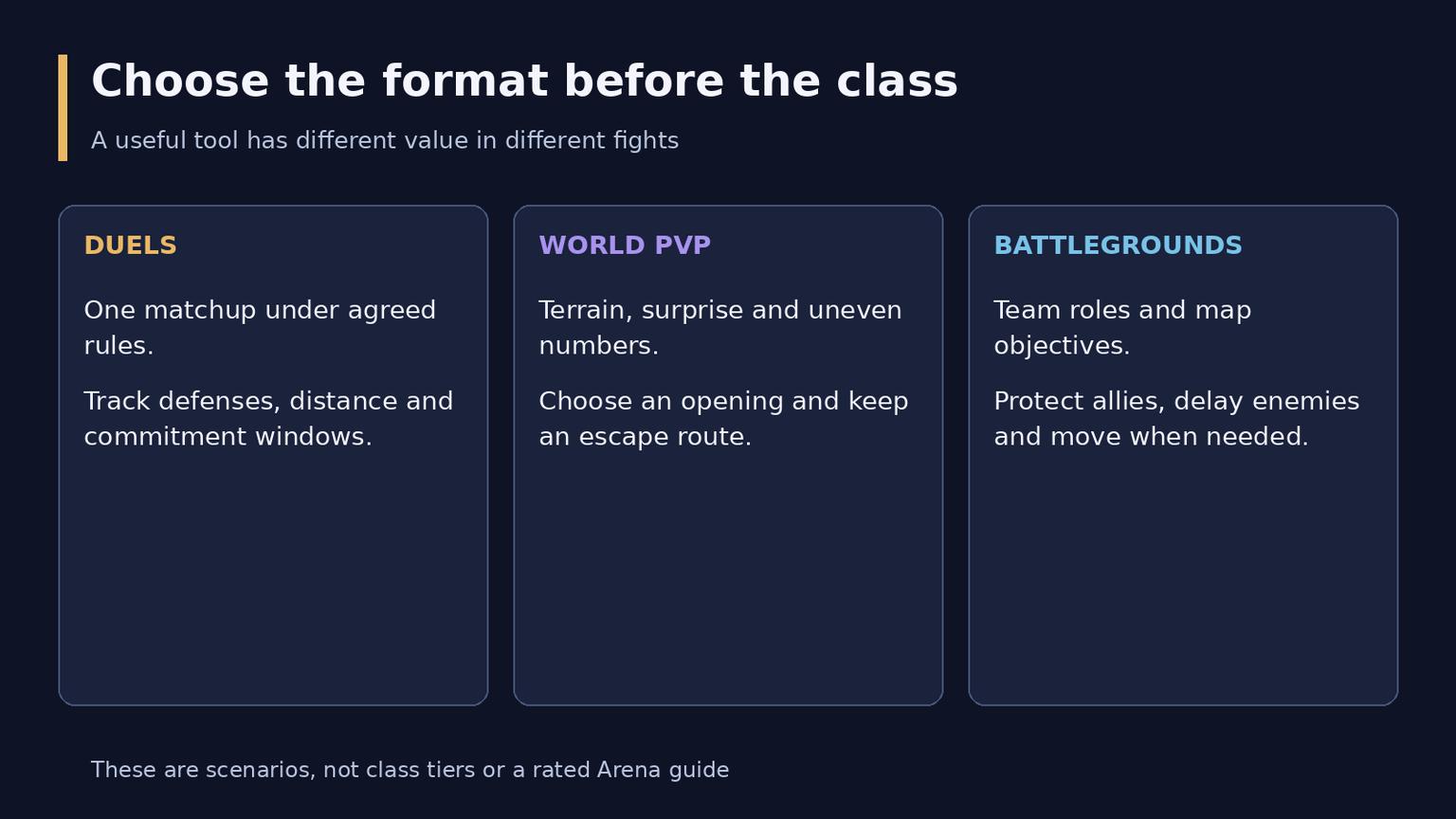
Three PvP scenarios and their different priorities
A duel tests a particular matchup under agreed conditions. It rewards recognizing the opponent's defensive tools, controlling distance and choosing when to commit. World PvP adds uneven numbers, terrain, surprise and the possibility of disengaging. A class that chooses fights well can feel stronger there than in a forced duel.
Battlegrounds add objectives and teammates. Darkspear Islands is a 15v15 battleground with strategic bases and a central flag. A useful player may spend a fight delaying an attacker, protecting a healer or moving to an undefended objective rather than maximizing damage.
This article does not present an Arena or Solo Shuffle tier list. Those systems must not be assumed from other versions of WoW. Joining battlegrounds alone is also different from a dedicated rated solo-queue mode; it changes how much organized support you can expect.
All nine classes at a glance
The rows describe equal options, not ranked positions. Pick the contribution you enjoy, then check the corresponding limitation.
Class | Practical PvP reason to choose it | What you need to manage |
Druid | Movement, forms, healing and objective support | Form choice, Mana and the cost of changing tasks |
Hunter | Ranged pressure, traps and pet options | Range, firing windows and pet control |
Mage | Distance control, interruption and burst opportunities | Fragility, Mana and defensive timing |
Paladin | Blessings, healing and defensive support | Positioning, Mana and the actual available spellbook |
Priest | Healing, shields or a Shadow damage path | Cast exposure, Mana and help when focused |
Rogue | Stealth openings, disruption and target isolation | Energy, control sequencing and a workable escape |
Shaman | Totems, offensive disruption and healing or damage | Placement, spell choices and incoming pressure |
Warlock | Periodic damage, Fear and demon-dependent tools | Pet survival, resources and enemy removal effects |
Warrior | Sustained melee commitment with team support | Reaching targets, weapon quality and staying alive |
Independent pressure and control
Mage for players who enjoy managing distance
Mage is a useful first shortlist choice for a player who wants ranged control rather than simply trading hits. Polymorph can remove an opponent from the immediate exchange, Frost Nova creates space, Counterspell disrupts casting, and Blink helps reposition. These tools are most valuable when used to create a specific safe cast or escape route.
Frost investment offers a control-focused foundation; Fire emphasizes offensive opportunities, and Arcane changes setup and Mana decisions. They are talent directions, not three complete toolkits you receive simultaneously. Ice Block is a 16-point milestone, so its access still depends on the build.
Mage is not automatically an easy beginner class. Spending movement and defensive tools too early can leave a fragile character with no answer to the next attack. Practice surviving and keeping a route open before judging success only by damage.
Rogue for choosing when an engagement starts
Rogue suits players who enjoy scouting, approaching unseen and turning control into an opportunity. Sap and stuns can isolate a target or delay someone near an objective. Vanish can help reset an unfavorable exchange when conditions allow, but it is not a guarantee against detection or continuing damage.
Subtlety supports stealth tricks and control-oriented decisions; Assassination emphasizes daggers, poisons and finishing moves, while Combat supports direct weapon pressure. Choosing talents across trees still spends a limited budget. Do not describe every deep offensive and defensive talent as part of one standard build.
Rogue's value in a battleground is not restricted to winning a duel. Calling incoming attackers, delaying a reinforcement or forcing an opponent to defend can create a useful advantage without producing the highest damage total.
Warlock for pressure that outlasts one cast
Warlock is a good shortlist choice if you enjoy managing several resources and a demon while applying periodic pressure. Fear offers disruption, and damage over time can continue while you reposition. Neither makes the class immune to interrupts, defensive cooldowns or removal of its effects.
Affliction develops periodic damage and drains; Demonology invests more in the relationship with the pet; Destruction develops direct spell threats. Soul Link is a 21-point Demonology milestone in Forever, rather than the old 31-point position. It is a build investment, not a passive benefit of every Warlock.
Pets supply different tools, so include their position and survival in your plan. A pet-dependent defensive or disruptive setup loses important options when the demon is unavailable. The class's ability to exchange Health for Mana is also a risk during enemy pressure, not an unconditional supply of free resources.
Objective play and supporting a group
Druid for movement and changing the task
Druid is our objective-focused shortlist choice for players who enjoy forms, route planning and helping a carrier. Healing can preserve an ally while forms support movement or melee work. Stealth belongs to the appropriate form and conditions; it does not mean permanent invisibility during every objective action.
Feral Combat develops melee and form-based play, Restoration develops healing, and Balance develops ranged spells. The flexibility comes with tradeoffs: leaving one task for another costs time, resources or position. A damage build does not become a full healer merely by casting an emergency heal.
Choose this class if you want to learn when to fight and when to move. Its contribution is often easiest to see in a saved ally or a successful objective transition rather than a personal damage chart.
Hunter for ranged space and local defense
Hunter can pressure an approach, use traps to complicate movement and manage a pet alongside weapon attacks. Marksmanship emphasizes ranged weapons, Beast Mastery emphasizes the companion, and Survival can support moving between ranged and melee actions. Treating all Hunters as helpless at close range ignores those different investments.
Range still matters. Plan positions from which you can shoot, see incoming opponents and retreat without abandoning the objective. A pet does not defend an unattended base by itself, and its selected abilities are not interchangeable with every other pet's tools.
Do not import the modern backward-jump interpretation of Disengage or assume every modern Hunter interrupt exists here. Read the Forever spellbook. The class can be rewarding for a new ranged player, but managing range, traps and a companion is a real learning task.
Warrior for coordinated melee pressure
Warrior is worth considering when you want to commit to a target with allies who help you stay connected and recover damage. Movement control used against you, target access and weapon quality can change the experience sharply. Chasing beyond healing range can erase the value of a strong offensive opening.
Arms, Fury and Protection emphasize different combinations of weapon attacks, sustained pressure and durability. A deeper talent preview is not the same as the ordinary level 30 toolkit. Likewise, surviving longer does not by itself establish a Protection build as the best objective holder.
Do not rank Warrior last simply because a solo matchup feels difficult. Judge the job in the group you actually play with. In Forever, incoming-damage Rage calculations ignore absorbs, so the old blanket instruction never to shield a Warrior because it prevents Rage is inappropriate.
Four healing and support choices
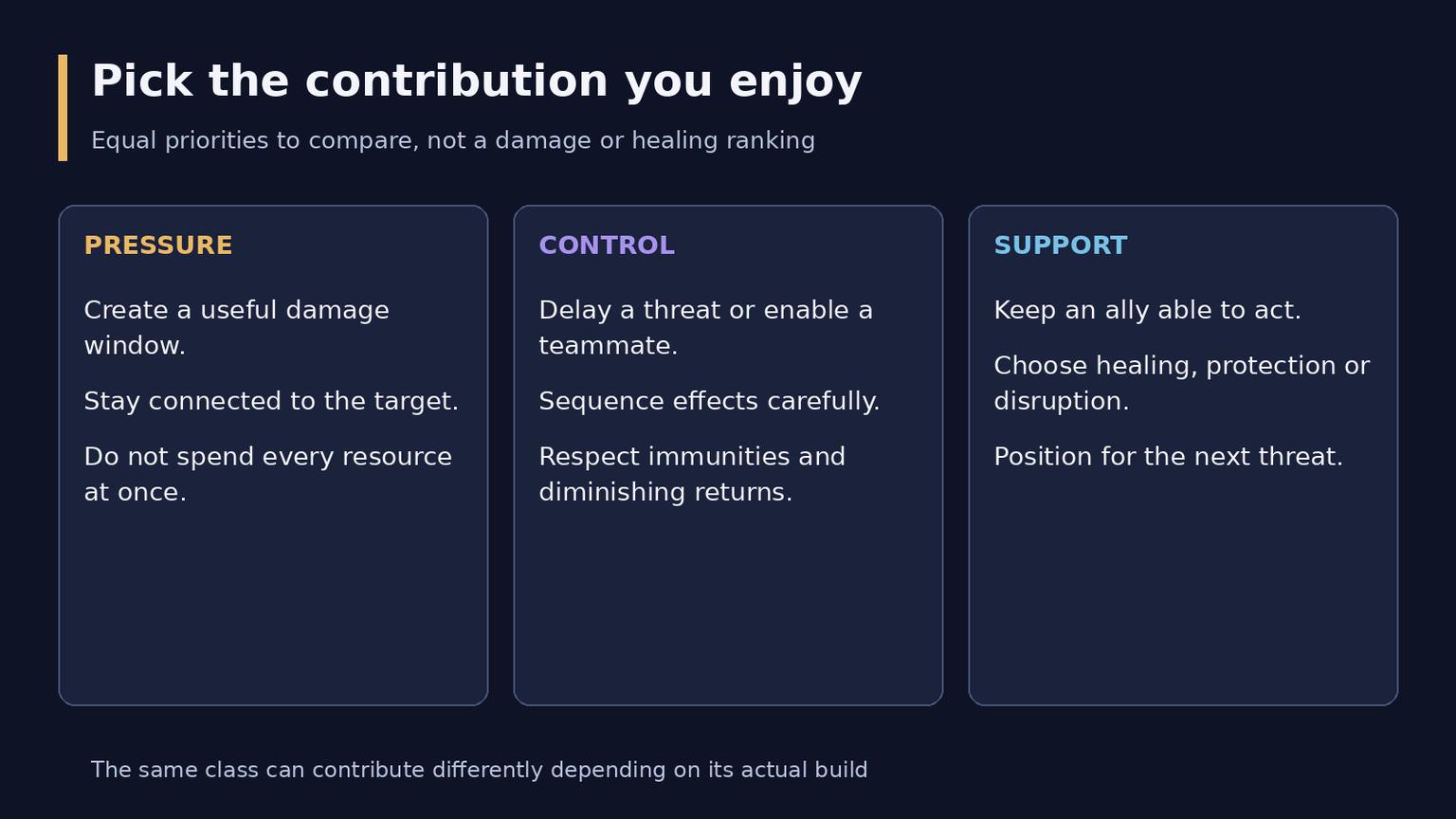
Pressure control and support are different class priorities
Priest for shields or a deliberate healing role
Priest offers a clear support starting point when you want to combine direct recovery with Power Word: Shield. Discipline develops shielding and Penance, while Holy develops direct healing tools. Penance is a 21-point talent that can heal an ally or damage an enemy; those are alternative uses, not automatic healing from every offensive spell.
Shadow is a damage direction with its own tradeoffs. Do not advertise one Priest as simultaneously delivering a full Shadow offense and a full deep healing build. Priests also need positioning and help when focused; access to shields does not remove vulnerability to interruption or concentrated pressure.
Paladin for helping an ally keep acting
Paladin is a practical support option if you enjoy selecting the right blessing, healing and protecting an ally at the right moment. Blessing of Freedom can address movement restrictions; it is not immunity to every type of control. Defensive options must be checked against the character's learned spells, talents and restrictions.
Holy develops recovery, Retribution develops offensive weapon-and-Holy pressure, and Protection develops durability. Voice of Truth is an 11-point Holy talent granting a temporary answer to Silence and Interrupt, not blanket immunity to all control. Paladin uses Mana here; the name Holy Power in a talent does not establish the modern spendable resource.
A visible defensive tool can make the class attractive to a beginner, but it does not excuse poor positioning. Learn which ally needs help and preserve a way to keep casting rather than treating survival alone as the win condition.
Shaman for timely totems and disruption
Shaman suits players who want healing or damage alongside active totem decisions. Elemental develops spell pressure, Enhancement develops melee work, and Restoration develops recovery. Totemic Projection allows relocation of totems, but placement, reach and resources still need attention.
Offensive removal of enemy buffs and a well-timed spell disruption can help your team finish a target. Grounding Totem is a specific spell-redirection tool; the latest notes confirm it is destroyed after redirecting a spell. Do not assume it continues to protect the group indefinitely.
Shaman support is strongest when it solves the current problem rather than following a fixed totem list. A group under caster pressure asks different questions from an isolated melee exchange. That does not establish one specialization as the universally strongest healer or damage dealer.
Druid healing for mobile objective support
Restoration Druid is the fourth healing option, separate from the melee and ranged directions discussed above. Healing over time and appropriately timed instant actions help support movement, while direct recovery still matters when damage becomes dangerous.
Plan the route and healing together. Casting, changing form and taking over another task are decisions with costs. A mobile support identity is not proof of unlimited Mana, immunity to control or the highest recovery against every damage pattern.
Beta changes that can alter your choice
Recent updates are a reason to revisit an old tier list, not a reason to invent a new statistical order. The October 8 notes removed reduced efficacy for critical strikes in PvP. They also corrected diminishing returns for Hunter Entrapment and stopped it repeatedly activating from Frost Trap's periodic effect.
The October 15 build changed Mage damage and control interactions, Hunter firing behavior and pet tools, Priest talents, Shaman abilities and other class mechanics. These are not all PvP-only modifiers. For example, Hunter Auto Shot now requires a brief stationary window, while the Grounding Totem fix affects how its protection is consumed.
Read the current description when selecting a build. Do not apply a PvE damage chart directly to players, and do not assume that a control effect has identical duration or effectiveness against every opponent. Immunities, removal tools and diminishing returns can change an apparent advantage.
Make the final choice with a short test
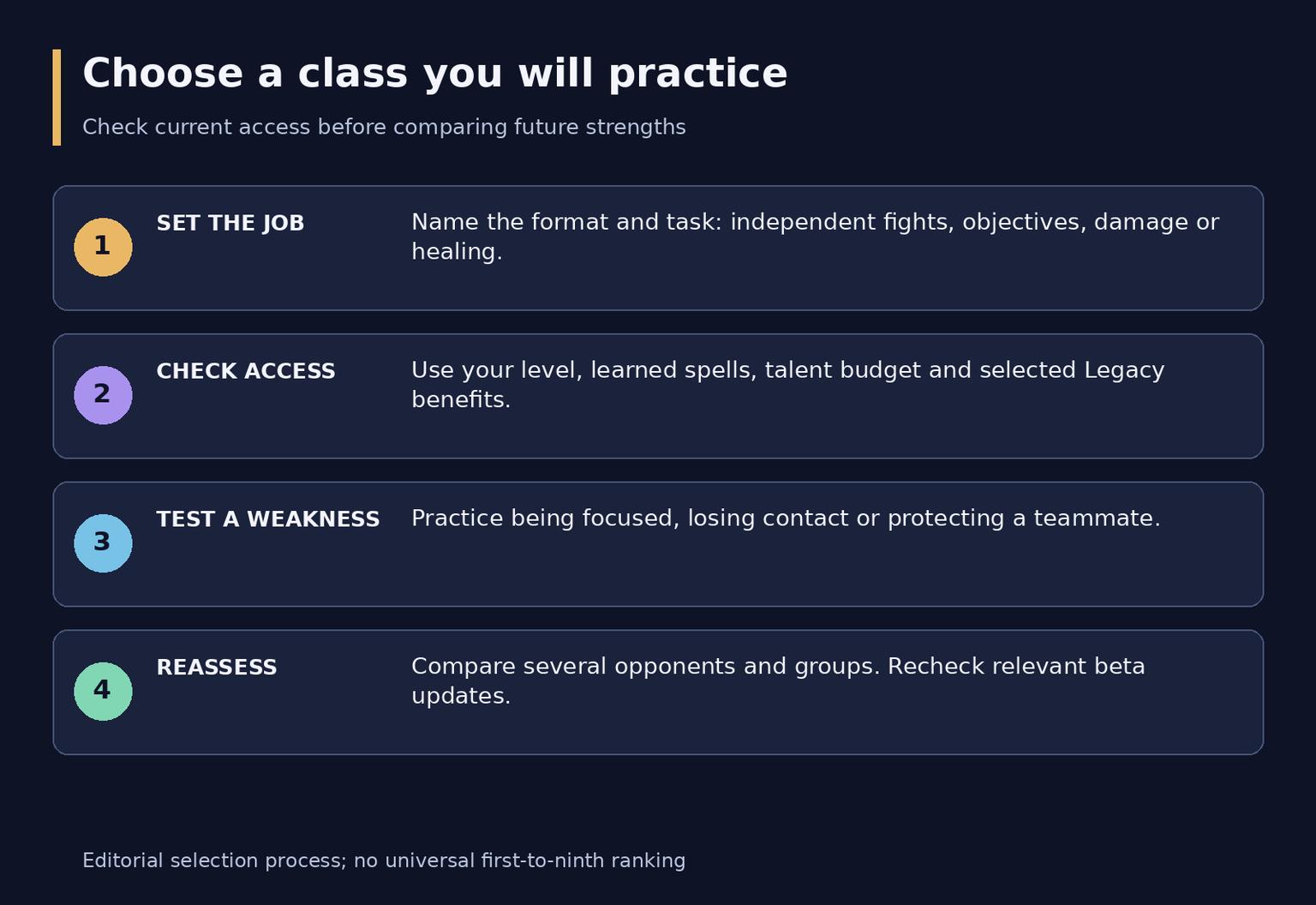
Four steps for choosing a PvP class
1. Choose the format and job. Decide whether you want independent fights, objective work, organized damage or healing.
2. Check your actual build. Use the current level, learned spells, talent budget and selected Legacy benefits. Separate future milestones from available actions.
3. Test the difficult situation. Practice being focused, losing target access or protecting an ally. Record why the attempt failed before blaming class balance.
4. Reassess after changes. Compare results across several matchups and groups, then revisit the build after relevant beta updates.
For a first character, choose the decision process you are willing to practice. Mage asks you to manage distance; Rogue asks for control sequencing; Warlock adds demon and resource management; a healer asks you to keep other players alive under pressure. Comfort with that work is a more useful starting point than a tier letter with no level or format attached.