WoW Forever Subtlety Rogue Guide
Subtlety in World of Warcraft: Forever combines a strong Stealth opener, efficient Combo Point generation and a choice between sustained bleeds, instant damage and control. The practical starting point is a level-30 Hemorrhage build. Its attraction is flexibility: open on your terms, use a finisher suited to the target and keep an escape available.
This guide was checked on October 24, 2026. The beta ended on October 23 at 10 AM PDT, and launch is scheduled for November 4. There is currently no playable live release to test. The last beta cap was 30; the latest independently extracted client is 1.60.1.70532. Blizzard's latest gameplay development notes located are dated October 15. Client data and beta reports describe the preparation below, rather than a proven launch or level-60 meta. Recheck launch notes before committing to a final build.
What the specialization does well
Premeditation and Initiative accelerate the opening resource cycle. Hemorrhage is a cheap repeatable builder, while Serrated Blades and Hemorrhage support Rupture against durable targets. Stealth access, interrupts and stuns let you choose when damage is safe. Subtlety works as a solo and small-group damage build and offers substantial PvP control.
Its limitations matter in dungeons: slow target switching can waste Combo Points, bleeds need time, positional dagger attacks require access to the target's back, and this build has no general-purpose burst AoE rotation. Do not confuse strong opening damage with a demonstrated best sustained DPS ranking. The short beta and low cap do not establish final raid performance.
What Forever changes
The official Rogue deep dive confirms substantial changes from Classic. Sap no longer breaks Stealth by default. Dirty Tricks replaces Improved Sap and lowers Sap and Blind Energy costs. Premeditation moves to the 16-point milestone and gives a 20-second window to use or add to its points. It no longer requires Stealth. Initiative and Setup reach a guaranteed trigger at three ranks, but only when their specific triggering conditions occur.
Hemorrhage costs 35 Energy and gives one Combo Point. Its Forever effect strengthens your Rupture by 15% for 15 seconds, and the ability has enhanced dagger damage. Serrated Blades now ignores a percentage of armor rather than the old flat amount and improves Rupture. Ghostly Strike also gains enhanced dagger damage. Dirty Deeds removes Garrote's behind-target restriction and reduces opener costs when selected.
The deeper talents are not all available in a normal level-30 build. Quietus strengthens Sinister Strike, Ghostly Strike and Hemorrhage against targets below 35% health and requires Dirty Deeds. Cutthroat lets Backstab trigger an Ambush that does not require Stealth. Thousand Cuts is the 31-point talent: Rupture ticks reduce the cost of your next Hemorrhage or Backstab by 3 Energy per stack, up to five stacks. A normal 21-point build, or even a 26-point Legacy build, cannot reach it. Do not use that feedback loop to explain level-30 performance.
Level-30 talent builds
You receive 21 ordinary talent points by level 30. The following two 0/0/21 allocations are legal examples, not measured best-in-slot talent rankings. The PvE column follows a published beta allocation with solo-friendly Setup. The PvP column is an editorial variant that moves those three points into Master of Deception for Stealth encounters.
Talent | PvE and solo example | PvP example |
Camouflage | 4/5 | 4/5 |
Opportunity | 2/2 | 2/2 |
Master of Deception | 0/3 | 3/3 |
Setup | 3/3 | 0/3 |
Improved Ambush | 3/3 | 3/3 |
Initiative | 3/3 | 3/3 |
Ghostly Strike | 1/1 | 1/1 |
Premeditation | 1/1 | 1/1 |
Serrated Blades | 3/3 | 3/3 |
Hemorrhage | 1/1 | 1/1 |
Total | 21 | 21 |
The defining investment is the route through Premeditation, Initiative and Serrated Blades to Hemorrhage. Opportunity supports your openers. Setup is situational: it rewards qualifying dodges or resists, so a dungeon Rogue who is not being attacked should not value it as passive Combo Point generation. Stealth detection, movement, opener crit and defensive utility are adjustable choices rather than universal damage requirements.
Forever's Talented Legacy benefit can supply up to five additional class talent points at this cap. With all five actually unlocked, an optional extension is Dirty Deeds 2/2, Elusiveness 2/2 and Preparation 1/1, for 26 points in Subtlety. This is a separate progression-dependent version. Preparation resets specified Rogue cooldowns; read its current tooltip instead of assuming it resets every ability. Without the extra points, neither example includes Preparation or Dirty Deeds.
A dagger-focused Backstab path with Combat support is a different allocation. You cannot simply add Combat's Puncturing Wounds to the complete 21-point Hemorrhage example for free. At level 60, a 31-point Subtlety route can incorporate Thousand Cuts and spend remaining points elsewhere, but its final cross-tree allocation and raid ranking remain future theorycraft. Dual Specialization at level 40 is also outside the last beta cap.
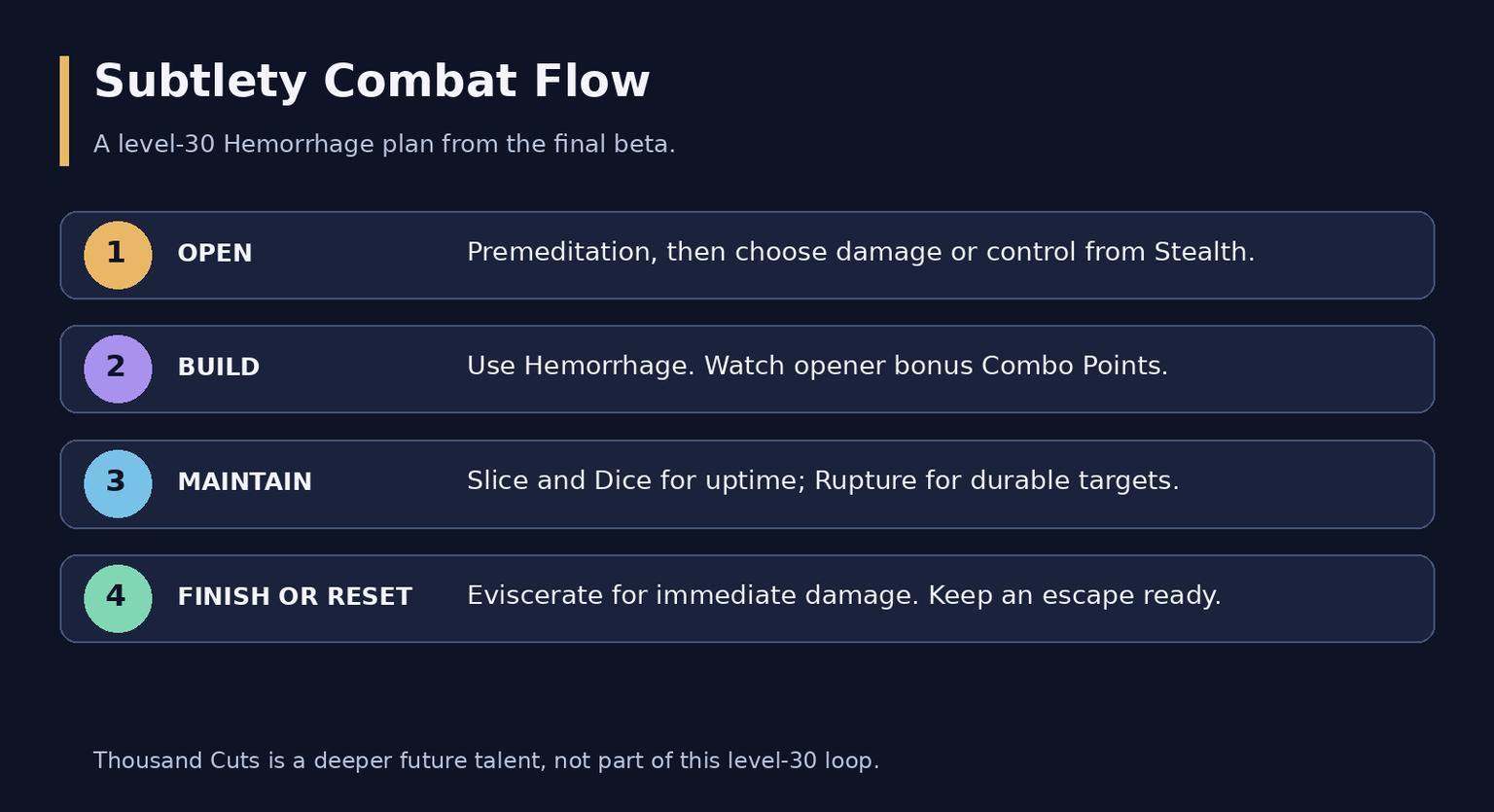
Choose the opener and finisher for the actual target and level-30 toolkit.
Single-target priority
Prepare and open
Apply the poisons you have learned, equip a suitable main hand and identify whether the target will live long enough for bleeds. Approach in Stealth and use Premeditation shortly before engaging so its points do not expire. Watch the point display: Initiative can add another point to qualifying openers, so do not overfill immediately.
Garrote suits a durable target that can bleed. Ambush offers immediate damage when you have a main-hand dagger and can attack from behind. Cheap Shot is a control opener when a stun creates a safer damage window. The base builds above do not have Dirty Deeds, so keep Garrote's positional requirement; the optional extension changes that. Do not spend Energy trying to execute an opener your weapon or position cannot support.
Build and spend
Use Hemorrhage as the accessible repeatable builder. Refresh its Rupture-supporting effect when relevant, rather than treating the bleed bonus as a permanent passive. Use Ghostly Strike when its damage and defensive benefit justify the cost. Backstab is an alternative with a main-hand dagger and rear access, but a higher-cost positional button is not automatically the best use of every global.
Maintain Slice and Dice when there is enough uninterrupted melee time to benefit. Use Rupture on targets that will survive its duration, especially when armor makes a bleed attractive. Use Eviscerate when immediate damage will finish the target or a fresh bleed would mostly be wasted. There is no universal instruction to spend the first five points on Rupture in every fight. Enemy lifetime, existing buffs and the next target change the decision.
Avoid generating at maximum points. If the target is about to die, use a useful finisher now: Slice and Dice can carry into the next enemy, while Eviscerate can secure the kill. Do not refresh an almost full-duration bleed just because five points are available. Pool enough Energy for the next planned action without sitting at the Energy cap.
Movement and multiple targets
Energy regeneration is smoother than Classic's old two-second tick model. Use movement to recover Energy and reconnect for a purposeful builder-finisher sequence. Combo Points remain attached to a target: switching targets alone can preserve the old points, but building points on another target replaces that previous investment. Interrupting a second enemy and returning is different from starting a new resource cycle there.
On several enemies, focus the dangerous target, interrupt casts and apply a bleed to a second durable enemy only when the time and resources pay off. Do not import Fan of Knives, Black Powder or a Retail Shadow Dance sequence. During downtime, choose the next position and preserve useful resources rather than applying a bleed that cannot tick.
Weapons and stats
For Hemorrhage, compare actual main-hand damage and the Forever dagger modifier. A slower non-dagger main hand can deliver strong individual strikes; a good dagger enables Ambush and Backstab. A dagger in the off hand does not remove those abilities' main-hand requirement. Avoid weapon swaps in the middle of a tight opener unless the gain is deliberate: swapping can cost a global cooldown and reset the swing timer.
Weapon damage is an important upgrade lever. Agility, Attack Power, Crit and available Hit improve damage in different ways; poisons now scale with Attack Power. Check Hit and Expertise where available, but do not copy level-60 Classic hit caps, weapon-skill racial bonuses or Retail stat weights into level-30 Forever gearing. Haste, Mastery and Versatility priorities from another version are not a substitute for this client's item and ability rules.
For PvE, favor reliable damage, a suitable weapon and enough durability to remain in melee. For PvP, Stamina and practical survival can outweigh a small theoretical damage increase. No fixed numeric stat weights or universal off-hand speed optimum have been established here. Compare the actual weapons, proc effects and poison plan rather than buying an obsolete full-set list.
Poisons at this cap
The class poison quest becomes relevant at level 20. Use the ranks you can actually learn and carry reagents. Instant Poison is a straightforward choice for short encounters; Deadly Poison has more opportunity to pay off on long-lived targets. In PvP, Crippling Poison helps keep contact and Mind-numbing Poison can pressure casters when available. Choose the hand assignment around your equipped weapons and purpose; this guide does not claim a tested universal best pairing.
Wound Poison's database training requirement is level 32, so it is not part of a level-30 toolkit. Check individual tooltips for charges and duration rather than assuming all poisons last the same time. Forever permits poisons alongside sharpening or weightstones and Windfury effects; the old mutual-exclusion rule is not a valid reason to leave poisons off.
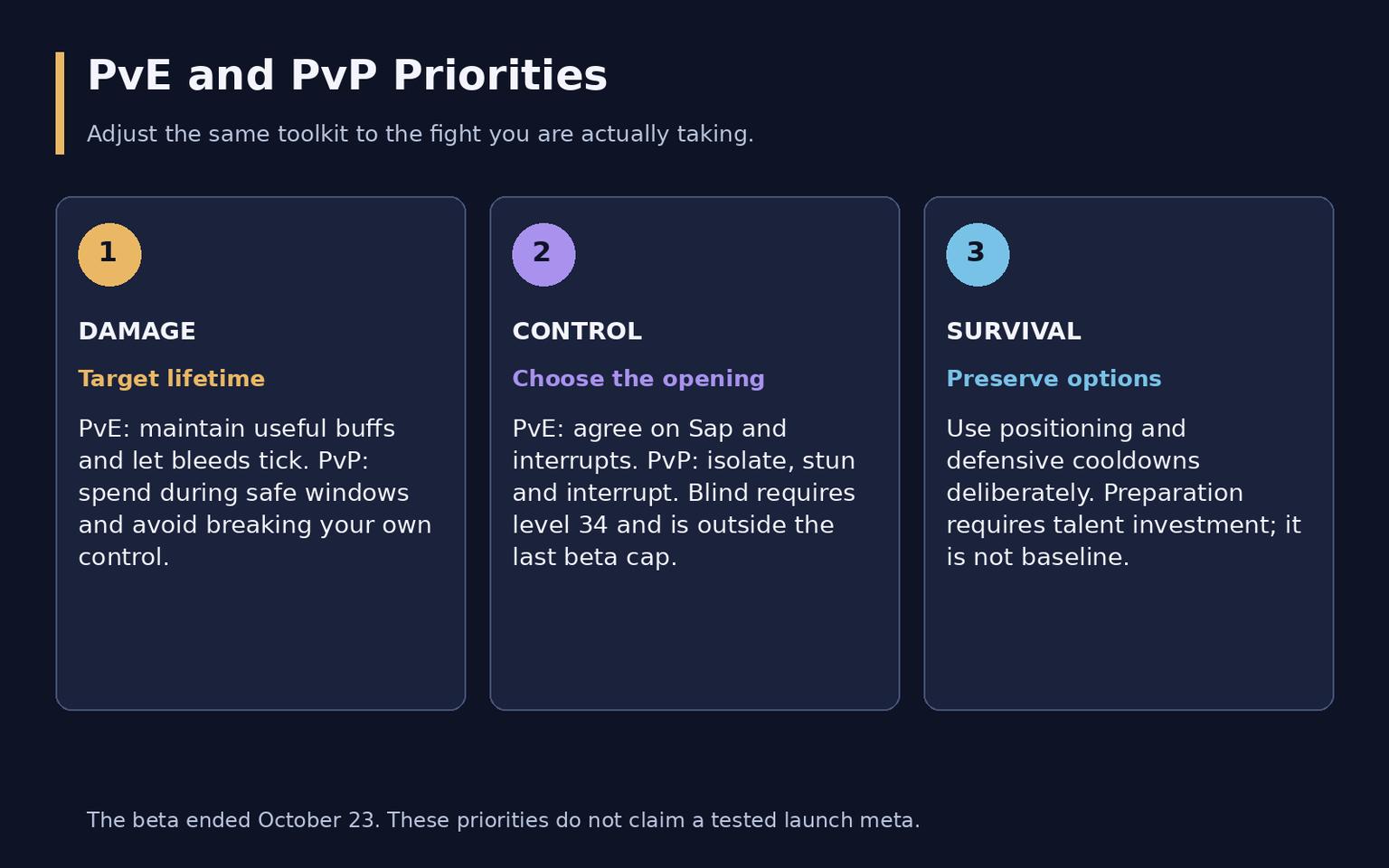
Damage, control and survival priorities change with the encounter.
PvP control and survival
Sap an eligible out-of-combat target to isolate the fight; baseline Sap preserves Stealth. Use Cheap Shot to create an opening, then choose between damage and a Kidney Shot finisher according to the opponent's response. Kick dangerous casts instead of spending every global on damage. Gouge buys a pause only if ongoing damage will not immediately break it. Plan Garrote, Rupture and Deadly Poison around that limitation.
Vanish can create an escape or another Stealth opener, but continued damage and detection still matter. Leave a route out, pool Energy before committing and use Evasion or Sprint with a purpose. If your actual build includes Preparation, reserve the reset for a second meaningful defensive or offensive window. It is absent from the ordinary examples.
Blind is trained at level 34. It belongs in a future toolkit discussion, not a last-beta level-30 control chain. Likewise, do not promise a fixed unbreakable stun sequence against every opponent: available counters, positioning and control interactions determine whether the sequence works. Subtlety wins by choosing a window and keeping options, not by repeating one opener regardless of matchup.
Race choices after October changes
Blizzard's October 15 notes replace Human Sword Specialization with Ruthless, granting 2% critical strike chance, and Orc Axe Specialization with Savage, granting 1% critical strike chance. Blood Fury's cooldown becomes three minutes. Skyborne's Wind Blessed grants 3% haste, and Dwarf Mace Specialization is replaced by Earth Fury, increasing critical damage and healing by 2%.
These changes invalidate Classic recommendations based on sword, axe or mace weapon skill. Human crit is a simple damage-oriented consideration; Orc burst timing and other racial utility may suit a different plan. A PvP choice must also account for the specific control or survival tools you want. There is no verified universal best race from the closed level-30 beta, and old racial tier lists are insufficient evidence. Unconfirmed localized names for new racial effects remain in English.
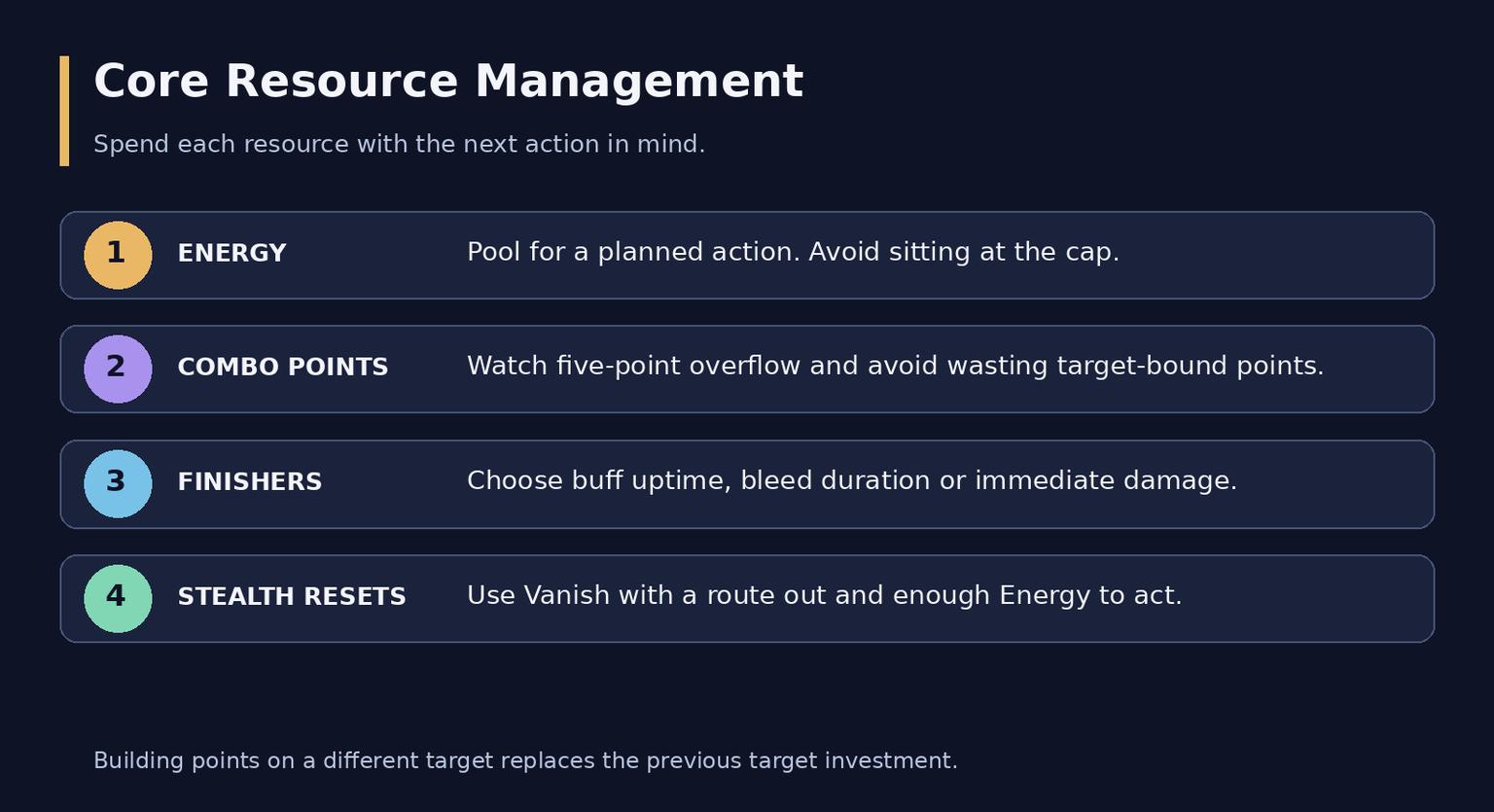
Manage Energy, target-bound Combo Points, finishers and Stealth resets together.
Practice priorities and mistakes
Start by reproducing one legal 21-point build, then test opener points, Slice and Dice uptime and the target's remaining life before each finisher. Add Legacy points only after the benefit is unlocked. Learn which weapon and position each attack needs. In a group, agree on Sap, interrupts and whether Expose Armor is useful before overwriting an existing armor debuff; the stronger applicable reduction takes precedence.
Common mistakes are following a level-60 capstone rotation at level 30, assuming Preparation is baseline, using an unavailable Blind or Wound Poison, building on a new enemy before spending old points, and breaking your own control with bleeds. Other traps are clipping Rupture on a dying enemy, ignoring Energy while chasing and using outdated racial bonuses. Blizzard's final notes also fixed unintended poison retaliation and a respec Energy exploit; neither is a legitimate method to build a rotation around.
Frequently asked questions
How good is Subtlety Rogue in WoW Forever?
The last beta supported a flexible opener, bleed and control playstyle at level 30. It is useful for solo play and PvP, but the closed beta does not establish a launch or level-60 raid DPS ranking.
Which build should I start with for PvE?
Use a legal 0/0/21 Hemorrhage example as a starting point, adapting defensive choices to solo or group play. Dirty Deeds and Preparation require additional investment, such as the separately unlocked Legacy extension described above.
Which build is better for PvP?
The 0/0/21 example with Master of Deception favors Stealth encounters. Setup can suit different melee matchups. Choose according to the control and survival tools you need; Blind is not available at the last beta's level-30 cap.
Which abilities matter most in the damage priority?
Premeditation and an appropriate Stealth opener start the cycle, Hemorrhage builds points, and Slice and Dice, Rupture or Eviscerate spend them according to buff duration and target lifetime. Thousand Cuts belongs to a future deeper build.