Hero Talents in WoW Midnight
Hero Talents give a specialization different ways to develop its combat style. A Hunter can strengthen their bond with beasts or adopt the Dark Ranger's abilities, while a Priest can focus on Halo or tears in the Void. Your chosen tree affects abilities, their interactions, and the order in which you use them.
In Midnight, this progression continues beyond level 80. The game has 40 Hero Talent trees, with two options for each specialization and one active at a time. Demon Hunters also gain Annihilator alongside their new Devourer specialization.
This guide covers Midnight 12.1 as of October 9, 2026. It explains progression and the identity of every tree; a specific raid, dungeon, or PvP build still needs to suit your specialization.
How Hero Talents work
Your talent interface contains a class tree, a specialization tree, and a separate Hero Talent tree. The latter develops a particular combat theme, such as summoning allies, empowering an attack, transforming, or improving familiar spells. It preserves your specialization's role. Blood Death Knights, for example, remain tanks whether they choose Deathbringer or San'layn.
A tree begins with its defining mechanic. Subsequent talents expand it, create interactions with regular abilities, and provide defensive or utility effects. Choice nodes require you to pick one of the available options. Completing the tree does not let you activate both sides of a choice node at once.
Your Hero Talent selection is saved with your talent loadout. You can change it under the usual talent respec rules, outside combat; restrictions also apply during activities such as an active Mythic+ run or PvP match. Prepare the appropriate loadout before starting.
Levels and points up to level 90
Hero Talents unlock at level 71. The starting node of your selected tree activates automatically, and each level from 71 through 80 awards one spendable Hero Talent point. By level 80, you have 10 points plus the starting node.
Midnight adds three more Hero Talent points. The final total is therefore 13 spendable points and 14 active nodes including the starting node. The node count and the number of awarded points are different.
Level | Point awarded | Total spendable Hero Talent points |
71-80 | One Hero Talent point at each level | From 1 to 10 |
81 | Specialization | 10 |
82 | Class | 10 |
83 | Hero | 11 |
84 | Specialization | 11 |
85 | Class | 11 |
86 | Hero | 12 |
87 | Specialization | 12 |
88 | Class | 12 |
89 | Hero | 13 |
90 | Specialization | 13 |
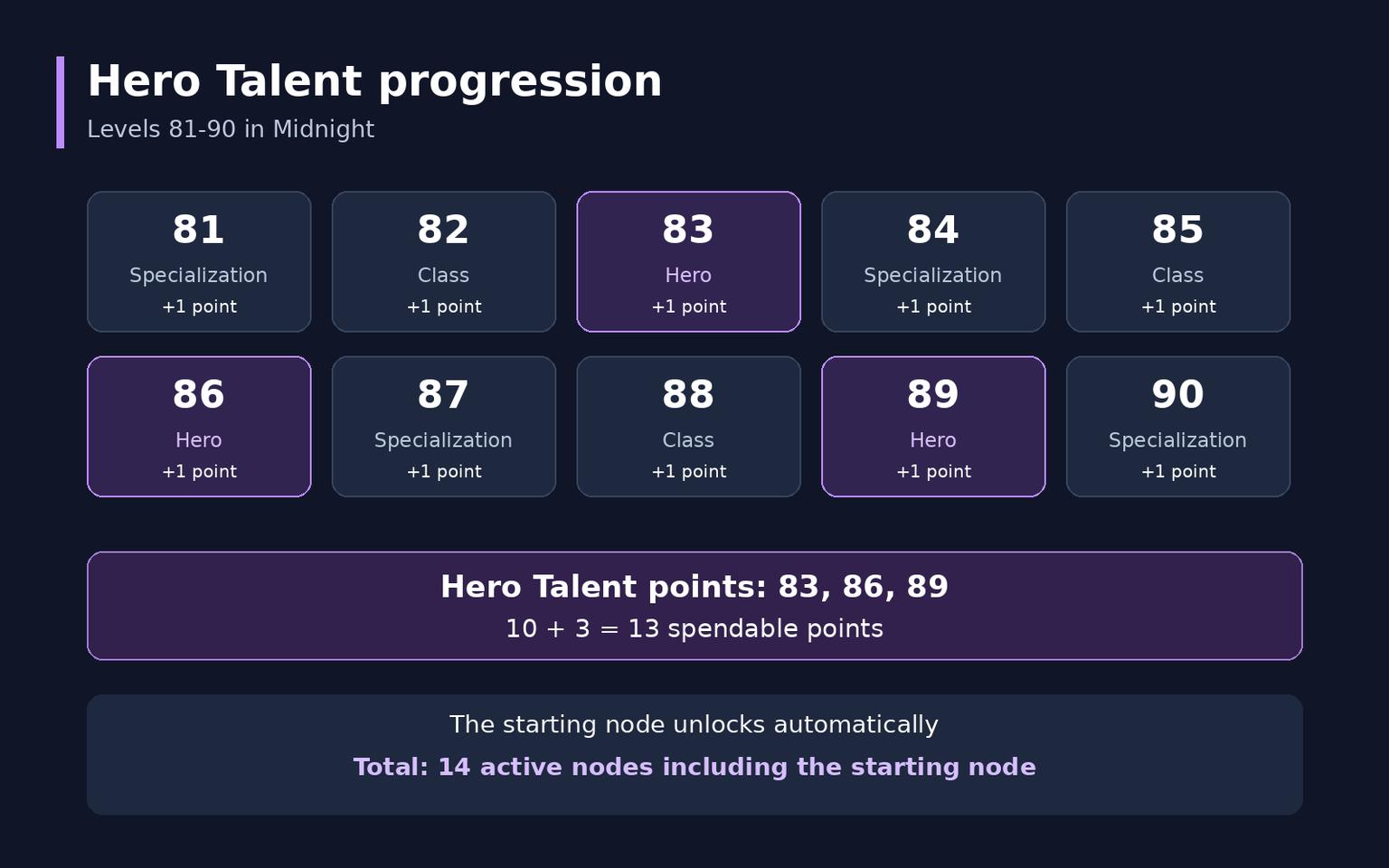
You receive the final Hero Talent point at level 89. Level 90 completes specialization progression. Reaching level 80 filled a Hero Talent tree in The War Within, but it does not finish an expanded Midnight tree.
What changed in Midnight
Each Hero Talent tree gained an additional column containing three nodes. Levels 81-90 award 10 new points in total: three class points, three Hero Talent points, and four specialization points.
Apex Talents also unlock at level 81. They sit within the specialization tree and use its points. Fully developing them takes four points: one for the initial effect, two for the intermediate enhancement, and one for the final effect. These talents develop the specialization's core abilities and work alongside your selected Hero Talent tree.
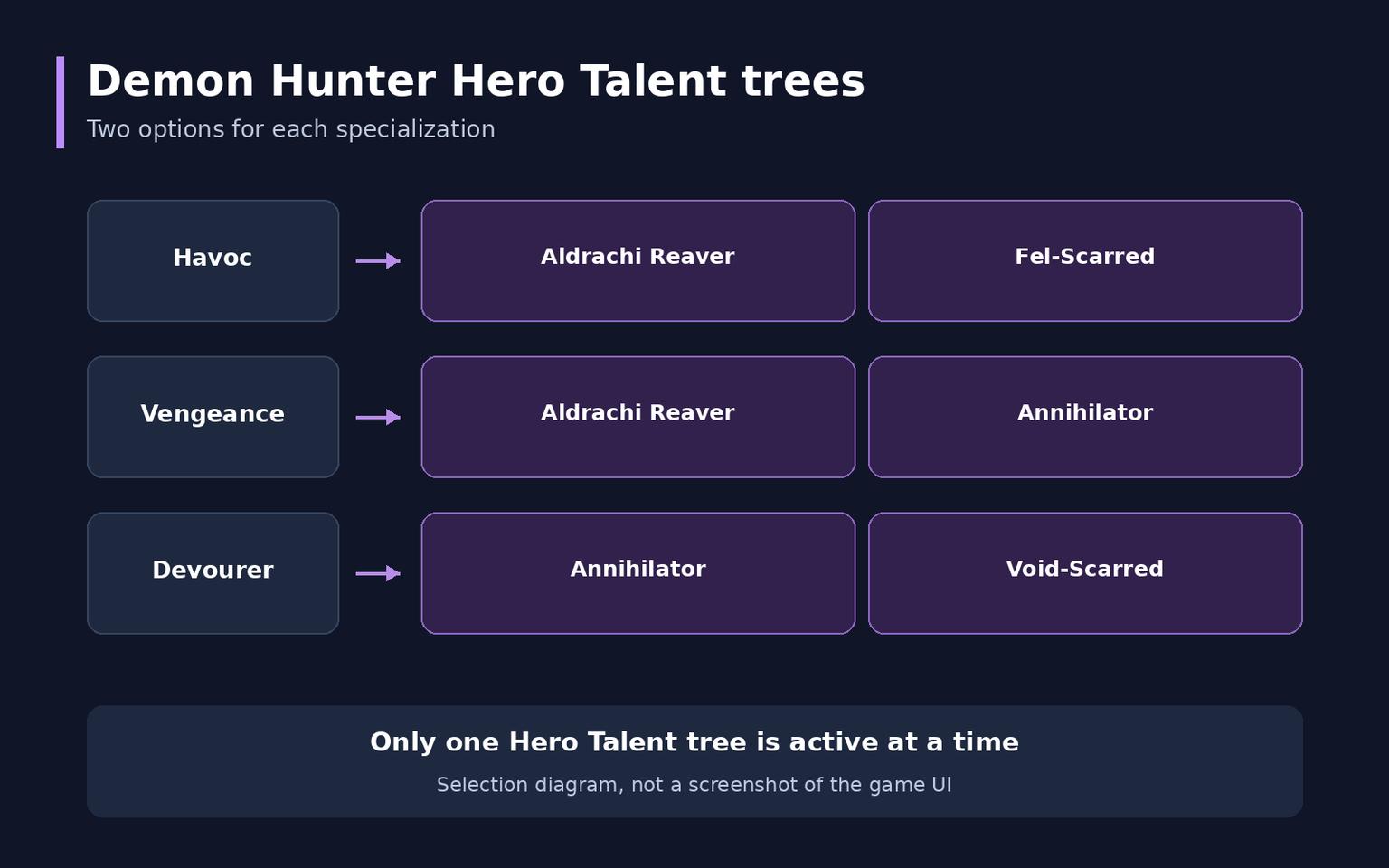
Demon Hunters have new combinations to choose from. Vengeance selects between Aldrachi Reaver and Annihilator. Devourer has Annihilator and Void-Scarred. Havoc retains Aldrachi Reaver and Fel-Scarred. Fel-Scarred and Void-Scarred are related versions of one tree for different specializations; they should not be counted as two separate trees in the overall total.
Individual mechanics have changed too. For Protection Paladins, Templar's access to Hammer of Light is now tied to Divine Toll. Older instructions built around Eye of Tyr no longer apply. Check a returning The War Within loadout's interactions before relying on it.
Every tree by class
The tables show eligible specializations and each tree's central mechanic. Names match the English terms used in guides and talent calculators. Every class has three trees except Druid, which has four.
Death Knight
Tree | Specializations | Core mechanic |
Deathbringer | Blood, Frost | Reaper's Mark and empowered attacks that unleash scythes |
Rider of the Apocalypse | Frost, Unholy | Summoning Horsemen to help attack enemies |
San'layn | Blood, Unholy | Vampiric strikes and interactions between blood and shadow magic |
Demon Hunter
Tree | Specializations | Core mechanic |
Aldrachi Reaver | Havoc, Vengeance | Soul Fragments, Reaver's Glaive, and subsequent empowered attacks |
Fel-Scarred; Void-Scarred | Havoc; Devourer respectively | Empowering demon form; Devourer emphasizes melee combinations and Voidsurges |
Annihilator | Vengeance, Devourer | Voidfall meteors and interactions with the specialization's key abilities |
Druid
Tree | Specializations | Core mechanic |
Elune's Chosen | Balance, Guardian | Lunar magic and enhancements to related abilities |
Druid of the Claw | Feral, Guardian | The empowered Ravage attack and animal form benefits |
Keeper of the Grove | Balance, Restoration | Treants and bonuses linked to summoning them |
Wildstalker | Feral, Restoration | Additional plant effects that deal damage or heal over time |
Evoker
Tree | Specializations | Core mechanic |
Chronowarden | Augmentation, Preservation | Time magic, Chrono Flame, and enhancements to core spells |
Flameshaper | Devastation, Preservation | Dragonflame and interactions between fire effects and damage or healing |
Scalecommander | Augmentation, Devastation | Empower spells, Essence spenders, and aerial support |
Hunter
Tree | Specializations | Core mechanic |
Dark Ranger | Beast Mastery, Marksmanship | Black Arrow and related shadow attacks |
Pack Leader | Beast Mastery, Survival | Summoning beasts and strengthening coordinated pet attacks |
Sentinel | Marksmanship, Survival | Lunar and Arcane effects, with different interactions for each specialization |
Mage
Tree | Specializations | Core mechanic |
Frostfire | Fire, Frost | Combining Fire and Frost effects |
Spellslinger | Arcane, Frost | Creating magical splinters and related enhancements |
Sunfury | Arcane, Fire | Spellfire Spheres and summoning an Arcane Phoenix |
Monk
Tree | Specializations | Core mechanic |
Conduit of the Celestials | Mistweaver, Windwalker | Assistance from the Celestials and the Celestial Conduit ability |
Master of Harmony | Brewmaster, Mistweaver | Storing and spending vitality to enhance damage or healing |
Shado-Pan | Brewmaster, Windwalker | Additional Flurry Strikes and stronger core attacks |
Paladin
Tree | Specializations | Core mechanic |
Herald of the Sun | Holy, Retribution | Solar damage and healing effects |
Lightsmith | Holy, Protection | Sacred weapons and defensive armaments for yourself and allies |
Templar | Protection, Retribution | Hammer of Light and additional Empyrean Hammer strikes |
Priest
Tree | Specializations | Core mechanic |
Archon | Holy, Shadow | An enhanced Halo and interactions with core abilities |
Oracle | Discipline, Holy | Stronger healing; Discipline emphasizes Penance and shields |
Voidweaver | Discipline, Shadow | Entropic Rift and empowered spells while it remains active |
Rogue
Tree | Specializations | Core mechanic |
Deathstalker | Assassination, Subtlety | Marking a selected target and improving damage against it |
Fatebound | Assassination, Outlaw | Coin flips with different effects |
Trickster | Outlaw, Subtlety | Unseen Blade attacks and empowered finishers |
Shaman
Tree | Specializations | Core mechanic |
Farseer | Elemental, Restoration | Summoning ancestors to help deal damage or heal |
Stormbringer | Elemental, Enhancement | Lightning effects and the powerful Tempest spell |
Totemic | Enhancement, Restoration | Surging Totem and enhancements linked to totems |
Warlock
Tree | Specializations | Core mechanic |
Diabolist | Demonology, Destruction | Cycling through powerful demon summons and empowered spells |
Hellcaller | Affliction, Destruction | Wither and enhancements to damage over time |
Soul Harvester | Affliction, Demonology | A demonic soul and extra effects when spending Soul Shards |
Warrior
Tree | Specializations | Core mechanic |
Colossus | Arms, Protection | Building power to strengthen Demolish |
Mountain Thane | Fury, Protection | Lightning, thunder attacks, and interactions with Avatar |
Slayer | Arms, Fury | Execution marks, Execute, and Bladestorm |
How capstone talents affect combat
A Hero Talent capstone usually develops the tree's defining mechanic. Read its effect for your own specialization: the same name does not guarantee identical triggers for a tank, healer, and damage dealer. The following examples show what to look for.
Exterminate for Deathbringer. After Reaper's Mark explodes, it empowers subsequent eligible attacks. Blood uses Marrowrend; Frost uses Obliterate or Frostscythe. An empowered attack summons two scythes and costs one Rune. It is not free, so you still need the resource. The number of empowered casts depends on your talent choices.
Thrill of the Fight for Aldrachi Reaver. For Havoc, consuming both Reaver's Glaive enhancements grants Haste and strengthens the next Reaver's Glaive. Complete the empowered attack sequence rather than stopping after the glaive throw itself.
Claw Rampage for Druid of the Claw. For Feral, Shred and Swipe have a 20% chance to trigger Ravage during Berserk. Ravage replaces your next Ferocious Bite with an empowered area attack. Watch for those procs during Berserk and use them promptly.
Stampede for Pack Leader. For Beast Mastery, the first Kill Command after Bestial Wrath summons a charging line of beasts. Your position relative to the enemy group matters: this is not a circular attack centered on the Hunter.
Isothermic Core for Frostfire. For Fire Mages, Meteor also calls down a Comet Storm. An existing Fire ability gains a Frost component that interacts with the rest of the tree. It shows how enhancing an existing button can substantially change its contribution to combat.
Ruination for Diabolist. Summoning a Pit Lord turns the next eligible spell into Ruination: Hand of Gul'dan for Demonology or Chaos Bolt for Destruction. Keep track of the demon summon cycle so that you recognize the empowered attack when it becomes available.
Choosing a tree
Start with your specialization's two options. Look at what each one adds: a separate ability, a sequence of empowered attacks, a periodic effect, or another summon. For Devourer, for instance, Void-Scarred emphasizes melee combinations, while Annihilator develops meteors and their associated attacks.
Next, identify the content you want to play. Damage against a single boss, quickly clearing groups, and surviving in PvP call for different builds. A recommendation from a raid guide does not automatically suit dungeons just because it covers the same specialization. Compare the complete loadout, including regular and Apex Talents.
After switching trees, check your action bars and read the new effects. A few minutes at a training dummy can help you identify replacement abilities and the effects you need to track. Healers should also consider access to single-target healing and casting while moving; tanks should examine defensive interactions.
Tree rankings depend on balance updates and gear. Save separate loadouts for the activities you play and update them using guidance for the current patch, rather than looking for one permanent choice for the entire expansion.
Frequently asked questions
Can you use two trees at once
No. Only one Hero Talent tree is active for your selected specialization. To use the other, change your loadout or respec.
Why are there both 13 points and 14 nodes
The starting node unlocks automatically. You then receive 10 points from levels 71-80 and three more while leveling through Midnight. Options within a choice node remain mutually exclusive.
Do you have to choose between Hero and Apex Talents
No. They use separate point pools: Hero and specialization points respectively. Both forms of progression belong to the same character loadout.
Do Hero Talents change your rotation
Yes, depending on the tree. Some mainly add passive bonuses; others introduce an ability, replace an attack, or require a different sequence. Check the interactions whenever you switch.
Hero Talents give a specialization different ways to develop its combat style. A Hunter can strengthen their bond with beasts or adopt the Dark Ranger's abilities, while a Priest can focus on Halo or tears in the Void. Your chosen tree affects abilities, their interactions, and the order in which you use them.
In Midnight, this progression continues beyond level 80. The game has 40 Hero Talent trees, with two options for each specialization and one active at a time. Demon Hunters also gain Annihilator alongside their new Devourer specialization.
This guide covers Midnight 12.1 as of October 9, 2026. It explains progression and the identity of every tree; a specific raid, dungeon, or PvP build still needs to suit your specialization.
How Hero Talents work
Your talent interface contains a class tree, a specialization tree, and a separate Hero Talent tree. The latter develops a particular combat theme, such as summoning allies, empowering an attack, transforming, or improving familiar spells. It preserves your specialization's role. Blood Death Knights, for example, remain tanks whether they choose Deathbringer or San'layn.
A tree begins with its defining mechanic. Subsequent talents expand it, create interactions with regular abilities, and provide defensive or utility effects. Choice nodes require you to pick one of the available options. Completing the tree does not let you activate both sides of a choice node at once.
Your Hero Talent selection is saved with your talent loadout. You can change it under the usual talent respec rules, outside combat; restrictions also apply during activities such as an active Mythic+ run or PvP match. Prepare the appropriate loadout before starting.
Levels and points up to level 90
Hero Talents unlock at level 71. The starting node of your selected tree activates automatically, and each level from 71 through 80 awards one spendable Hero Talent point. By level 80, you have 10 points plus the starting node.
Midnight adds three more Hero Talent points. The final total is therefore 13 spendable points and 14 active nodes including the starting node. The node count and the number of awarded points are different.
Level | Point awarded | Total spendable Hero Talent points |
71-80 | One Hero Talent point at each level | From 1 to 10 |
81 | Specialization | 10 |
82 | Class | 10 |
83 | Hero | 11 |
84 | Specialization | 11 |
85 | Class | 11 |
86 | Hero | 12 |
87 | Specialization | 12 |
88 | Class | 12 |
89 | Hero | 13 |
90 | Specialization | 13 |
You receive the final Hero Talent point at level 89. Level 90 completes specialization progression. Reaching level 80 filled a Hero Talent tree in The War Within, but it does not finish an expanded Midnight tree.
What changed in Midnight
Each Hero Talent tree gained an additional column containing three nodes. Levels 81-90 award 10 new points in total: three class points, three Hero Talent points, and four specialization points.
Apex Talents also unlock at level 81. They sit within the specialization tree and use its points. Fully developing them takes four points: one for the initial effect, two for the intermediate enhancement, and one for the final effect. These talents develop the specialization's core abilities and work alongside your selected Hero Talent tree.
Demon Hunters have new combinations to choose from. Vengeance selects between Aldrachi Reaver and Annihilator. Devourer has Annihilator and Void-Scarred. Havoc retains Aldrachi Reaver and Fel-Scarred. Fel-Scarred and Void-Scarred are related versions of one tree for different specializations; they should not be counted as two separate trees in the overall total.
Individual mechanics have changed too. For Protection Paladins, Templar's access to Hammer of Light is now tied to Divine Toll. Older instructions built around Eye of Tyr no longer apply. Check a returning The War Within loadout's interactions before relying on it.
Every tree by class
The tables show eligible specializations and each tree's central mechanic. Names match the English terms used in guides and talent calculators. Every class has three trees except Druid, which has four.
Death Knight
Tree | Specializations | Core mechanic |
Deathbringer | Blood, Frost | Reaper's Mark and empowered attacks that unleash scythes |
Rider of the Apocalypse | Frost, Unholy | Summoning Horsemen to help attack enemies |
San'layn | Blood, Unholy | Vampiric strikes and interactions between blood and shadow magic |
Demon Hunter
Tree | Specializations | Core mechanic |
Aldrachi Reaver | Havoc, Vengeance | Soul Fragments, Reaver's Glaive, and subsequent empowered attacks |
Fel-Scarred; Void-Scarred | Havoc; Devourer respectively | Empowering demon form; Devourer emphasizes melee combinations and Voidsurges |
Annihilator | Vengeance, Devourer | Voidfall meteors and interactions with the specialization's key abilities |
Druid
Tree | Specializations | Core mechanic |
Elune's Chosen | Balance, Guardian | Lunar magic and enhancements to related abilities |
Druid of the Claw | Feral, Guardian | The empowered Ravage attack and animal form benefits |
Keeper of the Grove | Balance, Restoration | Treants and bonuses linked to summoning them |
Wildstalker | Feral, Restoration | Additional plant effects that deal damage or heal over time |
Evoker
Tree | Specializations | Core mechanic |
Chronowarden | Augmentation, Preservation | Time magic, Chrono Flame, and enhancements to core spells |
Flameshaper | Devastation, Preservation | Dragonflame and interactions between fire effects and damage or healing |
Scalecommander | Augmentation, Devastation | Empower spells, Essence spenders, and aerial support |
Hunter
Tree | Specializations | Core mechanic |
Dark Ranger | Beast Mastery, Marksmanship | Black Arrow and related shadow attacks |
Pack Leader | Beast Mastery, Survival | Summoning beasts and strengthening coordinated pet attacks |
Sentinel | Marksmanship, Survival | Lunar and Arcane effects, with different interactions for each specialization |
Mage
Tree | Specializations | Core mechanic |
Frostfire | Fire, Frost | Combining Fire and Frost effects |
Spellslinger | Arcane, Frost | Creating magical splinters and related enhancements |
Sunfury | Arcane, Fire | Spellfire Spheres and summoning an Arcane Phoenix |
Monk
Tree | Specializations | Core mechanic |
Conduit of the Celestials | Mistweaver, Windwalker | Assistance from the Celestials and the Celestial Conduit ability |
Master of Harmony | Brewmaster, Mistweaver | Storing and spending vitality to enhance damage or healing |
Shado-Pan | Brewmaster, Windwalker | Additional Flurry Strikes and stronger core attacks |
Paladin
Tree | Specializations | Core mechanic |
Herald of the Sun | Holy, Retribution | Solar damage and healing effects |
Lightsmith | Holy, Protection | Sacred weapons and defensive armaments for yourself and allies |
Templar | Protection, Retribution | Hammer of Light and additional Empyrean Hammer strikes |
Priest
Tree | Specializations | Core mechanic |
Archon | Holy, Shadow | An enhanced Halo and interactions with core abilities |
Oracle | Discipline, Holy | Stronger healing; Discipline emphasizes Penance and shields |
Voidweaver | Discipline, Shadow | Entropic Rift and empowered spells while it remains active |
Rogue
Tree | Specializations | Core mechanic |
Deathstalker | Assassination, Subtlety | Marking a selected target and improving damage against it |
Fatebound | Assassination, Outlaw | Coin flips with different effects |
Trickster | Outlaw, Subtlety | Unseen Blade attacks and empowered finishers |
Shaman
Tree | Specializations | Core mechanic |
Farseer | Elemental, Restoration | Summoning ancestors to help deal damage or heal |
Stormbringer | Elemental, Enhancement | Lightning effects and the powerful Tempest spell |
Totemic | Enhancement, Restoration | Surging Totem and enhancements linked to totems |
Warlock
Tree | Specializations | Core mechanic |
Diabolist | Demonology, Destruction | Cycling through powerful demon summons and empowered spells |
Hellcaller | Affliction, Destruction | Wither and enhancements to damage over time |
Soul Harvester | Affliction, Demonology | A demonic soul and extra effects when spending Soul Shards |
Warrior
Tree | Specializations | Core mechanic |
Colossus | Arms, Protection | Building power to strengthen Demolish |
Mountain Thane | Fury, Protection | Lightning, thunder attacks, and interactions with Avatar |
Slayer | Arms, Fury | Execution marks, Execute, and Bladestorm |
How capstone talents affect combat
A Hero Talent capstone usually develops the tree's defining mechanic. Read its effect for your own specialization: the same name does not guarantee identical triggers for a tank, healer, and damage dealer. The following examples show what to look for.
Exterminate for Deathbringer. After Reaper's Mark explodes, it empowers subsequent eligible attacks. Blood uses Marrowrend; Frost uses Obliterate or Frostscythe. An empowered attack summons two scythes and costs one Rune. It is not free, so you still need the resource. The number of empowered casts depends on your talent choices.
Thrill of the Fight for Aldrachi Reaver. For Havoc, consuming both Reaver's Glaive enhancements grants Haste and strengthens the next Reaver's Glaive. Complete the empowered attack sequence rather than stopping after the glaive throw itself.
Claw Rampage for Druid of the Claw. For Feral, Shred and Swipe have a 20% chance to trigger Ravage during Berserk. Ravage replaces your next Ferocious Bite with an empowered area attack. Watch for those procs during Berserk and use them promptly.
Stampede for Pack Leader. For Beast Mastery, the first Kill Command after Bestial Wrath summons a charging line of beasts. Your position relative to the enemy group matters: this is not a circular attack centered on the Hunter.
Isothermic Core for Frostfire. For Fire Mages, Meteor also calls down a Comet Storm. An existing Fire ability gains a Frost component that interacts with the rest of the tree. It shows how enhancing an existing button can substantially change its contribution to combat.
Ruination for Diabolist. Summoning a Pit Lord turns the next eligible spell into Ruination: Hand of Gul'dan for Demonology or Chaos Bolt for Destruction. Keep track of the demon summon cycle so that you recognize the empowered attack when it becomes available.
Choosing a tree
Start with your specialization's two options. Look at what each one adds: a separate ability, a sequence of empowered attacks, a periodic effect, or another summon. For Devourer, for instance, Void-Scarred emphasizes melee combinations, while Annihilator develops meteors and their associated attacks.
Next, identify the content you want to play. Damage against a single boss, quickly clearing groups, and surviving in PvP call for different builds. A recommendation from a raid guide does not automatically suit dungeons just because it covers the same specialization. Compare the complete loadout, including regular and Apex Talents.
After switching trees, check your action bars and read the new effects. A few minutes at a training dummy can help you identify replacement abilities and the effects you need to track. Healers should also consider access to single-target healing and casting while moving; tanks should examine defensive interactions.
Tree rankings depend on balance updates and gear. Save separate loadouts for the activities you play and update them using guidance for the current patch, rather than looking for one permanent choice for the entire expansion.
Frequently asked questions
Can you use two trees at once
No. Only one Hero Talent tree is active for your selected specialization. To use the other, change your loadout or respec.
Why are there both 13 points and 14 nodes
The starting node unlocks automatically. You then receive 10 points from levels 71-80 and three more while leveling through Midnight. Options within a choice node remain mutually exclusive.
Do you have to choose between Hero and Apex Talents
No. They use separate point pools: Hero and specialization points respectively. Both forms of progression belong to the same character loadout.
Do Hero Talents change your rotation
Yes, depending on the tree. Some mainly add passive bonuses; others introduce an ability, replace an attack, or require a different sequence. Check the interactions whenever you switch.