WoW Midnight Arcane Mage Guide: Talents, Rotation and Gear
Arcane rewards a player who can keep casting while planning a few seconds ahead. Its damage comes from a connected sequence: generate Arcane Charges and Arcane Salvo, spend them with Arcane Barrage, then use the Prismatic Bolt opportunities that follow. Sunfury adds its Phoenix and Arcane Soul cycle to that foundation.
This PvE guide was checked on October 17, 2026 for Midnight 12.1.5 and Season 2. It focuses on learning the current Sunfury priorities, choosing a build for the encounter and preparing equipment. Arcane can concentrate damage on an important enemy while hitting nearby targets, but scattered enemies and badly timed movement reduce that advantage.
What changed and what to track
Prismatic Bolt is the current Apex talent; Touch of the Archmage was removed in the 12.1 redesign. Arcane Missiles remains central to the specialization rather than being displaced by an Orb-only approach. Arcane Pulse was redesigned as an area attack and charge-recovery tool, while Orb Mastery no longer spends Clearcasting as it did before the redesign.
Do not confuse four different indicators on your interface:
Indicator | What it tells you |
Arcane Charges | Up to four charges; they strengthen core spells and increase Arcane Blast's mana cost |
Clearcasting | Access to Arcane Missiles and a condition for several spending decisions |
Arcane Salvo | A stacking damage benefit consumed by Arcane Barrage; the cap is 25 for Sunfury and 20 for Spellslinger |
Prismatic Bolt | A temporary replacement for Arcane Blast triggered through spending Salvo with Barrage |
Prismatic Bolt generates four charges and hits the main target plus nearby enemies. Its damage and mana cost do not scale with Arcane Charges, and it is not simply an Arcane Blast with every Blast modifier attached. Use its actual effect and the current priority rather than transferring assumptions from the spell it replaces.
Show these indicators near your character, together with Arcane Surge and Touch of the Magi. A clean view of the next decision is more useful than a large collection of unrelated alerts. The built-in cooldown tracking tools provide a starting point; check any optional addon's compatibility with current combat-information restrictions.
Hero Talents and encounter builds
Sunfury is the current recommended PvE starting point for both raiding and Mythic+. Spellslinger remains an alternative playstyle built around splinters, but its presence in the talent interface does not imply equal current performance. Treat recommendations as patch-specific rather than permanent class rules.
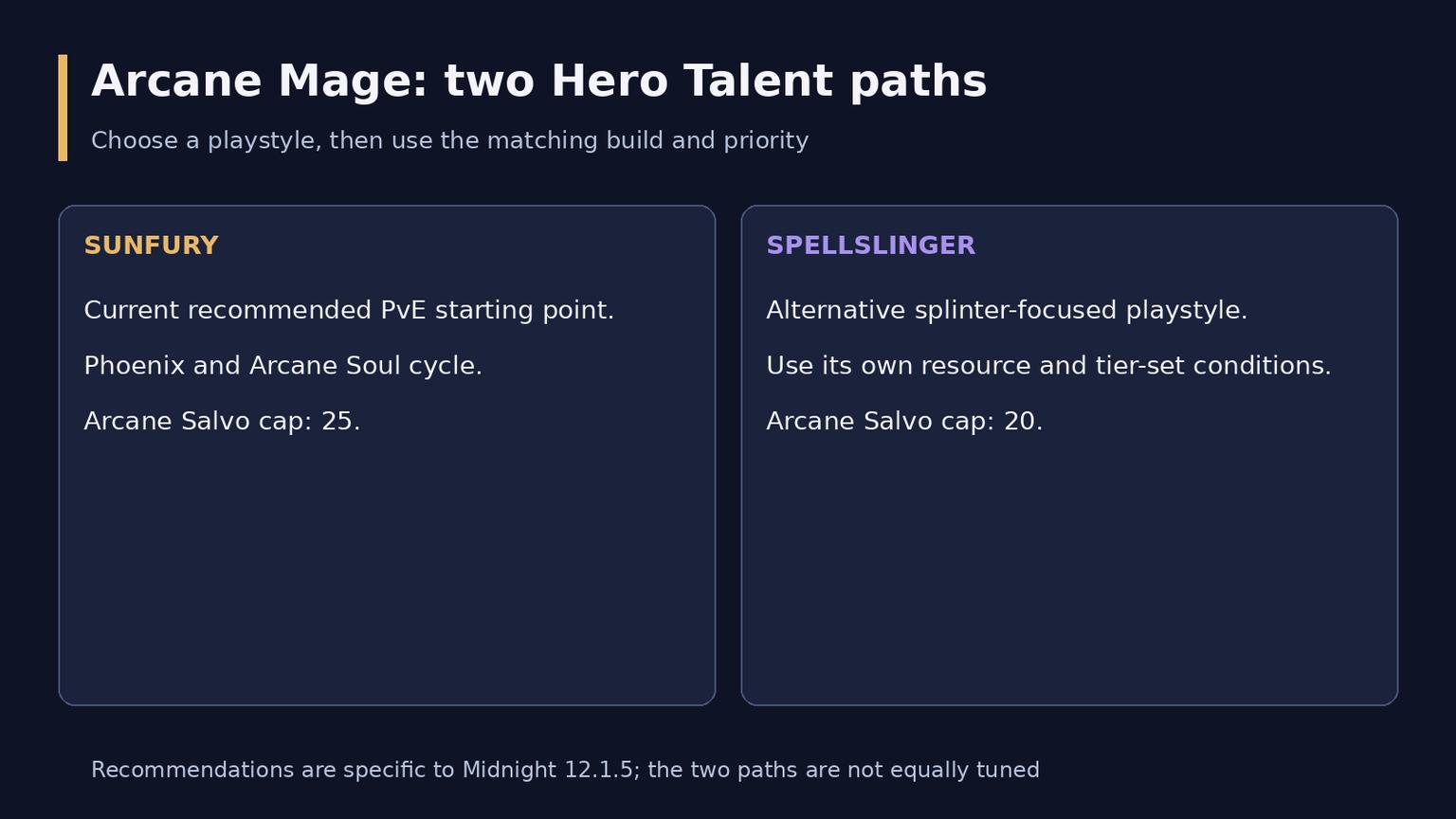
Compare the two Arcane Hero Talent paths
Choose the rest of your talents around the encounter:
Situation | Build direction |
One boss with no extra enemies | Pure single-target setup |
Raid encounter with additional enemies | Raid/cleave setup so your main-target damage also contributes to waves |
Mythic+ | Area-damage setup with dungeon-specific utility such as curse removal or control |
Delves and outdoor play | Preserve the damage engine while allocating more mobility, control and survival |
A small theoretical damage gain is not useful if the chosen utility leaves your group unable to handle a dangerous cast or curse. Before importing a new setup, check its content label, Hero tree and optional active spells. Do not copy an old level-by-level table that still assigns points to a removed Apex talent.
During leveling, learn resource generation and Barrage recovery first. Use major cooldowns on worthwhile enemies instead of saving them throughout an entire questing session. A leveling character will not yet have every endgame interaction, so add complexity as the relevant talents become available.
A practical Sunfury priority
The following is a compact learning priority for the current Sunfury style. Read from the top after every action and use the first applicable line. It is not a repeating sequence that requires every spell to be cast once. Spellslinger and optional talents can change the conditions.
1. Use Arcane Missiles with Clearcasting when you have fewer than 12 Arcane Salvo stacks.
2. During Arcane Soul, prioritize Arcane Barrage.
3. Use an available Prismatic Bolt; with four-piece equipped, aim to benefit from eight Cumulative Power stacks when practical.
4. Use Arcane Barrage with Clearcasting and at least 12 Salvo, or when Salvo reaches the Sunfury cap of 25. Normally aim to Barrage at four charges.
5. Rebuild low charges with Arcane Orb; the current Sunfury reference uses it below three charges.
6. Use Arcane Blast when none of the higher-priority actions applies. Barrage is also a fallback when you cannot afford another Blast.
The opener has its own sequence and can use Barrage before reaching the normal four-charge condition. Do not delay the entire opening cooldown window merely to satisfy a rule intended for the sustained priority.
The key decision is whether spending now allows efficient rebuilding. Always waiting for 25 Salvo can waste a useful Clearcasting cycle; firing Barrage at low Salvo without a reason can waste the resources you just built. Follow the conditions rather than adopting either extreme.
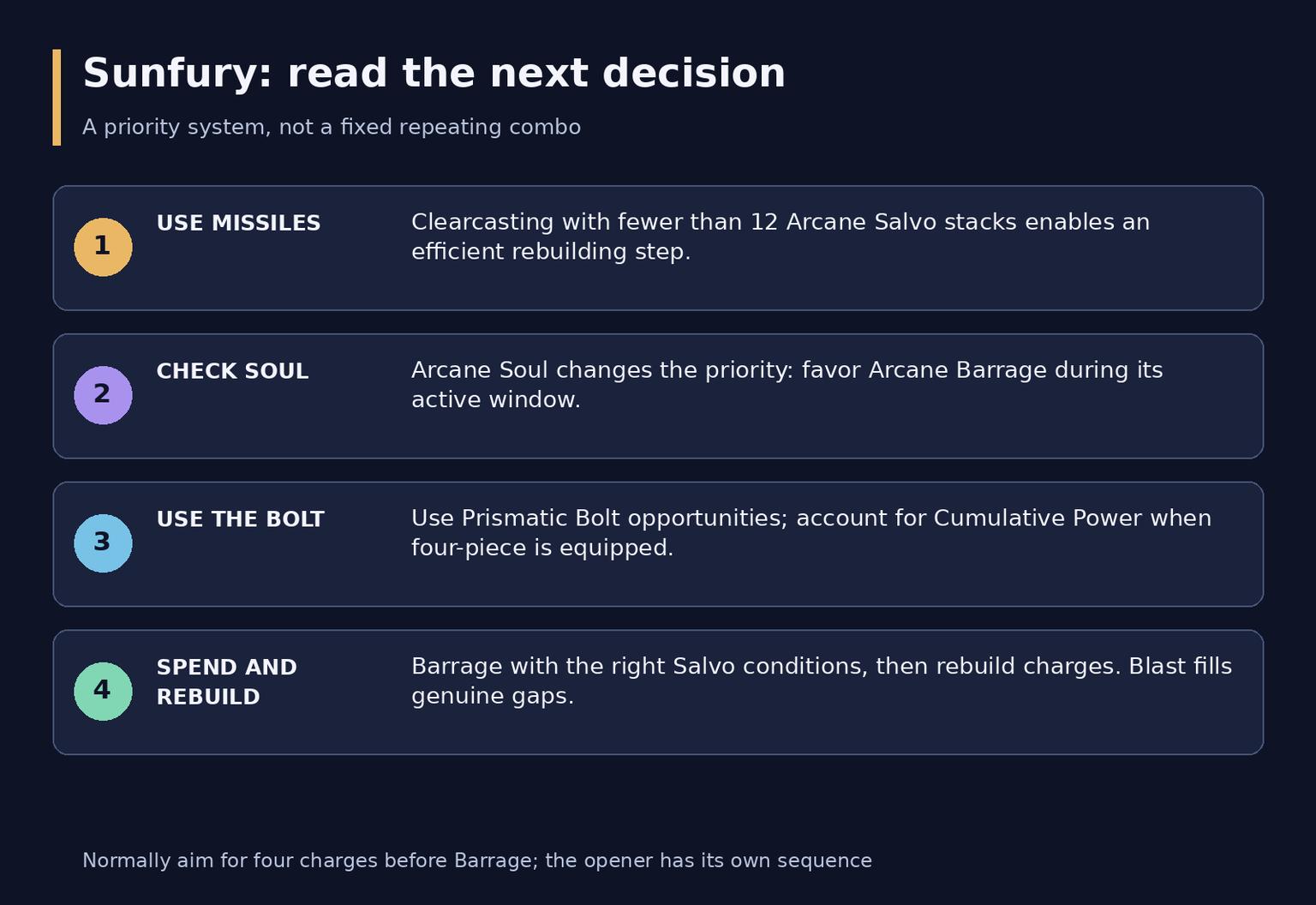
Read the Sunfury resource decisions in order
Several enemies and priority damage
The basic engine remains similar against grouped enemies. Keep the durable priority target selected, let the tank establish the group and check that nearby enemies are actually in range of your cleave. A large target count on the nameplate display is not proof that every spell will hit every enemy.
Arcane Orb can rebuild charges efficiently in a group. Arcane Pulse is an optional talent, not a mandatory button in every recommended Sunfury build. If you select it, use the priority appropriate to that setup instead of forcing it into every single-target cycle. Targets can die before a cooldown's payoff, so judge the remaining life of the pack as well as its size.
Open the fight and preserve cooldown alignment
Arcane Surge has a 90-second cooldown and Touch of the Magi has a 45-second cooldown. There is one intermediate Touch between the paired windows. This is the opposite of waiting for every second Surge before using Touch.
For an opening window with both ready:
1. Prepare long-duration offensive items before Surge so their effects cover it.
2. Pre-cast Arcane Surge for the pull when the encounter allows it.
3. Activate shorter offensive item effects at the appropriate point after Surge.
4. Cast Arcane Missiles, then Arcane Barrage.
5. Apply Touch of the Magi while Barrage is traveling, before it lands, then follow the normal priority.
Coordinate Time Warp with the group; it is not an automatic extra step on every pull. Different trinkets have their own timing requirements, so an item with a special mechanic may need more than a generic “use all cooldowns” macro.
Use the next Touch around 45 seconds later rather than saving it without a specific encounter reason. A short delay for an imminent priority wave can be sensible, but repeatedly delaying the intermediate Touch also shifts the next paired window. Before holding an ability, identify what the delay gains and whether it costs a use before the fight ends.
Choose a Touch target that will survive its damage-storage period, normally twelve seconds. A nearly dead minor enemy can be a poor anchor even when it is surrounded by other enemies. Move into a stable position before the window, so forced travel does not replace the casts intended to build its damage.
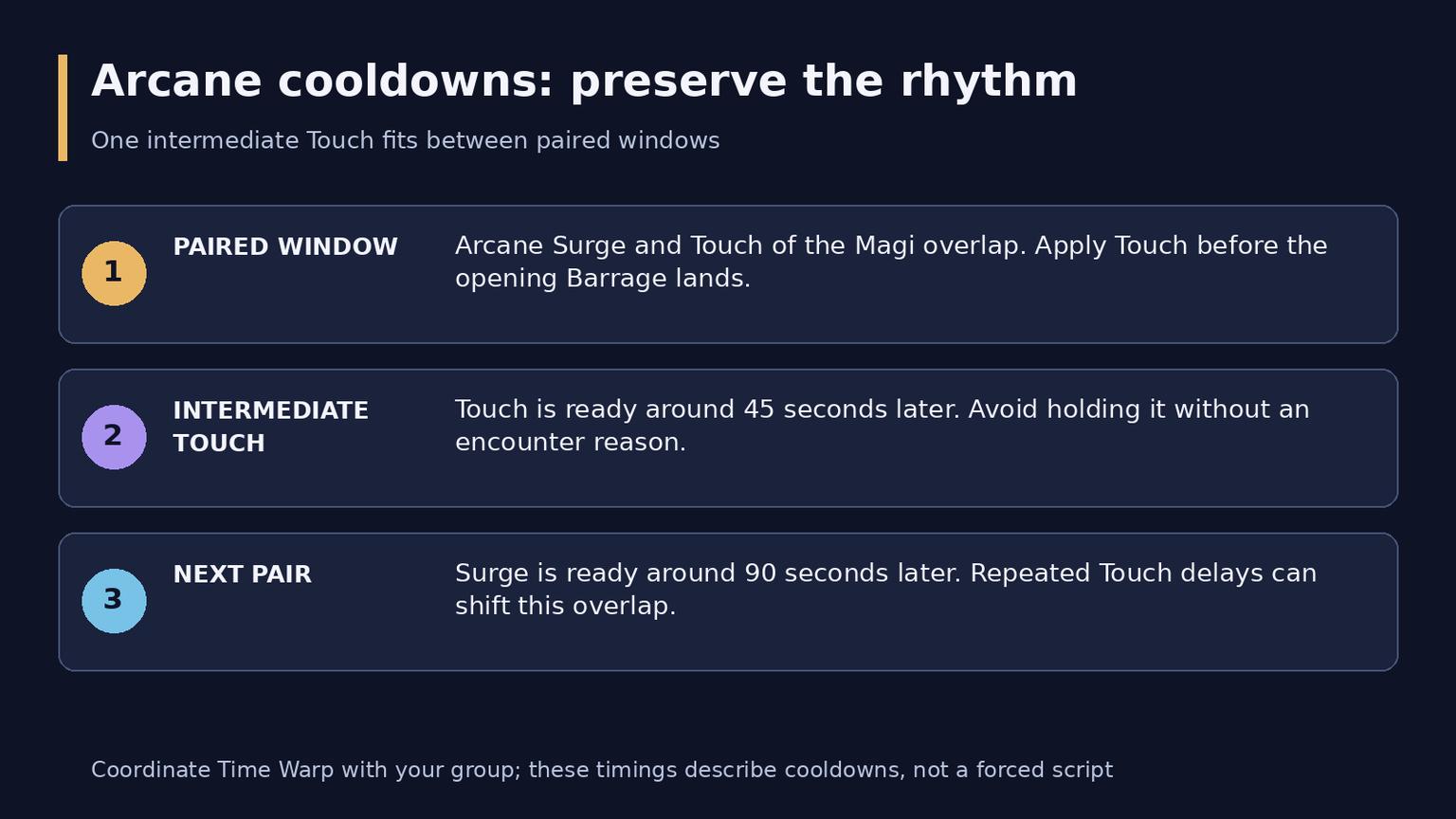
Plan the paired and intermediate cooldown windows
Mana, movement and staying alive
Mana still exists, and high-charge Arcane Blast is expensive, but the current missile-centered Sunfury cycle is much less about deliberately emptying and refilling mana than older versions of Arcane. Do not interrupt a productive damage window just to follow an obsolete fixed mana percentage.
Arcane Surge spends mana and then greatly accelerates regeneration. Evocation, when talented, is a recovery option rather than a mandatory pre-pull channel. If you repeatedly run dry, first check whether you are filling too much time with Blast, ignoring Clearcasting or delaying Surge.
Plan small movements around instant spells. Slipstream, when selected, allows movement during the relevant channels; Shimmer or Blink handles repositioning according to the chosen talents. Reposition early when a mechanic is predictable, then reserve an emergency movement tool for the unexpected.
Prismatic Barrier should be used before predictable damage. Alter Time requires a useful starting health and position, so think about where its return will place you. Mirror Image interacts with Refractive Images, which delays part of incoming damage over time. That is not the same as permanently removing all of that damage; remain alert to the delayed portion and the next mechanic.
Counterspell, Spellsteal and Remove Curse can matter more to a pull than one additional damage cast. Assign interrupts before combat where possible. An enemy being knocked up by control does not mean its important cast is permanently handled or that it cannot immediately resume another spell.
Equipment and the Season 2 set
Secure four-piece before chasing a perfectly curated list of armor slots. The Season 2 two-piece adds a missile wave and increases Arcane Missiles damage by 5%. Four-piece grants Cumulative Power from missile waves: 3% per stack for the next Arcane Blast, Arcane Pulse or Prismatic Bolt, up to 24%. The older 40% value is obsolete.
For Sunfury, the set supports the existing missile-and-Bolt engine. Track the buff without turning every proc into an indefinite wait for a perfect moment. Losing a usable Bolt or missing an important damage window can outweigh a theoretical extra stack.
These are useful equipment targets, not a guarantee that every listed item beats everything already in your bags:
Item | Source and role |
Jan'thrazet, the Soul Fang | Ula'tek; standout weapon with an additional effect |
Freightrunner's Flask | Murder Row; on-use trinket to evaluate with your cooldown windows |
Twisted Horror's Tendril | Kith'ix; current raid trinket target |
Aln'hara Lantern | Crafted off-hand option |
Martyr's Bindings | Crafted wrist option |
In Season 2, Catalyst conversion retains the source item's stats, so inspect eligible items rather than assuming the printed tier name determines the best stat combination. Compare the whole equipment set, including four-piece, sockets and special effects. A weapon upgrade is worth investigating early, but a universal crest order cannot account for every replacement you already own.
For a costly craft, compare the proposed item with your existing setup before committing resources. Evaluate trinkets as a pair, not as two isolated rankings. A lower-ranked item that you can use properly can be preferable to an effect that conflicts with the encounter or your other trinket.
Stats, gems and consumables
Intellect is the primary stat and Haste is a strong general secondary-stat starting point. The other secondary stats are close enough, and their ordering varies enough by profile, that a rigid universal list is misleading. Compare meaningful upgrades with a character simulation; do not discard a higher-level item solely because one secondary stat appears lower in a generic ranking.
There is no special Haste percentage that everyone must reach before Arcane works. Diminishing returns reduce the value of additional rating at thresholds; they do not turn the stat off. Keep the actual gain and the rest of your equipment in view.
Preparation | Practical choice |
Flask | Flask of the Blood Knights is a safe general option; compare alternatives for your gear |
Damage potion | Light's Potential |
Healing potion | Concentrated Silvermoon Health Potion |
Weapon augment | Thalassian Phoenix Oil |
Food | Silvermoon Parade or an appropriate maximum-stat meal |
Augment rune | Void-Touched Augment Rune, when its cost suits the content |
For enchants, Mark of the Worldsoul on the chest, Arcanoweave Spellthread on legs and Eyes of the Eagle on rings are useful reference choices. Weapon-enchant recommendations differ between current profiles, so compare Rite of the Hash'ey and Acuity of the Ren'dorei rather than declaring one permanently best. Non-damage slots can support movement or damage avoidance.
Only one epic gem can be equipped. Powerful Eversong Diamond benefits from the surrounding gem-color setup; an Intellect-oriented alternative can be competitive with fewer sockets. Do not copy a complete color arrangement without having the sockets it assumes. Use a simulation for the finished configuration rather than comparing a single gem in isolation.
Professions can support crafting, consumables or income. Choose them for those uses; learning a profession does not replace acquiring a good item, selecting the right talents or practicing the cooldown sequence.
A short practice plan
Start with a stable target and learn to identify Charges, Salvo, Clearcasting and Bolt without searching the screen. Then practice the Surge-Missiles-Barrage-Touch opening until you can apply Touch before the projectile lands. Add the intermediate Touch, movement and defensive timing in separate steps.
When reviewing a run, ask concrete questions: did a cooldown lose an entire use, did Touch go onto a dying enemy, did a Bolt opportunity sit unused, or did avoidable movement stop your casts? Fix the largest repeated loss before making minor gear changes. The goal is reliable decisions in the encounter, not a perfect-looking resource bar on a training dummy.