Best DPS in WoW Midnight: Raids, Mythic+ and Solo
There is no single DPS specialization in WoW Midnight that solves every combat problem equally well. Raiding calls for damage on the right target alongside reliable mechanics, Mythic+ adds crowd control and dungeon pacing, and solo play requires surviving without a dedicated healer. A combined tier hides those differences, making it a poor starting point for choosing a character.
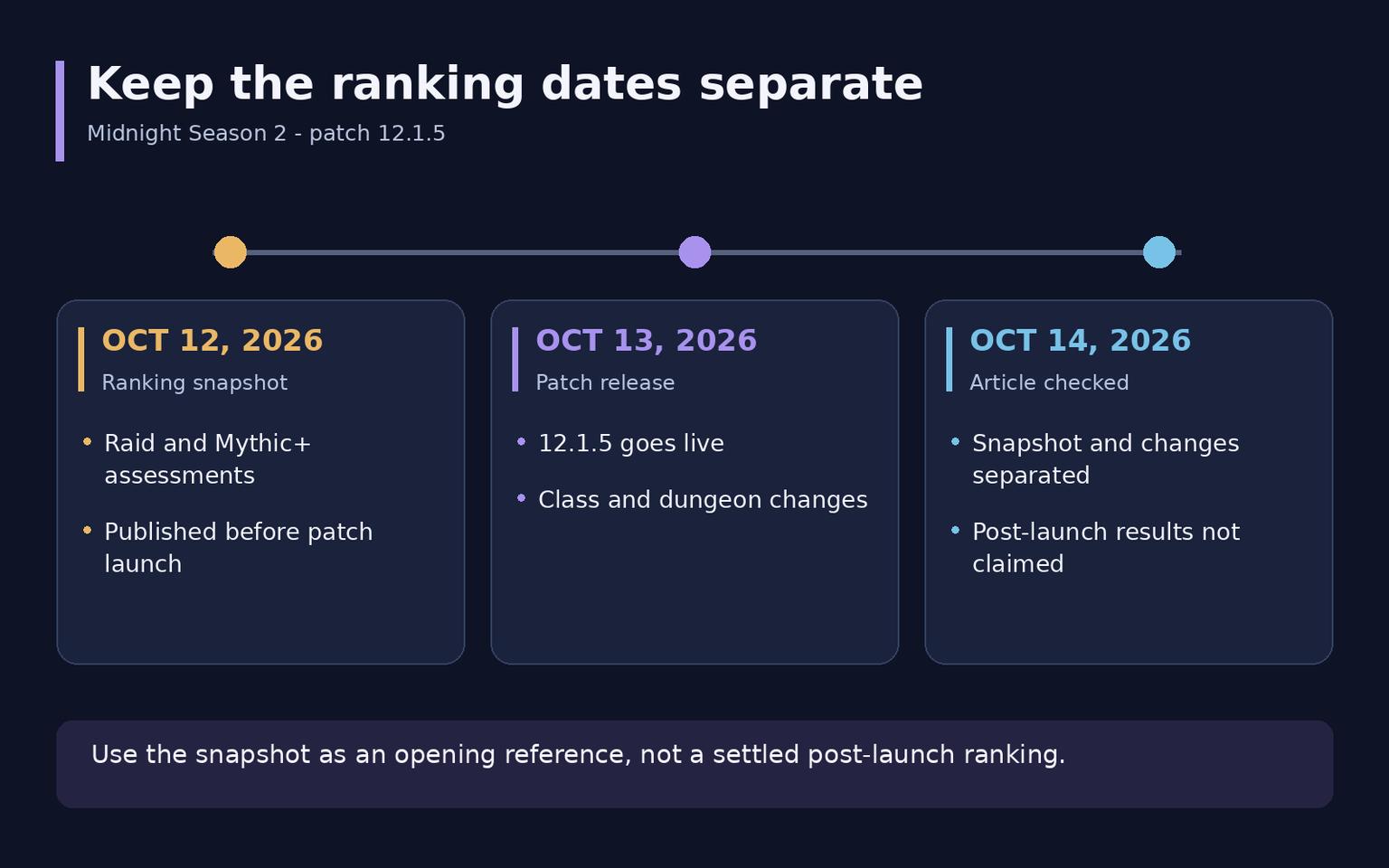
This guide was checked on October 14, 2026, after the release of patch 12.1.5. The comparison uses Icy Veins' Season 2 assessments updated on October 12. Treat them as a reference for the opening of the patch, rather than a settled ranking based on results collected after its launch.
How to read a DPS tier list
DPS stands for damage per second, but a specialization's placement reflects more than that number. Raid value depends on encounter length, required burst windows, additional targets, and contribution to the lineup. Mythic+ also brings pack transitions, interrupts, crowd control, and surviving dangerous attacks into the comparison.
Letters represent groups within the author's assessment. S+ and S are the highest placements, A+ and A the next group, and B and C lower placements. A letter does not correspond to a fixed percentage damage gap. Compare it within the same activity and the same edition of the list.
The table covers 16 options: strong candidates for group play and several useful contrasts. It is a selection to help you choose a character, rather than a complete catalogue of every specialization. Row order does not rank specializations within a tier.
Class and specialization | Raids | Mythic+ |
Unholy Death Knight | S | A |
Frost Death Knight | A | A+ |
Devourer Demon Hunter | A | A+ |
Feral Druid | B | S |
Beast Mastery Hunter | C | A+ |
Arcane Mage | A+ | S+ |
Windwalker Monk | A | S |
Retribution Paladin | A+ | S |
Shadow Priest | A+ | B |
Assassination Rogue | A+ | S+ |
Outlaw Rogue | B | S |
Subtlety Rogue | A | A+ |
Elemental Shaman | B | S+ |
Demonology Warlock | S | A+ |
Arms Warrior | A+ | S+ |
Augmentation Evoker | B | C |
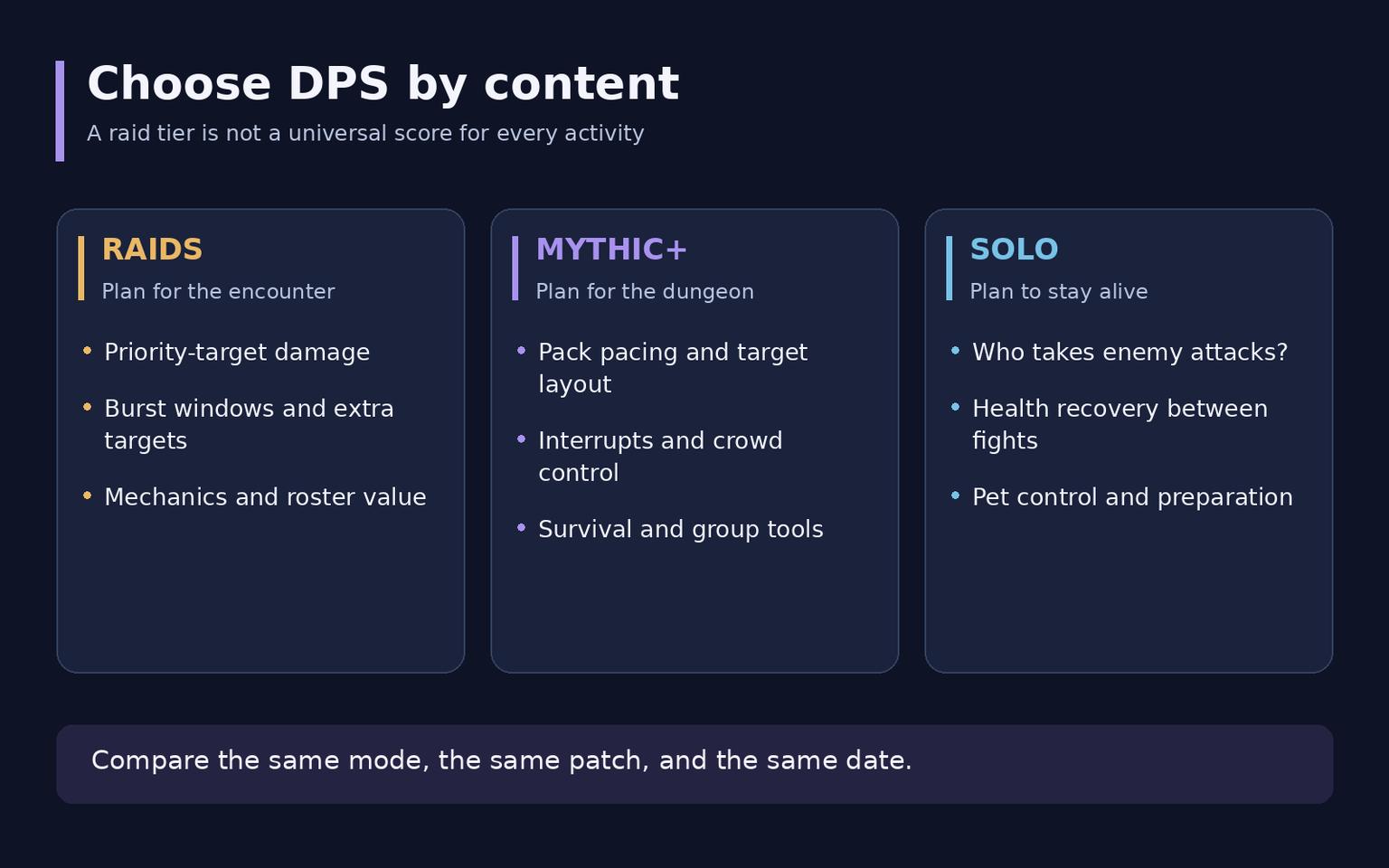
This comparison helps avoid a common mistake when switching activities: a choice that suits your raid roster may not be the most convenient option for your regular dungeon party. Check the current specialization guide before making the final decision.
What to check after patch 12.1.5
The update arrived on October 13 and affects more than classes. The official hotfixes dated that day also change enemy health and damage in dungeons. An earlier specialization comparison therefore cannot automatically be treated as a test of every condition in the new patch.
Devourer players should pay particular attention to their talent setup. Blizzard changed Collapsing Star: cancelling the cast no longer triggers the previous five-second cooldown, and a cast already underway gains extra range tolerance. However, repeatedly cancelling it cannot slow Fury drain indefinitely. Several talents also moved, and Void-Scarred interactions changed.
These are reasons to review the current build and rotation, rather than to promote the specialization in a tier list yourself. New equipment and further tuning may alter the assessment. If you plan to play a character for months, understanding its combat style matters more than predicting the next movement between letters.
Six specializations to compare first
Demonology Warlock
Demonology revolves around summoned demons, with resource generation between summons. It combines single-target damage with attacks against enemies grouped together. Predictable movement suits the specialization better than chaotic repositioning and frequent target changes, which complicate damage preparation.
Consider it if you enjoy managing summons and preparing attacks ahead of time. On a familiar boss, work out when additional enemies will appear and plan your summons around that moment. Having numerous minions does not replace watching your own position.
Unholy Death Knight
Unholy combines diseases, summoned undead, and direct attacks. It has defensive tools and can continue a substantial part of its damage when forced away from an enemy. Target changes need to account for reapplying diseases and moving pets into position.
It suits players willing to plan attacks and track several effects. Identify the important target with your group before the pull. Prepared pressure on a dangerous enemy is more useful than a late attempt to redirect every minion towards something already close to dying.
Arcane Mage
Arcane alternates powerful cooldown windows with quieter periods between them. Mana remains an important resource: performance depends on managing expenditure and recovery alongside offensive cooldowns. Additional targets can help increase pressure on the main enemy.
Choose it if you enjoy planning when to deliver damage. Before entering a dungeon, think about typical enemy lifetimes and when the party needs a major attack. Poorly timed cooldowns can waste the advantage offered by a well-chosen talent setup.
Arms Warrior
Arms uses relatively short burst windows and offers options for single-target, two-target, and broader multitarget damage. Its toolkit requires melee access, while self-healing is not its defining advantage.
Consider it if you enjoy heavy-weapon combat and are prepared to maintain contact with enemies. Plan how to leave dangerous ground and return safely, because time spent unable to attack affects your result. Strong damage never removes the need to use defensives and handle mechanics.
Elemental Shaman
Elemental combines spell damage with control and support tools. Its setup can accommodate different tasks, but target distribution matters: fighting two enemies is not equivalent to attacking a large, tightly grouped pack. Movement also requires attention to the abilities available at that moment.
It is worth considering if you enjoy helping shape a dungeon's pace. Coordinate interrupts and control so that several players do not spend every tool on the same cast. That cooperation can improve a run even without increasing your personal damage.
Assassination Rogue
Assassination deals damage through poisons, bleeds, and their amplification. It works well on an important target, but establishing effects takes time. Defensive and control tools help it survive mechanics and reduce pressure on the group.
The specialization suits players who prefer deliberate work on a chosen enemy. When your party changes targets, consider the new target's remaining health and expected lifetime. Fully preparing long-lasting effects is not always worthwhile if your teammates will kill it with their next few attacks.
Choosing melee or ranged
Decide which combat distance you enjoy before comparing neighbouring tiers. Melee players repeatedly solve the problem of keeping access to a target without taking avoidable hits. Casters choose when to stand still and when to move. Ranged does not automatically mean easier, and melee does not automatically mean weaker.
If you want to move frequently while attacking, consider Beast Mastery Hunter. Its regular combat loop allows almost continuous movement, although particular talent setups include stationary casts. That freedom can make learning mechanics more comfortable than playing a higher-ranked specialization with an unfamiliar rhythm.
Picking a DPS for solo play
For quests and ordinary outdoor enemies, ask who takes the hits, how health is restored, and how much preparation the next fight requires. The group table above is not a solo-progression ranking.
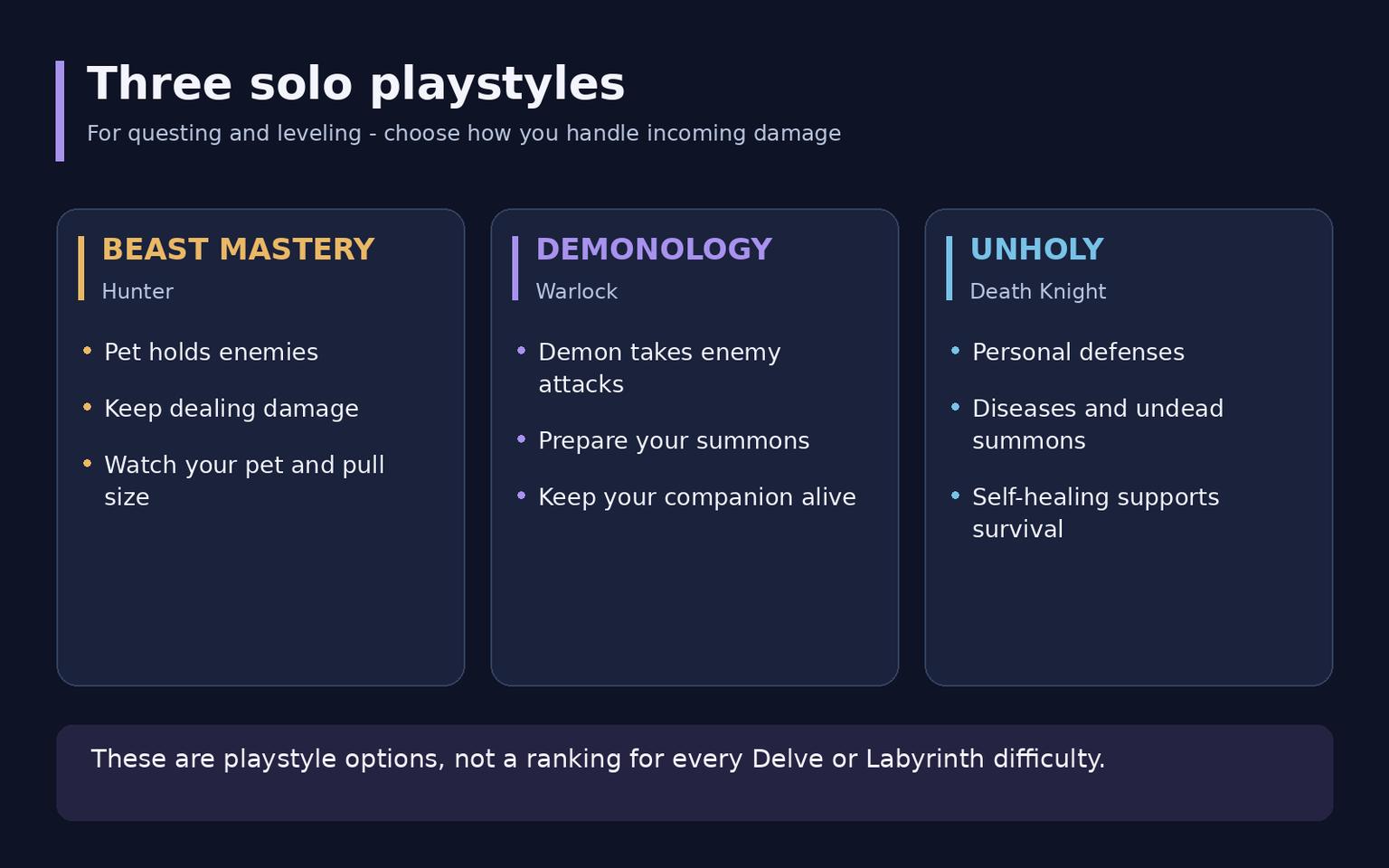
Beast Mastery Hunter can use a pet to hold enemies. Demonology Warlock has a demon that helps fulfil the same role, taking attacks while the player deals damage. In either case, monitor your companion's condition and avoid pulling more enemies than you can safely manage.
Unholy Death Knight offers a different approach: personal defenses, diseases, summons, and self-healing. It suits players who prefer staying closer to enemies. These suggestions concern the convenience of questing and leveling. They do not promise success at every Delve difficulty, elite event, or Labyrinth challenge without preparation.
Matching a DPS to your party
Start with what the lineup already provides. Does it need another interrupt, more control, additional protection, or a particular damage profile? A second character with similar tools can help, but it may also leave the same weakness unresolved.
Evaluate Augmentation Evoker through its contribution to allies. Its value depends on teammates' actions, so a personal damage row does not describe everything it adds. Providing support does not, by itself, guarantee that it is the strongest choice for a particular lineup.
Before committing to a new specialization, try it in several familiar encounters. Compare more than total damage: examine missed casts, deaths, work on the priority target, and your share of mechanics. That review helps identify the actual obstacle, whether it is character setup, an unfamiliar rotation, or a combat style that does not suit you.
Frequently asked questions
Should I change characters after every update
Usually, review talents, equipment, and mistakes first. A specialization change requires learning. Its position in somebody else's ranking does not automatically give you the experience needed to play it well.
Can I use this table for PvP
No. This guide covers group PvE. Arenas and battlegrounds need separate assessments of control, defensives, teammate interactions, and current PvP tuning.
Does a low tier mean a specialization is unplayable
No. A ranking compares choices under particular conditions. Preparation, encounter knowledge, and completing assigned tasks also matter for an actual group. A low assessment is not a ban on playing the character.
What is a comfortable starting choice
For quests, Beast Mastery Hunter or Demonology Warlock is a sensible starting point if you enjoy pet gameplay. For a group, choose a combat style you like, then study its current guide and your lineup's requirements.