Best WoW Midnight Professions for Gold, Crafting and Housing
Herbalism and Mining are a reasonable first pair for a new character with a modest budget. If personal consumables matter more, consider Alchemy with Herbalism. For equipment, choose a craft around the items you need; for housing, begin with the decor you want. No profession is the best at making gold, supplying a raid and furnishing every room at the same time.
This guide was checked on October 14, 2026 for Midnight Season 2, in the context of patch 12.1.5. It compares profession roles, useful combinations and the cost of developing them. It does not promise gold per hour: material prices, finished-item prices and access to recipes differ between players and change over time.
A shortlist for each goal
A character can learn two primary professions. Cooking and Fishing do not occupy those slots, so you can develop them alongside your main pair. This table identifies practical candidates rather than assigning letters to their earning potential.
Goal | Consider | Check before committing |
Gather materials without production | Herbalism + Mining | Route efficiency and material prices |
Supply your own potions and flasks | Alchemy + Herbalism | Recipes and the full reagent cost |
Make plate equipment and weapons | Blacksmithing + Mining | The relevant specialization and order demand |
Make leather or mail armor | Leatherworking + Skinning | Armor type and available recipes |
Make cloth armor and process items | Tailoring + Enchanting | Cloth cost and disenchanting results |
Produce gems and jewelry | Jewelcrafting + Mining | Required quality and ore-processing cost |
Produce runes, contracts and written goods | Inscription + Herbalism | Product choice and ink cost |
Create devices and convenience items | Engineering + Mining | Device restrictions and other crafted materials |
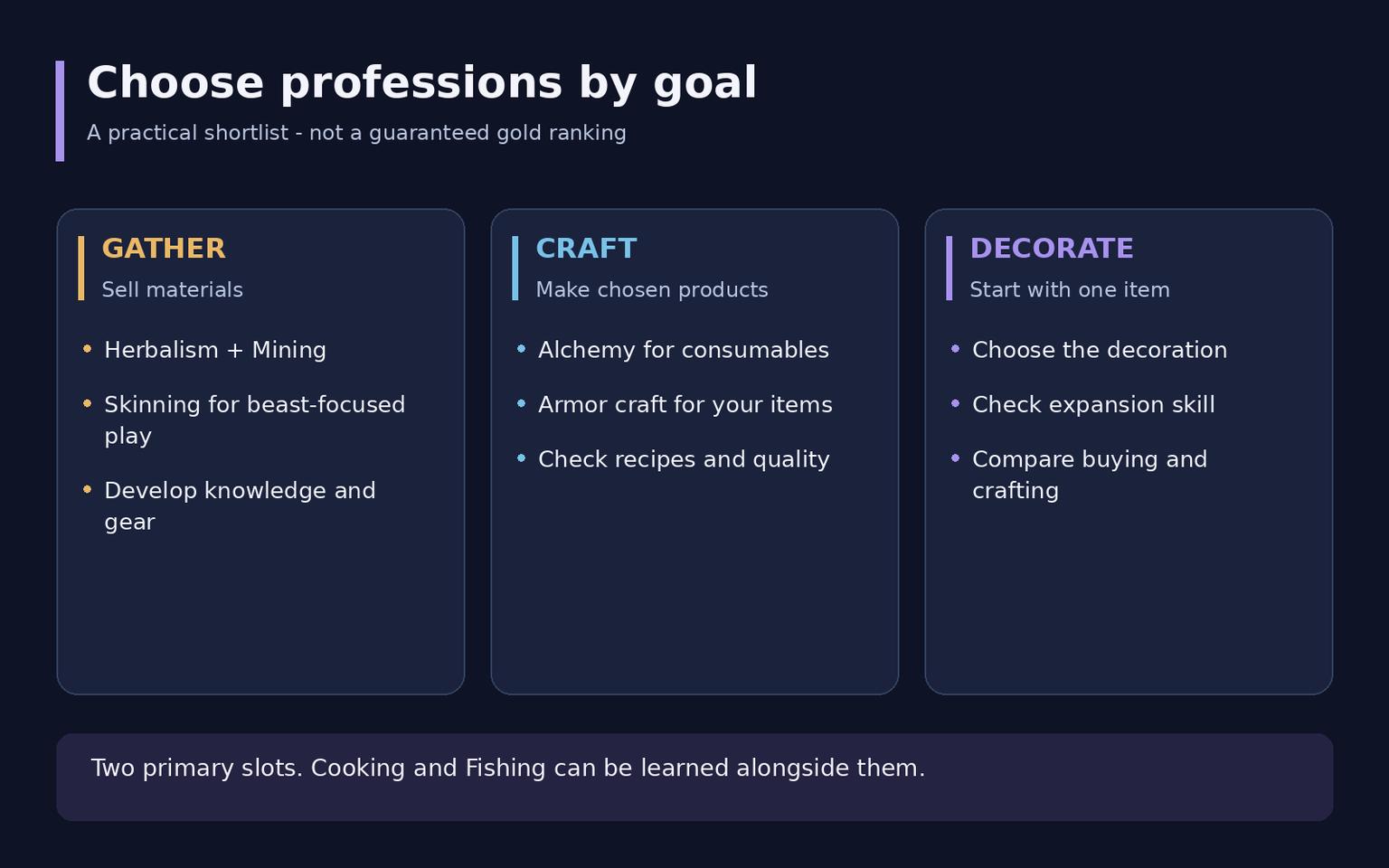
A gathering-and-crafting pair simplifies sourcing, but it does not make production free. Gathered materials could have been sold, so their market value remains part of your cost. Two production professions are also valid if you are prepared to buy reagents or supply the character from another hero.
What the professions offer
Herbalism and Mining
Herbs primarily supply Alchemy and Inscription, while ore supports Blacksmithing, Jewelcrafting and Engineering. Gathering lets you begin selling materials without establishing a production catalog. Knowledge and profession equipment still affect longer-term efficiency, so equal results without development should not be assumed.
This pair suits someone who enjoys exploring and collecting resources between quests. Compare routes using time spent and materials actually sold, rather than the fullness of your bags. A more expensive reagent is not automatically the better target if finding it takes much longer.
Skinning
Skinning supplies leather and scales for Leatherworking. It fits naturally when your usual activities already involve killing suitable creatures. Specializations develop different gathering directions, so judge the profession against the enemies you actually encounter.
It is not a requirement for Leatherworking: you can buy its materials instead. If gathering through combat appeals to you, however, the connection between the two is straightforward. Check whether the materials you obtain sell at an acceptable price before investing heavily.
Alchemy
Alchemy creates potions, flasks and materials through transmutation. It is convenient for a character that regularly uses consumables. Investment in the appropriate specialization can also extend flask duration, giving personal value even without production for sale.
For earning gold, select a particular direction. Potions, flasks and transmutes have different costs. Players regularly consuming potions does not establish profit for every Alchemist. Compare the complete recipe cost, the required quality and Concentration spending before building a large inventory.
Inscription
Scribes make Vantus Runes, contracts, stat-selecting Missives, selected weapons and profession equipment. Treatises also support profession knowledge progression. The catalog is broad, but preparing one clear product line is more manageable than trying to develop everything at once.
Consider Inscription if working across several product types sounds interesting and you are willing to assess each market. Herbalism supplies part of the raw material chain for inks. A large catalog does not prove that Inscription is automatically the best profession for every player or market.
Jewelcrafting
Jewelcrafters produce gems, rings, necklaces and profession accessories. Prospecting ore supplies material for further processing, making Mining a natural partner. Buying ore and other reagents remains an option if you prefer production to gathering.
Decide whether your initial focus is gems or jewelry orders. These require different development choices. One successful recipe does not establish the profitability of the entire profession. When processing ore, account for material yields and purchase cost rather than valuing the operation only by its rarest possible result.
Enchanting
Enchanting improves equipment and converts suitable items into reagents through disenchanting. It can be useful to someone who regularly acquires loot and wants to produce gear enhancements. Disenchanting is not always more valuable than selling the item, so compare the available alternatives.
Tailoring offers a convenient connection between making equipment and processing it. Do not craft armor solely for disenchanting without calculating the cloth and additional reagent costs. For selling enchants, begin with a small selection whose costs and sales you can follow.
Blacksmithing, Leatherworking and Tailoring
Blacksmiths make plate armor, weapons and profession tools. Leatherworkers produce leather and mail armor, along with selected enhancements and drums. Tailors make cloth equipment, bags, spellthreads and profession gear, and can develop time-limited specialty cloth production.
Choose a craft around the items and specialization you want to develop. Quality and recipe access may require knowledge, equipment and investment. An order-based business also needs customers: learning a profession does not itself create a queue of paying clients.
Tailoring does not need a separate gathering profession to obtain cloth. Mining is a useful partner for Blacksmithing, and Skinning for Leatherworking. These are convenient sourcing routes rather than a requirement for combat power; many crafted items can be commissioned from someone else.
Engineering
Engineers make devices, weapons, equipment, profession items and decor. In Midnight, discovering some recipes involves recycling crafted reagents from other professions. Mining therefore helps with sourcing, but does not cover the whole material list.
Choose Engineering for particular devices and the crafting process itself. Before investing, check which items require the profession to use and which work for a buyer without it. The existence of an Engineering combat-resurrection device, for example, does not mean only Engineers can use it.
Evaluate earnings before producing stock
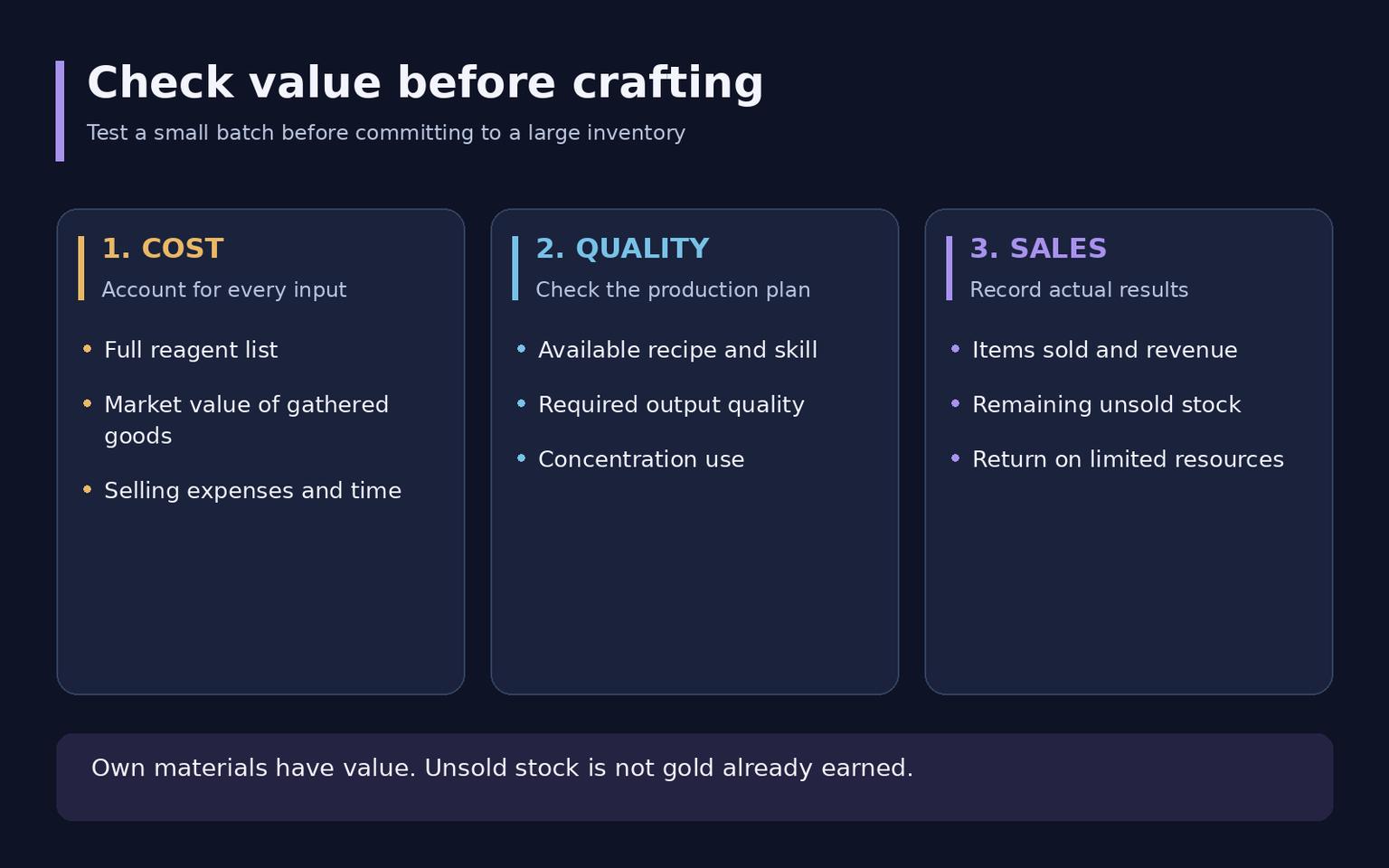
Separate gathering sales, auction production and crafting orders. Gathering is primarily constrained by your time. Production adds recipe access, quality, Concentration and reagent costs. Orders also depend on their terms, commission and whether you can meet the customer's requirements.
Calculate a small trial batch first. Subtract all reagent costs and selling expenses from expected revenue. Record how much actually sold, along with the time spent gathering, crafting and listing. Unsold stock is not gold you have already earned.
Concentration can raise crafting quality, but its supply is finite and recovers over time. Compare the return on that resource as well as the margin on one item. Producing a larger volume does not fix an unprofitable basic calculation.
Expert lists can identify candidates, but an August forecast for the season's opening is not an October price check. Inscription, Jewelcrafting, Tailoring and Alchemy offer different production opportunities. A trial calculation is a better way to choose between them than assuming a fixed income from any of them.
Class pairings and multiple characters
Your class suggests interesting products without dictating a mandatory profession pair. Warriors, Paladins and Death Knights may enjoy Blacksmithing; Mages, Priests and Warlocks may prefer Tailoring. Hunters, Shamans and Evokers wear mail, so Leatherworking serves them as well as leather users.
Rogues, Druids, Monks and Demon Hunters have another clear reason to consider Leatherworking. Any class may still get more practical value from Alchemy, gathering or Engineering. Base the choice on activities and recipes instead of armor type alone.
With several characters, you can keep gathering on the one that spends time outdoors and crafting on a hero with an established catalog. This is an organizational suggestion, not shared profession progression: check knowledge, recipes and Concentration separately for each character. Test demand on the first producer before building a large group of crafting alts.
Cooking and Fishing
Cooking supplies individual food and group feasts. Fishing provides fish for some recipes and can be an activity in its own right. Both can be learned alongside two primary professions, so neither needs to replace your main craft or gathering skill.
You do not have to catch every fish yourself to use Cooking; buying ingredients is possible. Fishing need not serve Cooking exclusively either, since catches can be sold. Match the choice to your routine and compare finished food with its complete ingredient cost before assuming that making it yourself saves gold.
Choosing professions for housing decor
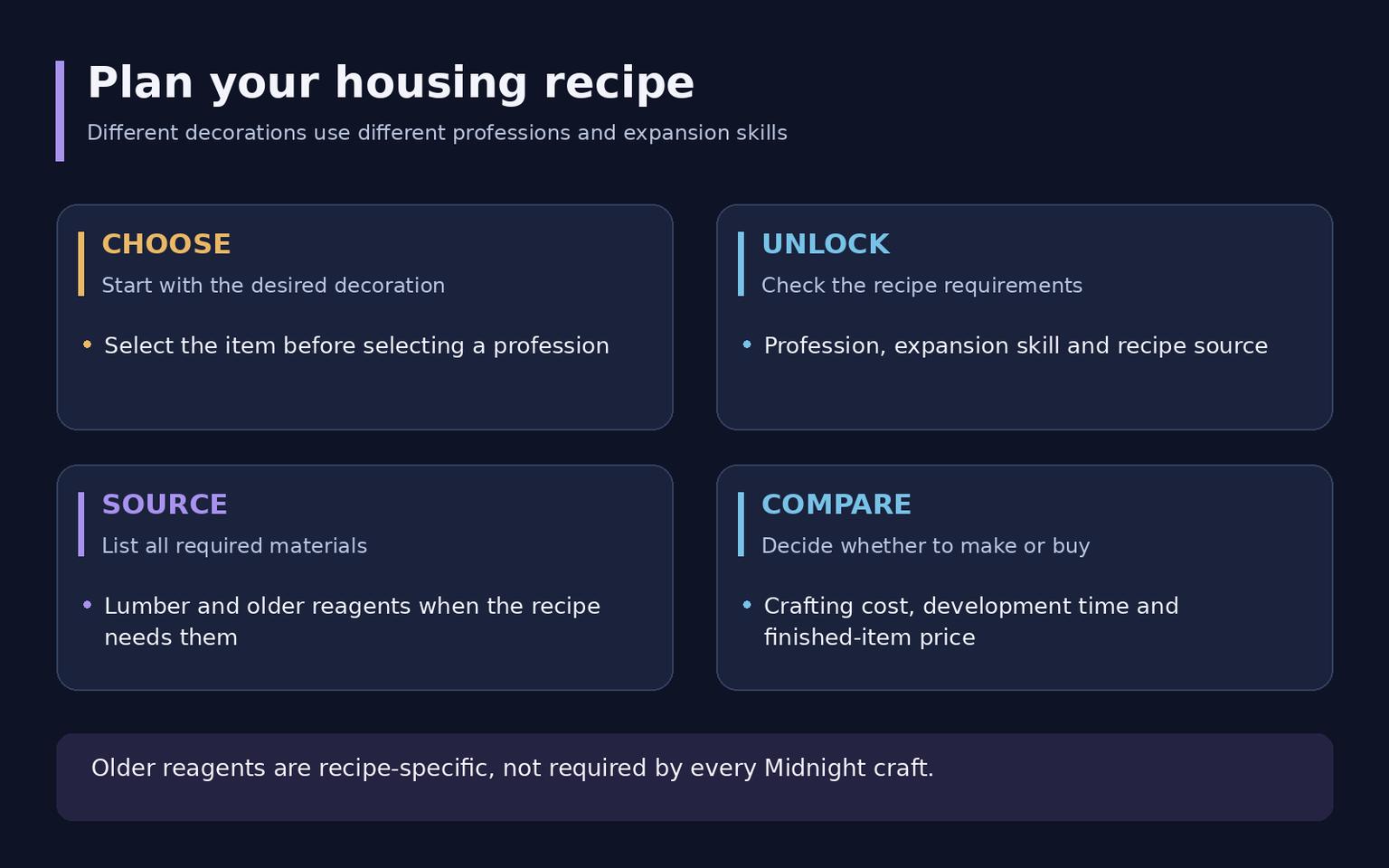
Several crafting professions make decor, including Cooking. Inscription, Tailoring, Blacksmithing and other crafts supply different items. Beginning with a particular decoration is more useful than trying to declare one profession the winner for every interior.
Blizzard confirms that decor recipes use reagents from different expansions and lumber. That does not mean every Midnight combat recipe needs older materials. For a particular item, check the expansion skill, recipe source and complete reagent list. Alchemy also makes dyes, but strong demand for every color is not guaranteed.
For one decoration, compare buying it with developing a profession solely to make it. For regular decor crafting, build a small catalog and check its material cost. Evaluate old supplies against relevant recipes: not everything in the bank belongs at a vendor, but not every stored item has automatically become valuable.
A plan before your first investment
Choose one main goal and two or three relevant recipes. Check where that expansion's profession is learned, how recipes are obtained and which knowledge branch they need. Begin with accessible crafts and useful first-craft bonuses rather than purchasing supplies for the entire catalog.
Artisan's Moxie is profession-specific, so do not plan to move a universal balance between different crafts. Allocate knowledge around your chosen goal too. Since patch 12.1, Theremis offers a one-time knowledge reset for each profession. Treat it as a chance to revise your plan rather than unlimited switching between builds.
After several play sessions, compare cost, convenience and results. If personal supply is the goal, assess that benefit separately from sales income. Change direction after checking the evidence, so that an unsupported promise of greater profit does not waste the time already invested.
Frequently asked questions
Which pair is suitable for a beginner?
Herbalism and Mining provide a clear starting point if you enjoy gathering. Earnings depend on routes and prices, while knowledge and equipment remain relevant to development.
Must I choose a craft for my class's armor?
No. It is a convenient theme rather than a requirement. Many items can be commissioned, leaving your primary professions free for other goals.
Which profession guarantees the most gold?
None guarantees a fixed result. Compare accessible recipes, quality, material cost and actual sales in your market.
Are old materials needed for every recipe?
No. Their use is confirmed for particular decor recipes. Check the reagent list of each product separately.