WoW Midnight Druid Guide: Specs, Talents and Gameplay
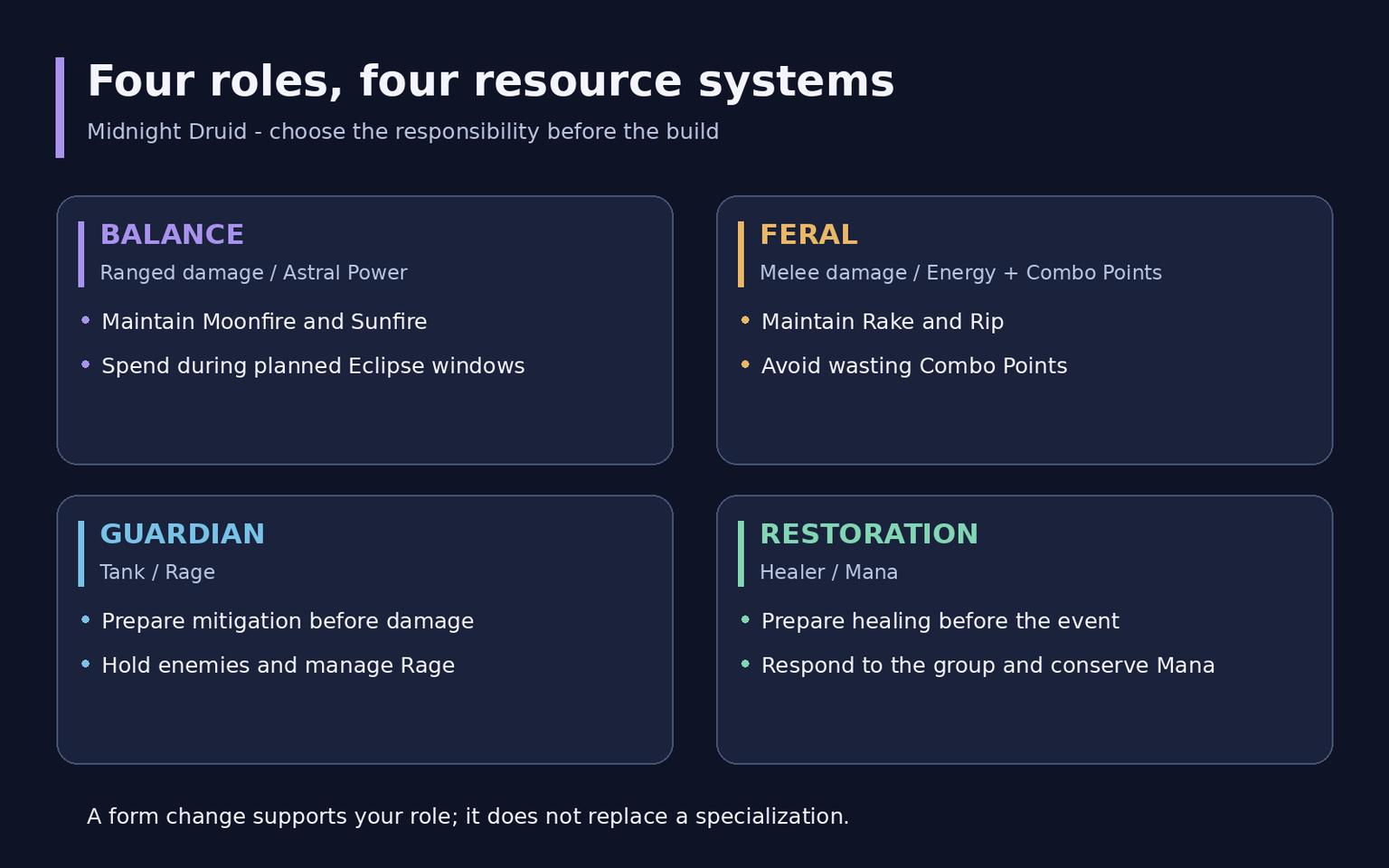
Druid offers tanking, healing, melee damage and ranged damage. Shifting forms alone does not replace a specialization: a healer's Cat Form does not supply the full Feral toolkit, and a Balance character entering Bear Form does not become a dedicated tank. A new role needs appropriate talents, equipment and practice.
This guide covers Midnight PvE, Season 2 and patch 12.1.5, with information checked on October 14, 2026. Start with the job you want to perform, then learn its resource and core abilities. That explains why one Druid prepares healing before damage, another pools Astral Power, and a third divides Rage between mitigation and attacks.
Specialization | Role and resource | Main responsibility |
Balance | Ranged damage, Astral Power | Maintain damage-over-time effects and use Eclipse windows |
Feral | Melee damage, Energy and Combo Points | Maintain Bleeds and spend efficiently on finishing moves |
Guardian | Tank, Rage | Hold enemies and prepare mitigation for incoming damage |
Restoration | Healer, Mana | Prepare heal-over-time effects and respond to dangerous events |
Strengths and practical limits
Forms, movement tools and utility let Druids contribute beyond their main role. That flexibility needs discipline: an unnecessary shift can take time away from healing or mitigation. Helping someone else works best when your own responsibility is already covered. Keep Mark of the Wild active on the group before combat. Assign utility ahead of time and check which tools your selected build actually provides.
Guardian has a relatively approachable foundation for a new tank, but learning the route and dangerous enemies remains essential. Restoration rewards knowledge of upcoming damage. Feral manages two resources, while Balance plans empowered windows and movement between them. Choose according to those jobs rather than a blanket claim that the entire class is easy or difficult.
Race and forms
Consider form appearances, faction access and the value of racial abilities in your group. No race is universally best for all four specializations. Midnight adds Haranir to the available options: they can be Druids on either faction and are unlocked through the expansion campaign. Check allied-race access before creating your character.
What changed in Midnight
Season 2 changes
In 12.1, Balance received a more pronounced Astral Power cycle: generation and some free spender procs were reduced while spenders were strengthened. Preparing for Eclipse therefore matters more, but pooling should never become an excuse to waste generation at a full resource bar.
Feral received talent and tuning updates. Bleeds and Energy management remain central. Effects applied during Tiger's Fury retain its enhancement for their duration, so a simpler specialization still requires attention to that interaction.
Guardian's Gory Fur and Wild Guardian were redesigned. The former links free uses of defensive and offensive Rage spenders; the latter awakens a spirit that interacts with Thrash and Mangle. The older description involving echoed abilities after Berserk ends should not be used for the current build.
Restoration received updates to Innervate, Tranquility and several talents. Innervate restores Mana instead of granting the former free-casting window. Tranquility provides protective roots with damage absorption and knockback protection. Overgrowth now exists as a new talent linked to Nature's Swiftness and the next Regrowth; an old list of removed abilities does not describe its current version.
The relevant 12.1.5 update
Restoration's Nature's Bounty was redesigned: Regrowth also heals up to three allies with Rejuvenation active for 15% of its healing, prioritizing the most injured. When talented, prepared effects therefore support both the damage event and the healing that follows it.
The other three specializations received no comparable overhaul of their core gameplay in 12.1.5. New items can still change gearing decisions. Check build and equipment recommendations separately from the date of a major class redesign.
Talents for the encounter
The class tree supplies shared defensive, control and movement tools; the specialization tree establishes your primary role. A Hero Talent tree adds another layer. First identify the encounter: a raid boss, enemy groups in Mythic+, or solo play. After importing a build, read the changed abilities and put the required buttons on your bars.
Specialization | Available Hero Talent trees | Specialization Apex talent |
Balance | Keeper of the Grove / Elune's Chosen | Ascendant Eclipses |
Feral | Druid of the Claw / Wildstalker | Unseen Predator |
Guardian | Druid of the Claw / Elune's Chosen | Wild Guardian |
Restoration | Keeper of the Grove / Wildstalker | Everbloom |
Apex talents belong to the specialization tree, rather than providing a third alternative Hero Talent tree. Their names help identify the correct build, but you still need to understand their current interactions.
Keeper of the Grove Balance revolves around Force of Nature windows. Elune's Chosen with Lunar Calling changes your builder: Starfire is used even against one target, and Solar Eclipse is disabled. The instruction to always use Wrath against a single enemy therefore does not fit every build.
For Feral, Druid of the Claw emphasizes direct attacks and interacts with Ravage, while Wildstalker works with Bloodseeker Vines. Guardian's Elune's Chosen strengthens lunar abilities, including Lunar Beam; Druid of the Claw provides a different attack profile. For Restoration, choosing between Keeper of the Grove and Wildstalker depends on the group's healing needs and talent synergies. Another player's single successful run is a poor reason to change trees.
Core gameplay for each specialization
Balance
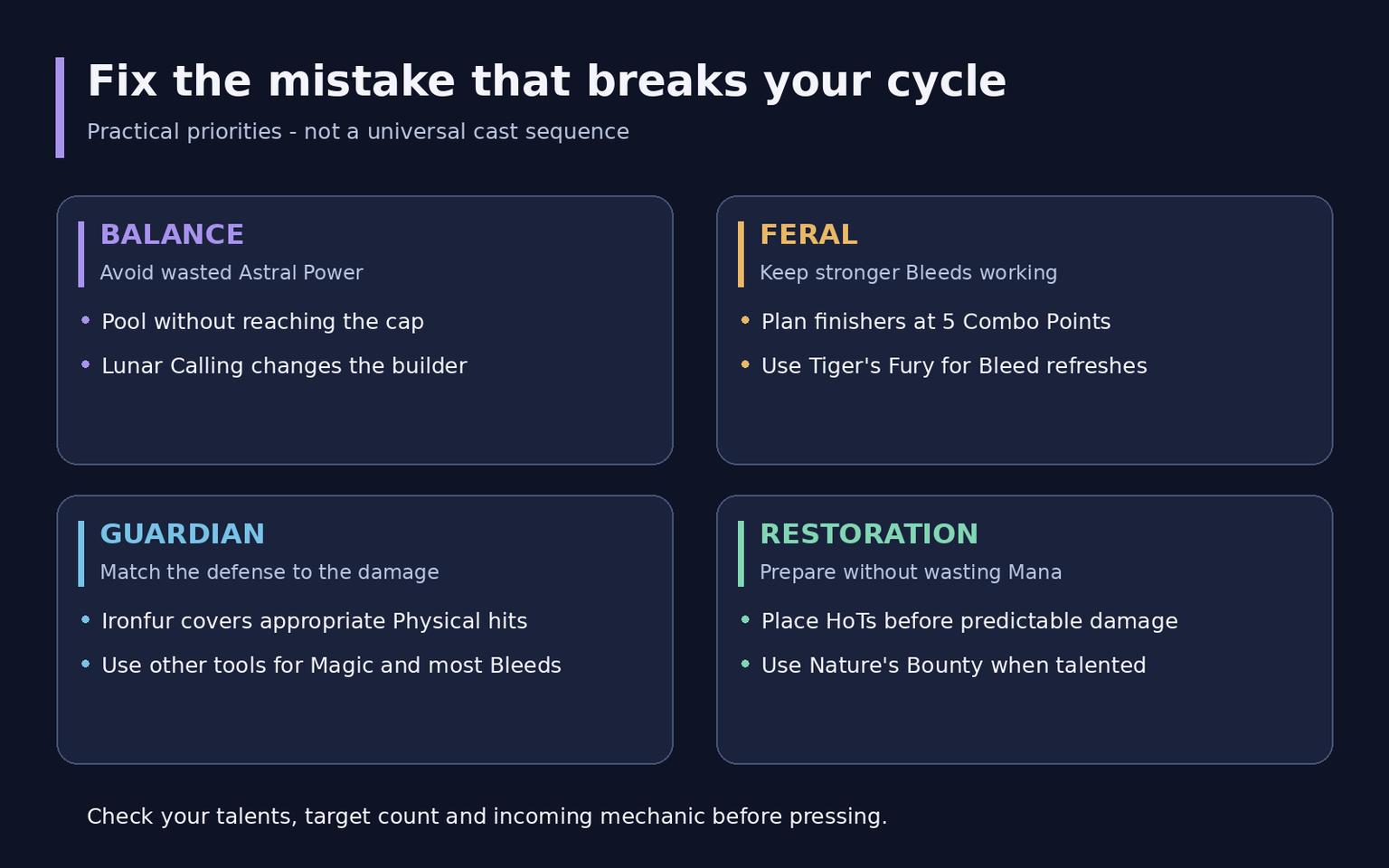
Track Moonfire, Sunfire, Eclipse and Astral Power. Eclipse is activated through its own button, with the version determined by your last appropriate builder. Lunar Calling applies the restriction explained above. Starsurge normally spends resources against one target, while Starfall serves multiple targets.
Prepare periodic effects and chosen cooldowns before the important window. Stored resources are useful if you can spend them while empowered; a full bar wastes the next gain. Plan a position that lets you complete casts, and pair short movements with instant actions. First keep this cycle working, then refine the precise opening sequence for your build.
Feral
Shred helps build Combo Points; Rake and Rip maintain Bleeds. Plan finishers at five Combo Points while leaving enough time to rebuild for the next Rip refresh. A normal Ferocious Bite benefits from sufficient Energy, typically at least 50, while a free Apex Predator's Craving proc follows its own rules.
Use Tiger's Fury with its Energy return and Bleed refreshes in mind. Do not replace an empowered effect with a weaker one merely because the button is available. In multi-target encounters, talents determine how Bleeds spread and finishers gain additional value. Your first practical goal is to stop wasting Combo Points and dropping core effects; optimizing damage per cast follows from that foundation.
Guardian
Generate Rage with Mangle and Thrash, hold enemies and recognize free casts granted by your talents. Ironfur adds Armor and primarily helps against appropriate Physical damage. Applications can overlap, so one stack is not a universal mitigation ceiling.
Before a heavy series of attacks, prepare Rage for additional stacks. Magic damage and most Bleeds require other defensive tools because Armor usually does not reduce them. Barkskin is proactive, while Frenzied Regeneration helps recover lost health. Avoid spending every resource on an offensive button before a known dangerous hit, and do not leave Bear Form for a small damage gain without a safe window.
Restoration
Maintain Lifebloom on an appropriate target and put Efflorescence where allies actually stand. Before expected damage, distribute Rejuvenation, then use Wild Growth, Swiftmend and Regrowth according to the party's condition. Raid preparation covers more targets; a dungeon demands faster recognition of one player in danger.
Coordinate Tranquility and other powerful healing tools with encounter events. Account for the updated Nature's Bounty when selected and for the Mana cost of preparation. Applying effects to everyone without incoming damage is not always productive. Deal damage when allies are safe and no dangerous event is imminent. Judge healing by the assignment completed and players kept alive, rather than throughput alone.
Equipment and stats
Intellect is the primary stat for Balance and Restoration; Agility serves Feral and Guardian. When changing roles, examine weapons and trinkets especially carefully: reusable leather armor does not make every set appropriate for all four jobs.
Secondary stats depend on item level, talents and encounter type. Balance often values Mastery; Feral compares Mastery, Haste and Critical Strike. Guardian commonly considers Haste and Versatility while also examining actual survival. Restoration needs different combinations of Haste and Mastery for raids and dungeons. These are comparison starting points, rather than instructions to discard a higher-level item because of one stat line.
Choosing an upgrade
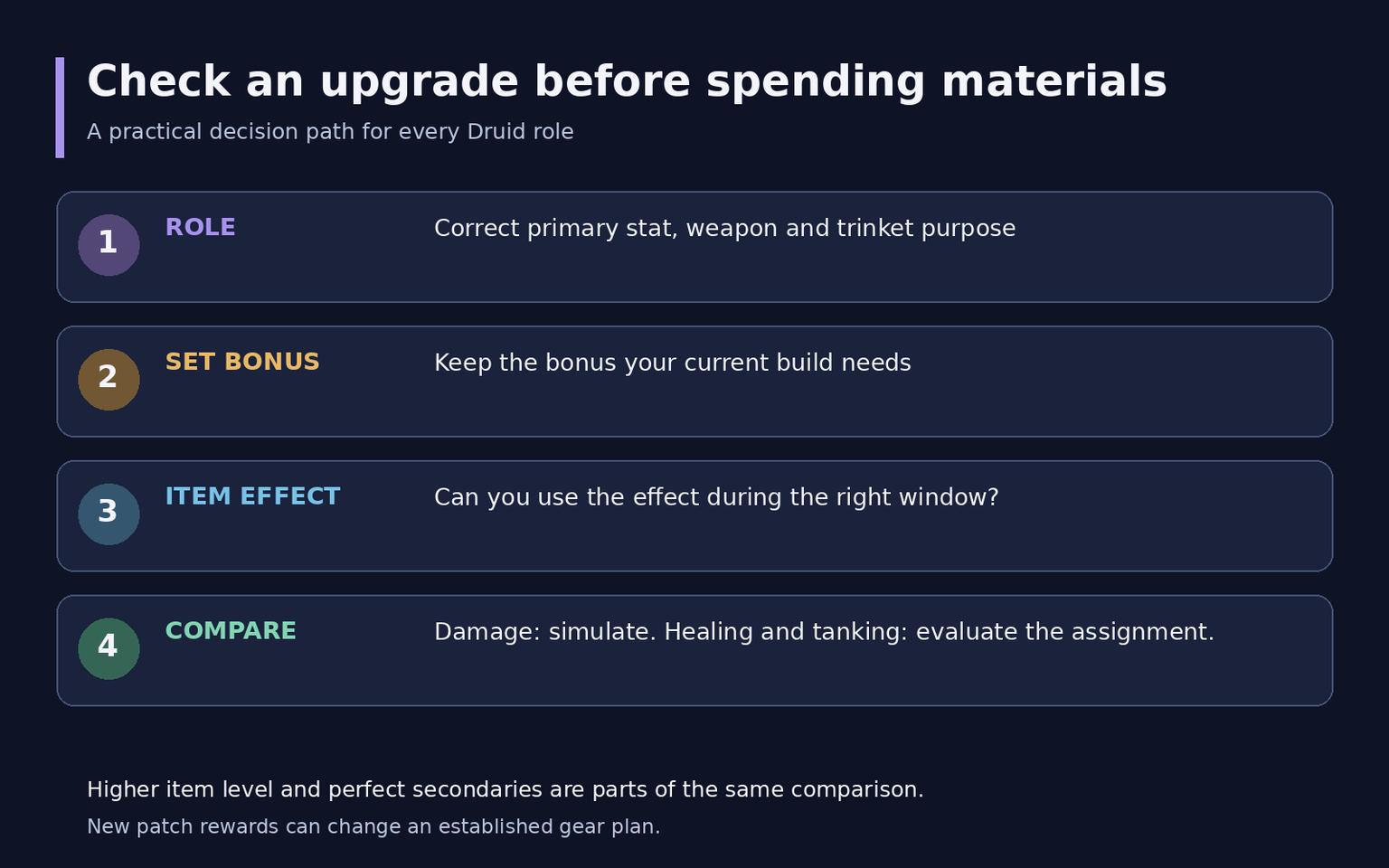
Check whether a replacement preserves the required set bonus, whether its trinket effect fits your role, and whether you can align it with an important encounter window. For damage, simulate the available choices on your own character instead of borrowing someone else's table. Healers benefit from evaluation in the context of their group and combat records; a tank's damage simulation does not replace checking mitigation.
Plan crafted equipment after assessing weak slots and rewards already received. Do not spend limited materials merely to fill a list: identify the desired stats and embellishment first. There is no single best-in-slot set for all four specializations, and new patch rewards can change an otherwise established setup.
Consumables and enchants
The following are starting options for PvE on the check date. Match flasks and combat potions to your stats and encounter. In particular, verify which stat Potion of Recklessness will boost with your current equipment.
Specialization | Flask | Combat potion |
Balance | Flask of the Magisters; Flask of the Blood Knights with a different stat distribution | Potion of Recklessness or Light's Potential after comparison |
Feral | Flask of the Magisters or Flask of the Blood Knights | Potion of Recklessness; Light's Potential for a different gear setup |
Guardian | Flask of the Blood Knights | Light's Potential |
Restoration | Flask of the Blood Knights in raids; Flask of the Magisters in Mythic+ | Potion of Recklessness |
Carry Concentrated Silvermoon Health Potion separately for health recovery. Thalassian Phoenix Oil is a temporary weapon enhancement. Bring food for group play, such as Harandar Celebration. Choose quality according to difficulty and budget: consumables support an encounter plan but cannot compensate for a missed mechanic.
Enchants and gems
Current weapon recommendations include Enchant Weapon - Rite of the Hash'ey for Balance and Feral, and Enchant Weapon - Berserker's Rage for Guardian. Restoration recommendations differ between Acuity of the Ren'dorei and Berserker's Rage, so compare them for your assignment instead of declaring one universally best.
Apply an enhancement to its intended slot: a helm enchant is not a cloak enchant. Sunfire Silk Spellthread suits Balance, while Arcanoweave Spellthread suits Restoration. Gems help adjust stat distribution; Indecipherable Eversong Diamond is one verified baseline option. Do not automatically carry it into every advanced setup without comparison.
Interface and simple macros
Make resources, periodic effects, mitigation and major cooldowns easy to see. A healer particularly needs party frames that display their healing effects. Establish readable information first, then add only features that help you make decisions.
For an English client, this example casts Rejuvenation on a living friendly mouseover target, falling back to normal casting:
#showtooltip Rejuvenation
/cast [@mouseover,help,nodead][] Rejuvenation
For Restoration, self-cast Innervate, provided your build has the ability:
#showtooltip Innervate
/cast [@player] Innervate
Macros do not choose a target by health or execute your entire rotation with one press. These examples were checked for syntax and condition intent; test them in your client before combat. Multiple actions on the global cooldown generally require separate presses.
Leveling and professions
On the way to level 90, Guardian is comfortable for surviving groups of enemies, Balance attacks from range, and Feral lets you learn melee immediately. Restoration is more naturally learned in a group. The fastest option depends on route, equipment and familiarity, rather than a compulsory Cat Form choice for every player.
As talents unlock, keep the primary role functional before adding useful defense and movement. Do not combine abilities from four specializations into one leveling rotation. When moving into harder dungeons, revisit talents for enemy control and group survival.
Choose professions by purpose: Leatherworking for your armor, Alchemy for consumables, Enchanting for enhancements, or gathering for income. An advantage in one gathering activity should not be generalized to every profession and form. Earnings depend on prices, routes and investment, as well as the character's class.
PvP considerations
PvP talents, control and equipment require separate planning. Do not transfer PvE priorities without checking their relevance. Druid mobility helps when it lets you survive an attack, maintain the right distance or support an ally, but every form change should have a purpose.
For example, Balance's Stellar Protection protects periodic effects when dispelled and matters in that interaction. It is not an extra button in a standard PvE rotation. Arena and battleground specialization choices depend on composition and assignment; this general guide does not establish a ranking across all four roles.
Frequently asked questions
Can one set cover every role?
Some leather equipment is reusable, but weapons, trinkets, talents and stat distribution need checking for each role. One form does not replace a dedicated specialization.
Which specialization suits a first Druid?
Guardian, Balance and Feral offer different approaches to solo combat. If you want to heal, start in a small group and learn the incoming damage pattern.
Is there one correct Druid rotation?
No. Priorities depend on specialization, Hero Talents, selected talents and target count. Learn the main resource and defenses first, then your build's exact sequence.
Must I change Hero Talents before every encounter?
Change when the new assignment calls for a different damage or healing profile. After switching, check altered abilities, interactions and keybindings.