WoW Midnight Hunter Guide: Specs, Talents and Gameplay
Hunter offers three damage specializations. Beast Mastery and Marksmanship fight at range, while Survival combines melee attacks, a pet and explosives. All use Focus, but their generation and spending patterns differ. A single rotation cannot describe the whole class.
This guide was checked on October 14, 2026, for Midnight Season 2 with patch 12.1.5 changes included. It covers choosing a spec, the basic combat loops, pets, equipment and group preparation. Treat it as a starting point: exact priorities depend on your Hero Talents, tier bonuses and the encounter.
Strengths and limitations
Hunter combines damage, control and independence. A pet can take attacks in solo play, traps create time to reposition, and active defenses help you survive dangerous moments. Mobility does not replace damage reduction, however. Sustained damage still requires planning your recovery and defensive cooldowns.
Specialization | Main playstyle | What to watch |
Beast Mastery | Mobile ranged combat built around pets | Pet positioning, target access and empowered commands |
Marksmanship | Powerful shots and concentrated damage windows | Time to cast and spending Precise Shots |
Survival | Melee combat with a pet, bombs and weapon attacks | Focus, Tip of the Spear and a safe position |
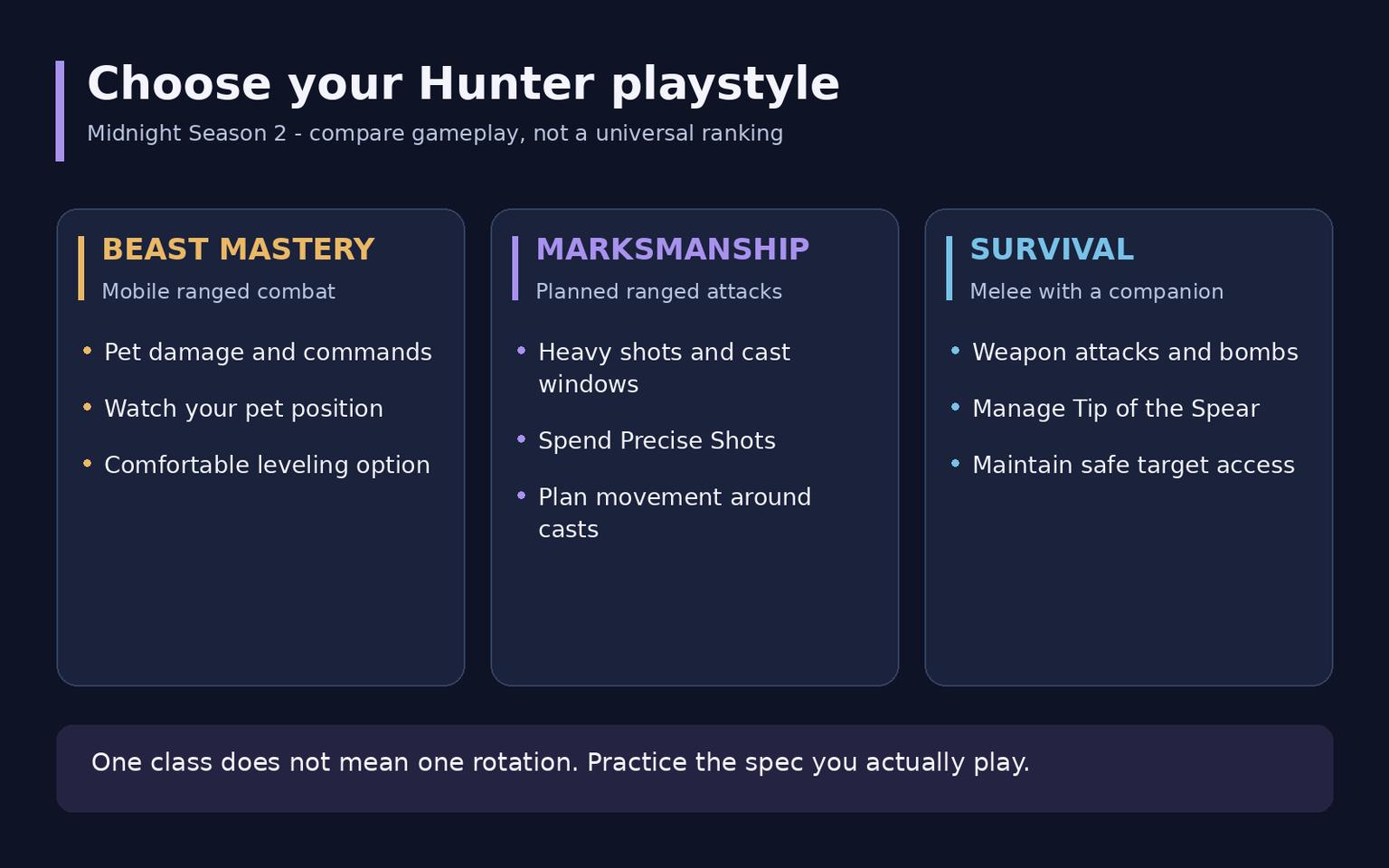
Beast Mastery is a comfortable starting point for quests and learning the class. Choose Marksmanship if you enjoy planning heavy shots from a distance. Survival suits players who want to alternate attacks while fighting close to an enemy. These are playstyle choices, not a damage ranking for every raid and dungeon.
What to check after patch 12.1.5
Marksmanship loses Unload and gains Blood Fletching. The new passive rewards critical Aimed Shots with additional bleeding. Removing the old talent also changes how you handle Precise Shots.
As Sentinel, spend the proc before Rapid Fire outside Trueshot instead of expecting Rapid Fire to consume it automatically. The current specialization overview still advises Dark Ranger to use Rapid Fire on cooldown. This distinction belongs to Marksmanship's Hero builds, not to every Hunter.
Blizzard also corrected Survival's Raptor Swipe interactions during Aspect of the Eagle. Those fixes do not create a new class-wide rotation. The current Beast Mastery overview reports no substantial change to its basic gameplay loop in 12.1.5.
Talents: define the job before spending points
The class tree supplies shared tools, and the specialization tree shapes your damage mechanics. A Hero tree adds another layer to the selected playstyle. Hunter has the following combinations:
Specialization | Hero Talent options |
Beast Mastery | Dark Ranger / Pack Leader |
Marksmanship | Dark Ranger / Sentinel |
Survival | Pack Leader / Sentinel |
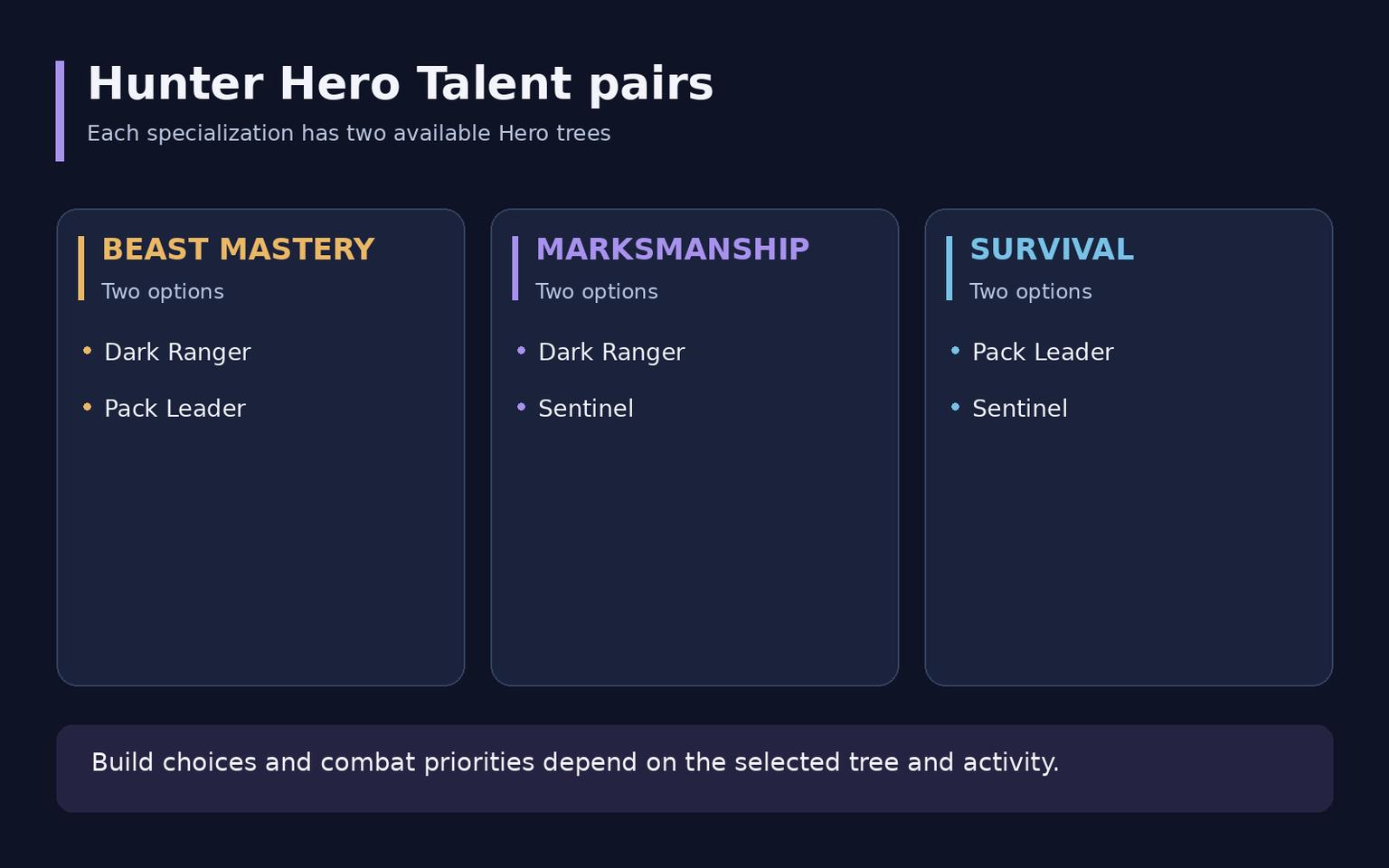
Keep separate loadouts for raid encounters and Mythic+ dungeons. A raid build must suit the actual boss, while a dungeon build balances group damage with useful tools. Removing a defensive or control talent for a small damage gain can be counterproductive when the party depends on that ability.
Midnight's Apex Talents reinforce each specialization: Nature's Ally for Beast Mastery, Take Aim for Marksmanship and Raptor Swipe for Survival. They are not a shared fourth spec. Before practicing, check that the advice matches your selected talents rather than another Hunter's setup.
The combat fundamentals for each spec
Beast Mastery
Your core tools include Kill Command, Barbed Shot, Cobra Shot and Bestial Wrath. With Nature's Ally, weave an empowering shot between Kill Commands instead of casting two commands consecutively without their benefit. Against multiple enemies, Wild Thrash supports your pet's cleave damage.
Start by checking that the pet is alive, attacking the correct enemy and close enough to the targets. Avoid leaving important abilities unused for long periods, while considering imminent enemy spawns. The Season 2 tier set increases Cobra Shot's significance, so treating it as an unimportant filler does not describe the complete current priority.
Marksmanship
The basic loop combines Aimed Shot and Rapid Fire with spending Precise Shots. Arcane Shot handles the standard single-target spender role; Multi-Shot serves groups according to your talents. Trueshot creates a window in which unnecessary movement can cost valuable casts.
Explosive Shot returned to the Season 2 toolkit, so it should not be described as universally removed. Check the 12.1.5 proc rules for Sentinel and Dark Ranger before following an older sequence. Practice a short stationary cycle first, then introduce movement and several targets.
Survival
Kill Command generates Focus and Tip of the Spear stacks. Those stacks strengthen subsequent attacks, including Wildfire Bomb, Boomstick and Raptor Strike. Build the relevant enhancement, then spend it on a suitable ability without overflowing your resource or wasting stack generation.
Two mistakes pull in opposite directions: repeatedly preparing stacks while delaying a strong attack, or attacking without the enhancement when it is readily available. Bombs and ranged tools do not turn Survival into a full ranged specialization. You still need to plan access to the enemy and a safe melee position.
Pets: choose the job you need covered
Pets are central to Beast Mastery and Survival. Families offer different utility and taming requirements, while exotic families are restricted to Beast Mastery. A creature's appearance is not evidence of higher base damage. Petopia provides models, families and locations for finding a suitable companion.
If the party needs a Bloodlust equivalent, check access to Primal Rage through a Ferocity pet. When another player already covers that job, consider defensive benefits and convenience for the encounter. Marksmanship handles pets differently and can play without a permanent companion; its preparation should not simply copy Beast Mastery's.
In the open world, allow the pet to hold enemies and monitor its health. In dungeons, check that automatic Growl will not interfere with the tank. After jumps or target changes, confirm that your pet actually reaches the enemy. A companion stuck away from combat can remove a significant part of your toolkit.
Defenses and group responsibilities
Aspect of the Turtle helps with appropriate dangerous mechanics, but it is not protection against every possible effect. Use damage reduction before a heavy hit and healing after taking damage. Feign Death can drop threat or stop certain targeted casts, but it does not replace following boss mechanics.
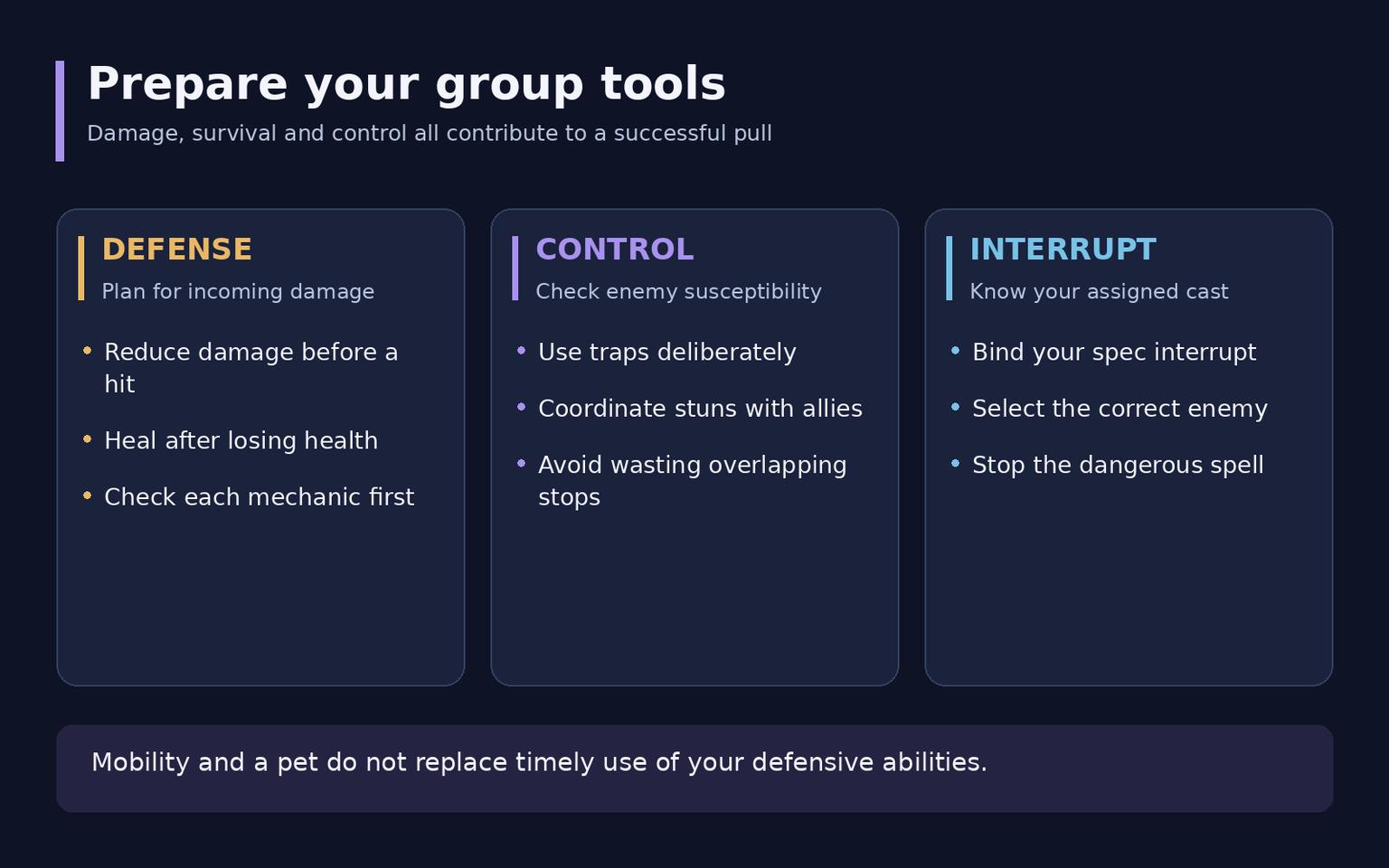
The ranged specs and Survival use different interrupt abilities. Bind yours comfortably and identify the dangerous cast you are assigned to stop. Traps and stuns supplement an interrupt, but enemies are not equally susceptible to every control effect. Correct targeting and timing matter more than pressing every available button.
Stats and equipment
Agility is the class's primary stat. Evaluate secondaries for your actual specialization and Hero build rather than for Hunter as a whole.
Setup | Starting guideline for secondary stats |
Beast Mastery, Pack Leader | Mastery, Critical Strike, Haste, Versatility |
Marksmanship | Critical Strike, Mastery, Versatility, Haste |
Survival | Mastery, Critical Strike, Haste, Versatility |
These are broad guidelines, not fixed item weights. Beast Mastery's Dark Ranger single-target setup can prioritize Critical Strike before Mastery. Survival assessments place Critical Strike and Haste relatively close together. Your existing equipment matters; comparing available items in a character simulation is more reliable than reading a generic priority as a shopping list.
Evaluate your weapon, tier bonuses and trinkets together. A best-in-slot entry may assume another item level, talent setup or combination of effects. Before crafting, identify your weakest slot and realistic replacement drops. A popular recipe is not automatically the best use of seasonal materials for your character.
Consumables and item improvements
Bring a flask, combat and healing potions, food, a weapon augment and suitable enchants. Weapon oil and an augment rune are separate categories. Current Marksmanship guidance includes Flask of the Shattered Sun and Potion of Recklessness, but check both the flask and the potion's secondary-stat behavior against your equipment.
Inspect likely item replacements before buying expensive gems or enchants. During progression, timely defenses and correct proc spending are often more useful than paying for upgrades without understanding your mistakes.
Leveling, professions and your interface
The class leveling guide recommends Beast Mastery for most leveling needs. Your pet takes attacks while the Hunter can move through much of the combat loop. Begin with manageable pulls, keep the companion healthy and increase the number of enemies gradually. This does not guarantee the same ease at every solo difficulty.
Choose a race around appearance, useful abilities and preferred activities. A small simulated damage difference does not make one race mandatory across all three specs. Professions should also serve a purpose, whether that means personal crafting, consumables or gathering. Accessing crafted equipment through orders does not require learning the corresponding craft yourself.
Keep Focus, relevant buffs, important cooldowns and pet health near your main area of attention. A cursor macro can shorten the targeting step for ground-based traps. It also demands careful cursor placement and the spell name recognized by your client. Try it safely before relying on it in a group encounter.
Prepare a separate PvP setup
Arena and battlegrounds need their own talent loadout. Check PvP talents and control conditions instead of transferring a raid sequence unchanged. Decide whom to trap, when to interrupt healing and where to retreat after attacking. Survival must plan safe access back to the target; ranged specs need space to keep firing. Coordinated help for a teammate can matter more than one additional attack.
Frequently asked questions
Which spec should a first-time Hunter try?
Beast Mastery is an approachable starting point for quests and class practice. Compare all three playstyles before making your longer-term choice.
Is one spec best for everything?
No. Raids, dungeons and solo activities have different requirements, and results change with patches and player preparation.
Can every Hunter follow the Marksmanship rotation?
No. Abilities, resource loops and pet roles differ. Even two Hero builds within one specialization may require different decisions.
Should I immediately buy a complete best-in-slot setup?
Compare your current items, tier bonuses and available upgrades first. An ideal item list is not a progression plan for your particular character.