WoW Midnight Monk Guide: Specs, Talents and Gear
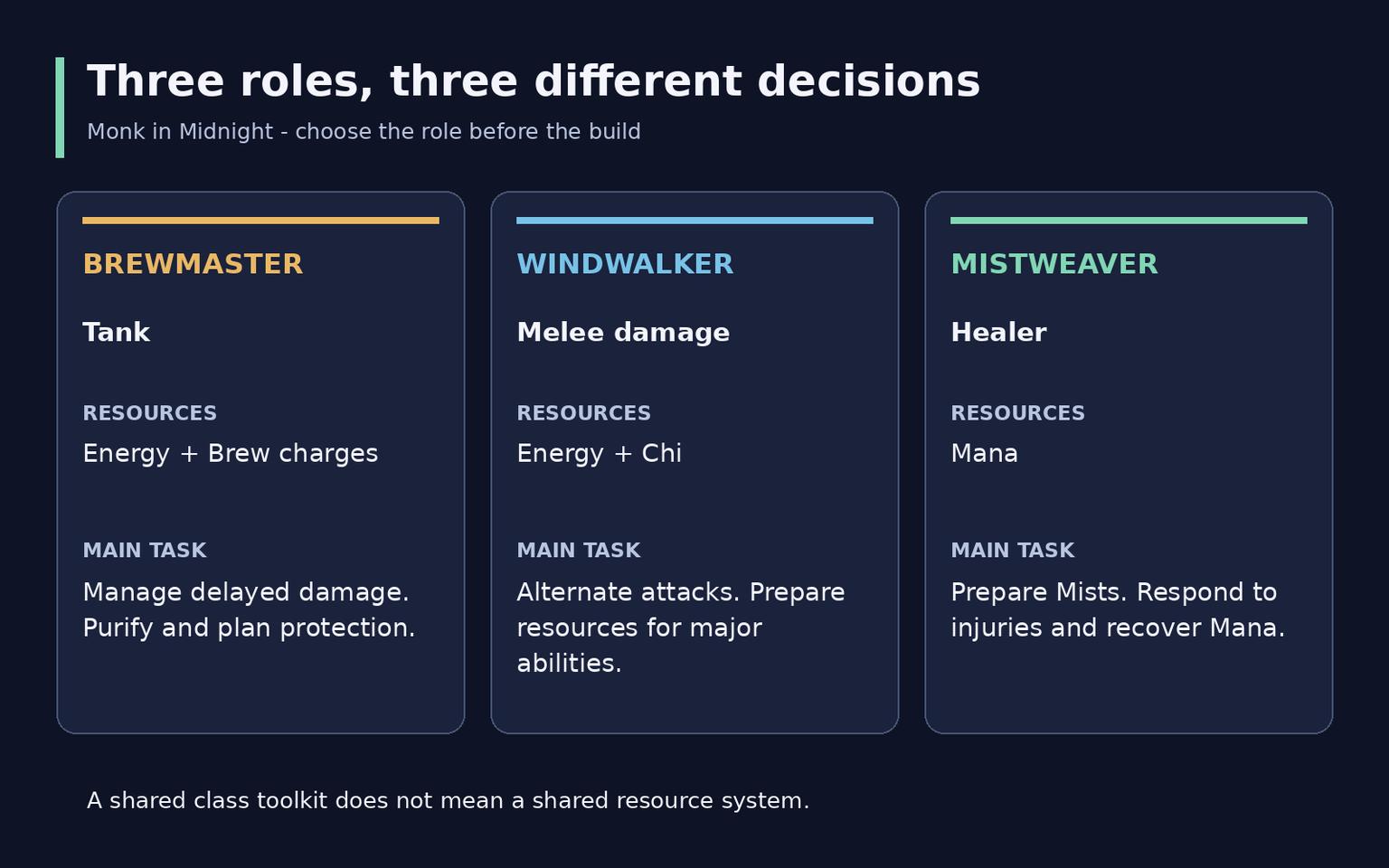
Monk in WoW Midnight can tank, deal melee damage or heal. Each specialization asks you to solve a different problem. Brewmaster manages delayed incoming damage, Windwalker balances resources while alternating attacks, and Mistweaver combines healing preparation with an active presence in combat. Choose the job you want first, then build the habits and equipment that support it.
This guide covers Season 2 PvE in patch 12.1.5, checked on October 14, 2026. It explains specialization fundamentals, Hero Talent choices, combat priorities, gearing and preparation for raids and Mythic+ dungeons. PvP requires its own talent choices and balance context.
Specialization | Role and resources | Main learning task |
Brewmaster | Tank; Energy and Brew charges | Manage Stagger, purify at useful moments and prepare for dangerous hits |
Windwalker | Melee damage; Energy and Chi | Alternate attacks, prepare resources and plan offensive cooldowns |
Mistweaver | Healer; Mana | Set up healing, choose the right target and find a safe combat position |
Windwalker is a practical starting point for solo questing. Brewmaster suits players who want responsibility for enemy positioning and the group's pace. Mistweaver requires attention to allies as well as encounter mechanics: contributing damage matters, but keeping someone alive takes priority. These are starting suggestions, rather than promises about leveling speed or guaranteed group invitations.
What to check in Midnight
If you are returning from an earlier expansion, review your spellbook before relying on an old action bar. Brewmaster no longer has Rising Sun Kick or Dampen Harm, and Diffuse Magic is no longer a separate active defensive cooldown. Mistweaver's Mana Tea restores Mana without its former subsequent spell-cost reduction. Windwalker's Zenith changes Chi spending and the availability of important attacks.
October 6 tuning improved some rotational sources of Brewmaster durability and selected Mistweaver heals. The 12.1.5 notes also fixed Transcendence: Transfer being usable while silenced with Linked Spirits. These adjustments do not mean every Monk specialization has a new fixed rotation. The useful next steps are to update your build, identify the buttons it actually contains and practise with your current equipment.
Monk retains mobility and control tools. Leg Sweep can stop suitable nearby enemies, while Paralysis can temporarily remove an individual target from the fight. Check enemy immunity and coordinate control with your party. Mystic Touch increases Physical damage taken by an affected enemy; it is not an increase to every damage school.
Hero Talents and build selection
Each specialization has two available Hero Talent trees. Keep separate raid and dungeon loadouts, and understand which active abilities or interactions a build adds before you use it.
Specialization | Hero Talent trees | Useful selection question |
Brewmaster | Shado-Pan / Master of Harmony | Do you want straightforward additional damage or more flexible Brew interactions? |
Windwalker | Shado-Pan / Conduit of the Celestials | Do you prefer a steadier rhythm or carefully planned burst windows? |
Mistweaver | Conduit of the Celestials / Master of Harmony | Are you playing around Celestial effects or stored vitality? |
Shado-Pan is a useful Windwalker starting point because it asks for less attention to an additional Hero cooldown window. Conduit of the Celestials requires more deliberate alignment. Encounter timing, tuning and execution affect the result, so one tree should not be treated as a permanent winner for every character.
Brewmaster's Master of Harmony adds interactions to defensive Brews, while Shado-Pan fits naturally into the basic attack cycle. Conduit of the Celestials is the current Mistweaver starting recommendation. If you choose Master of Harmony, learn its vitality spending rules rather than copying the other tree's sequence.
The Apex Talents are also distinct: Tigereye Brew for Windwalker, Spiritfont for Mistweaver and Bring Me Another for Brewmaster. They develop existing abilities instead of supplying one shared class button. Import a current build for the role and content you intend to play. After importing, inspect talent allocation and your action bar, especially when switching between saved loadouts.
Windwalker
Resources and priorities
Energy generates Chi through Tiger Palm, and Chi supports your important attacks. Mastery: Combo Strikes rewards alternating abilities. Avoid turning combat into repeated presses of one convenient attack, and do not generate Chi beyond your available capacity.
Windwalker follows a priority system, not a permanently repeating sequence. Prepare enough Chi before Fists of Fury and Rising Sun Kick become available. Blackout Kick! and Dance of Chi-Ji procs can change your next useful action. During accelerated cooldown windows, the practical order may differ from normal play.
Start dummy practice by checking three things: whether resources are ready for a major attack, whether important abilities sit unused, and whether you repeat an attack unnecessarily. Once that works, practise movement and target changes. Pressing buttons faster cannot compensate for repeatedly arriving at an important cooldown without the resources to use it.
Cooldowns and multiple targets
Zenith reduces Chi costs and improves the cooldown reduction supplied by Blackout Kick. Plan it for a period when you can remain in reach of your target. Conduit of the Celestials adds Celestial Conduit and related buff timing; pressing every available offensive button together can waste useful effects.
Spinning Crane Kick becomes important against multiple enemies. With the Season 2 four-piece bonus, Unbroken Rhythm affects using it after Fists of Fury. Do not transplant an oversimplified single-target sequence without accounting for your set bonus and Hero tree.
In a dungeon, removing one dangerous enemy can matter more than raising total damage across the pack. Consider upcoming movement before committing to a longer ability, and use a defensive before predictable damage when the mechanic permits. Review a failed pull for lost uptime and unnecessary exposure as well as the damage meter.
Brewmaster
Understanding Stagger
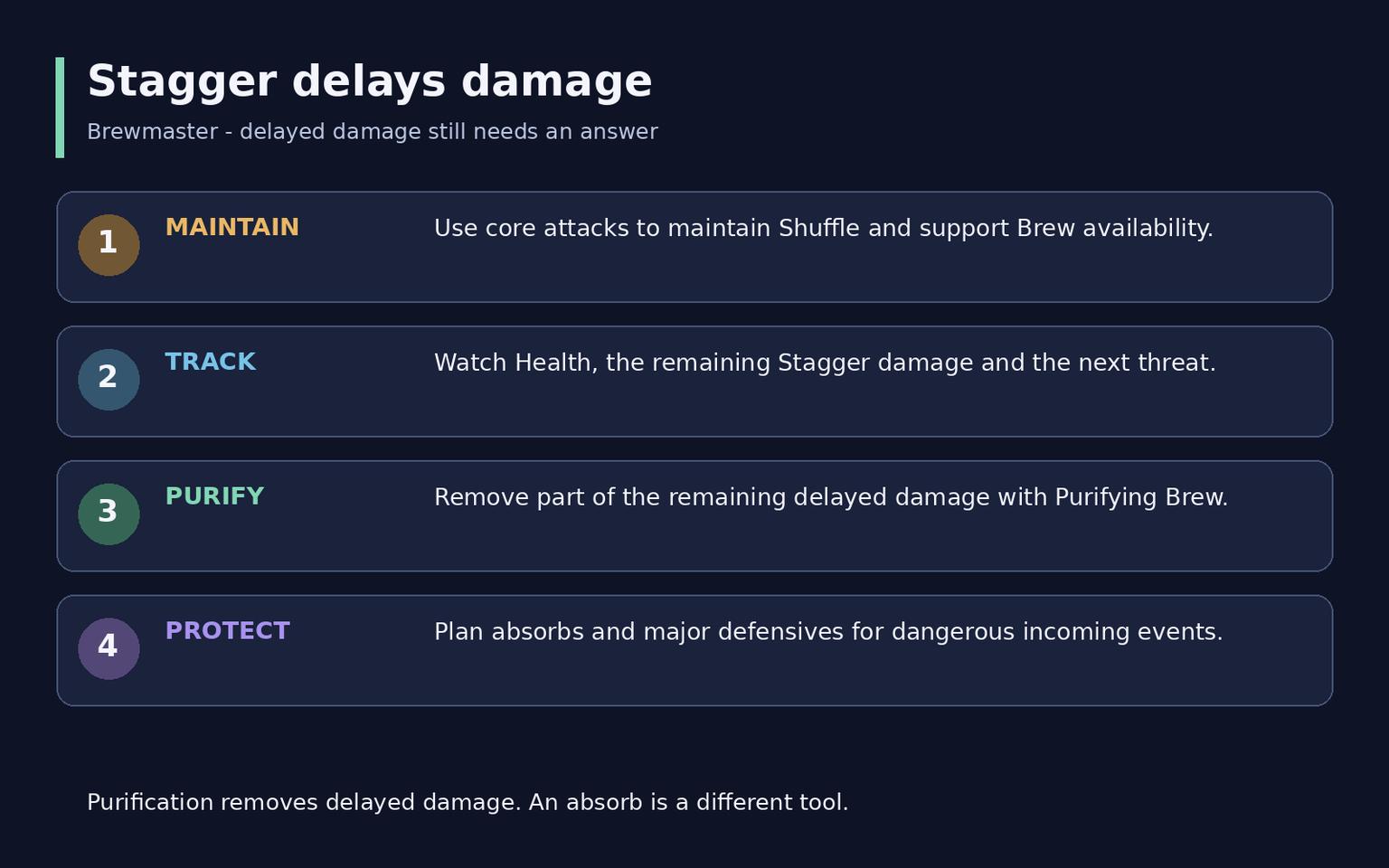
Stagger moves part of incoming damage into a damage-over-time effect. It does not erase that damage on its own. Without further action, the delayed portion will continue to reduce your Health. Purifying Brew removes some remaining Stagger damage; Celestial Brew or Celestial Infusion provides an absorb.
Maintain Shuffle through your main attacks and reserve Energy for Keg Smash. Blackout Kick also matters to the basic survival cycle. Your attacks do more than produce damage: they maintain defensive effects and help reduce Brew cooldowns.
Avoid leaving both Purifying Brew charges ready for long periods, but account for the next dangerous hit. Retaining an available charge lets you respond after a sudden increase in delayed damage. Purifying moderate Stagger can be reasonable when another charge is about to return; waiting exclusively for a red indicator is not required.
Defense and enemy positioning
Treat the basic attack cycle, clearing accumulated damage and preparing for the next event as separate decisions. An absorb does not replace purification, and purification does not guarantee that the next hit is safe. Celestial Brew and Celestial Infusion have longer base cooldowns following the seasonal change; attacks and talents affect their actual availability.
Face enemies away from allies and leave yourself a clear direction to move. If Health is falling, assess Stagger, defensive availability and positioning before deciding how many enemies to engage next. A ready Brew is not sufficient reason to increase a pull's size.
Discuss major defensives with your healer. Fortifying Brew and external support are more useful within an understood plan than when every cooldown is spent at once. Purification, absorbs and healing should remain available for individual decisions. Combining them into one compulsory defensive macro removes that control.
Mistweaver
Preparing healing
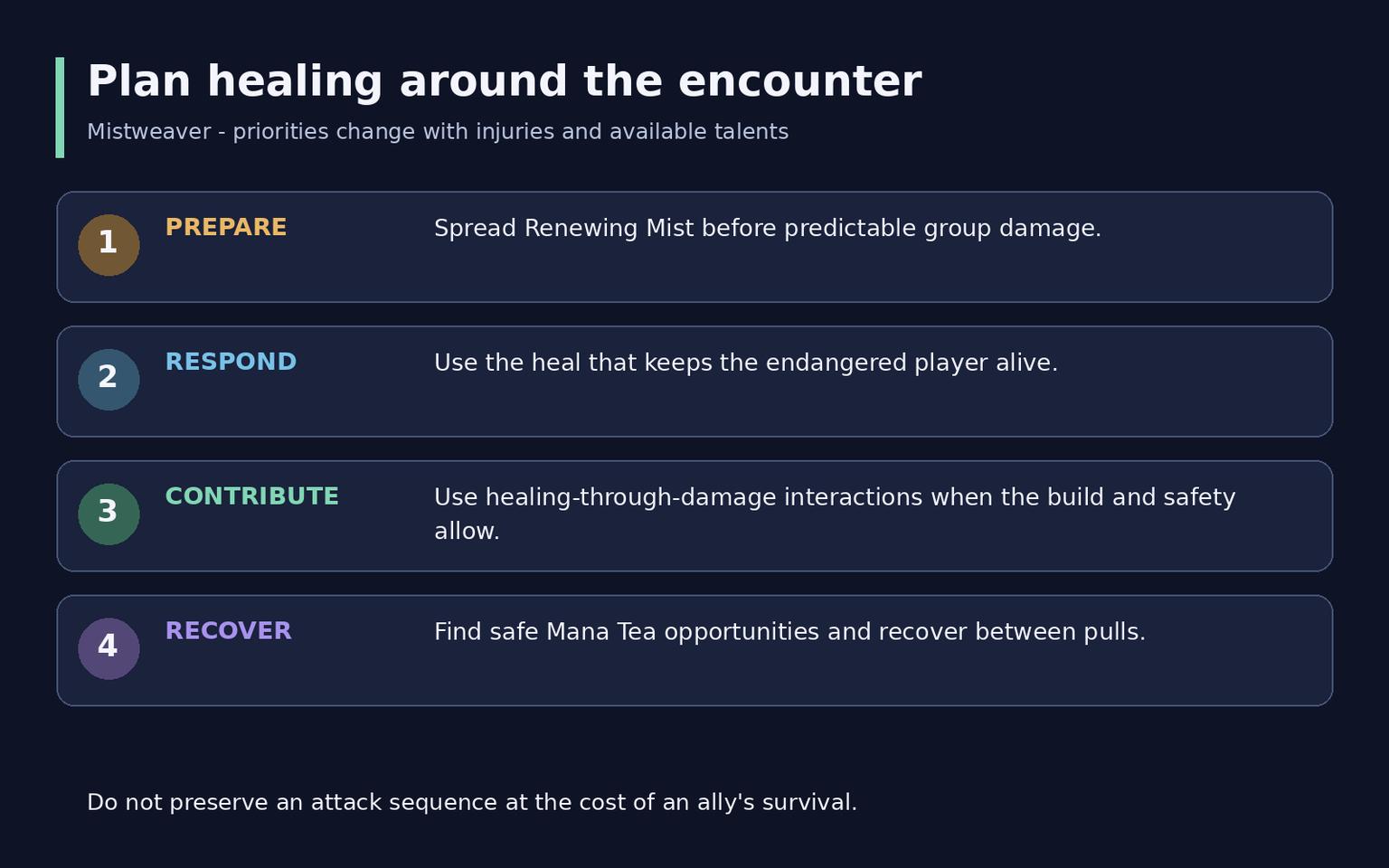
Set up readable party frames and Renewing Mist tracking first. Spread Renewing Mist before expected group damage and avoid losing new charges to a full reserve. Then respond to the actual situation: rescuing one player and preparing for a scheduled raid event require different actions.
Use Vivify, or Sheilun's Gift when a talent replaces it, according to active benefits and injured allies. Enveloping Mist matters for targeted healing and Spiritfont interactions. Do not spend every expensive heal just because it is available. Overhealing consumes Mana that may be needed later in the encounter.
In raids, allocate major healing cooldowns to particular events. In dungeons, preserve an answer to unexpected damage and consider whether an injured player can survive the next hit. This is more reliable than assigning the healer one fixed rotation for an entire fight.
Melee healing and Mana
Builds with Jadefire Teachings and Way of the Crane use attacks as part of their healing. That does not justify ignoring Health bars to preserve damage output. Change your actions and position when melee is unsafe or an ally needs immediate help.
Mana Tea replenishes Mana. Find safe opportunities to use it before further stack generation would be wasted. Between pulls, allow time to recover where necessary and tell the tank when Mana is already limiting the healing you can provide.
Invoke Chi-Ji and Invoke Yu'lon support different ways of using Enveloping Mist. Check which version your loadout contains. Thunder Focus Tea also needs to be spent according to your talents and current task, so an old macro that always follows it with the same spell can give the wrong result.
Gear and stats
All three specializations wear leather, but check weapons and trinkets separately when changing roles. Brewmaster and Windwalker use Agility; Mistweaver uses Intellect. Higher item level is generally useful for primary stats, while a set bonus or trinket effect needs its own comparison.
Specialization | Primary stat | Secondary-stat starting point |
Windwalker | Agility | Compare Haste, Critical Strike and Mastery for your gear; Versatility is usually weaker for pure damage |
Brewmaster | Agility | Critical Strike, Versatility and Mastery matter for defense; Haste generally ranks lower |
Mistweaver | Intellect | Haste is a useful starting preference; other values depend on build, content and defensive needs |
Do not chase an arbitrary percentage at the expense of overall equipment quality. Windwalker can compare available items through character simulations. Brewmaster should assess damage and defensive reliability separately. Mistweaver needs to consider fight length, overhealing and Mana use: a damage ranking cannot answer those questions.
Account for your current set bonus before replacing a piece, and avoid expensive enchants on an item you expect to replace shortly. When moving from tanking to healing, check the actual weapon and trinkets even if some armor works for both roles. Choose professions for what you enjoy making and how convenient they are; no profession is a mandatory class requirement.
Consumables
Your consumables should match your role. These are practical baseline options, rather than a demand that every Monk carry an identical setup.
Role | Flask | Potion and purpose |
Windwalker | Flask of the Blood Knights | Potion of Recklessness for an offensive window |
Brewmaster | Flask of Thalassian Resistance | Liquid Luster as a general Versatility option |
Mistweaver | Flask of the Blood Knights | Lightfused Mana Potion for immediate Mana recovery when needed; choose a throughput potion for the relevant task |
Mistweaver potion advice differs between builds and guides. Some emphasize throughput, while others plan for Mana recovery. Do not automatically spend a Mana potion at the start of a fight or use a stationary recovery item where movement will be required. Read the actual limitations of the item you intend to carry.
For every role, prepare Concentrated Silvermoon Health Potion, suitable food and Thalassian Phoenix Oil. Choose gems and enchants around current equipment. Weapon enchant examples are Rite of the Hash'ey for Windwalker and Acuity of the Ren'dorei for Brewmaster and Mistweaver. Pandaren should account for Epicurean when comparing food, but selecting a race is not a substitute for learning the role.
Simple macros and interface setup
A mouseover Vivify macro for an English client:
#showtooltip Vivify
/cast [@mouseover,help,nodead][] Vivify
It selects a living friendly mouseover target, then falls back to normal casting rules if that condition is not met. If your talent replaces Vivify with Sheilun's Gift, change the spell name and test that version separately.
Paralysis on a saved focus, with a fallback to your current target:
#showtooltip Paralysis
/cast [@focus,harm,nodead][] Paralysis
The macro does not check immunity, range or whether your build includes the spell. Practise on a suitable target. Avoid attaching automatic defensive Brew use to offensive buttons: it prevents you from choosing when protection is needed.
Keep resources, important cooldowns and personal defense visible. Brewmaster needs Stagger and Brew charges; Windwalker needs Chi and the last attack used; Mistweaver needs Mists and Mana. Begin with a readable basic interface, then add only the tracking that solves an actual problem.
Frequently asked questions
Which specialization is easiest to start with
Windwalker is a practical introduction for questing. Choose Brewmaster or Mistweaver if you want the corresponding group role, and learn it in easier content before pushing difficult keys.
Can one build cover everything
A baseline loadout is useful for learning. Raid mechanics, multiple enemies and control requirements change talent value. Keep separate versions and inspect the action bar after switching.
Why does Brewmaster keep taking damage after a hit
That is the delayed part of Stagger. Track it, purify at appropriate moments and plan protection. Damage smoothing is not the same as removing all incoming damage.
Must Mistweaver always keep attacking
Attacks matter in the appropriate build, but their value depends on safety and the group's condition. When someone is in danger of dying, the necessary heal takes priority over maintaining the attack cycle.