WoW Midnight PvP Guide: Modes, Gear and Rewards
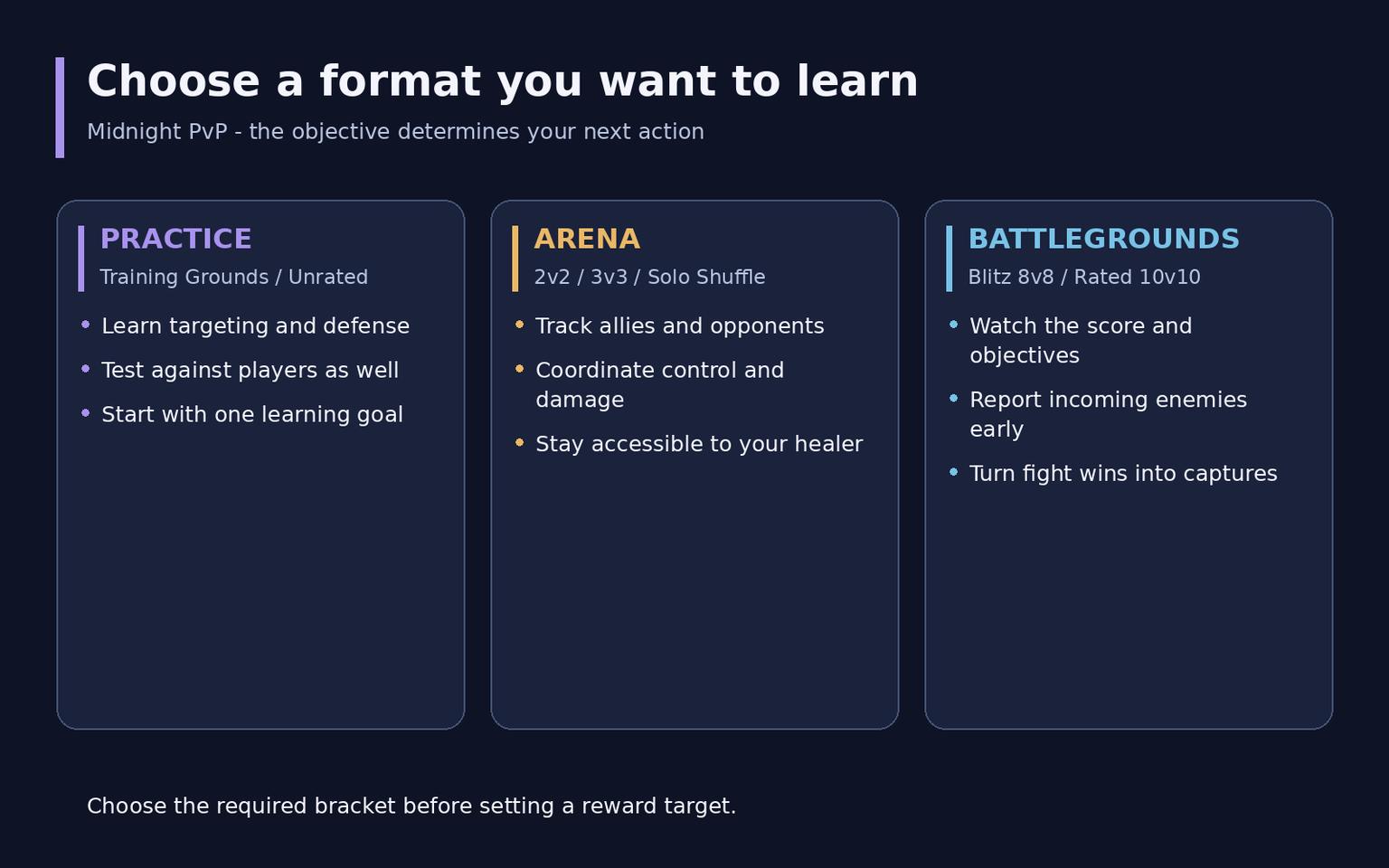
Choose a format before committing to a rating target in Midnight. Arenas reward coordination within a small group, while battlegrounds require decisions about objectives and movement across the map. Even on the same specialization, the talents and habits that work in one setting may need adjustment in another.
This overview covers Midnight Season 2 and patch 12.1.5, with information checked on October 14, 2026. Rated play opened in August and the season is already underway. The guide explains the available modes, crowd control changes, gearing choices and major reward requirements. Season 1 equipment and reward conditions are kept out of the current reference.
For a new player, the most useful first goal is to recognize danger and respond while an option remains available. Equipment improves your chances, but choosing a target, staying accessible to your healer and protecting an objective still require deliberate decisions.
Choose the right mode
Format | Team and entry | Main assignment |
2v2 Arena | A premade pair | Pressure a target and work with your partner |
3v3 Arena | A premade trio | Coordinate damage, control and defensive trades |
Solo Shuffle | Solo queue for 3v3 rounds | Adapt to changing teams across six rounds |
Battleground Blitz | 8v8, solo or an eligible duo with a healer | Make quick objective and map decisions |
Traditional Rated Battlegrounds | An organized 10v10 team | Divide assignments and coordinate the group |
Unrated PvP | Random battlegrounds and Arena Skirmishes | Learn against players without a rating target |
Training Grounds | Practice against game-controlled opponents | Establish basic habits before live PvP |
With a friend, 2v2 gives you fewer players to track while you learn what caused a defensive trade to fail. Solo Shuffle offers rated arena play without organizing a regular team. If you enjoy flags, nodes and deciding where help is needed, try battlegrounds before progressing to Blitz.
Consider the activity a reward requires. Gladiator progress belongs to 3v3, while Legend and Strategist have their own modes. A goal involving a premade team also requires time for finding partners and learning together; include that in your expectations before planning a push.
Use practice with a purpose
Training Grounds offers battleground encounters against computer-controlled opponents, with 3v3 arenas added in Season 2. Select the mode through the PvP tab in Group Finder. It provides a place to check keybinds, target selection and defensive reactions before adding the unpredictability of other players.
Give each practice session a specific assignment. You might maintain a route back to your healer or recognize a dangerous cast before spending your interrupt. Then test the habit in unrated matches against players. Beating a practice opponent does not establish your likely arena rating or teach every response a coordinated enemy can make.
Duels can help you recognize another class's abilities, but a one-on-one exchange does not reproduce a healer arena. World PvP has further variables, including nearby players, terrain and outside assistance. Use these activities to learn what they actually test.
Arena fundamentals and Solo Shuffle
Coordinate in 2v2 and 3v3
Agree on an initial target and who will control the enemy healer. Reassess when that target becomes inaccessible or uses a major defensive. Sometimes preserving your next attack while surviving an enemy window creates a better opportunity than continuing to chase.
Watch your own healer's position. Moving behind a pillar can block healing even when the healer appears close on the map. Return to a usable position before emergency help becomes necessary. Healers should choose a position that offers access to allies and a route to cover as the fight moves.
Keep defensive communication short and useful. If two players spend major saves unnecessarily on the same event, fewer tools remain for the next attack. At the same time, an immediately lethal threat needs a response even when a teammate has not confirmed the plan.
Use control to support a defined action. Interrupting a heal during pressure, stopping damage while retreating and separating enemies have different purposes. Spending every available control button at the opening can leave nothing for the moment that matters most.
Adapt across six rounds
A standard Solo Shuffle lobby contains two healers and four damage dealers. They play six 3v3 rounds with teams rearranged between rounds. Check your available support, interrupts and useful targets again when the next round starts.
Matchmaking rating, or MMR, is part of the rating calculation. Four round wins do not guarantee the same rating gain in every lobby, and three wins do not guarantee a neutral result. Solo Shuffle also tracks rating by specialization, so changing specs does not simply copy your established progress.
Treat previous rounds as information. Notice which defensive saved an opponent and where your teammate lost access to help. Start the next round with a small workable plan, then adjust what failed. Replacing your entire approach after each loss makes it harder to identify which change improved your play.
Battlegrounds and War Mode
Battleground Blitz is an 8v8 objective mode. Winning a fight should lead to a capture, a flag escort or control of a useful location. High damage away from the relevant objective can contribute little to the actual result.
Before moving, check the score and which objective needs players next. Report incoming enemies early with a location and approximate number. When everyone heads to one fight, consider who covers the remaining objectives. Staying in place and calling for support can be the correct play even when a larger battle looks more exciting.
Traditional Rated Battlegrounds remain organized 10v10 play, with assignments and communication across the team. Blitz has its own map rules as well as a smaller team size. Read the active timers and objective state rather than assuming that a familiar map behaves exactly like its unrated version.
War Mode enables open-world PvP and associated rewards, including Bloody Tokens. It can provide variety and suitable filler equipment. Winning an outdoor fight does not grant the same rated progress as a rated arena or battleground match.
Crowd control and Season 2 changes
Track the category
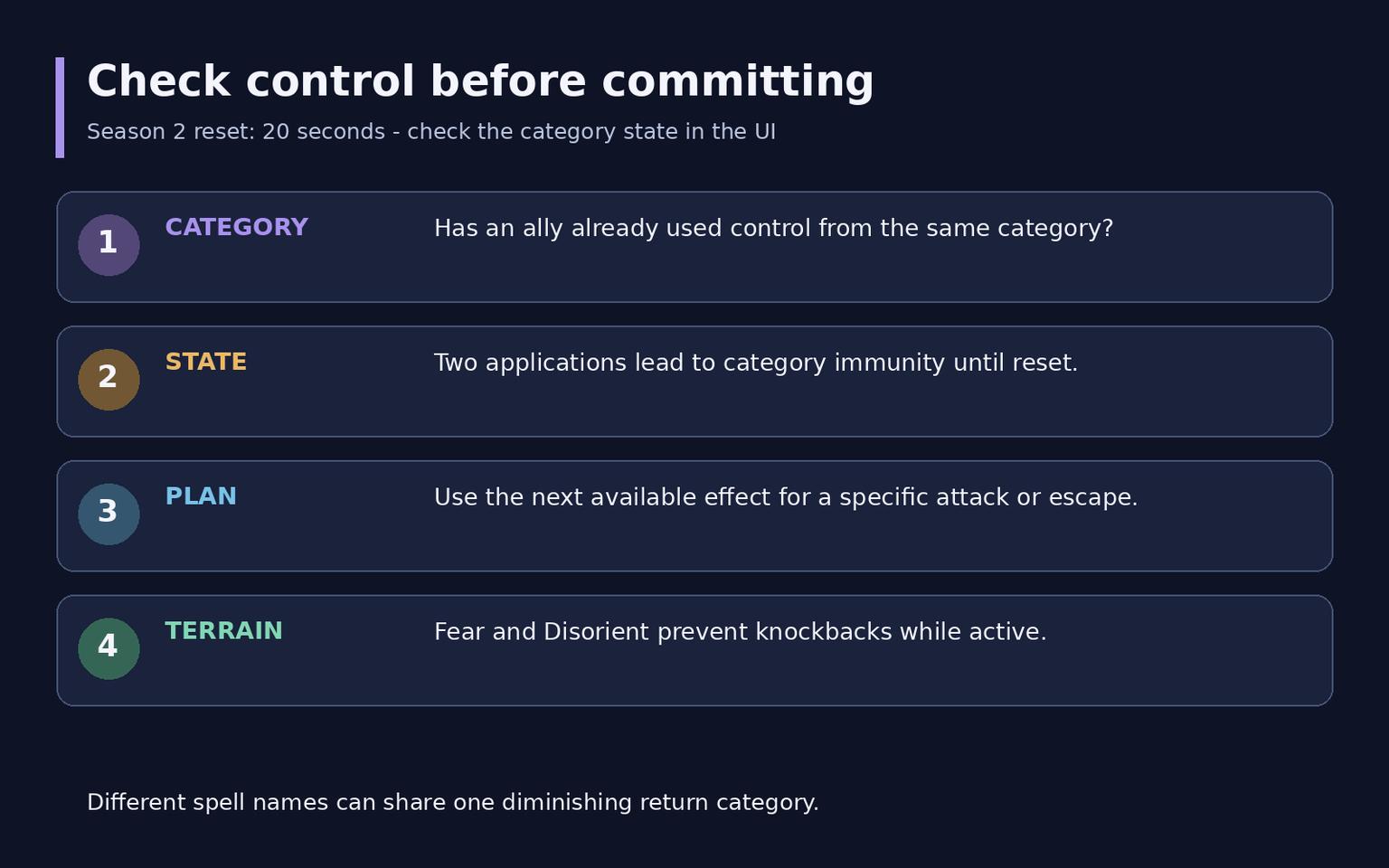
Diminishing returns reduce repeated crowd control from the same category on the same player. In Midnight, two applications lead to immunity to further control from that category until it resets. Season 2 extends the reset time from 16 to 20 seconds.
The category matters, even when another player uses a different named spell. If a teammate has already applied matching control, your next attempt may be shortened or fail. Inspect the target's state and agree on the sequence before committing damage. Pressing the first button does not establish the start of a new fully effective window for every subsequent action.
Check your selected abilities for category, duration and how their effects can be removed. A stun and a spell interrupt serve different purposes. Immunity to one category does not make a player immune to every form of disruption.
Movement and survival
Patch 12.1 reduced many movement slows, particularly effects with frequent application during ordinary attacks. There is no single replacement percentage for all abilities. Review your own movement tools and save a gap closer or escape for the point where distance actually changes the exchange.
Players receive 20% less healing in battlegrounds. Do not apply that battleground-wide modifier automatically to arenas. Damage dealers should use defensives before a situation becomes unrecoverable; healers must identify the player under meaningful pressure while tracking their available resources.
Players affected by Fear or Disorient can no longer be knocked back. A plan involving a ledge must account for that interaction. Useful abilities do not necessarily form a useful combination when one effect prevents the intended use of the next.
These are Season 2 foundations rather than a complete class balance list. Patch 12.1.5 includes further class changes, so review an old PvP build before reusing it. An overview cannot establish one best class for every bracket or promise a uniformly slow match pace across all compositions.
PvP equipment and currencies
Compare the item level specified for PvP. An item's normal level and the level used in an eligible PvP setting can differ. A lower number outside combat alone does not prove that an arena item is worse than a raid drop.
Season 2 source | PvP item level | Purpose |
Honor equipment | 331 | Establish a starting set |
Bloody Token equipment | 331 | Fill suitable slots through War Mode |
Conquest equipment | 344 | Plan purchases for your main set |
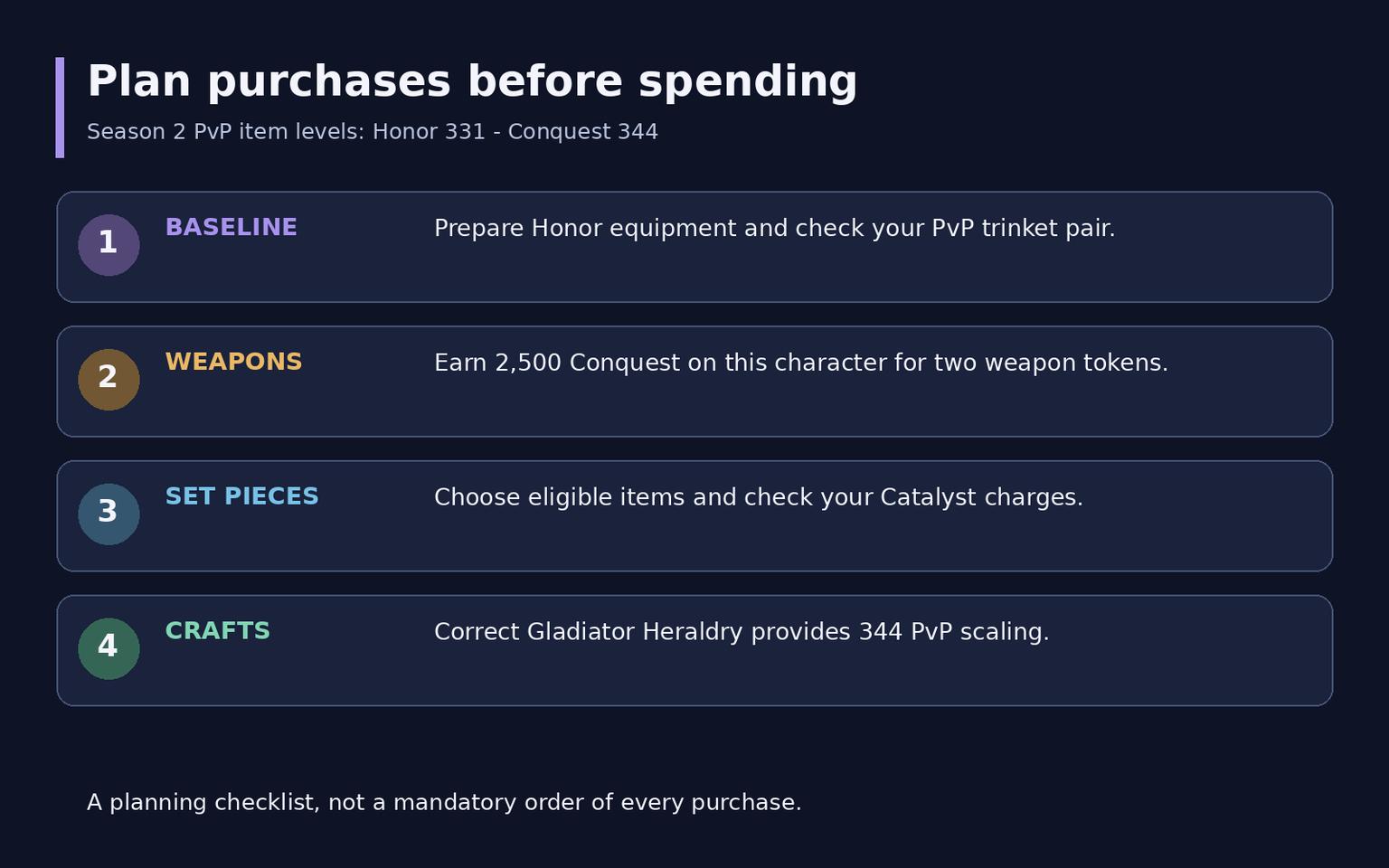
Crafts with Venomous Gladiator's Heraldry | 344 | Select stats and eligible embellishments |
These numbers describe the specified Season 2 categories. They do not apply to every crafted item. A PvP craft needs the appropriate seasonal reagent to provide the expected scaling.
Build a usable starting set and pay attention to weapons and PvP trinkets. Venomous Aspirant's Medallion, for example, removes the movement and loss-of-control effects covered by its tooltip. Check its availability and the trinket pair's set bonus before replacing the pair with arbitrary PvE items based only on normal item level.
The PvP vendors are in southeastern Silvermoon. Check available weekly quests and this character's current Conquest allowance before buying. A player starting late in the season should not treat the original Week 1 budget as today's limit. Avoid repeatedly paying for a slot you already have a plan to replace.
Weapons and class set planning
Earning 2,500 Conquest on this character during the season awards two weapon tokens. The condition concerns currency earned, rather than holding 2,500 unspent Conquest. Check Venomous Weapons of Conquest progress and the available exchange before making an expensive weapon purchase.
The Catalyst can convert eligible equipment into class set pieces. In Season 2, conversion retains secondary stats and certain additional effects. Choose the original item carefully; conversion should not be treated as a free way to repair unsuitable stats.
Check the value of two-piece and four-piece bonuses in your PvP build, then plan purchases around the charges available to you. Plan crafts without obstructing needed set slots. Select enchants and gems for your role, and prioritize costly enhancements on equipment you intend to keep.
Rating milestones and rewards
Main thresholds
Rank | Rating | Main Season 2 reward |
Combatant I | 1000 | Cloak appearance |
Combatant II | 1200 | Legs and bracers appearances |
Challenger I | 1400 | Gloves and boots appearances |
Challenger II | 1600 | Chest and belt appearances |
Rival I | 1800 | Shoulders and helm appearances |
Rival II | 1950 | Venomcoil weapon illusion |
Duelist | 2100 | Prestigious Gladiator cloak |
Elite | 2300 | Seasonal tabard and associated title |
Core Elite armor appearances unlock progressively through Rival I. They are a cosmetic goal rather than a separate set with stronger combat stats. The illusion, prestigious cloak and tabard belong to further milestones.
Mounts and mode-specific achievements
Vicious Lightbloom Boar is associated with seasonal rated wins at 1,000 rating or higher. Reaching the rating threshold alone does not finish the required progress.
Venomous Gladiator's Goredrake requires 50 wins in 3v3 while at Elite rank. Reaching 2,300 is only part of that goal. Solo Shuffle rounds and Blitz wins do not replace the required conventional 3v3 wins.
Legend requires 100 rated Solo Shuffle round wins at Elite, while Strategist requires 25 Battleground Blitz wins at that rank. Keep rounds separate from complete matches when checking achievement progress.
The end-of-season Venomous Gladiator title requires a top 0.1% finish on the 3v3 ladder and 150 season wins. It is a separate target from the mount. Other final-ranking titles have their own bracket and specialization conditions; an identical rating number does not imply an identical position on different ladders.
Prepare your interface and first rated session
Make ally health, important target effects, your own defensives and crowd control state readable. The default interface offers diminishing return tracking options and combat audio alerts. Review the functions available after an update instead of assuming that an old addon configuration still provides the same information.
Queue when you can accept the invitation. Missing a Solo Shuffle or Blitz queue triggers a one-minute account-wide queue restriction, with consecutive misses increasing the penalty. That missed-invitation rule is not a complete description of penalties for leaving a match already in progress.
Before the first session, check PvP talents, trinkets, targeting keybinds and party frames. Pick a concrete learning goal, such as returning to your healer's line of sight earlier or reporting an incoming attack before a base is contested.
After several games, review one repeated error. Identify which defensive remained available, where your healer was and which objective you overlooked. A short review ending in a specific adjustment gives the next session a clear purpose.
Frequently asked questions
Can I start without a permanent team
Yes. Solo Shuffle provides a solo route into rated arena play, and Battleground Blitz offers objective PvP. Both still require preparation. Finding regular partners for conventional 3v3 remains a separate task.
Does Elite transmog increase power
No. Appearance unlocks do not add stats. Combat preparation comes from equipment, useful stats, trinkets and the set bonuses appropriate to your build.
Can Solo Shuffle award the Gladiator mount
The Season 2 mount condition requires 50 conventional 3v3 wins at Elite. Solo Shuffle has separate achievements, including Legend.
Should I copy a ladder leader's build
Use it as a starting reference after checking the date, bracket and composition. Learn what the talents are intended to accomplish; a build alone does not teach positioning or when to spend a defensive.