FC 27 Wonderkids: Build a Practical Career Shortlist
The best young player for an FC 27 Career is someone your club can sign and develop. A famous prospect without a place in the squad may be less useful than a less celebrated footballer who receives suitable minutes and a clear job immediately.
Start with a short list and inspect the data inside your save. FC 27 changes player evaluation through Dynamic OVR, Growth Profiles and expanded scouting. A number in an external list cannot replace the player's condition, transfer interest and outlook in your particular Career.
The shortlist starts with three different jobs: attacking leader Yamal, creator Yıldız and wide development project Ngumoha. The Career promotional screens below illustrate profile comparison; check exact attributes, positions and fees in your own save.
Three names for an initial shortlist
Lamine Yamal - right-sided attack. His RW position and left-footed profile make him a candidate for an attacking project on the right. Compare control, passing and the option of moving inside as well as pace. If carrying and creating are the job, assess those actions rather than goals alone. Consider him when the club can support the transfer and provide a first-team place.
Kenan Yıldız - an attacking connector. The displayed profile lists CAM, LM and CM. Pace and dribbling stand out compared with the much lower defensive profile. Start by testing receiving between the lines and continuing attacks rather than using him as the sole holding midfielder. This is a useful search when midfield needs a connection to the forwards.
Rio Ngumoha - a left-sided development project. The example lists LM and LW, with pace well ahead of physical and defensive qualities. Plan situations where he receives in space and advances an attack. Holding possession with an opponent against his back is a different job. Wide rotation appearances provide a clearer initial plan than asking him to cover the whole flank alone immediately.
Candidate | Editorial scouting task | Check before negotiations |
|---|---|---|
Lamine Yamal | Young attacker for a club with substantial resources | Interest, availability and complete financial cost |
Kenan Yıldız | Candidate for a creative role | Suitable positions, tactical fit and squad competition |
Rio Ngumoha | Long-term development project on the flank | Minutes, growth assessment and readiness for your league |
If a candidate is unavailable, search for the same job: right-sided creator, player between the lines or young left winger. Age alone does not make two prospects interchangeable.
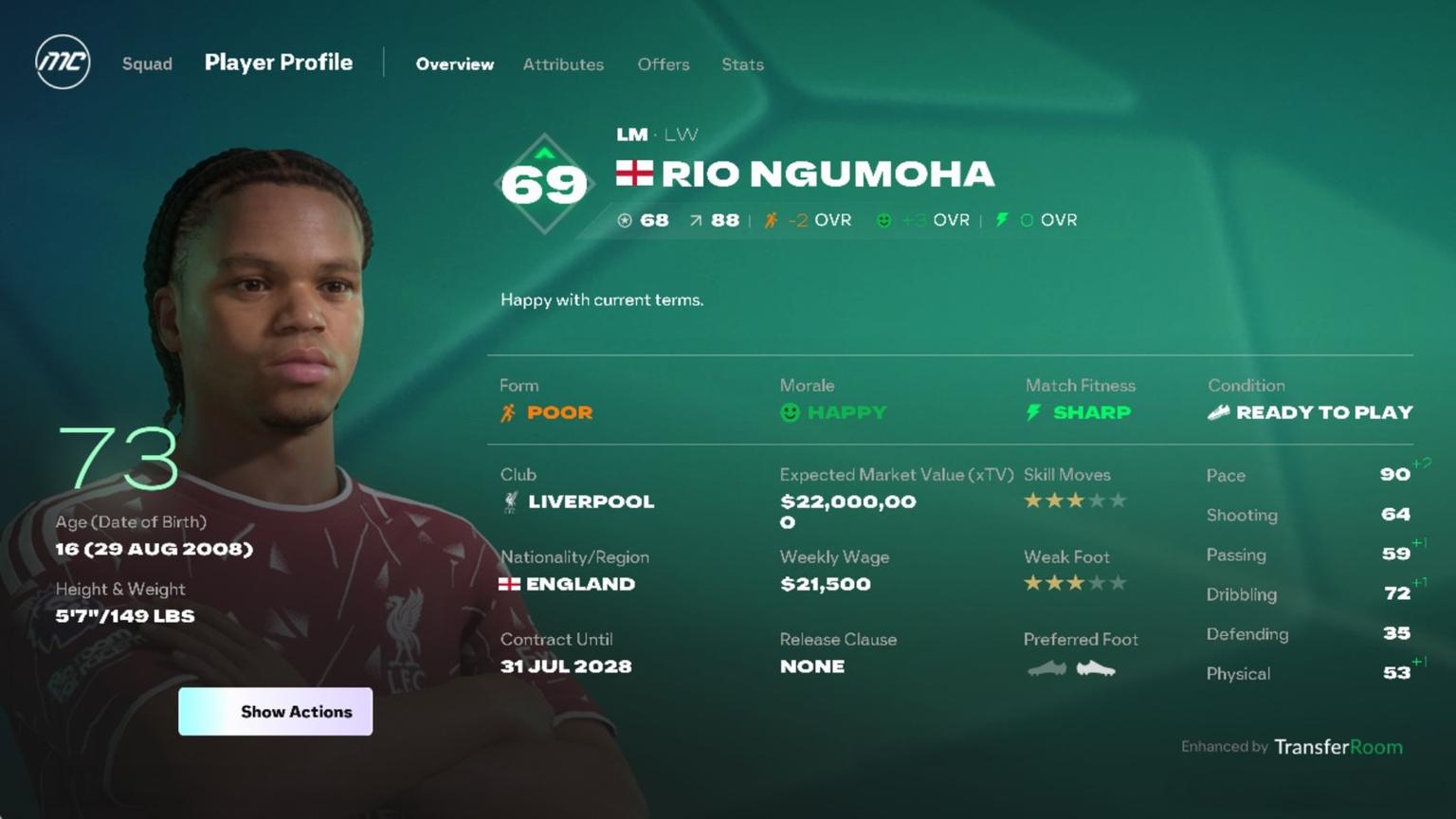
A young-player profile example. Values in the demonstration save may differ from your Career.
Starting data for comparison
This is an FC 27 Career database snapshot dated 6 October 2026, checked on 15 October. OVR is the initial overall rating, POT is the baseline potential assessment, and value is the database valuation rather than an agreed transfer fee. Use these figures to compare the scale of each project; an ongoing save can change both the data and the development outcome.
Player and club | Positions | OVR / POT | Estimated value |
|---|---|---|---|
Lamine Yamal, FC Barcelona | RW / RM | 90 / 95 | €167.5M |
Kenan Yıldız, Juventus | CAM / LM / ST / LW | 84 / 89 | €65M |
Rio Ngumoha, Liverpool | LM / LW | 75 / 88 | €13M |
The difference matters more than a high POT alone. Yamal is already ready for a leading role and needs a very different budget from Ngumoha. Yıldız has a 5-point gap between baseline OVR and POT, while Ngumoha has a 13-point gap. That is room in the baseline projection, not a promised increase within one season. Choose the required readiness first, then compare transfer terms.
Read ratings and development separately
Dynamic OVR reflects a player's current state, so a higher or lower displayed number does not always mean lasting change to underlying ability. Growth Profiles account for different development trajectories. Separate what a young footballer contributes now from the assessment of what they may become.
Scouting includes Tactical Fit, Future, Financial Assessment and Status. These areas help you investigate team suitability, development outlook and the circumstances of a potential move. A high OVR alone is not enough reason to negotiate; you also need player interest and a realistic plan for using the signing.
Base FUT item ratings are not a current Career table either. If an Ultimate Team database gives you a promising name, bring that name into your own search and compare the save data. Be particularly cautious with lists placing FUT OVR and Career potential side by side without explaining their origins.
Recruit for budget and role
Define the vacancy first. “A young midfielder” leaves too many possibilities. “Someone who can receive under pressure and eventually replace the main creator” provides useful criteria. Then decide how many minutes you can offer during the coming season.
Divide the budget between the transfer, wages and commitments after signing. Do not spend everything on the first payment. A successful signing needs to fit the team beyond one window. If the candidate expects a role you cannot provide, an attractive development assessment does not remove that conflict.
For immediate improvement, prioritise readiness for the required actions now.
For rotation, compare useful positions and the actual competition in your squad.
For a long project, judge the route to minutes rather than resale hopes alone.
Keep at least two suitable candidates for an important vacancy. That way, one club refusing an approach or one player's demands will not force a complete strategy change on deadline day. Alternatives should address the same problem instead of merely meeting an age filter.
Make a development plan before signing
Write down the first role before completing the deal: substitute appearances, selected cup matches or a rotation place. Avoid assuming you will find minutes later when several footballers already occupy the position. The plan must fit the calendar and your team's ability to support development.
Once the season begins, monitor performances, condition and execution of the required actions. A young player can help before becoming a complete star, perhaps by providing one attacking option or covering a particular job from the bench. Do not judge every appearance only through an OVR change.
If playing time is scarce, reconsider the candidate's place in the project. A possible loan requires checking available terms and the route back into your Career squad. Do not promise a fixed rating increase per season: neither a calendar nor a suitable development plan guarantees an identical result for everybody.
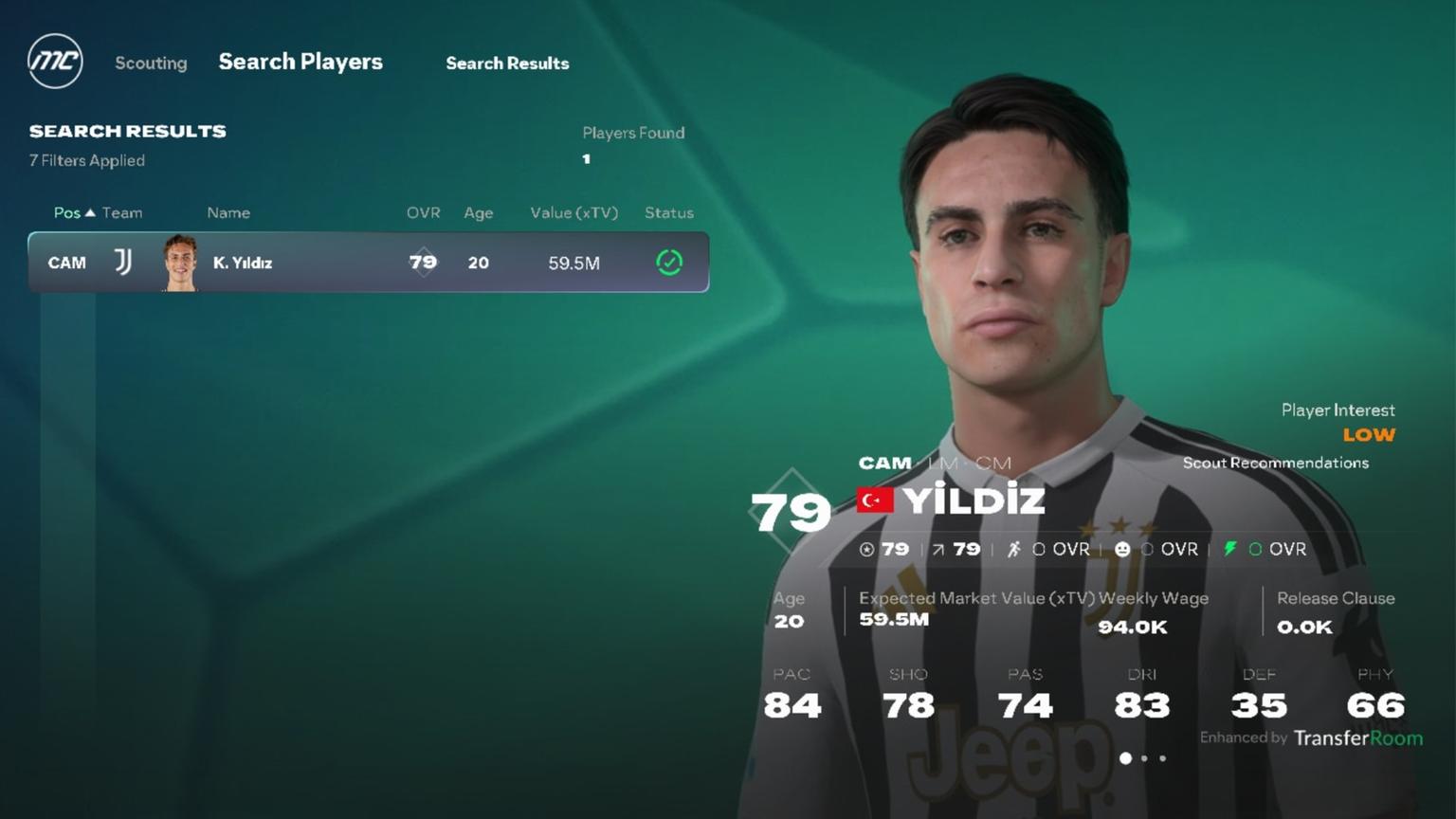
Player search presents a candidate alongside transfer interest and financial information. These are demonstration values.
Consider the academy alongside transfers
Not every youth requirement needs an expensive external signing. Check whether an academy player could fill the same role and compare readiness with outside candidates. A homegrown player still needs time and opportunities, so replacing financial cost with waiting is not the whole decision.
Account for game version and updates. Title Update 1.0.4 adjusted the number of generated players with high OVR and potential. An older video showing an unusually strong academy intake does not establish what a newly started Career will produce.
Compare academy and transfer options through the same questions: required actions, development time, wage pressure and route into the squad. This helps prevent signing another prospect solely because the name appears repeatedly in popular lists.
Check the final decision
Return to the three candidates and answer what problem each solves, why they suit it better than alternatives and where they will play. If your answer consists only of age or an attractive projection, the search is unfinished. Some clubs are better served by delaying a glamorous signing and improving a weaker position.
After the deal, retain the player's starting information and your season objective. That makes it easier to judge the decision later without rewriting expectations around a temporary rise or fall in form. A good shortlist supports informed recruitment rather than promising the same result in every Career.
FAQ
Who is the best FC 27 wonderkid?
Budget, role and minutes determine a practical answer. No candidate is equally available and useful to every club.
Can I use FUT OVR for Career?
Use it as a reason to investigate a name, then check exact player data and transfer circumstances in your Career save.
Are these three guaranteed to reach a listed POT?
No. The table provides baseline POT for comparison rather than a guaranteed outcome. Evaluate the actual development path inside your Career.
Is buying a talent or providing minutes more important?
Treat them as one decision. Signing a development project without a clear squad place puts your recruitment plan under pressure.