Overwatch Stadium Guide: Rules, Armory and First Matches
Stadium changes the familiar Overwatch rhythm: choose a hero for a match, develop that hero between rounds and answer opposing builds through purchases. Success depends on abilities, Items and positioning working together. A familiar character may perform a different job here than in regular Competitive.
For your first games, understand four things: your chosen queue's format, permanent Power choices, replaceable Items and why your team wins or loses engagements. You do not need to memorize the entire Armory beforehand. Understanding which next choice supports your plan is more useful.
This guide describes rules checked on October 15, 2026. Competitive and Quick Play differ in series length and progression pace, while October changed role distribution in Quick Play. An old instruction that applies one format to every match is therefore misleading: identify the queue before you enter.
Competitive and Quick Play: the important differences
Rule | Competitive Stadium | Quick Play Stadium |
|---|---|---|
Format | Best-of-seven, first to four round wins | Best-of-five, first to three round wins |
Power selections | Before rounds 1, 2, 4 and 6 | Before rounds 1, 2, 3 and 5 |
Roles | 1 tank, 2 damage, 2 supports | Open Queue with role limits |
Value for a beginner | Developing a plan through a ranked series | Faster tests of heroes and combinations |
Since October 6, Quick Play allows at most one tank, two damage heroes and three supports; one tank is required. The team still has five players. Competitive retains its 1-2-2 composition.
Check the queue card before starting. Custom games may use different rules, with configurable economy, round totals and other parameters. Testing a build in an unusual lobby is useful, but its purchase pace should not automatically be treated as standard Competitive progression.
Choose a hero for the whole match
In regular Overwatch, an unsuitable pick can often be corrected by switching characters. In Stadium, you plan the chosen hero's development through the series. Consider the team plan as well as opening strength: who takes space, who creates pressure and who helps survive the response?
Start with a hero whose basic abilities you understand. Knowing weapon range and a safe exit is more valuable than memorizing a complicated combination you cannot execute in time. For early games, choose one direction, such as weapon damage or developing a particular ability, instead of several unrelated plans at once.
Stadium's available roster differs from Overwatch's general hero list. Use this mode's selection screen. Do not assume that a new core-game hero already has Stadium Powers and Items. If your favorite character is absent, prepare an alternative in your role before the match begins.
Inside the Armory: your between-round choices
Powers establish direction
Powers change individual abilities and interactions. They do not require Stadium Cash and become available at particular stages of the series. Once selected, a Power remains part of the current build, so an early choice should support actions you are ready to repeat.
Read the entire activation condition before confirming. Does the effect work after a hit, during a particular ability or only near an ally? An impressive bonus may remain almost inactive with your playstyle. At the next selection, look for an extension of the functioning core rather than the flashiest description.
Items let you adapt
Items cost Stadium Cash. You can equip up to six at once and sell them for their full value. This lets you redistribute stats between rounds: sell a purchase that has stopped helping, free the slot and buy an answer to a visible threat.
The main groups are Weapon, Ability and Survival; the rarities are Common, Rare and Epic. The group helps you search for a particular action, while rarity indicates a purchase tier. An expensive item is not better merely because it is Epic: if its effect never activates, a simpler useful upgrade may deliver more.
Hero Builder helps establish direction. At the start it offers popular build options; later you can continue the existing route or consider recommendations against opponents. Use it as a starting point, then check whether the suggestion addresses your actual match.
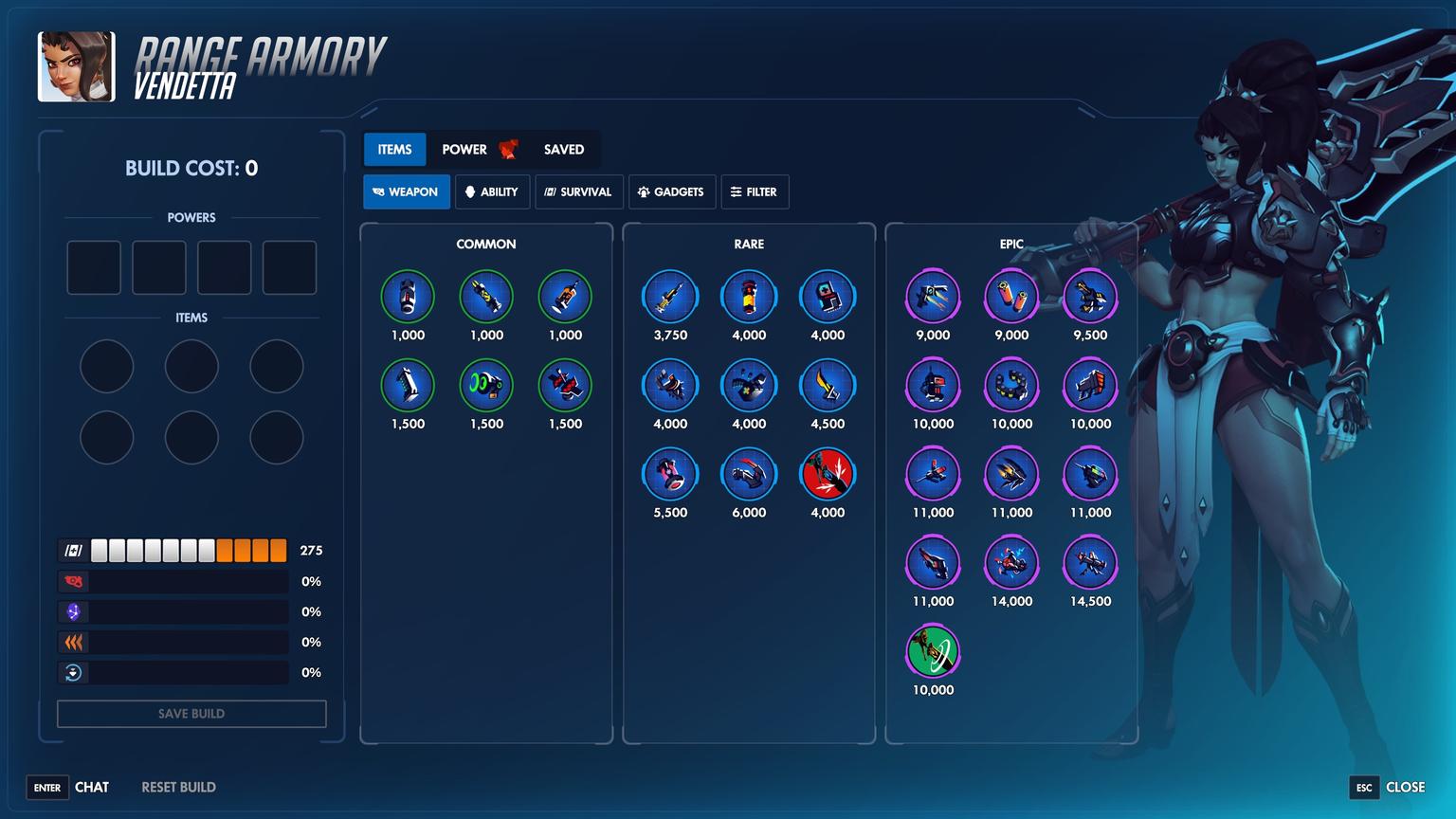
The practice Armory shows item categories and upgrade slots. This is a 2026 demonstration; check current effects and prices in the client.
Stadium Cash: spend for the next round
This currency develops your hero within the current match. Earning it reflects participation rather than only landing the final hit. A support therefore should not abandon allies to hunt eliminations, and a tank should not turn every engagement into an individual chase.
Track the available budget and remaining slots. Affordable early purchases let you perform your job immediately. Later, they can be sold and replaced with more suitable options. Saving toward an expensive item makes sense when your present build already handles its task.
A dangerous opponent may carry a bounty. That provides an additional reason to coordinate focus, but does not override positioning or the objective. Chasing a marked target across an exposed area can cost more than a successful elimination would earn.
Some survivability comes from economic progression, but October reduced passive health gained from currency. Do not assume that purely offensive purchases automatically provide enough durability. If you die before contributing, review defensive Items and your approach route.
A step-by-step routine for your first match
Before selection, identify the hero's task and agree on a general approach.
Choose an opening Power that supports that task immediately.
Spend the opening budget on useful affordable stats after reading their conditions.
During the round, play around cover and observe which part of the build actually works.
After the fight, identify one main problem: insufficient pressure, lost position, enemy healing or your own quick death.
In the Armory, change one purchase to address that problem while maintaining a coherent Power core.
For example, suppose you choose Soldier: 76 with On Me! so the field moves with you. If you travel far away from the group, field mobility does nothing for allies. Fix distance and route first. If you remain close but die to the opening response, review survivability rather than adding another damage bonus.
Read opposing builds, not just the score
Inspect enemy Powers and Items when that information is available. Identify the source of a recurring problem. Constant healing, amplified weapon damage and substantial overhealth require different answers. One universal purchase cannot cover everything at the same time.
Following October's update, El-Saka Suppressor applies healing reduction through weapon damage, while Cybervenom is linked to ability damage. Sundering Vial addresses overhealth. These are examples of Items with different jobs; choose using an application method you can deliver and the complete item description.
Ordinary selling cannot fully undo a poor early Power choice. However, you can change position, the next purchase and the team's action sequence. A lost round provides useful information when the next attempt actually differs from the previous one.
Objectives, camera and engagement pace
Stadium uses variants of familiar objectives, including Control, Push, Clash and Payload Race. First identify what wins the current round. Eliminations create opportunities to advance the objective; continuing a chase after a won fight can let opponents return before you use the advantage.
You can switch between first- and third-person cameras. Choose the perspective that makes it easier to read the surroundings and apply your abilities accurately. Learn the setting before a tense match. An unfamiliar camera angle can interfere with judging cover even if basic aiming already feels comfortable.
After winning an engagement, claim the next useful corner while retaining access to the objective. After losing one, return together. Economy and Powers strengthen a hero, but repeated individual entries still leave the group at a disadvantage.
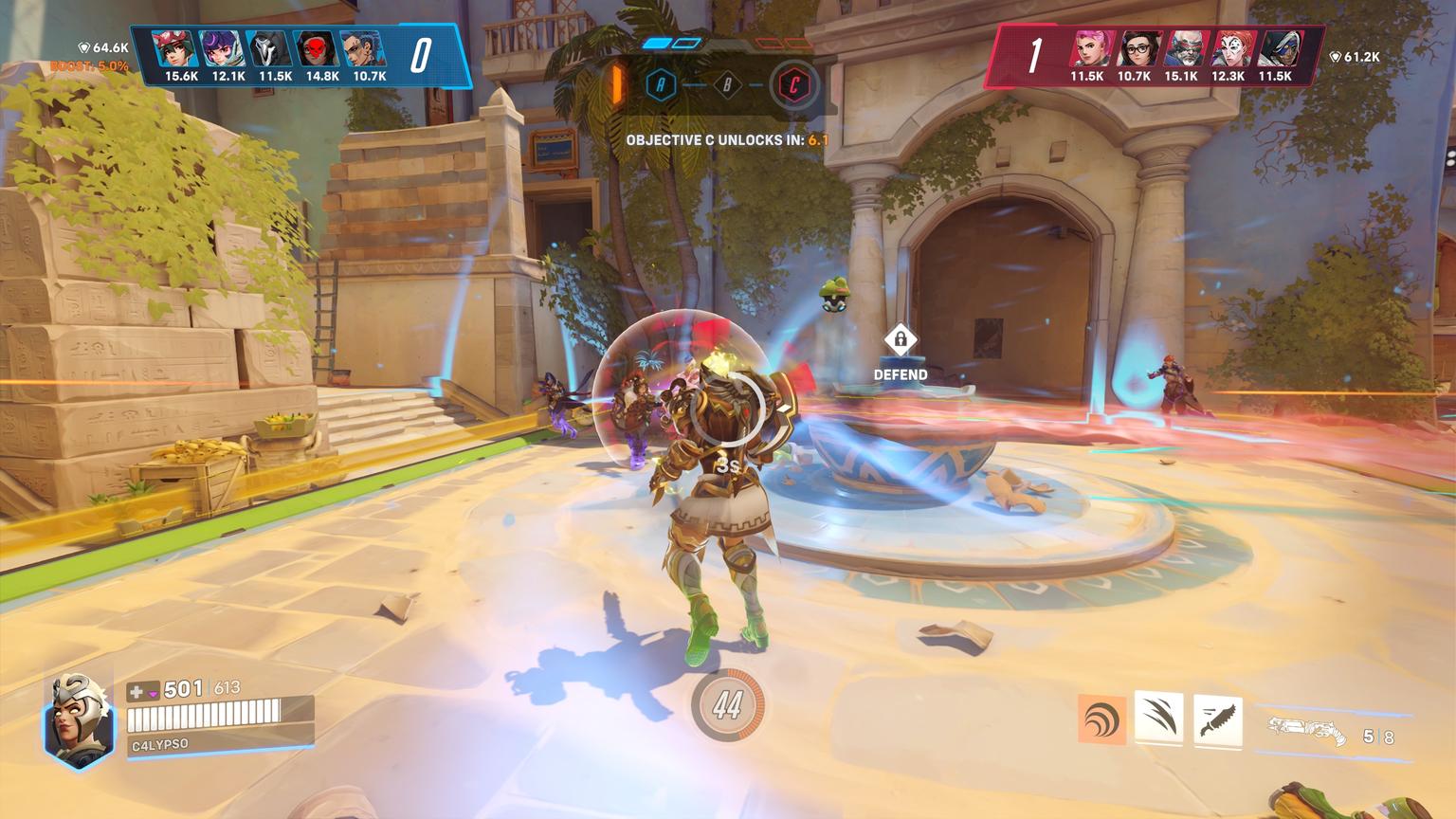
Third-person view in an official Stadium demonstration; choose the perspective that makes the fight easier to read.
FAQ
Can I play in first person?
Yes. Stadium supports first- and third-person views, selectable through its settings.
Do Items carry between matches?
Build progression belongs to the current match. A new match requires selecting upgrades and allocating that match's budget again.
Why does an older guide list different Power rounds?
The mode has changed since launch. Current Competitive uses rounds 1, 2, 4 and 6; Quick Play uses 1, 2, 3 and 5.
Where should I start without a prepared build?
Use a familiar hero, one development direction and Hero Builder suggestions. After each round, check whether the route helps you perform your job.