The First Descendant Luna Build: Support and Noise Surge
Luna first requires a role decision. Support amplifies allies and helps their resources, while Noise Surge changes skills for personal area damage. These are separate setups: the complete base-support package cannot be promised alongside every advantage of the damage modification.
The foundations below use Nimble Footsteps and Noise Surge after the 1.4.3 rework. Support prioritizes coverage, duration, MP and positioning near allies. The offensive option adds Non-Attribute, the appropriate Arche Type and skill critical statistics.
Assemble a working core and practice the rhythm in an easy operation first. Increase module costs and assign sockets after choosing a layout. Fully enhanced cards require developed capacity, so the list is not an instruction to install everything immediately on a new character.
What changed for Luna?
The September rework improved Stage Presence damage, unique-weapon ammunition capacity and ammunition recovery. A missed shot consumes MP: maintain the rhythm so Stage Presence does not end prematurely.
Base Passionate Stage, Relaxing Act and Delightful Stage serve different team needs. Passionate Stage concerns skill amplification, Relaxing Act provides resource support and changed recovery effects, while Delightful Stage assists Inspiration accumulation and enhanced cooldown support.
Do not press every button merely because it is available. Track notes, resources, enhancement state and allies within range. Team value depends on a buff reaching the useful window rather than the total number of activations.
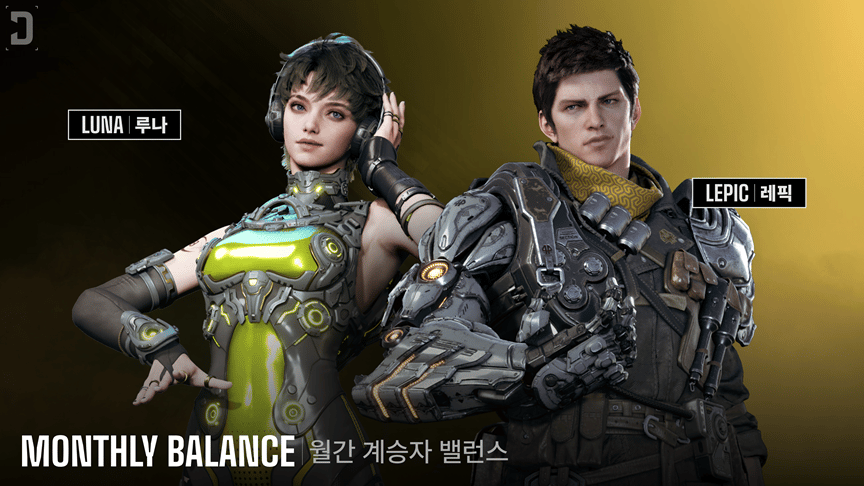
Luna and Lepic featured in the September balance update.
Nimble Footsteps support foundation
This Skill Module preserves the support direction and grants Luna mobility and range while supplying buffs. The rework improves useful Vivace accumulation, with MP recovery in and out of combat added at maximum stacks. It is a convenient foundation for following a moving squad.
Module | Purpose |
|---|---|
Nimble Footsteps | Mobile support Skill Module |
Increased HP | Health reserve |
Increased DEF | Additional defense |
Enlightenment | Higher Max MP |
Skill Expansion | Effect coverage within its applicable cap |
Skill Extension | Applicable effect duration |
Strong Mentality | Lower Skill Cost |
MP Accelerant | Additional duration and Max MP |
This means seven ordinary cards and one separate Skill Module. The remaining ordinary slots are flexible. Increased Shield adds a defensive direction; Non-Attribute Specialist helps when developing personal skill damage; consider MP Collector only in operations offering reliable opportunities for your own kills.
MP Collector has a chance to activate on an enemy kill, so it cannot be called guaranteed resource income during pure boss support. If ordinary enemies are scarce or allies defeat them, evaluate other resource and defensive options.
The selected core has no duplicate named groups: MP Accelerant occupies Cooldown, while an optional Non-Attribute Specialist occupies Battle. Skill Extension improves duration rather than critical chance. Choose card levels according to your actual budget and the problem you need to solve.
Playing the support setup
Before a dangerous window, position yourself so the effects reach the intended allies.
Activate Stage Presence and keep a controllable rhythm of notes and shots.
Maintain the effect suited to the team's task rather than a random button sequence.
Spend the enhanced state when the group can actually benefit from it.
Monitor MP and move with the squad while maintaining a safe distance.
A large radius does not replace positioning. An ally outside the area or a group scattered across the map gains no value from a theoretical maximum. Fit coverage to the route before deciding whether more duration is necessary.
Ordinary cooldown improvement does not mean every successful rhythm activation becomes faster. Consider Nimble Fingers and MP Conversion only after identifying the actual limiting stage of the cycle. Avoid spending several slots on a statistic that does not solve the current problem.
Noise Surge: a named offensive foundation
Noise Surge changes skill use: damage to nearby enemies and Luna's own stacking effects replace ally buffs. The rework changes damage, radius and stack behavior. Relevant stacks decline when duration expires rather than necessarily disappearing together as older descriptions suggest.

Luna: support and Noise Surge use different Skill Module options.
Ordinary slots | Role |
|---|---|
Increased HP, Increased DEF | Survival while approaching groups |
Non-Attribute Specialist | Non-Attribute amplification, Battle group |
Singular Specialist | Singular skill amplification, Attack group |
Skill Insight, Skill Concentration | Skill critical chance and critical damage |
Skill Expansion, Skill Extension | Coverage and applicable duration |
Strong Mentality, Enlightenment | MP cost and reserve |
These are ten ordinary slots plus the separate Noise Surge. Non-Attribute Specialist and Singular Specialist are compatible because Battle and Attack are different groups. Focus on Non-Attribute and Focus on Singular are alternatives to the corresponding Specialist cards, not additional cards stacked on top.
Start with HP, resources and the main amplification, then develop the critical pair. The percentage on Skill Insight is not the same final critical chance. Inspect the final value and actual results with Luna's own effects active.
Reactor, components and weapons
For Noise Surge's changed stage-skill damage, prioritize Non-Attribute/Singular, typically Materialized Singularity. Base Stage Presence has a different type: Tech. If building separately around it or another Skill Module, recheck skill types instead of automatically transferring the reactor.
Verify the Optimization Condition against the weapon you actually use. Then choose useful additional options: coverage and duration for convenience, or critical and appropriate skill statistics for offense. Good secondary lines do not repair an incorrect basic match.
Start External Components with HP, appropriate protection and useful MP options. Do not abandon stability for a complete offensive set if repeated knockdowns interrupt the cycle. A functional surviving setup is more practical than an unfinished maximum-damage plan.
An ordinary gun is needed between skills and when the unique weapon is inconvenient. An invested Thunder Cage offers a straightforward clearing foundation but is not mandatory for Luna. Do not assume all its firearm modules automatically amplify her unique skill.
Other Skill Modules and Ultimate Luna
Singer's Mercy is a separate direction using placed speakers. It changes effect delivery, making object position and group movement important. Its layout should not be mixed with Nimble Footsteps or Noise Surge as though all three cards were installed together.
Battlefield Concert and Battlefield Artist are available to Ultimate Luna. Their changed mechanics require separate tuning, so they are not part of this Normal Luna foundation. Unlocking Ultimate does not make all her builds equivalent.
Frequently asked questions
Which setup should I learn first?
Start with Nimble Footsteps for a group or Noise Surge for personal farming. Save separate presets.
Does Luna heal the team like Yujin?
Do not describe her as a direct healer replacement. Work with the specific buffs, MP and defensive effects of the chosen skills.
Can I install two Battle cards?
No. Select one module from that group. Focus on Non-Attribute replaces Non-Attribute Specialist, for example.
Is Ultimate required?
No. Normal Luna can use Nimble Footsteps and Noise Surge. Ultimate provides its own additional directions.