WoW Midnight Alchemy Guide: Leveling, Recipes and Builds
Alchemy produces potions, combat flasks, profession phials, transmuted reagents and housing items. Having access to those categories does not make developing all of them at once a sensible starting plan. Decide whether you want personal flask benefits, a focused consumable business or a transmutation routine before spending Knowledge.
This guide was checked on October 16, 2026 for Midnight Season 2 in the context of patch 12.1.5. It explains the profession's core systems and identifies seasonal recipes separately. It does not fix material prices or promise a gold return. Check the current market and your character's actual capabilities before placing a large order for materials.
Goal | Sensible first step | Avoid assuming |
Longer personal flask use | Put 15 Knowledge into the Fluent in Flasks root | That the benefit requires the entire production build |
Consumable sales | Choose potions, flasks or profession phials | That high demand automatically creates profit |
Transmutations | Learn the target recipe and its restrictions | That every conversion supports Multicraft |
Gradual profession leveling | Combine first crafts with useful recipes | That one shopping list guarantees skill 100 |
Training and a second profession
Camberon teaches Midnight Alchemy in Silvermoon, around 47.0, 51.8. Camberon's Cauldron is beside the trainer, and Melaris sells supplies nearby. Make sure you are learning the Midnight entry; older expansion skills are separate.
Herbalism is the natural pairing if you want to gather your own ingredients. The five main herbs are Tranquility Bloom, Argentleaf, Azeroot, Mana Lily and Sanguithorn, with Nocturnal Lotus as a rare additional find. Self-gathered herbs still have a value: using them in a potion means giving up the opportunity to sell them directly.
Any class can use Alchemy. Goblins receive +5 Alchemy skill and Kul Tirans +2 profession skill, but neither bonus replaces recipes, Knowledge or equipment. A small skill advantage does not require you to change the character you actually want to play.
Learning recipes through Camberon's Cauldron
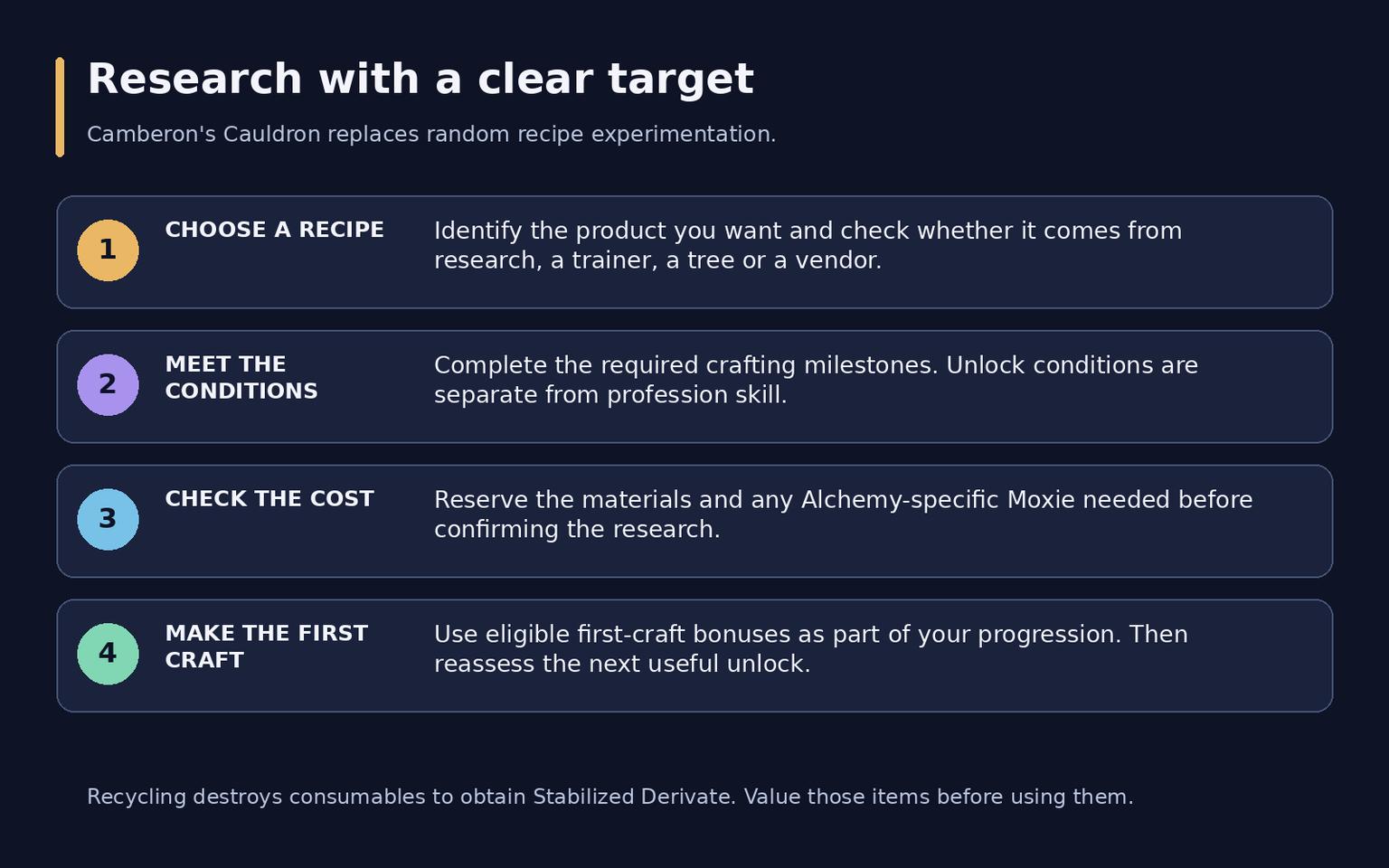
Midnight replaces the previous expansion's random experimentation with directed research. At the cauldron, choose a recipe and examine its prerequisites, such as making a specified number of potions or flasks. Once those conditions are met, learning the recipe costs materials and, in some cases, profession currency.
Directed research does not mean every recipe is immediately available for free. The trainer's basic recipe selection is already available by skill 15. Further recipes come from research, specialization, vendors and renown. If a target item is missing from the trainer, check where its recipe comes from before continuing to level without a plan.
Artisan Alchemist's Moxie is Alchemy's own currency. Its uses include recipe learning and purchases, as well as one-time Knowledge books. Do not treat another profession's currency as interchangeable, and reserve what your next intended unlock requires.
Recycling potions and flasks
Recycling destroys selected consumables to produce Stabilized Derivate, a reagent used in research and later crafts. Check how much your next objective needs before choosing items to destroy. A valuable potion is not a free ingredient merely because it is already in your bags.
Compare the value of the recycled items and any additional reagents. Cheap leftovers from your own production may be suitable, while other consumables are better kept for use or sale. The useful comparison is the cost of obtaining the required Derivate, rather than how many recycling actions you can perform.
Leveling Alchemy from 1 to 100
Skill rises through suitable crafts. Knowledge develops specializations, while each recipe has its own availability requirements. These systems interact without being interchangeable. The first specialization becomes accessible at base skill 25.
Skill stage | Practical action | Limitation |
1-7 | Around six crafts of Silvermoon Health Potion | Count crafting actions rather than individual bottles produced |
Roughly 7-20 | Recycle some of those potions | Check the recipe color and actual skill gains |
Roughly 20-27 | Research and make newly available first crafts | Transmutation requires a Philosopher's Stone |
Roughly 27-50 | Affordable available potions, first crafts and recycling | Yellow recipes may consume extra materials |
50-100 | Recipes matching your chosen specialization | Compare leveling cost with the value of the output |
The early stages are a framework, not a guaranteed action count for every character. Racial bonuses and variable skill gains from yellow recipes affect the actual materials needed. Test a few crafts before committing to a large batch.
As new recipes open, useful first crafts include Refreshing Serum, Lightfused Mana Potion and accessible intermediate reagents. Primal Philosopher's Stone enables transmutation; a suitable Philosopher's Stone from an earlier expansion can also meet that requirement.
After 50, potions, flasks and transmutes can all contribute. Light's Potential is an option for potion progression, Flask of the Shattered Sun for flasks, and Wondrous Synergist for transmutation. The last uses recharging availability, so it cannot replace unrestricted continuous production whenever you choose.
Approaching 100, stop budgeting as though one finished item always equals one skill point. Recipe colors change, gains become less reliable and different recipes can award different amounts. Compare the cost of progress, unlock requirements and usefulness of the finished product.
Four trees and three practical plans
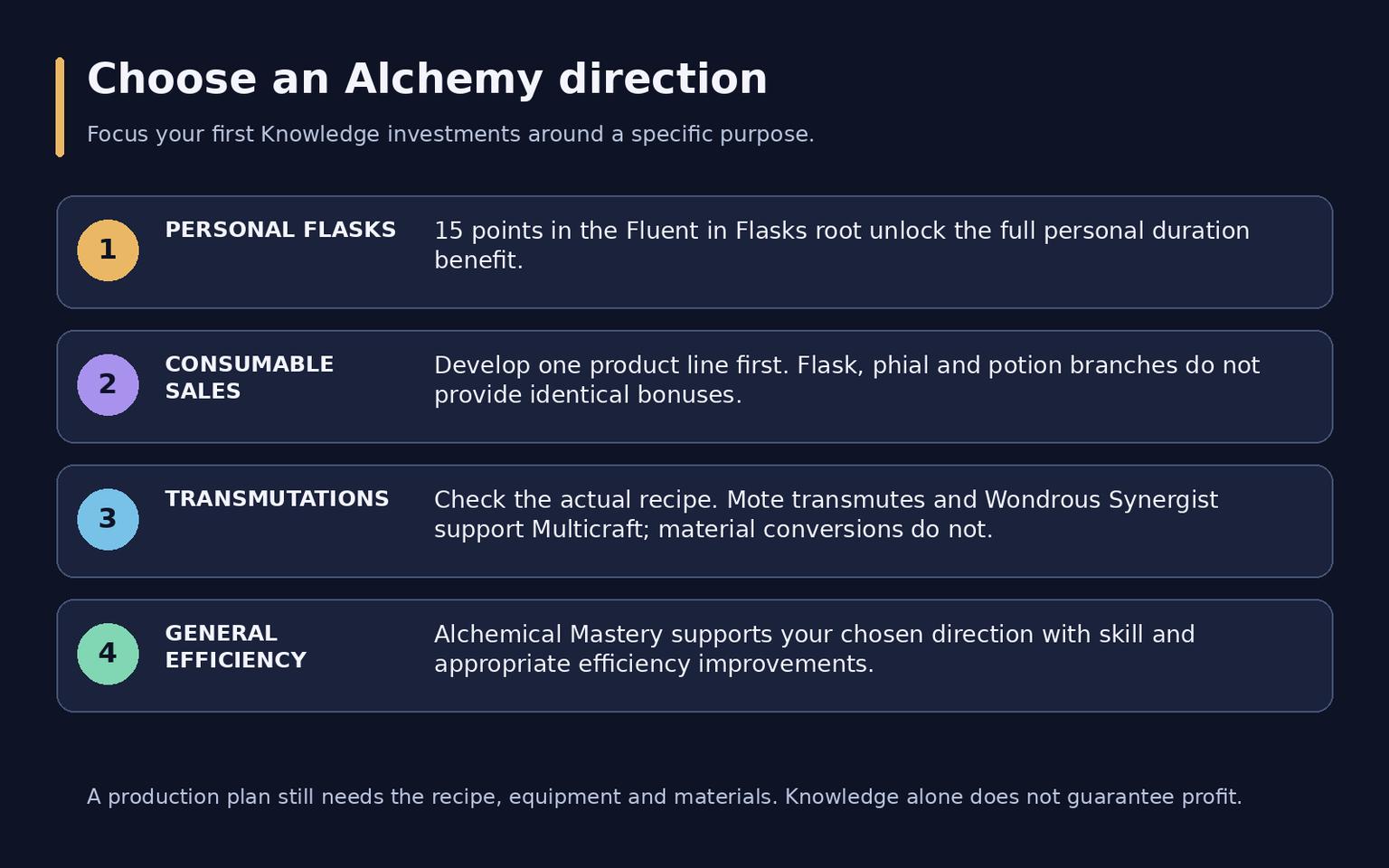
Spend Knowledge toward a particular product. General improvements matter, but spreading early points across every tree delays useful recipes and production bonuses.
Tree | Focus | Useful pairing |
Potion Prowess | Light and Void potions, associated recipes and stats | Development of the potion family you choose |
Fluent in Flasks | Combat flasks and profession phials | The appropriate flask or phial branch |
Transmutation Authority | Material conversions and Wondrous Synergist | Checking each recipe's supported stats |
Alchemical Mastery | General skill and crafting efficiency | The production line you have already selected |
Personal flask benefits
For longer-lasting consumables, put 15 Knowledge into the Fluent in Flasks root. Duration benefits unlock at 5 and 15 points, increasing the relevant flask and phial duration up to twice its base length. This is a benefit for the alchemist, not a special duration automatically passed to everyone buying your products.
You can continue into flask production afterward, but personal use does not require completing the entire tree. Decide separately whether you want an auction-house operation or simply the benefit on your own character.
Crafting consumables for sale
A straightforward combat-flask opening is 10 Knowledge in Fluent in Flasks, 10 in Sin'dorei Specialist and 20 in Flask Abundance: 40 points for a production foundation. If you took the personal-duration benefit first, the root already has 15, making that version of the opening 45 points in total.
A following investment can be 10 points in the Alchemical Mastery root and 20 in Recycle for flask and phial efficiency. The specialization node called Recycle is a passive improvement; do not confuse it with the action that destroys potions for a reagent.
For potions, choose Potion Prowess and focus on either the Light or Void path. Profession phials have their own branch within Fluent in Flasks. Investments in combat flasks should not be treated as identical improvements to every other product category.
Transmutations
Transmutation Authority develops material conversions and Wondrous Synergist, which is used for cauldrons and housing crafts. Synthesis Synergy improves work with that reagent, including recovery and available charges.
Mote transmutes and Wondrous Synergist support Multicraft, while material conversions such as Bouquet of Herbs and Box of Rocks do not. Inspect the stats shown for the recipe itself before selecting a tool. Saved materials also matter, making Resourcefulness useful across different conversion types.
Quality, Concentration and equipment
Midnight consumables and reagents that use quality have two ranks: normal and high. Material quality, skill, specialization and profession equipment determine the result you can reach. Where the recipe permits it, Concentration compensates for missing skill to reach a higher quality. Its regenerating pool limits the volume you can produce that way.
Ingenuity concerns Concentration refunds, Multicraft offers additional output and Resourcefulness can save materials. None of those chance-based effects should be counted as a guaranteed result on every craft. Before planning a batch without Concentration, check whether the desired quality is naturally achievable.
Starter equipment | Crafted by | Slot |
Hobbyist Alchemist's Mixing Rod | Scribe | Tool |
Bright Linen Alchemy Apron | Tailor | Accessory |
Chemist's Cap | Leatherworker | Accessory |
An alchemist uses one tool and two accessories. Fill empty slots first, then compare upgrade costs. Epic equipment adds more secondary stats, but an expensive set does not remove recipe requirements or Knowledge investment. When ordering equipment, inspect its quality and stats rather than only its rarity color.
Knowledge sources and a repeatable routine
First-craft bonuses are marked in the profession journal and provide one-time Knowledge. Eight Alchemy treasures each award three Knowledge, for 24 total. Beyond the Event Horizon: Alchemy adds another 10 and requires renown 9 with The Singularity; check the vendor's current conditions before buying it.
Source | Knowledge | Planning approach |
Patron orders | Depends on available order rewards | Check recipe, quality, materials and reward |
Weekly quest to complete three orders | 1 | Finish the requirements and claim the notebook |
Two weekly treasure items | 4 total | Separate these from the eight one-time profession treasures |
Alchemy treatise | 1 per week | Obtain through Inscription and use it |
Not every Patron order grants Knowledge, and some requirements may be beyond your character. A fixed total should therefore not be promised as a guaranteed weekly payout. If the order quest is unavailable, check the crafting-order introduction and its current prerequisites.
Catch-up is also associated with orders and is not an unlimited source for a character who has already caught up. Darkmoon Faire provides three Knowledge per monthly cycle, separately from the weekly routine. Track one-time rewards, recurring sources and catch-up in different parts of your own checklist.
What Season 2 adds
New recipes expand the base assortment. Being part of the expansion does not make them automatically available from Camberon.
Recipe | Purpose | What to check |
Concentrated Silvermoon Health Potion | New healing potion | Recipe source and the regular Health Potion used as an ingredient |
Liquid Luster | Versatility combat potion | Access conditions and effect description |
Alluring Nostrum | Shadow-damage combat potion | Reputation requirement and recipe price |
Ersatz Venom Splatter | Housing decor | Vendor, prerequisites and finished-item demand |
These seasonal recipes have different unlock sources. Locate the appropriate journal or vendor entry before purchasing materials. Compare a newer product with its basic counterpart using the full cost, rather than assuming the newer name makes it profitable.
Checking a production batch
Pick one recipe and a small production volume. Record all material costs, output without chance-based bonuses, Concentration spending and a realistic sale price. Include the auction-house cut and focus on what actually sells, rather than what can merely be listed.
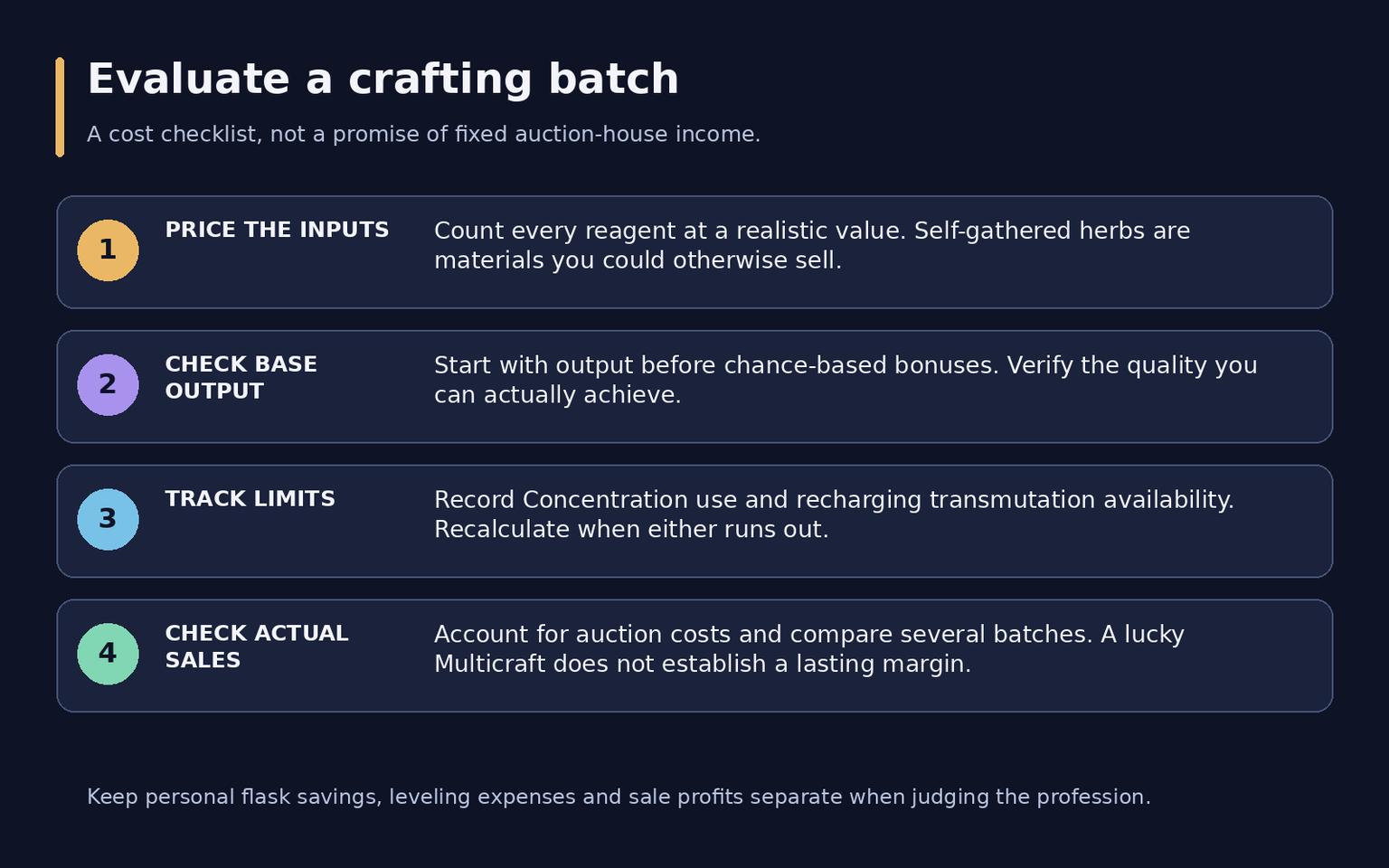
Then examine how Resourcefulness and Multicraft affect the average across several batches. One lucky run does not establish a lasting margin. If Concentration runs out, recalculate production without it: both achievable quality and cost may change.
Frequently asked questions
Does the trainer teach every recipe?
No. Camberon's Cauldron, specializations and separate vendors matter. Research requires meeting the relevant conditions and paying its costs.
What if I only want longer flasks?
Start with 15 Knowledge in the Fluent in Flasks root. Further production investment is a separate decision.
Do I need the highest-quality herbs for leveling?
Not always. Cheaper materials can be suitable for skill progression, but check the quality of a product intended for sale separately.
Can transmutation profit be guaranteed?
No. It depends on prices, output, available charges and the stats supported by the particular recipe.