WoW Midnight Demon Hunter Guide: Havoc, Vengeance and Devourer
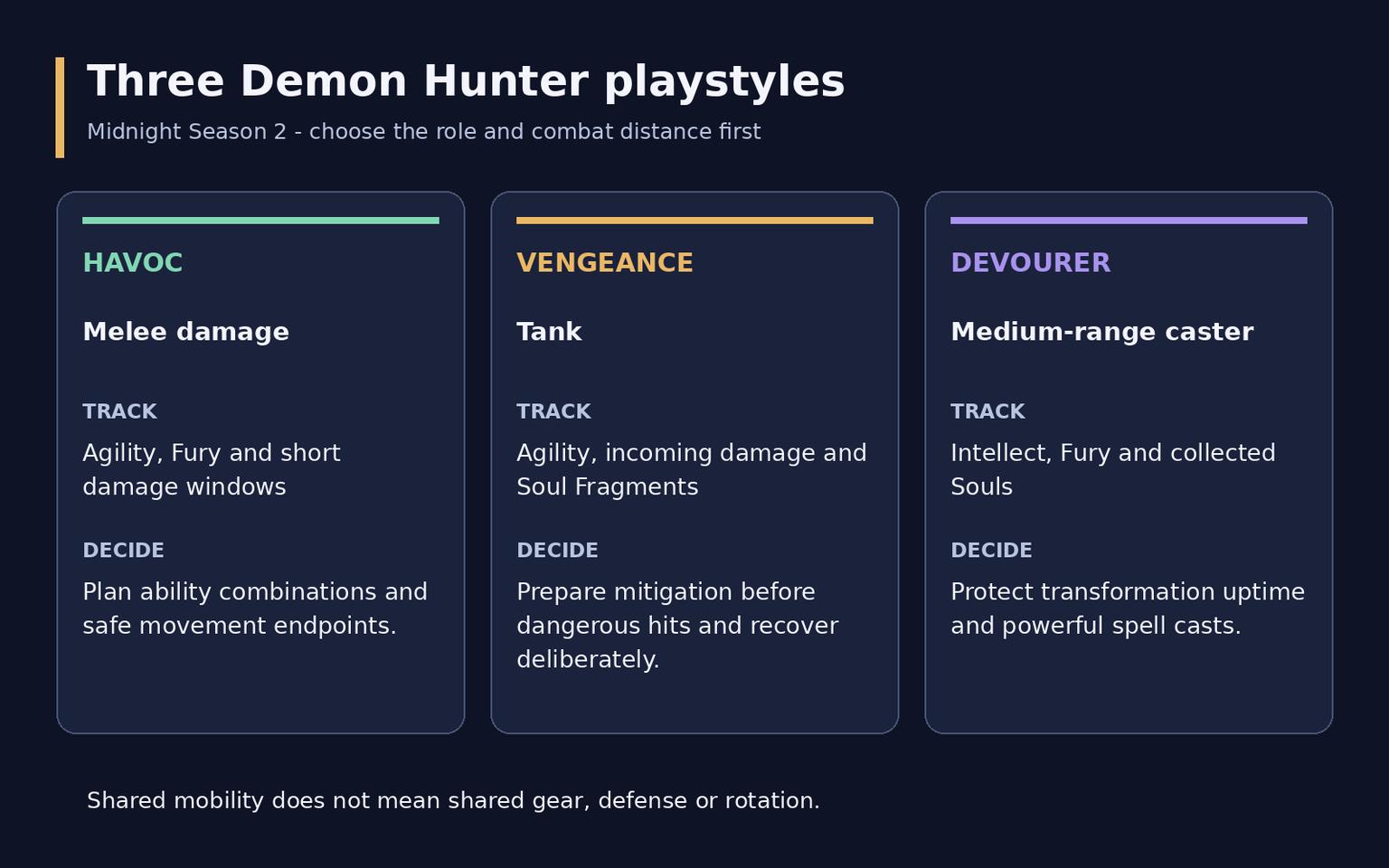
Demon Hunter offers three distinct playstyles in Midnight. Havoc deals melee damage, Vengeance tanks, and Devourer uses Intellect to cast Void spells from medium range. Shared mobility does not make their combat plans interchangeable. Changing specialization changes your resource decisions, weapon requirements, defensive tools and preparation for dangerous moments.
This guide was checked on October 15, 2026 for Season 2 and patch 12.1.5. It introduces the class for dungeons, raids and solo play through the decisions that matter in combat. It does not present one fixed button sequence for every situation. Talent choices, set bonuses and target count all affect the detailed priority.
Specialization | Role and primary stat | Main decisions |
Havoc | Melee damage, Agility | Manage Fury, short damage windows and safe movement |
Vengeance | Tank, Agility | Cover incoming damage and spend Soul Fragments effectively |
Devourer | Medium-range caster, Intellect | Manage Fury, Souls and Void Metamorphosis duration |
Start with the job you want to perform in a group. Tanking means learning enemy positioning and defensive planning. Choosing between the two damage specializations changes where you stand and how you deliver damage. A damage ranking alone says little about how comfortably you will execute the mechanics of a particular encounter.
What changed by patch 12.1.5
The most substantial recent gameplay updates affect Devourer. Cancelling Collapsing Star no longer triggers its former five-second cooldown. Its range increases after the cast begins, giving a moving target more room before the spell fails. However, its ability to slow Fury drain is limited. Repeated cancellation cannot indefinitely sustain a transformation.
Void-Scarred's interactions also changed. With Demonic Intensity selected, casting Collapsing Star resets The Hunt. Violent Transformation now resets Soul Immolation instead of providing the previous reset of The Hunt. An older plan that rushes to leave demon form simply to trigger another entry should therefore be reassessed against the current build.
Havoc and Vengeance did not receive an equivalent direct rotation redesign in 12.1.5. Earlier Season 2 tuning did change Aldrachi Reaver's value, however, and Vengeance gained baseline Sigil of Chains. Returning players should inspect talent positions and their actual action bars. An old import code or a familiar button arrangement may no longer represent the current setup.
Horde characters can be Blood Elves; Alliance characters can choose Night Elf or Void Elf. The Void Elf combination is unlocked through a short questline. Choose appearance and useful racial utility without treating them as substitutes for the right role, equipment or encounter execution.
Build your talents around the encounter
The class tree provides broad tools, while the specialization tree establishes the main combat engine. Hero Talents add another set of interactions. Choose them alongside the rest of the build instead of attaching a familiar Hero Talent name to an unrelated collection of abilities.
Specialization | Available Hero Talents | What distinguishes them |
Havoc | Aldrachi Reaver / Fel-Scarred | Follow-up attacks after Reaver's Glaive / transformation empowerment |
Vengeance | Aldrachi Reaver / Annihilator | Empowered attack sequences / distinct damage windows and Voidfall |
Devourer | Annihilator / Void-Scarred | Voidfall meteors / melee interactions and transformation combos |
For Havoc, Aldrachi Reaver is useful when damage into a dangerous priority target matters, while Fel-Scarred offers a strong area-damage profile. This does not prohibit either tree in raids or dungeons. Consider whether the group needs a particular enemy removed quickly or a shorter lifetime for the entire pack.
Current 12.1.5 guidance favors Annihilator for Devourer in raids and Mythic+. Its plan is less vulnerable to interruptions of close-range contact. Void-Scarred remains an option with extra movement and melee combinations. Before choosing it, check when encounter mechanics will actually let you approach the target.
Each specialization's Apex talents reinforce its combat identity: Eternal Hunt for Havoc, Untethered Rage for Vengeance and Midnight for Devourer. They do not remove the need to learn the core loop. Recognize important ability availability and resources first, then increase the complexity of the build.
Havoc and short damage windows
Havoc builds and spends Fury. Generate enough to support Blade Dance, then use Chaos Strike to spend excess without starving the next important action. Staying capped loses incoming resources; draining the bar without considering the next powerful ability can delay it.
Eye Beam, Metamorphosis and selected amplifiers form combinations. In suitable builds, transforming resets important abilities, so use them before the reset and preserve their second use afterward. If you select Essence Break, prepare resources and empowered attacks for its short window. Activating an amplifier while the relevant abilities remain unavailable wastes much of its purpose.
Aldrachi Reaver adds Reaver's Glaive and changes the value of the attacks that follow. Watch its empowerment effects and the intended target instead of inserting the extra button randomly into your normal sequence. Fel-Scarred has its own empowered transformation spells. Read the complete priority for the tree you actually selected.
Fel Rush and Vengeful Retreat can contribute to damage amplification in certain builds. Check the landing point, platform edges and nearby enemies before pressing them. If no safe route exists, sacrificing a small damage benefit is preferable to falling or engaging another pack. Mobility becomes useful when you control where it ends.
Vengeance and preparation before damage
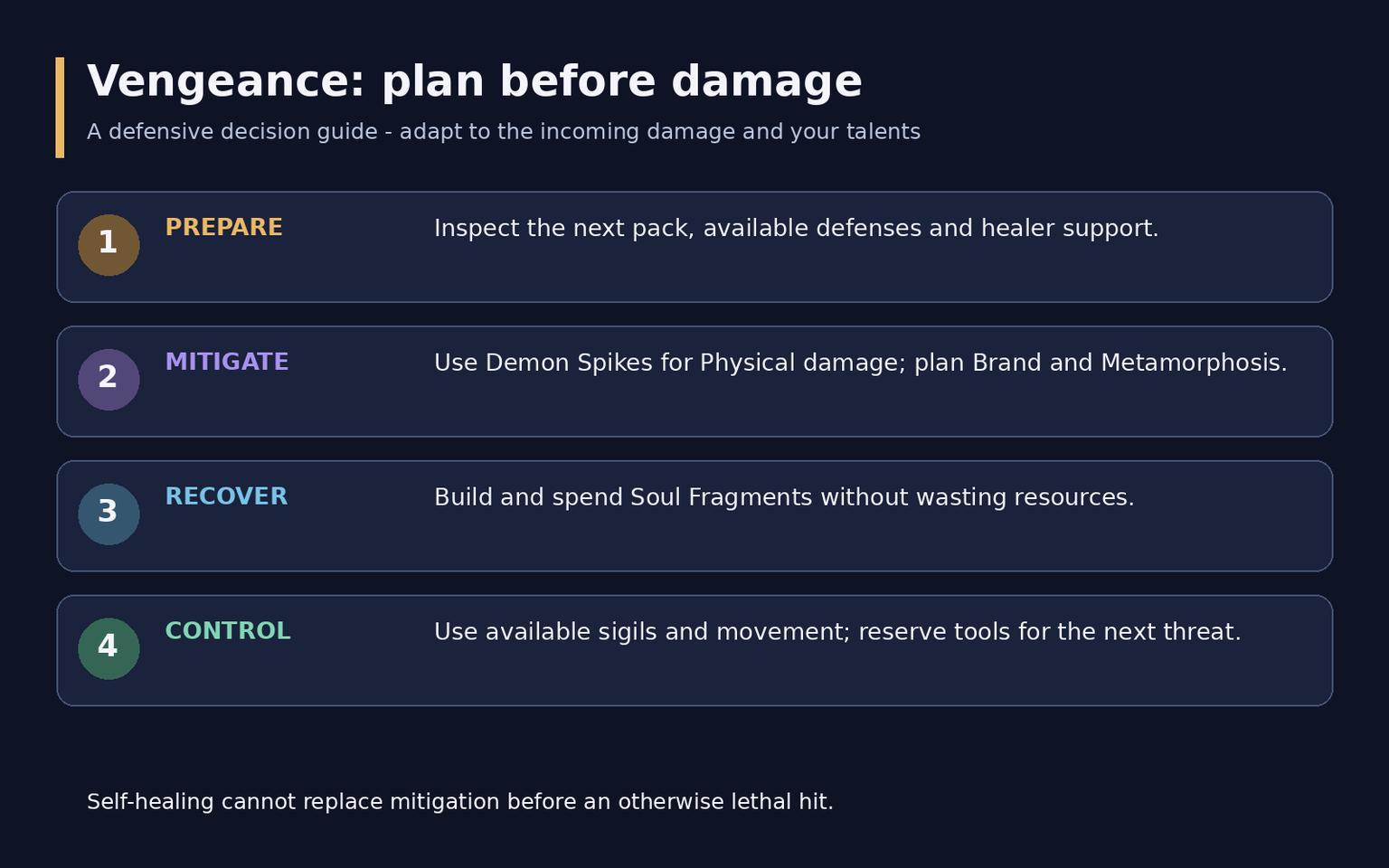
For a tank, resource spending supports recovery as well as damage. Fracture and other appropriate builders generate Soul Fragments; Soul Cleave and a selected Spirit Bomb consume them. Watch Fury, available fragments and the next dangerous hit together. Generating resources without a timely way to use them does not create reliable defense.
Use Demon Spikes frequently against Physical damage rather than reserving every charge for a nearly empty health bar. Fiery Brand and Metamorphosis cover other dangerous sections of the encounter. Self-healing helps recover from a hit, but it cannot replace mitigation before an otherwise lethal attack.
The start of a fresh pack deserves particular attention. Avoid spending every defensive during the safe end of the previous pull if dangerous damage follows immediately. Equally, holding cooldowns forever sacrifices later uses. Plan around the encounter's actual duration and coordinate external help with your healer.
Sigils and movement help collect enemies, stop casts and create space. Their availability depends on the selected nodes, though: talented Sigil of Silence replaces Sigil of Misery. Do not count every familiar sigil as a separate button available at once. Inspect the action bar and agree on control assignments before a difficult dungeon.
Devourer and Void Metamorphosis
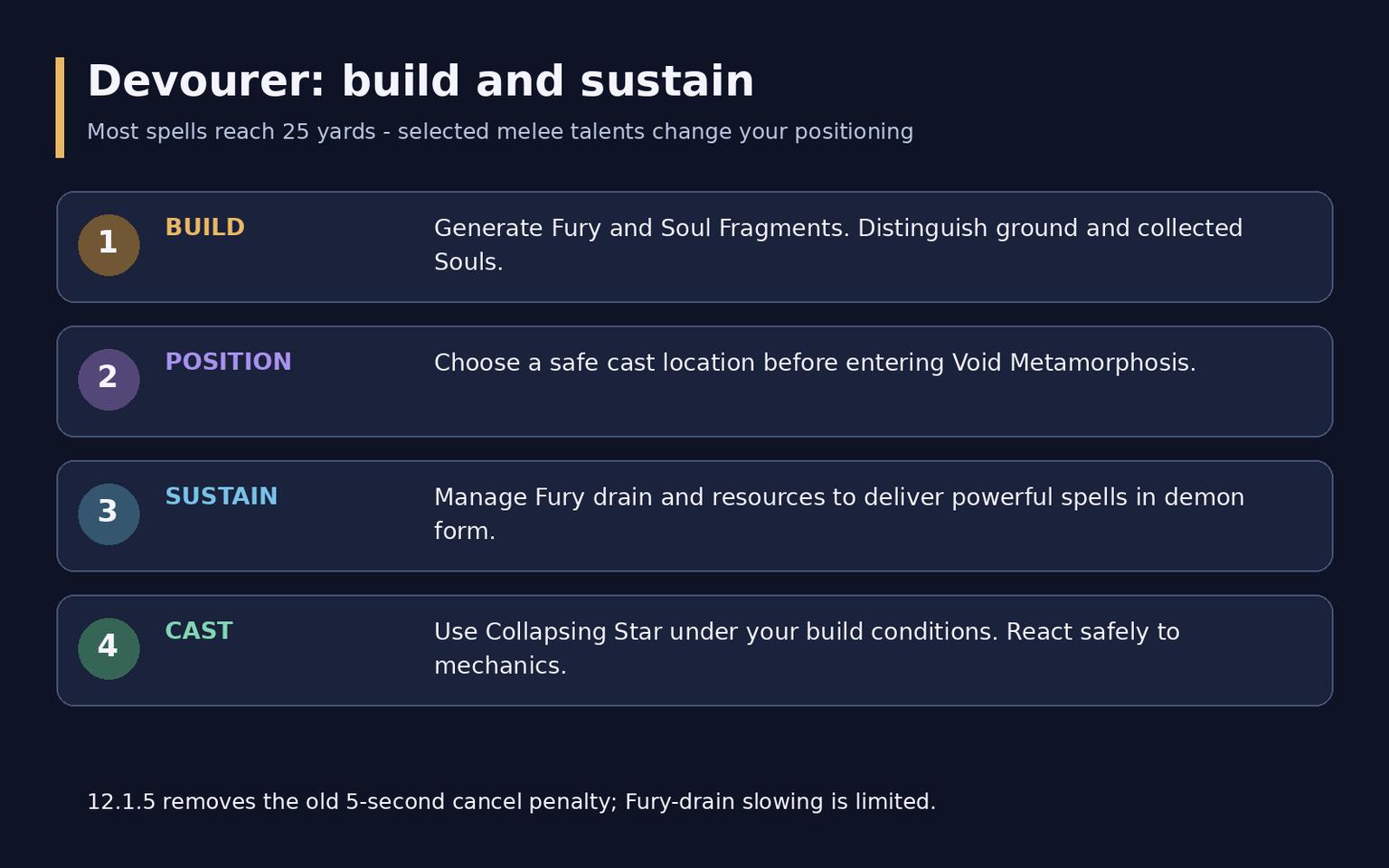
Most Devourer spells operate within 25 yards. That medium range requires different positioning from a longer-range caster. Builds using Voidblade and The Hunt also move the character toward enemies. Space behind you and a safe return route can matter as much as the initial distance to the target.
Consume helps generate Fury and Soul Fragments. Void Ray spends Fury outside transformation, while collected Souls unlock Void Metamorphosis. The transformation has no conventional timer-based cooldown: resource management determines the next entry. Fury drains while transformed, so maintaining the form and delivering its powerful spells becomes the central objective.
Distinguish fragments lying on the ground from resources already collected. Gather and spend them according to your build without stepping into dangerous ground effects. Abilities usable while moving help you prepare your next position. Schedule the longest stationary casts where an upcoming mechanic will not immediately force you away.
In the current version, both Hero Talent options benefit from productive Collapsing Star casts during transformation. The exact setup depends on talents and target count. Its improved cancellation behavior makes reacting to mechanics less punishing; it does not make repeatedly interrupting your own cast a desirable strategy. Protect the damage window without putting it ahead of survival.
Group contribution and personal defense
Check the toolkit of your actual specialization. Soul Cleave belongs to the tank, while Blur is not a universal defensive button shared identically by all three specs. Likewise, the tank's leap and Havoc's forward rush produce different positioning decisions.
Task | Example tool | What to check |
Interrupt a cast | Disrupt | Your specialization's range and availability |
Stop several enemies | Appropriate sigil or stun | Enemy susceptibility and the control order |
Help the group survive | Darkness when available | Ally positions and the incoming mechanic |
Survive a personal hit | Specialization-specific defense | Activate before the expected damage |
Leave dangerous ground | Available movement ability | A safe endpoint and route back |
The class also contributes Chaos Brand to support group magic damage. That contribution does not replace interrupts or encounter execution. After a failed run, review avoidable damage, dangerous casts left uninterrupted and lost target uptime before chasing a small secondary-stat adjustment. Those problems can have a larger practical effect on the next attempt.
Gear and secondary stats
All three specializations wear leather, but Devourer needs Intellect while Havoc and Vengeance use Agility. Warglaives can change their primary stat for Devourer; do not expect every sword, dagger or trinket to behave that way. Inspect weapons, effects and saved equipment sets after switching specialization.
Critical Strike is generally important among Havoc's secondaries. Devourer values Mastery highly, followed by Haste and Critical Strike. For Vengeance, Haste supports the core loop, while defensive decisions also depend on the complete equipment set and incoming damage profile. These are starting points rather than fixed weights or a universal mandatory Haste threshold.
Decision | Compare | Why item level is not enough |
Replace a weapon | Primary stat and effect | The weapon must support the specialization |
Replace a set piece | Retaining the useful set bonus | Losing the bonus can change the result |
Equip a new trinket | Effect and damage-window alignment | Two active trinkets require planning |
Commission a crafted item | Weak slot, stats and embellishment | A temporary replacement may not justify the expense |
Damage specializations should simulate alternatives for their own character. Tanks must also assess survival and the requirements of the actual encounter. A best-in-slot list does not guarantee that one isolated item improves an incomplete loadout. Keep separate equipment sets if you regularly change roles.
Enchants and consumables
A usual flask starting point is Flask of the Shattered Sun for Havoc, Flask of the Magisters for Devourer and Flask of the Blood Knights for Vengeance. Existing secondary stats can change the choice. Align Potion of Recklessness with an important window, and keep Concentrated Silvermoon Health Potion on an accessible key.
Food also differs between specializations. Havoc and Vengeance generally use a primary-stat feast such as Silvermoon Parade, or Royal Roast as personal food. Season 2 recommendations for Devourer highlight Feast of Knowledge and Champion's Bento instead. A food recommendation for one specialization should not become a class-wide rule.
Leg enhancements make the distinction especially clear: Devourer uses Sunfire Silk Spellthread, while Havoc uses Forest Hunter's Armor Kit. Vengeance also considers Armor and Stamina when choosing a leg enhancement. Choose gems and enchants after checking stats and the likely replacement date of the item. Expensive preparation cannot fix resource starvation or a missed defensive.
Leveling and your first group runs
Havoc is a convenient solo-questing option for players who enjoy fast melee combat. Vengeance lets you practice tanking immediately, while Devourer develops range awareness and transformation preparation. You do not have to level as one specialization when your intended destination is another.
Stage | Practice | Readiness to move on |
Solo quests | Resources and available defenses | No constant overcapping or avoidable deaths |
Training target | One complete damage window | Important abilities benefit from the intended buffs |
Easy dungeon | Interrupts and movement | Mechanics do not destroy the entire combat plan |
Harder encounter | Talents and cooldown allocation | You understand why each delay is necessary |
Give interrupts, healing potions and defensive tools distinct positions on your action bars. A focus macro can simplify stopping the assigned enemy, but it cannot identify the dangerous cast for you. Avoid combining every defensive into one button: the next mechanic may need the reserve you just spent.
Choose professions around your activities and expenses. Leatherworking is convenient for armor, but learning it is not a blanket requirement for accessing crafted equipment. For PvP, reconsider talents, gear and defensive planning separately. Advice for damaging a stationary target does not account for enemy crowd control and target swaps.
Frequently asked questions
Does every Demon Hunter need Intellect
No. Devourer uses Intellect; Havoc and Vengeance use Agility. Check weapons and trinkets whenever you switch specialization.
Does Devourer always fight from range
Most spells have a medium range of 25 yards. Selected talents add melee interactions, so your build affects where you need to stand.
Can one rotation cover all three specializations
No. Shared tools do not remove the different priorities of tank defense, Havoc's short damage windows and Devourer's resource-driven transformation.