WoW Midnight Enchanting Guide: Leveling and Specializations
Choose between crafting enchants, producing oils and rods, or disenchanting equipment for reagents. Each activity needs its own Knowledge investment and stat priorities. If you intend to sell enchants, identify a specific recipe and its specialization branch first. If materials are your goal, develop Disenchanting Delegate instead.
Enchanting can supply much of its own raw material. Unwanted equipment becomes dust, shards and crystals, while players need new enchants when replacing gear. However, materials from your own items still have value, and Concentration limits part of your production. A defined product and a modest starting budget make the profession easier to evaluate.
Checked October 15, 2026, for Midnight Season 2 in the context of Patch 12.1.5. This guide covers learning, leveling to 100, specializations, Knowledge, profession equipment and production decisions without assuming a fixed profit.
What changed in Midnight
Enchants and reagents that use quality ranks now have two ranks. Helms and shoulders have new enchant options, while Midnight does not add its own cloak or bracer enchants. Enchanted Crests from earlier expansions are also absent from Midnight's current crafting chain.
Season 2 added Enchant Weapon - Rite of the Hash'ey and decor including Furious Tiki Mask, Keen Hex Mask and Enchanted Voidwell Fish. Check a new formula's source and specialization category rather than judging it only by the equipment slot in its name.
Learn Enchanting and organize reagents
Visit Dolothos in Silvermoon City to learn Midnight Enchanting. An Enchanting supply vendor is nearby. If you are new to the profession, check basic training as well. Open the current expansion category in your journal: older formulas may remain available, but use different materials and skill progression.
Three main reagent types form the basis of production. The rarity of the equipment you disenchant helps identify a direction, but does not guarantee identical output from every item.
Reagent | Typical source | What matters |
Eversinging Dust | Disenchanting Uncommon, green equipment | Skill and investment in the dust branch |
Radiant Shard | Disenchanting Rare, blue equipment | The corresponding specialization and output quality |
Dawn Crystal | Disenchanting Epic, purple equipment | The destroyed item's value and the relevant branch |
Track reagent quality separately. Cheap dust can be suitable for skill gains but inconvenient for making your target enchant without Concentration. Select a recipe and inspect the expected result with the available materials before buying a large stock.
Separate three material operations
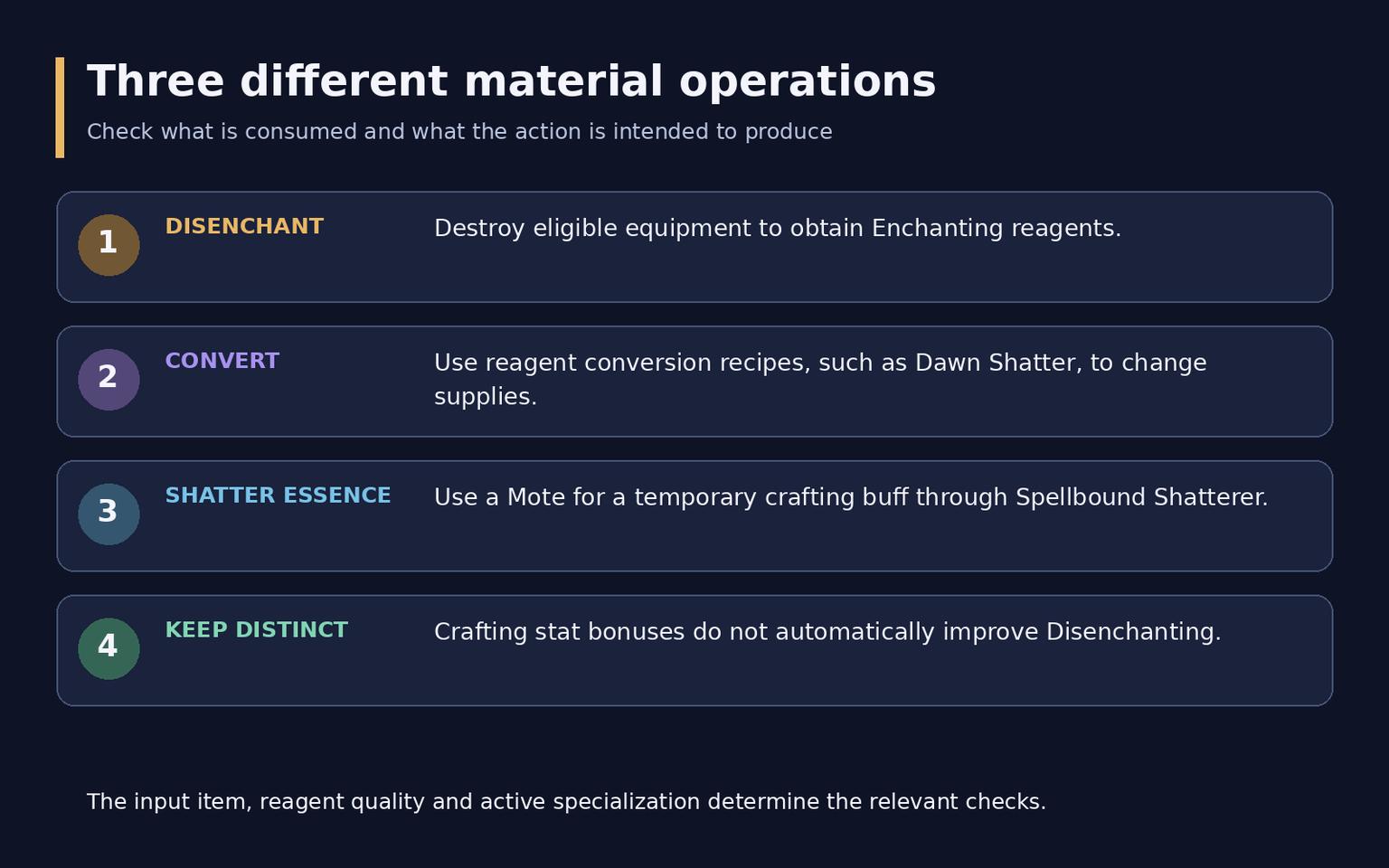
Disenchanting destroys an eligible equipment item and produces reagents. Remove items you want to keep from the working batch first. Pay particular attention to alternate-specialization gear and appearances you still need, since you receive materials in place of the original item.
Dawn Shatter converts a Dawn Crystal into three Radiant Shards. Other conversion recipes provide less rare materials. These processes reorganize your supplies rather than automatically improving their quality. Compare the input's value with the output and read the recipe's quality conditions before converting valuable reagents.
Shatter Essence serves another purpose. Through Spellbound Shatterer, you obtain a temporary crafting buff by using a Mote, such as a Mote of Wild Magic. It supports Resourcefulness, Ingenuity and Multicraft on applicable crafts. Activate the buff when needed; Knowledge investment does not mean that its temporary effect is permanently running.
Level Enchanting from 1 to 100
Disenchant suitable unwanted equipment first. This can raise skill to 25 while providing starting materials. If equipment is scarce, compare available early crafts with buying cheap eligible inputs. Making an expensive item solely to destroy it afterwards deserves a separate cost calculation.
Use the first-craft filter and revisit the trainer as formulas become available. A Knowledge reward and a skill increase are separate checks. A gray recipe can still provide its first-craft Knowledge while no longer advancing skill.
Stage | Practical approach | Cost check |
1-25 | Disenchant unwanted items and make available first crafts | Begin with suitable items you already own |
25-40 | Use available basic enchants, oils and cosmetic effects | Compare the full cost of the next skill increase |
40 to roughly 60 | Add new enchants and suitable wands while collecting first crafts | Check difficulty and skill points awarded by each recipe |
Roughly 60-100 | Continue through your chosen specialty and available formulas | Evaluate cost, sale potential and output quality |
The exact changeover depends on your route. Some trainer formulas remain useful beyond 60, but later progression generally becomes more expensive. A complete shopping list to 100 without knowing your recipes and market would be unreliable.
Use cosmetic first crafts
Jennara Sunglow in Silvermoon teaches Gleeful Glamours. Their Midnight versions have their own first-craft rewards and can help build Knowledge. These are temporary cosmetic transformations: they do not change racial abilities or replace a race-change service.
Inspect which formulas still show the first-craft bonus. Set aside dust and matching Motes for the recipes you choose, but do not assume that every cosmetic item will sell and repay its crafting cost.
Finish the later skill points
Advanced weapon enchants and other difficult formulas can take skill to 100. Favor recipes you already know and can support with relevant Knowledge. Apply enchants to Vellum when you want a saleable result rather than an enhancement on your own equipment.
Profession rods and combat wands offer other development directions. Before accepting an order, check the recipe, inputs and requested quality. Selling finished enchants through the Auction House and making equipment through an order are different ways of operating.
Understand the four specialization trees
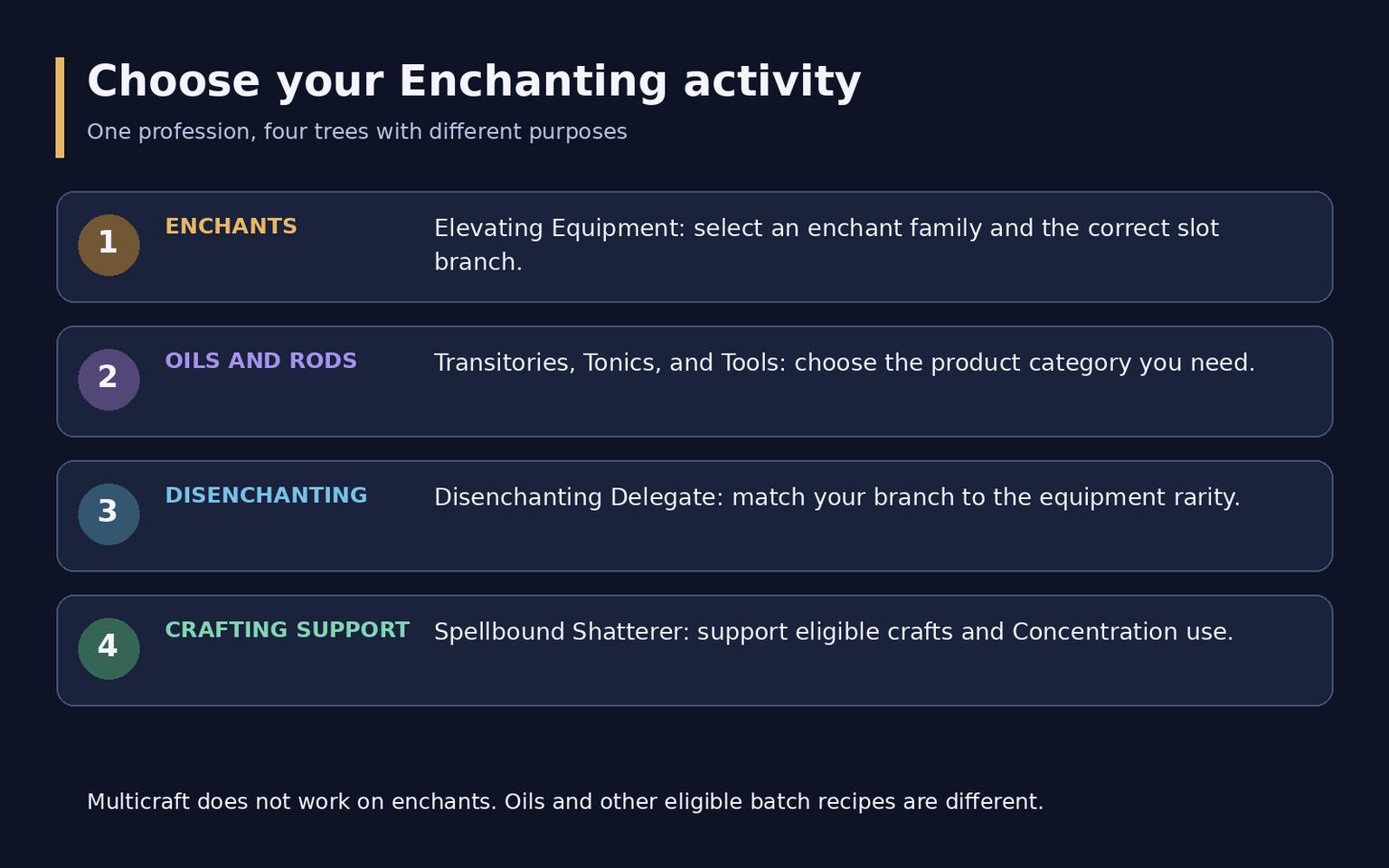
The first specialization unlocks at skill 25. Accessing further trees and spending Knowledge are separate steps. Start with the action you expect to perform most often.
Tree | Main purpose | Sensible initial focus |
Elevating Equipment | Gear and profession-tool enchants | One enchant family and a relevant slot group |
Transitories, Tonics, and Tools | Oils, wands, rods and cosmetics | The product category you intend to make |
Disenchanting Delegate | Reagent quality and yields from equipment | The branch matching your available equipment rarity |
Spellbound Shatterer | Crafting bonuses and Concentration support | Supporting the production route you selected |
Crafting enchants
Elevating Equipment divides into Thalassian Talents, Amani Augments and Haranir Heightening. Each contains further branches for slot groups. For your first product, confirm both relationships: its enchant family and the branch that actually supports that recipe.
A bulk-crafting starting direction is 30 Knowledge in the main node and 20 in the chosen category, followed by the relevant final branch and reagent-saving support. Expand only after checking the first product's quality and sales. Learning many formulas does not make them equally economical.
Small batches using Concentration
For occasional crafting sessions, consider Spellbound Shatterer and Infinite Ingenuity. One initial direction is 20 Knowledge in the main node and 30 in that branch. You still need an available formula: Concentration-related bonuses do not produce a saleable item by themselves.
The resource regenerates over time. Compare the result without Concentration, the cost of raising quality and the likely sale return. This approach reduces the need for constant bulk production, but it neither makes reagents free nor guarantees earnings each time you log in.
Disenchanting for materials
Develop Disenchanting Delegate for this activity. Taking the main node to 30 opens access to the three branches, then you can invest up to 30 in the appropriate one: Dust Deliverer for Uncommon equipment, Shard Supplier for Rare equipment or Crystal Collector for Epic equipment.
Skill and the Disenchanting specialization matter here. Crafting Resourcefulness, Ingenuity and Multicraft do not improve the Disenchanting action. If you regularly obtain only blue equipment, developing that category is more useful than immediately spreading points evenly across all three.
Profession equipment and stats
You use one tool and two accessories: a runed rod, a hat made by a Tailor and a focusing accessory made by a Jewelcrafter. A starting set includes Runed Refulgent Copper Rod, Bright Linen Enchanting Hat and Silvermoon Focusing Shard.
Stat | Where it helps | Important limit |
Skill | Craft quality and Disenchanting results | Specialization bonuses apply to their stated categories |
Resourcefulness | Saving reagents on eligible crafts | Does not restore the equipment destroyed by Disenchanting |
Ingenuity | Refunding part of spent Concentration | A proc is not guaranteed |
Multicraft | Eligible oils and other batch recipes | Does not work on enchants themselves |
For enchant production, match stats to Concentration use and reagent savings. For oils, Multicraft can become considerably more useful. Avoid buying an expensive tool simply because it has been described as the profession's best item.
Epic and Rare profession equipment can have the same skill bonus while offering different secondary stats. That distinction matters especially on a dedicated disenchanter: a more expensive Epic item does not automatically improve the result you want.
Check a batch before crafting
Gather the inputs, select their quality and check that your temporary Shatter Essence buff is active if you intend to use it. Inspect expected output and Concentration cost. If the resource requirement exceeds what you have, reduce the batch or reconsider the inputs before starting production.
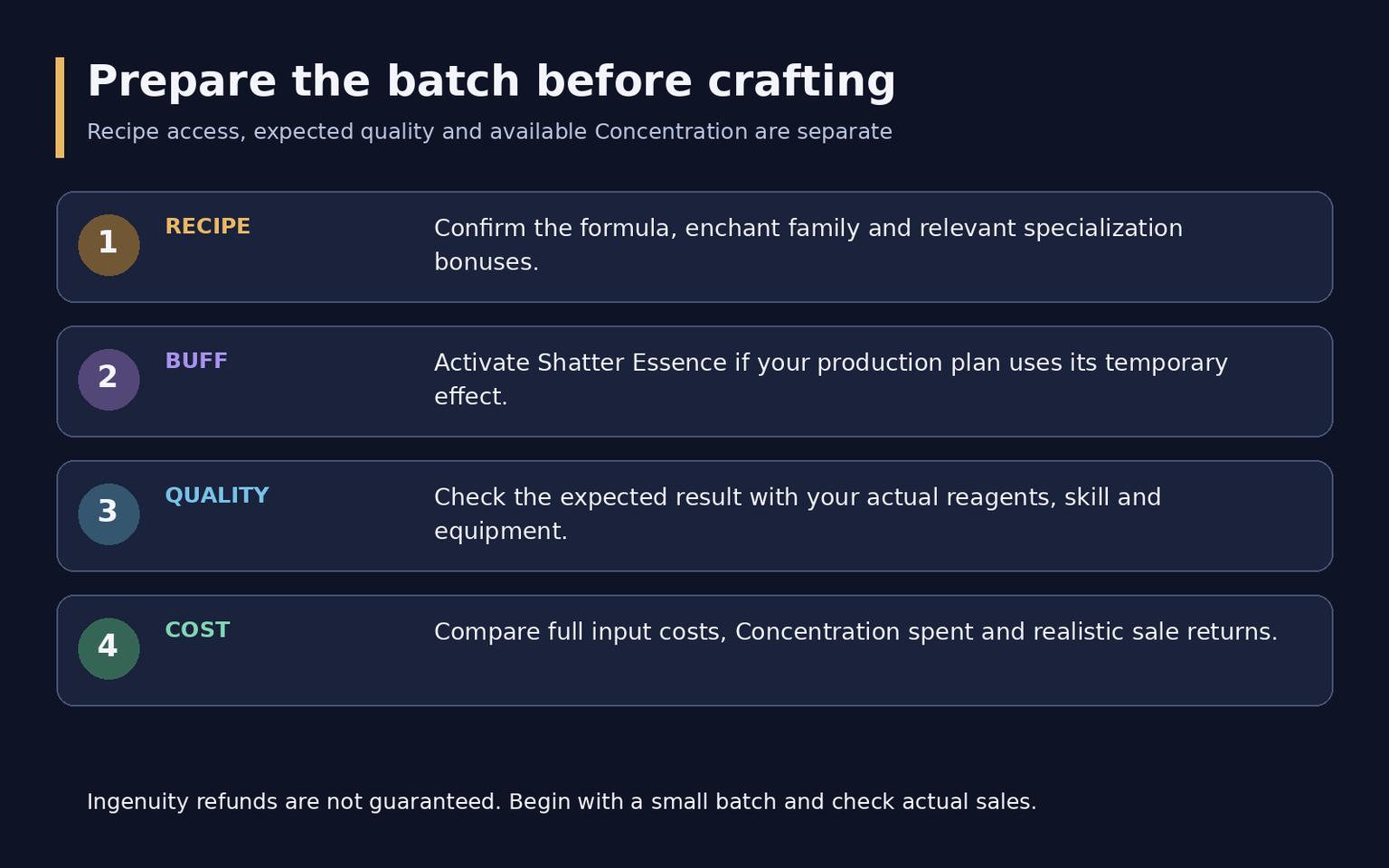
Keep records by recipe: reagents spent, Concentration used, finished items and actual sales. Enchant competition extends beyond a single realm, so one high-priced listing does not prove a profitable niche. Begin with a small batch and measure how quickly it sells.
Knowledge and weekly activities
Enchanting has its own Knowledge drops from Disenchanting. Do not automatically import the weekly Engineering routine or another crafting profession's order system.
Source | Reward | Frequency |
First crafts | Knowledge from eligible new recipes | Once per recipe |
Eight profession treasures | 3 each, 24 in total | Once per character |
Trainer quest | 3 Knowledge from the relevant turn-in quest | Weekly, after the required unlocks |
World finds | Two different items, 4 Knowledge in total | Weekly |
Disenchanting and Treatise | Five essences worth 1 each, then a shard worth 4; Treatise adds 1 | Track these weekly sources separately |
The Disenchanting sequence uses Swirling Arcane Essence and Brimming Mana Shard. Commission a Thalassian Treatise on Enchanting from a Scribe. The Darkmoon Faire provides an additional monthly opportunity rather than a recurring weekly reward.
Characters who are behind can earn catch-up Knowledge through Disenchanting. First check completion of the required weekly sources and whether you actually have Knowledge to catch up. Avoid buying a large stock of equipment on the assumption that additional Knowledge continues indefinitely: the catch-up pool is finite.
Pairing professions and valuing equipment
Tailoring produces suitable cloth equipment and therefore pairs comfortably with Enchanting. A self-crafted item still costs the materials consumed to make it. Compare Disenchanting with selling the item and with selling those materials separately.
Start with unwanted equipment you already have, then test small batches of crafted items. Other crafting professions also provide eligible products; the cost of the particular item matters more than the profession pairing's name. Gathering suits players who prefer earning gold separately and purchasing their Enchanting inputs.
A racial skill bonus can help near a quality threshold. However, changing race or character before checking the formula and complete investment is premature. The bonus does not replace training, Knowledge or a suitable tool.
Frequently asked questions
Why does Multicraft not produce extra enchant scrolls
Enchants themselves do not support it. Relevant skill bonuses, Resourcefulness and Concentration management matter more for those recipes; oils should be evaluated separately.
Should I disenchant every unwanted item
Compare the item's value with the expected materials first. Equipment you no longer need in combat may be better sold or retained for another purpose.
Can I focus entirely on Disenchanting
Yes. It has a dedicated tree and does not require a simultaneous bulk-enchant business. You still need to develop skill and Knowledge for the equipment category you process.