WoW Midnight Evoker Guide: Devastation, Preservation and Augmentation
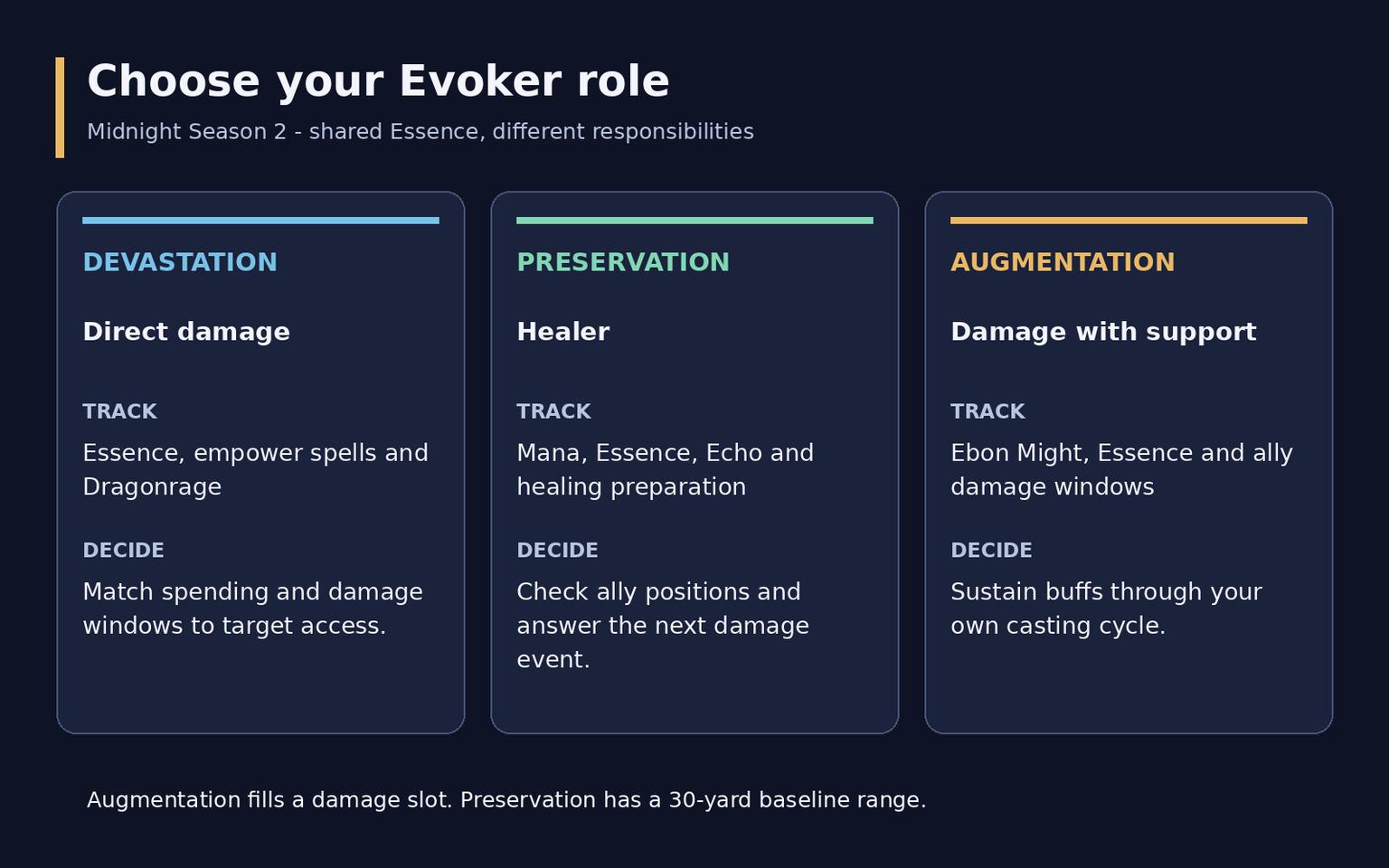
Evoker in Midnight rewards control over spell empowerment, positioning and timing. Devastation deals direct damage, Preservation heals, and Augmentation combines personal attacks with empowering allies. All three use Essence and empowered spells, but they spend those tools toward different goals.
This guide was checked on October 15, 2026 for Season 2 and patch 12.1.5. It explains how to choose a specialization, recognize its core interactions and prepare for dungeons and raids. One shared rotation would be misleading: a healer's decisions are not an attack sequence, and Augmentation's contribution cannot be judged solely by its personal damage.
Specialization | Role | Central responsibility |
Devastation | Ranged damage | Coordinate Essence spending, empower spells and Dragonrage |
Preservation | Healer | Prepare healing around incoming damage and ally positions |
Augmentation | Damage dealer with support | Sustain ally buffs through your own spell cycle |
Augmentation fills a damage slot rather than replacing the healer or tank. Its output depends on allies and the damage windows available to them. Devastation is usually more straightforward to assess during solo quests: your attacks produce direct results without needing suitable teammates to empower.
Evoker is available to Dracthyr on either faction. That is a class restriction, not a claim that every Dracthyr must be an Evoker. All three specializations use Intellect and mail armor. When changing roles, still inspect trinkets, secondary stats and the purpose of your saved equipment set.
Range, Essence and empowerment rank
Most Devastation and Augmentation attacks operate at medium range, around 25 yards. Preservation has a baseline spell range of 30 yards. Some talents alter the range of helpful abilities, so read the individual spell tooltip. A single 25-yard rule does not accurately describe the entire class.
Essence regenerates over time. Essence Burst makes the appropriate spender free, so track both the resource bar and the proc. Wasted regeneration and lost procs slow the cycle. Preservation must manage Mana as well: a free Essence cost does not remove every other expense involved in healing.
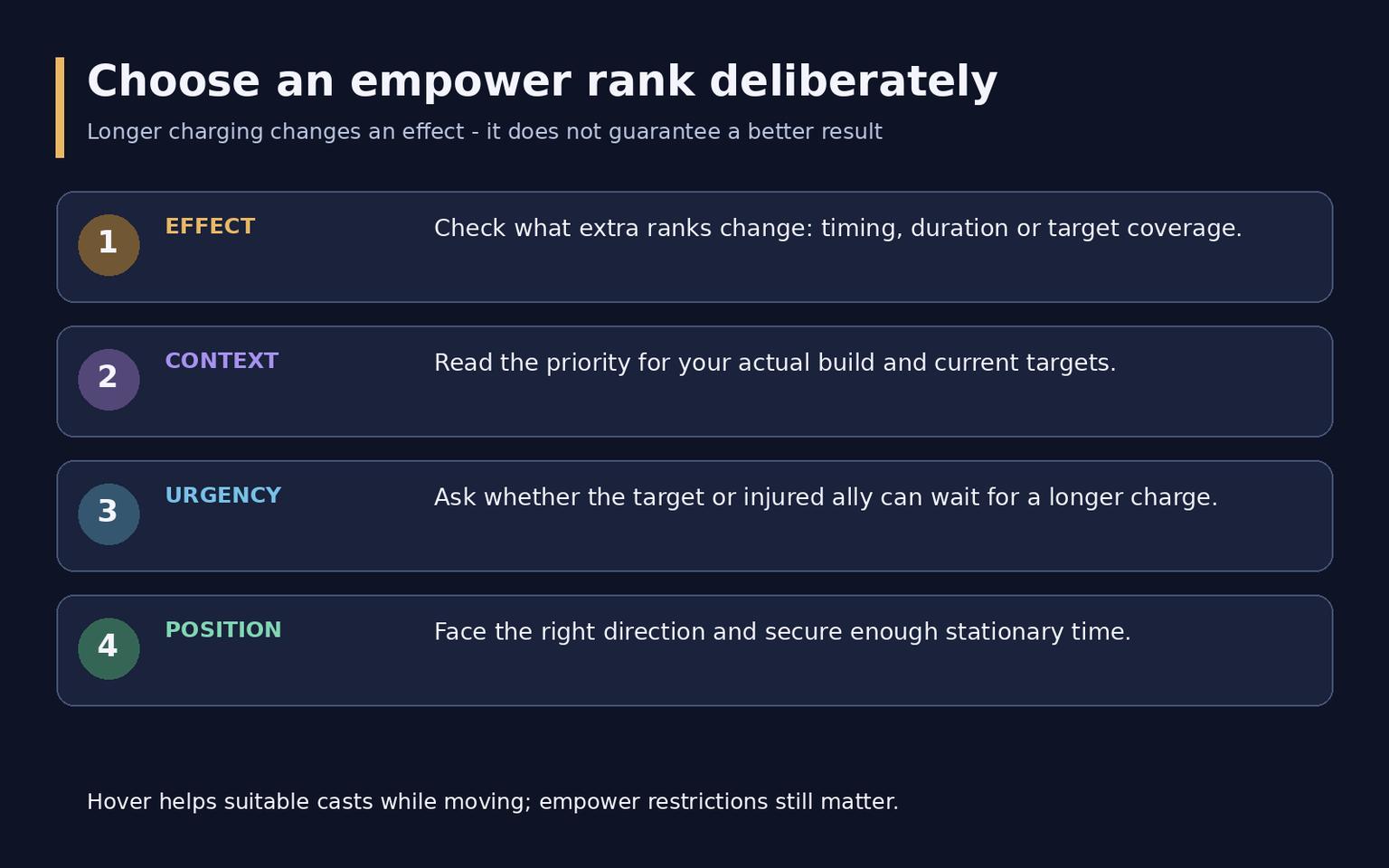
Empowered spells change their effect according to the rank reached before release. Holding them longer is not always better. For example, empowering Fire Breath shifts more of its damage into the initial hit at the expense of its damage-over-time duration. Current Devastation priorities frequently use rank one.
Decision | Inspect | Why maximum rank is optional |
Fire Breath | Build and target lifetime | Immediate and delayed damage are distributed differently |
Eternity Surge | Your Hero Talent priority and targets | Current interactions determine the required rank |
Dream Breath | Healing urgency and upcoming damage | A stronger initial response is not always necessary |
Any empower spell | Safe stationary time | Waiting too long may prevent the cast from finishing |
Hover allows suitable spells to be cast while moving, but it does not remove every movement restriction from empowered spells. Choose a position before using a breath and check the direction of its cone. Being within range cannot compensate for allies or enemies standing behind you.
Talents and Season 2 changes
Start by deciding what the class tree needs to provide: personal defense, movement or group tools. Then choose the specialization tree and a compatible Hero Talent option. Keep separate builds for raids, dungeons and solo activities, and inspect the actual selected abilities after importing a setup.
Specialization | Hero Talents | Different emphases |
Devastation | Scalecommander / Flameshaper | Empowered attacks and flight / Fire Breath interactions |
Preservation | Chronowarden / Flameshaper | Bronze combinations and preparation / Dream Breath and follow-up healing |
Augmentation | Chronowarden / Scalecommander | Buffs and time / greater focus on personal attacks and Breath of Eons |
Apex talents also belong to distinct specializations: Rising Fury, Merithra's Blessing and Duplicate. They reinforce the main plan without removing resource and positioning decisions. A strong Hero Talent choice for one specialization does not automatically transfer to another.
Patch 12.1 added Unbound Flame after Devastation's Dragonrage ends. Patch 12.1.5 did not introduce a comparable new redesign of its core loop. Augmentation's official changes improve how certain buffs interact with Mastery, while Scalecommander gains increased Melt Armor damage. These updates do not make an old talent import universally suitable for every group.
Preservation has an important current restriction: Merithra's Blessing duration was reduced from one minute to 30 seconds. Consume Flame healing increased by 20% after a fix to its double application of healing amplifiers. That figure is not a 20% increase to the specialization's total healing.
Devastation and the Dragonrage window
Disintegrate and Pyre are the main Essence spenders. Living Flame and Azure Strike fill gaps and help generate Essence Burst. First learn to avoid unnecessary idle time and resource waste. Then align spending with the powerful abilities of your chosen Hero Talent build.
Dragonrage establishes an important damage window. With Animosity selected, empower spells help extend it, so inspect Fire Breath and Eternity Surge availability before entering. Starting immediately before a long loss of target access wastes the opportunity. Constantly delaying the window can also cost an entire use over the encounter.
Scalecommander revolves around Deep Breath and Mass Disintegrate interactions; Flameshaper emphasizes Fire Breath and Consume Flame. Current guidance favors Scalecommander for raids and Mythic+, but its detailed priority still depends on selected talents. Flight requires control of the route and endpoint, not merely hitting the enemy on the way through.
After Dragonrage ends, the selected Apex talent provides Unbound Flame: four uses that generate Essence Burst. Recognize this follow-up phase and spend the free casts it produces. Against multiple targets, follow your build's spender priority instead of replacing the entire combat plan with one area-damage button.
Preservation and healing preparation
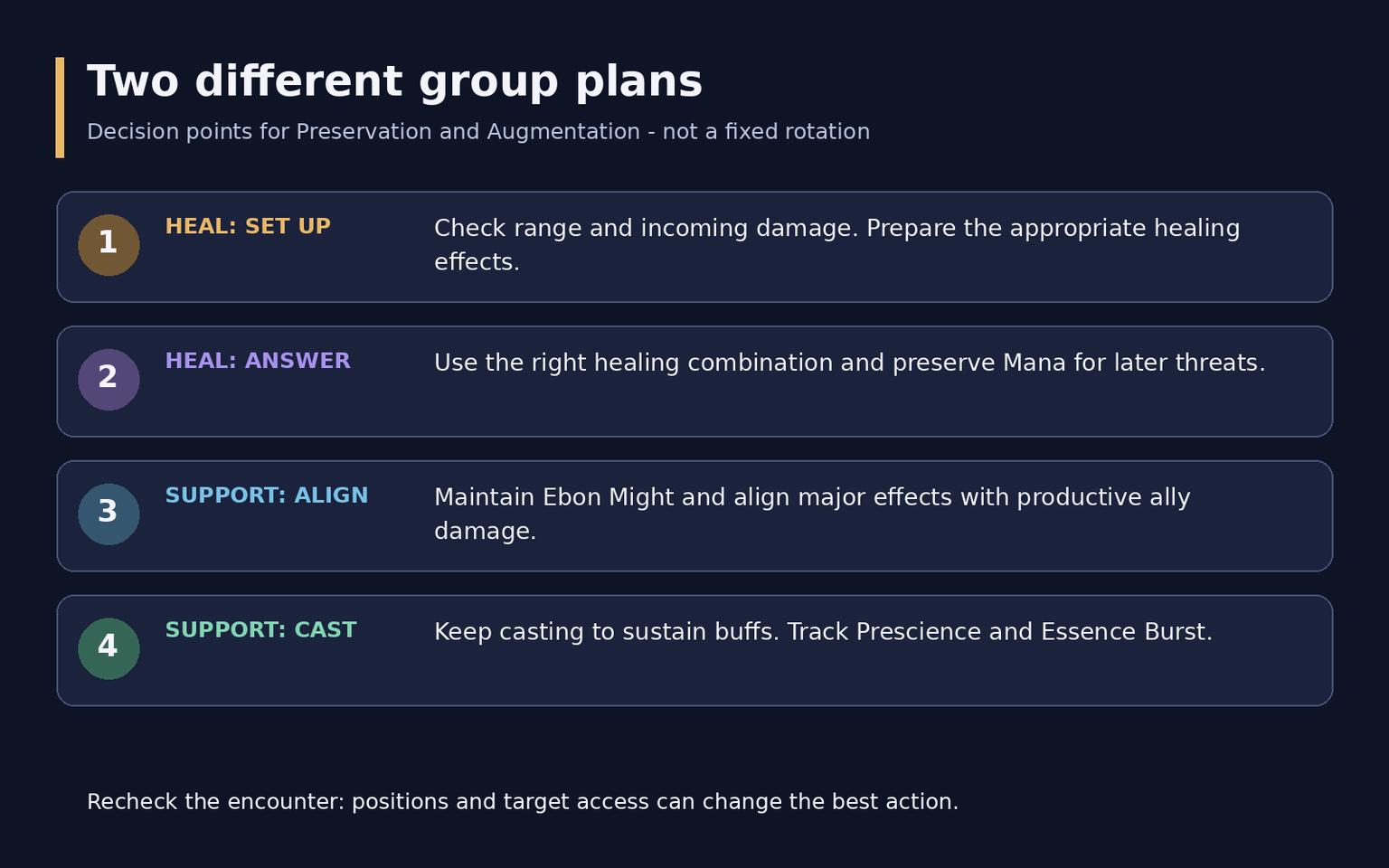
Preservation's central decision is who needs which response before the next dangerous event. Echo prepares additional healing through the next qualifying spell. Temporal Anomaly and selected Emerald Blossom interactions help distribute those effects. Green spell visuals do not make every ability an interchangeable Essence spender.
Dream Breath supplies important healing over time. Verdant Embrace and Merithra's Blessing help answer damage spikes. Flameshaper places particular value on interactions between Dream Breath and Consume Flame. Raids and small groups differ in target selection and response urgency, which quickly makes a fixed sequence inadequate.
Check ally positions before expected damage. If part of the group is outside your range or cone, choose a better position first. Verdant Embrace moves your character toward its target, so inspect whether that location is safe. High healing output does not compensate for losing the healer to an unsafe movement ability.
Spend Mana according to the actual threat. Repeatedly healing healthy players reduces the reserve for a dangerous later phase. When healing is unnecessary, contribute damage and support resource interactions. That opportunity depends on the next mechanic as well as current health bars.
Augmentation and productive buff uptime
Ebon Might is the specialization's foundation. Fire Breath, Upheaval and Eruption help sustain its duration through the appropriate interactions, with filler spells connecting the cycle. Supporting allies does not mean waiting for them to do all the work: your own casting maintains their empowerment.
The current Ebon Might system distributes its benefit among eligible damage dealers. Prescience follows separate targeting rules and does not manually direct Ebon Might onto a tank or healer. Old advice about selecting four recipients should not be imported into a current raid without checking the changed mechanic.
Align Breath of Eons with allies' strong attacks while keeping Ebon Might active. For Prescience, watch available charges and which players can actually deal damage now. Buffing someone occupied by a long non-damaging mechanic is less useful, even if they normally lead the group's output.
Chronowarden emphasizes support and time effects, while Scalecommander puts more weight on personal offensive interactions. Current guidance favors Chronowarden for raids and difficult keys; Scalecommander's more direct approach can suit routine runs. This is a recommendation for an activity rather than a guaranteed result in every composition.
Utility and defensive planning
Check which tools are available to your actual specialization before starting. Quell, for example, is not part of Preservation's current toolkit. Do not promise the group an interrupt simply because another Evoker build had one.
Task | Example tool | Check beforehand |
Survive personal damage | Obsidian Scales | Activate before the dangerous hit |
Keep acting during movement | Hover | Restrictions of the individual spell |
Provide group Haste | Fury of the Aspects | The agreed shared damage window |
Stop enemies | Tail Swipe or Wing Buffet | Susceptibility and displacement direction |
Move an ally | Rescue when available | Safety of the route and destination |
Blessing of the Bronze supports group mobility. Utility does not replace personal defense or treatment of dangerous effects. A knockback can break the tank's carefully arranged pack, so coordinate displacement. Avoid using several group responses together when a following mechanic needs a separate answer.
Equipment and secondary stats
Intellect matters to every specialization, but secondary stats have different values. Critical Strike is an important Devastation starting point, while Augmentation values Mastery highly. Preservation priorities change between raids, Mythic+ and talent builds. A blanket rule that Mastery always comes first does not describe every healing setup.
Compare complete loadouts. A damage simulation helps evaluate offensive changes; a healer also needs an appropriate gear-evaluation tool and an understanding of the required healing profile. Item level alone cannot describe trinket alignment or the cost of losing an important set bonus.
Choice | Compare | Practical purpose |
Weapon | Intellect, item level and effect | Improve the character's main responsibility |
Set piece | Retaining a useful bonus | Evaluate the full equipment combination |
Trinket | Damage, healing or stat effect | Match the task and activation window |
Crafted item | Weak slot, embellishment and replacement timing | Spend resources for a clear benefit |
Enchants must match the actual equipment slot. A helm enchant does not become a cloak enchant because a table labels it incorrectly. Sunfire Silk Spellthread appears among leg enhancements for damage specializations; Preservation uses Arcanoweave Spellthread. Choose gems after assessing your own stats instead of copying one class-wide option.
Consumables and your first runs
For Devastation, choose between Flask of the Blood Knights and Flask of the Shattered Sun according to existing Haste and Critical Strike. Augmentation's main starting point is Flask of the Magisters. Preservation also uses it for healing, with a Haste alternative possible in Mythic+ when additional healing is unnecessary.
A healer needs a separate Mana plan. Lightfused Mana Potion and Potion of Recklessness share a cooldown. If Mana determines success, preserve the ability to restore it. Concentrated Silvermoon Health Potion is an emergency personal response and does not share that cooldown. For Augmentation, Potion of Recklessness is especially appropriate when Mastery is the highest secondary stat.
Choose food for Intellect and the activity, such as Silvermoon Parade or a suitable personal meal. Expensive consumables cannot correct missed breath cones or repeatedly dropped Ebon Might. On a limited budget, fix those problems first, then invest in finer stat adjustments.
Devastation is convenient for solo leveling; a future healer benefits from beginning easy group runs earlier. Practice empower ranks on a training target, then introduce movement and encounter mechanics. Place Essence, important procs and defenses where they remain visible without repeatedly looking away from the battlefield.
Friendly-target macros can simplify healing and support, but cannot choose the correct spell for you. Pick professions around costs and interests: Alchemy with Herbalism is convenient for self-supply, without being a mandatory performance pairing. Reassess talents and defensive planning for PvP, where enemy crowd control and limited range create different decisions.
Frequently asked questions
Should every breath be fully empowered
No. The appropriate rank depends on the effect, build and urgency. Some current priorities use rank one, so a longer charge is not automatically a better decision.
Can Augmentation replace the healer
No. It is a support-oriented damage specialization. Buffs and auxiliary healing do not change its main group role.
Does every Evoker have a 25-yard range
No. That is a useful guideline for most attacks of the two damage specializations. Preservation has a 30-yard baseline; individual abilities and talents require checking their tooltips.